• Home
  • About
    • Our Contributors
    • Our Beliefs
  • Blog
  • Bible Studies
    • Scripture Dig
  • Archives
  • Shop
  • Advertise
  • Contact
    • Email
    • Facebook
    • Instagram
    • Pinterest
    • Twitter

Do Not Depart

Encouragement and Tools to Abide in God's Word

You are here: Home / Archives for Genesis

Created Like Him to Create

November 17, 2016 by Caroline 1 Comment

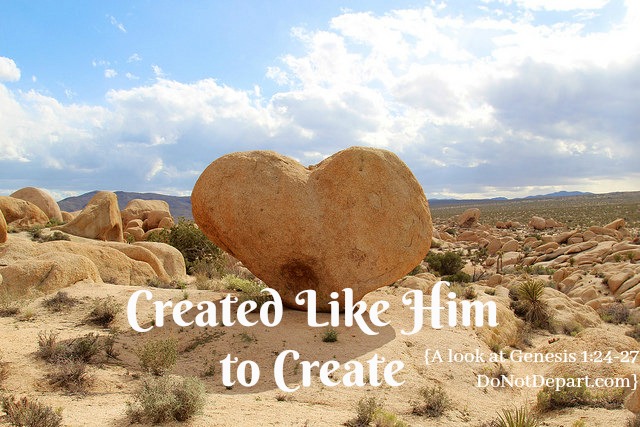
Created Like Him to Create {DoNotDepart.com}

“And God said, “Let the land produce living creatures according to their kinds: the livestock, the creatures that move along the ground, and the wild animals, each according to its kind.” And it was so. God made the wild animals according to their kinds, the livestock according to their kinds, and all the creatures that move along the ground according to their kinds. And God saw that it was good.

Then God said, “Let us make mankind in our image, in our likeness, so that they may rule over the fish in the sea and the birds in the sky, over the livestock and all the wild animals,[a] and over all the creatures that move along the ground.”

So God created mankind in his own image,
in the image of God he created them;
male and female he created them.” – Genesis 1:24-27 (NIV)

God created the heavens and earth, the light out of dark, sky and sea and land, plants and trees, sun and stars, and creatures of all kinds.

Including animals on land, fish in the sea, birds in the sky. (Check out Lindsey’s great post about how all these differences in creatures are part of what makes the world so beautiful.) He also created us to reign over those creatures, which means we care, use, and shepherd with love.

But let’s backtrack a little again to this truth: He created us.

Us.

At the beginning of the month, we hinted at how God created us to trust, to praise, to love.

Genesis 1:27 tells us God created us in His image. To have likeness with Him.

Does that make your jaw drop?

He created us to be like Him, and He is a Creator.
Created Like Him to Create {DoNotDepart.com}
Modified from original photo with permissions

God as Creator

Let’s look at a few verses to get an idea of what that means.

  • First, God is love (1 John 4:8,16). God is truth (Proverbs 30:5, Psalm 25:5). Since God is perfect and He is love and truth, every act He does always has both love and truth in it.
  • Psalm 95:3-5 reminds us that God created the world, and that act of creation inspires praise and joy from His creation (Psalm 95:1-2,6-7).
  • Psalm 19:7-10 shows us even God creation of His rules, decrees, and commands are life-giving and filled with love and joy.
  • Psalm 33 (especially Psalm 33:4-5) points out that everything God does is for truth, for what’s right, and for and with unfailing love.

Like Lisa said earlier this week, every action we take is an act of creation, and we can create all things in love with God’s help.

His Hands and Feet, Not His Replacement

We are called to be His ambassadors and His hands and feet to spread love on this earth, but that doesn’t mean we should ever think of ourselves as ultimate creators. When we fall into that way of thinking, we seek power instead of service, we ostracize instead of welcome, we hurt instead of help.

Instead, we are created by His love (1 John 4:19) to spread grace-given His love (Ephesians 2:8-10).
     We fill up on His love, and then pour that love to others.
          We soak up His light and reflect it out into the world.

He created us to create, and this call to create sprouts from love and from gratitude because of love.

How can what you create today share His love?

Extra study until the next post:

  1. Reread all of Genesis 1 again. Look at all the creating God did first before He created in us. Be in awe of it. Marvel at it. Praise Him for it through prayer, song, and your own creation today.
  2. Look around you about people you know who are living for God. How do their acts — small and large — create love in the world? We can be examples for each other, too.
  3. I highly recommend reading [amazon_link id=”1400203759″ target=”_blank” ]Love Does[/amazon_link] by Bob Goff. His book looks at how each of our actions can create love in the world.
  4. I also recommend any of Emily P. Freeman’s writings, including her blog and her books, especially [amazon_link id=”0800722442″ target=”_blank” ]A Million of Ways[/amazon_link] for more about creating as a believer.
We are created to create like Him, so what does that look like? #GodTheCreator

Click To Tweet

What can you create today to share His love? #GodTheCreator

Click To Tweet

God Said It…And It Was So

November 8, 2016 by Kelli LaFram 1 Comment

God said and it was so

“And God said, “Let there be a vault between the waters to separate water from water.” So God made the vault and separated the water under the vault from the water above it. And it was so. God called the vault “sky.” And there was evening, and there was morning—the second day. And God said, “Let the water under the sky be gathered to one place, and let dry ground appear.” And it was so. God called the dry ground “land,” and the gathered waters he called “seas.” And God saw that it was good. Then God said, “Let the land produce vegetation: seed-bearing plants and trees on the land that bear fruit with seed in it, according to their various kinds.” And it was so. The land produced vegetation: plants bearing seed according to their kinds and trees bearing fruit with seed in it according to their kinds. And God saw that it was good.” Genesis‬ ‭1:6-12‬ ‭(NIV‬‬)

God said…and it was so

God said, “let there be a vault…” and into existance came our sky. The atmosphere that would shield us from meteors and from the rays of the sun God had yet to create appeared. This vault also would serve as a blanket to keep us warm in the night and in cooler winter months. It would be the greenhouse roof for the vegetation that He would soon speak into existence. It would contain layers of clouds to separate the waters above from the water below. God said it and it was so.

Next, He spoke and the waters came together and land, in the form of mountains, peaks, and valleys, was exposed. He gave the waters boundaries and the seas were created. And simply by the sound of His voice it was so. Not long after, He spoke into existence all type of vegetation — plants, trees, and grasses — that would yield or contain seed so that could continually produce. God said it, it was so, and it was good.

His Word Continues

God created simply by the power of His Word. And His word continues to speak today. As we look around us we can still see the vegetation spoke into existence long ago. We walk on the dry ground that God created when He commanded the oceans and rivers take shape. We breath in and feel the wind of the atmosphere that He created with us in mind. His Word speaks. Our surroundings are evidence that a Word once spoken by God continues to be spoken by God forever (A.W. Tozer, The Pursuit of God).

The Word Became Flesh

In the beginning was the Word, and the Word was with God, and the Word was God. He was in the beginning with God. All things were made through him, and without him was not any thing made that was made. In him was life, and the life was the light of men. The light shines in the darkness, and the darkness has not overcome it… And the Word became flesh and dwelt among us, and we have seen his glory, glory as of the only Son from the Father, full of grace and truth. John 1:1-5, 14 (ESV)

The same Word that was spoken in Genesis became flesh to create something else new. Jesus came into this fallen and dark world to make each of us a new creation. 2 Corinthians 5:15 says that “if anyone is in Christ, he is a new creation.” Through faith in God’s grace, we are created to be righteous and holy (Ephesians 4:24). We have also been created in Christ Jesus for good works (Ephesians 2:10). This is the truth! It is God’s spoken word!

God said it…and it is so.

I realize there is great debate within the church today about whether or not a person can lose his or her salvation. Because of this debate you may be wondering, as I often have, am I really saved? Am I really a new creation? Dear friends, don’t wonder. Don’t question. Simply believe. If you have put your faith in the Jesus Christ for your salvation, then the answer is YES! You are a new creation! God said it and it is so.

If you can believe that He spoke into existence all that you see around you, the air that you breath, and the ground that you stand on, then please believe that He is powerful enough to make a new creation out of you.

Additional Study Steps:

  1. Read Psalm 104:1-18. How does this passage compare to Genesis 1:6-13?
  2. Read John 1:1-5. How does this passage compare to Psalm 104:1-18
  3. Visit BlueLetterBible.org and do a keyword search for “creation”. Search using different Bible translations.
  4. Read [amazon_link id=”1600661068″ target=”_blank” ]The Pursuit of God[/amazon_link] by AW Tozer, focus on chapter six if your time is limited.
  5. Respond to God in prayer and worship. Honor Him for making you a new creation.
Our surroundings are evidence that a Word once spoken by God continues to be spoken by God forever.

Click To Tweet

The same Word that was spoken in Genesis became flesh to create something else new.

Click To Tweet


Friends,

Please remember that I am human and flawed and my thoughts on this passage and others may not always be right. Please hold what I write up against the Word of God and listen to the Holy Spirit as He speaks to you directly. That said, I’m wondering if you are struggling to believe with all confidence that you are a child of God. I wonder if you struggle to believe that you are pure just as Jesus is pure. If so, please leave a comment or send me an email. I’d love to share some amazing truth with you. Truth about what Jesus has done for you and who He says you are as a believer.

Only by grace,

Kelli

Creation: From Nothing to Something

November 3, 2016 by Ali Shaw Leave a Comment

Creation: From Nothing to Something... God's creation of the first day is a bit like the new spiritual birth of a Believer. How? Read more at DoNotDepart.com

Genesis 1:1-5 tells us about the very beginning of the beginning:

1In the beginning, God created the heavens and the earth. 2The earth was without form and void, and darkness was over the face of the deep. And the Spirit of God was hovering over the face of the waters.

3And God said, “Let there be light,” and there was light. 4And God saw that the light was good. And God separated the light from the darkness. 5God called the light Day, and the darkness he called Night. And there was evening and there was morning, the first day.  (Genesis 1:1-5)

Like I wrote about last month, my oldest daughter often asked me very deep questions about the creation of the world when she was very little. When she asked me what was in the beginning before God created the world, I answered, “Nothing was made before it was made.” But honestly, that concept is very difficult to imagine.

Our world is full of “something-ness” so it is impossibly difficult to wrap our minds around “nothingness.”

But that’s how it was in the beginning. There was nothing. Then there was something.

Creation: From Nothing to Something... God's creation of the first day is a bit like the new spiritual birth of a Believer. How? Read more at DoNotDepart.com
I think that simple (yet mind boggling) concept tells us much about God’s character. He is the Creator that needs no materials to start His design with. He is the Builder that crafts His projects from nothingness.

The First Day

It’s God’s business to go about creating something from nothing, isn’t it? And I love the fact that the initial few verses of Genesis explain that He first created the heavens and the earth, and then light. It was only when He pulled the good light away from the darkness that the dawning of a new day could begin.

The whole concept of creation is a little like what happens inside of us when we become believers in Jesus, isn’t it?

Prior to a saving faith in Jesus Christ, we are a bit like a dark, formless world. Without the Son (the Light of the World, see John 1:5-13), there can be no life or growth. So, we exist in a state of spiritual darkness— spiritual nothingness. (See 1 Peter 2:9, John 8:12)

But when the Light dawns in our hearts, something happens. A new day comes and a new creation is born. (2 Cor 5:17) The light is separated from the darkness. And our creator God molds us into the image of His son and we learn to walk in the eternal light of His glorious being. (1 John 2:6)

We pass from nothing to something… from death into life.

He created the world to show His glory. And He offers us the free gift of spiritual birth to glorify His son, Jesus.

Oh, thank you, Father Creator-God, for crafting this beautiful world around me, and thank you for creating newness in my heart through the life, death, and resurrection of your Son, Jesus!

How do you see God’s character revealed in creating something from nothing? Tell us in the comments or on our Facebook page!

Ali

Additional Study Steps:

  1. Read Genesis 1:1-5. Note every action God did and every word He spoke.
  2. Copy Genesis 1:4. Journal through your thoughts on this verse and how it relates to spiritual birth.
  3. Read John 1:5-13 and John 8:12. Think about the sun. As light, how does Jesus give life and growth, similar to how the sun gives life and growth to the world?
  4. Who do you know that needs to know the Creator God? Pray that they would receive Jesus as their light and salvation. Pray about how you could witness to this person.
Creation: From Nothing to Something. How is the first day like spiritual birth? #GodTheCreator

Click To Tweet

It’s God’s business to go about creating something from nothing. Spiritual rebirth! #GotTheCreator

Click To Tweet

God the Creator {A New Series}

November 1, 2016 by Caroline 1 Comment

God the Creator - a new series on Genesis 1 and 2:1-3 at DoNotDepart.com
Modified from original with permission. Original photo credit.

“In the beginning, God created…” (Genesis 1:1)

Aren’t those words just beautiful? God created. He literally created something from nothing, and from that nothing (that He turned into something) came our big (yet small), beautiful world.

He created the heavens and the earth (Genesis 1:1-2),

light out of dark (Genesis 1:3-5),

sky and sea and land (Genesis 1:6-10),

plants and trees (Genesis 1:11-13),

sun and stars (and with it, day and night) (Genesis 1:14-19),

creatures in the sky, sea, and on land (Genesis 1:20-25),

and then …

What did He do then?

He created humans, in His likeness, in His own image (Genesis 1:26-27).

God the Creator created us. He created us to trust, to praise, to love. He created us to create, in His likeness, in that praise and love.

That’s what we’ll focus on this November, in this season of gratitude. We are created to live creative lives. And, just like all of our other skills and personalities, our creative talents don’t always look the same as our neighbor’s.

Some of us create with words, some with pictures, some with food, some with service, some with leadership, and more.

But we all have this need to create in common, and this call to create in love and in gratitude because of love.

Join us this month as we read Genesis 1 and Genesis 2:1-3 together and learn more about God the Creator and what that means for our own creative lives as we follow Him.

How do you find yourself often creating?

Extra study until the next post:

  1. Read through Genesis 1 and Genesis 2:1-3 once, or even twice, this week.
  2. What ways do you find yourself creating in love throughout the week?
  3. Write or say (or draw or sing, etc!) a short prayer of thanks to God for creating us and gifting us with creativity.
  4. Read through posts from our archive on the Marvelous Creator that looked at other verses and instances where we see God as creative.
A new series at @DoNotDepart all about living the creative life with #GodTheCreator:

Click To Tweet

‘In the beginning, God created…’ and #GodTheCreator created us to be creative, too. Read along with @DoNotDepart this month:

Click To Tweet

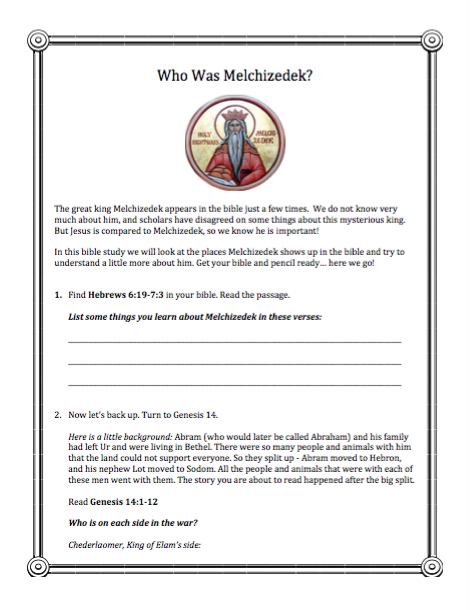
Who Was Melchizedek? (A Mini-Bible Study for Kids)

July 15, 2016 by Patti Brown 1 Comment

Who Was Melchizedek? (A Mini BIble Study for Kids) - download this free printable bible study from DoNotDepart.com


Who Was Melchizedek? (A Mini BIble Study for Kids) - download this free printable bible study from DoNotDepart.com
Have you ever been reading along in the bible and suddenly bump into a name that seems to be coming out of nowhere? Knowing figures from the Old Testament greatly informs our understanding of the New Testament. And the name Melchizedek is an important one in the book of Hebrews.

There is not a lot known about Melchizedek, but the fact that Jesus is compared to him means he is worth the time to study! He also shows up in Genesis right after a pretty amazing battle, so his story can be a fun one for kids to dig into. Just download and print this short bible study:

Who Was Melchizedek? (A Mini BIble Study for Kids) - download this free printable bible study from DoNotDepart.com
I recommend you work through the study yourself first, or do it alongside your children, so that you can be involved in discussions with them about Melchizedek and the light his life sheds on the person of Jesus. If you have younger children, focus on reading the scripture passages together. You could have them illustrate parts of the Genesis story we reference, after you read it aloud.

If you come across any awesome kid-friendly references on Melchizedek, please share them in the comments so other families can find them too!

Download “Who Was Melchizedek”, a free bible study for kids! #LetTheChildrenCome #JesusAsHighPriest

Click To Tweet

Let the Children Come - monthly feature on helping children to abide in God's Word via DoNotDepart.com
 

Jesus as High Priests - new series on Hebrews 4:14-5:14

On Celebrating Instead of Striving This Christmas

December 19, 2015 by Caroline 3 Comments

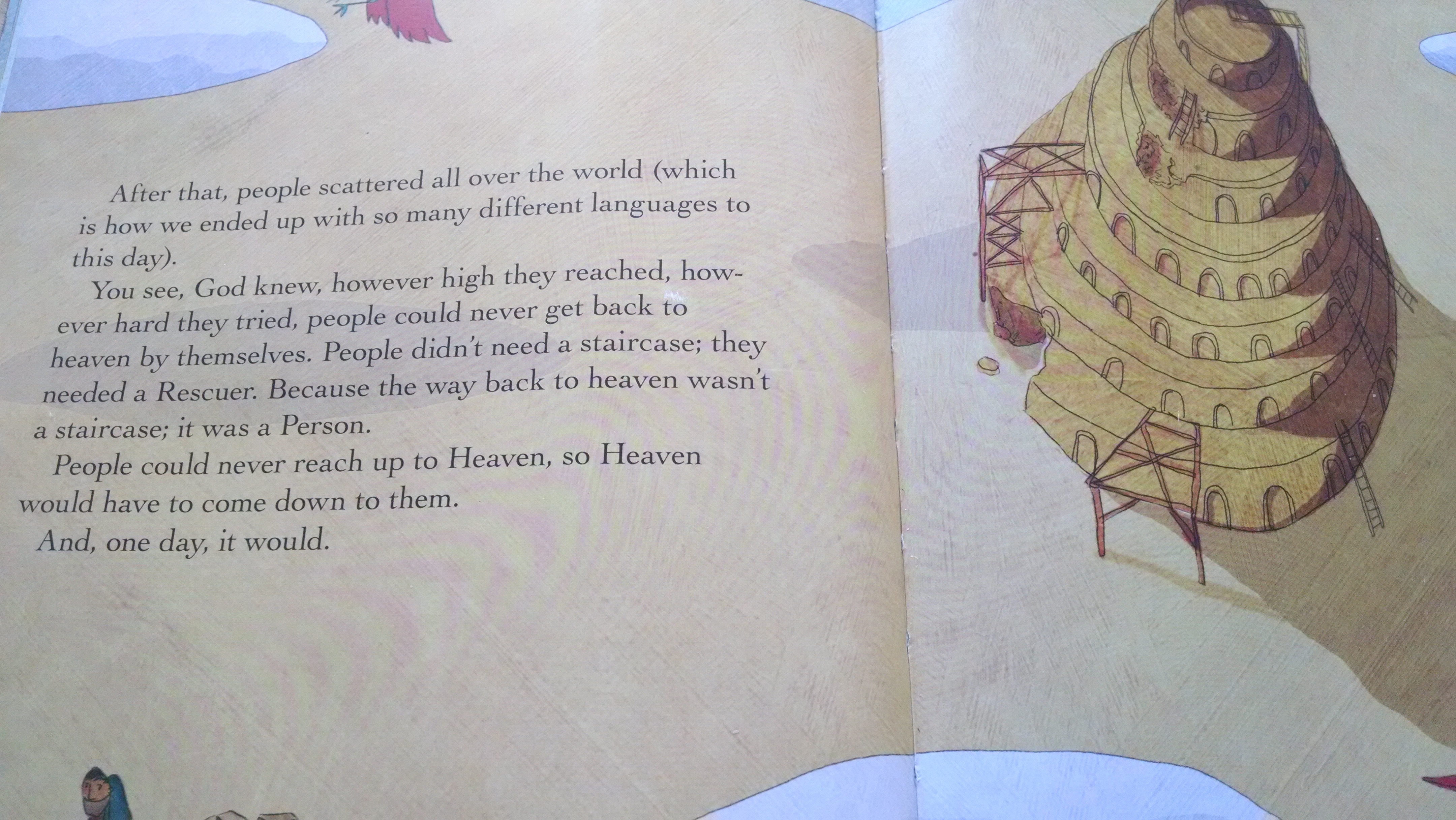
Jesus Storybook Bible page 54

You know how you can read a Bible story over and over again, and sometimes you need to read it in a different translation or version to see something new?

One of my favorite ways to do that? Children’s bibles.

Yep. Children’s bibles. Good ones.

One of my family’s very favorites is [amazon_link id=”0310708257″ target=”_blank” ]The Jesus Storybook Bible[/amazon_link] by Sally Lloyd-Jones, illustrated by Jago (Zonderkidz, 2007).

Sometimes (actually, often, for this one), reading a story in this Bible brings an aspect to light or emphasizes something I need to hear just at that moment. This particular storybook Bible also beautifully links every Old Testament story to the Christ of the New Testament.

For example, take the story of The Tower of Babel (Genesis 11:1-9).

On Striving, and for the Wrong Reasons

In Genesis 11:4, we learn that the people wanted to build a tower that “reaches to the heavens.” So reaching the heavens was part of their goal. But we also learn the secondary reason: “… so that we may make a name for ourselves.”

God sees what they are doing and decides they must be stopped, so He “confuses their language” and creates new languages amongst a people who had once all spoken the same language.

The Jesus Storybook Bible offers this about their reasoning for the tower:

“We’ll be like God. We’ll be famous and safe and happy and everything will be all right.” – p. 50

Yes, as a storybook Bible, this is inferred, but it’s also grounded in what we know about us as humans and what the Bible has taught us about ourselves over our history.

Sometimes we forget. Sometimes we think we need to strive, to work, to scramble for safety, happiness, and some sort of goal that will bring us closer to God.

We think we must do it. That it’s all up to us.

The Jesus Storybook Bible continues:

“But God wasn’t pleased with them. God could see what they were doing. They were trying to live without him, but God knew that wouldn’t make them happy or safe or anything. If they kept on like this, they would only destroy themselves, and God loved them too much to let that happen. So he stopped their plans.” – pp. 50-51 (emphasis added)

This. This is something I think I miss when I quickly reread the story of the Tower of Babel when I’ve read it over so many times.

The people became arrogant, yes (don’t we?), and wanted more for themselves, yes (don’t we?).

But the main point to remember (and that this children’s storybook bible shows me)? It’s about God’s love.

What We Really Need

At Christmas, it’s so easy to fall into the trap of “we must to do this, we must make that, it must look like this.”

Or, in some cases, when Christmas can be a stressful time if certain family relationships are strained or toxic, it can feel like we have to fight just so hard for even a little peace and focus on Christ in the season.

We get tired over trying so hard.

One solution? Celebrate, instead of strive.

(Easier said than done, I know.)

Here’s where The Jesus Storybook Bible reminds us to celebrate:

“You see, God knew, however high they reached, however hard they tried, people could never get back to heaven by themselves. People didn’t need a staircase; they needed a Rescuer. Because the way back to heaven wasn’t a staircase; it was a Person.

People could never reach up to Heaven, so Heaven would have to come down to them.

And, one day, it would.” – p. 54 (emphasis added)

Jesus Storybook Bible page 54

Heaven came down at Christ’s birth.

That’s what Christmas is for. To celebrate “heaven come down” and know that we are already loved.

Once we know that, feel that, remember that, we can share that celebration and love with others.

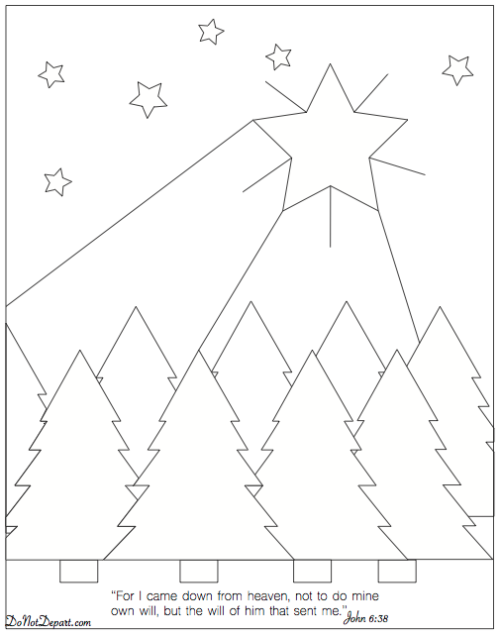
“For I have come down from heaven not to do my will but to do the will of him who sent me.” – John 6:38 (emphasis added)

For one small way to celebrate, please enjoy this free printable coloring page to do with your family! Click on the image below to open the file and choose “save as” to save to your computer and then print. Thanks to our friend, Ashley Taylor, for creating this printable! 

John 6:38 printable

(Please do not sell, edit, or host this printable elsewhere. It is a free gift for readers of Do Not Depart. Please do share a link to this post so others can find it, too!)


How do you celebrate at Christmas and share that celebration with others? What helps you remember if Christmastime becomes a strained time for you or your family? Please share and encourage each other in the comments!


Sometimes it can be easy to forget Christmastime is for celebrating over striving:

Click To Tweet

How a children’s storybook Bible reminds us about #JesusintheOT and celebrating at Christmas:

Click To Tweet

Resurrection: Preparing our hearts to celebrate Easter

March 5, 2013 by Julie Leave a Comment

Resurrection Series on www.donotdepart.com

We’re born wanting something we can’t have. Have you ever lost a loved one? Have you ever battled for your own life? Since death was announced in Genesis 3:19, people have searched for ways to prolong life, live forever, and outwit death. After all, Adam’s judgment echoes through the ages to all of us: “Therefore, just as sin came into the world through one man, and death through sin, and so death spread to all men because all sinned.”   (Romans 5:12)

From tombs full of riches for the afterlife to quests for the fountain of youth to modern medical technology, the hope of life and fear of death spurs men on to find the key to eternal life. Losses, disappointments, and decay tasted in earthly life point to our shared ultimate end: “And just as it is appointed for man to die once, and after that comes judgment” (Hebrews 9:27).

Only One has power over death. There have always been skeptics; even the Sadducees of Jesus’ day scoffed at the thought of immortality. Scripture records the stories of a few who were powerless over death, but they saw God intervene and do the unimaginable: restore life.

Brought to Life In the Old Testament

  • The Widow of Zeraphath’s Son (1 Kings 17:17-24)
  • The Shunnamite Woman’s Son (11 Kings 4:20-37)
  • The Man thrown into Elisha’s Tomb (II Kings 13:21)

Brought to Life In the New Testament

  • The Widow of Nain’s Son (Luke 7:11-16)
  • Jairus’ 12 year old daughter (Mark 5:35-43)
  • Lazarus (John 11:1-44)
  • Tabitha (Acts 9:36-41)
  • Eutychus (Acts 20:7-12)
  • Saints buried near Jerusalem (Matt. 27:51-53)

These people did not raise themselves, but they were raised by God. His power worked independently, and occasionally through His servants, to defeat death itself. As foretold in Genesis 3:15, the Enemy’s plan suffered a fatal blow when the gospel triumphed in the risen Savior. The resurrected life of Jesus makes our abundant life possible. What man could never do, God did.

Resurrection is the conquering of death, the overcoming of the Enemy’s plan to thwart God’s gift of life. Jesus said, “The thief comes only to steal and kill and destroy. I came that they may have life and have it abundantly.“ (John 10:10)

This month we celebrate the Resurrection victory over loss and pain and death. With “Easter” at the end of this month, we want to prepare our hearts with fresh appreciation for the Resurrection. All month long, we will share Bible Study tools to help you focus on this greatest of all mysteries that makes abundant life possible.

Behold! I tell you a mystery. We shall not all sleep, but we shall all be changed … the dead will be raised imperishable, and we shall be changed. For this perishable body must put on the imperishable, and this mortal body must put on immortality…“Death is swallowed up in victory. O death, where is your victory? O death, where is your sting?”… thanks be to God, who gives us the victory through our Lord Jesus Christ.
(Excerpts from 1 Corinthians 15:51-57)

Join us this month on Do Not Depart as we share Bible Study Tools to prepare our hearts for a celebration of the Resurrection.

El Roi–The God Who Sees Me

July 12, 2012 by Sandra Peoples 3 Comments

Have you ever felt like your problems weren’t actually your fault?

  • Someone else made a mistake at work, but you have to fix it.
  • Your husband wanted the new TV, but now you both have more credit card debt.
  • Your son told his teacher a lie, but you have to make it right with her.

Hagar had problems that weren’t her fault. She had obeyed her mistress Sarai and did what she was supposed to do. Now that Hagar was carrying Abram’s child, Sarai turned on her. She fled to the wilderness. The angel of the Lord met there. He told her she would bear a son and name him Ishmael, which means “God hears.”

Hagar responded, “So she called the name of the LORD who spoke to her, ‘You are a God of seeing,’ for she said, ‘Truly here I have seen him who looks after me’” (Genesis 16:13).

She called Him El Roi, the God who sees me. She named her son Ishmael, God hears.

Friends, we don’t have a god who is distant, or busy, or hands-off. He sees. He hears. He knows. When you feel you are in the wilderness, when your problems aren’t even your fault, He sees.

I’m the middle child, and as you may know, we are often ignored (I’m sure if you’re the oldest or youngest, you disagree, but all the other middle children know it’s true). In my teenage-angst I often thought, “No one notices me. They don’t even care.” Even as an adult there are times I think, “No one really gets it. They don’t even care.”

Then I remember God sees. He sees everything—the struggles, the triumphs, the lows, the highs. God hears. He hears everything—the cries, the laughter, the whispers.

If you feel invisible, know that you aren’t. Like Hagar, praise God for seeing and hearing you today.

Before He Came, He Came

November 16, 2011 by Teri Lynne Underwood 5 Comments

A moment of honesty here:  When Stephanie assigned me the topic “The theophanies of Christ” as my post for this series on Christ in the Old Testament, I felt really dumb.   I had never heard the word theophanies before and I had no idea what it meant.

So, I did what all good researchers do, I Googled it! And with a lot of help from Bible.org, I discovered that I did know what theophanies are.

Theophanies are “the preincarnate appearances of God the Son in angelic or human form.”

There are many examples of these preincarnate appearances in the Old Testament.  Here are a few of the people who experienced theophanies (now that I know this word, I’m sure I’ll be using it as often as possible!):

  • Abraham – Genesis 22:11-8, 24:7, 40
  • Jacob – Genesis 31:11, 48:15-16
  • Moses – Exodus 3:2, 13:21, 14:19
  • Balaam – Numbers 22:22-35
  • Gideon – Judges 6:11-24

This is certainly not an exhaustive list but it gives you a sampling of these experiences.

Theophanies of Christ, Jesus in Old Testament, Hagar and the Angel of God
Image Credit

Today, though, I want to focus on what we can learn from the first recorded theophany.  Generally speaking, theophanies reference “The Angel of Jehovah.”   We find the first use of this term in Genesis 16:7:

 The angel of the Lord found Hagar near a spring in the desert; it was the spring that is beside the road to Shur.

Hagar … Abraham’s concubine … was the first one to encounter the preincarnate Christ. 

And he said, “Hagar, slave of Sarai, where have you come from, and where are you going?” “I’m running away from my mistress Sarai,” she answered. Genesis 16:8

He found her.  Alone and afraid, Hagar had fled from her abusive mistress.   And the angel of the Lord sought her.

In the rest of this passage (Genesis 16:9-13) we find Hagar received comfort and assurance from the Angel.  He told her of her pregnancy and prophesied about her son.

And her response?  She was the first one to give God a name.   El Roi, the God who sees me.

Isn’t that one of the most beautiful attributes of Christ in the New Testament – He saw people.   The woman caught in adultery, the Samaritan woman at the well, Zaccheus hiding in the tree, shaggy fishermen and arrogant tax collectors … Jesus saw people.

This angel of the Lord appeared to Hagar again in Genesis 21:17 – 19.

God heard the boy crying, and the angel of God called to Hagar from heaven and said to her, “What is the matter, Hagar? Do not be afraid; God has heard the boy crying as he lies there. Lift the boy up and take him by the hand, for I will make him into a great nation.” Then God opened her eyes and she saw a well of water. So she went and filled the skin with water and gave the boy a drink.

Exiled by her son’s father at the command of Sarah, Hagar was, again, in the wilderness.  This time, though, she was not alone.  She had her son Ishmael with her and she was watching her own son die.

And once again, this God she had encountered, saw her.   Speaking words of encouragement and prophecy, He encouraged Hagar not to give up.   He met her needs – emotional and physical.

Just as He met Hagar’s needs, Christ met the needs of those He encountered during His earthly ministry.   He reached out to the lonely, rejected, and outcast … lepers and lame, blind and broken, He healed them … body and spirit.

 The Word became flesh and made his dwelling among us. We have seen his glory, the glory of the one and only Son, who came from the Father, full of grace and truth.  John 1:14

Before He came to dwell, He revealed Himself … hints of the fullness of what was to come.

 How does reading Hagar’s story encourage you about God’s presence in your own life?

“Son of Man” for “Children of God”

November 9, 2011 by Julie 3 Comments

A name reveals much about who we are; the names of Christ are no different. The Christmas story begins in Genesis 3:15 when God told Satan the offspring of the woman would one day overcome him. At that point, He was nameless to us, except for the  “need for seed,” the seed of man.


In giving a unique promise to Abram, Adam’s descendant, God assured him of blessing. By initiating a covenant relationship with Abram, God said that in him “all the families of the earth shall be blessed” (Gen. 12: 3).  It foreshadowed the One seed who would descend from Abram to save the world:  Jesus. In chapter 15 God assured childless Abram that his descendants would multiply like stars. The flesh of an animal was cut, providing a wall of blood to pass through as the covenant was sealed. In chapter 17 God changed Abram’s name to Abraham, showing he would be the “father” of many nations. A new name often accompanies a covenant relationship of oneness and reveals a new identity. No longer was Abram simply the father of his own family; he was divinely chosen as father of many nations and ancestor of the One who would fulfill God’s Gen. 3:15 promise.  Everyone would be impacted by Father Abraham’s descendant.

Son of God became Son of Man

Like Abraham’s name changed when he entered a covenant relationship, so did that of Jesus Son of God. “And the Word became flesh and dwelt among us, and we have seen his glory, glory as of the only Son from the Father, full of grace and truth” (John 1:14).   When Jesus was born, He humbled himself in a way I can not comprehend, but He provided us the benefit of sharing in His glory. He came as the Son of God, the holy One from heaven, the Prince of Peace. Reaching out for a relationship with man meant complete humility for Him, even down to changing His name.

I’m able to take on the name “child of God,” because Jesus took on the name “Son of Man.”

“Son of Man.” Such a human name to bear, if you’re the Son of God. Such an earthly name, when you’re heavenly. Such a low name, when you’re God Most High. Yet when He entered into a covenant love with us, He took on a new name to identify with us in our flesh: Son of Man.

“And if you are Christ’s, then you are Abraham’s offspring, heirs according to promise” (Gal. 3:29).

“But when thefullness of time had come, God sent forth his Son, born of woman, born under the law,  to redeem those who were under the law, so that we might receive adoption as sons. And because you are sons, God has sent the Spirit of his Son into our hearts, crying, “Abba! Father!” So you are no longer a slave, but a son, and if a son, then an heir through God” (Gal. 4:4-7).


In the Old Testament, Abrahamreceived a new name, and God promised all of Abraham’s descendants would share in his blessing.  The name change revealed identity change! If we are Christ’s, then we’re offspring of Abraham, his heirs.


When Jesus took on the form of a man, His new name revealed a change! As flesh and blood, Jesus put on mankind and became the sacrificial Lamb, so we could put Him on. Our covenant exchange of names provided blessing for us. He took on more than our name; the Lamb of God took on our sins.  He also took on the understanding of what it means to be tempted and tried like those who are “but dust.” How comforting to know the Son of Man understands.  We can be “children of God,” because Jesus became the “Son of Man.”


Because He is the Son of Man, I am a child of God, heir of righteousness, daughter of the King, son not slave, pure not dirty, forgiven not condemned, and redeemed not guilty.  No doubt, the covenant exchange of names works in our favor, but I’m so thankful to the Son of Man through whom all the nations of the world are blessed.


How would you finish this sentence:  Because He became the Son of Man, I am ____________ instead of _____________?

El Roi–The God Who Sees Me

November 2, 2011 by Sandra Peoples 2 Comments

Have you ever felt like your problems weren’t actually your fault?

  • Someone else made a mistake at work, but you have to fix it.
  • Your husband wanted the new TV, but now you both have more credit card debt.
  • Your son told his teacher a lie, but you have to make it right with her.

Hagar had problems that weren’t her fault. She had obeyed her mistress Sarai and did what she was supposed to do. Now that Hagar was carrying Abram’s child, Sarai turned on her. She fled to the wilderness. The angel of the Lord met there. He told her she would bear a son and name him Ishmael, which means “God hears.”

Hagar responded, “So she called the name of the LORD who spoke to her, ‘You are a God of seeing,’ for she said, ‘Truly here I have seen him who looks after me'” (Genesis 16:13).

She called Him El Roi, the God who sees me. She named her son Ishmael, God hears.

Friends, we don’t have a god who is distant, or busy, or hands-off. He sees. He hears. He knows. When you feel you are in the wilderness, when your problems aren’t even your fault, He sees.

I’m the middle child, and as you may know, we are often ignored (I’m sure if you’re the oldest or youngest, you disagree, but all the other middle children know it’s true). In my teenage-angst I often thought, “No one notices me. They don’t even care.” Even as an adult there are times I think, “No one really gets it. They don’t even care.”

Then I remember God sees. He sees everything—the struggles, the triumphs, the lows, the highs. God hears. He hears everything—the cries, the laughter, the whispers.

If you feel invisible, know that you aren’t. Like Hagar, praise God for seeing and hearing you today.


Beyond crumbling

October 12, 2011 by Julie 3 Comments

Centuries old bricks...

Yesterday morning I met friends for coffee to talk about a ministry close to our hearts; we met in an historical building turned coffee shop, perched on a sidewalk lining a brick street that has witnessed centuries of change. I love the sound of the old wooden floors, the aged bricks like faces who once filled the rooms, and the high ceilings that have echoed generations of voices. Sitting in the soft leather chair, I reflected on how much time has passed in the seasoned structure … and yet how little.

Ancient Corinth, crumbling after 1000s of yrs ...


When we attempt to reach out to the past, the time we can touch is so recent. Time is only familiar in our own lifetime. Even when I’ve had the privilege of walking on streets that are thousands of years old, I notice they still  crumble and decay; they are not everlasting.

God is not simply “historical” or aged or seasoned; He is the Ancient of Days. The God of the universe is eternal and without end.  While a name in our day makes us distinct from another person, a name in Biblical times revealed identity and carried the weight of authority and power. As God shared His names in the story of scripture, He unveiled who He is and what He’s like. Like a person’s portrait, God’s names illustrate His character. To know His names is to know Him.


As a result of God’s blessing in his life, Abraham was recognized as prosperous; King Abimelech made a covenant with him to insure peace, since it was obvious that God was with Abraham. After the agreement was forged, Abraham planted a tamarisk tree at Beersheba and called out to God, using the name “El Olam” for the first time. (Gen. 21:22-34) He acknowledged “The Everlasting God,” the God who is eternal. “Olam” is the quality of being everlasting and unable to deteriorate, change, or crumble.


After Abraham recognized God’s “everlastingness,” God tested him with the call to sacrifice his only son Isaac. Abraham’s greatest test followed his understanding of God’s timelessness. To “get this” about God results in the ability to trust Him in the hardest places, even at an altar where we lay down our treasure. To know that God is eternal and everlasting is to know that He exists before the hardships of our past, beneath the trouble of today, and beyond the possibilities of our future.

Trust in the LORD forever, for the LORD GOD is an everlasting rock.  ~ Isaiah 26:4

In other words, be confident and believe in Jehovah the Self-Existent One, because Jehovah is the Olam rock, the Rock who is perpetual, indefinite, eternal, forever.

Someday the old walls of my historic coffee shop will buckle, the aged bricks will crumble, the preserved glass will cease to be preserved, and my body own will wear out and run down.  But our God, El Olam, has and will live unchanged forever. We can trust the God with a name like that!

Lord, you have been our dwelling place in all generations.
Before the mountains were brought forth, or ever you had formed the earth and the world, from everlasting to everlasting you are God. ~ Psalm 90:1-2


How would you finish this sentence?

I can trust El Olam with my __________________, because He is everlasting before, beneath, and beyond where I am living today.


What is Your Name?

June 30, 2011 by ScriptureDig 1 Comment

All this week I will be sharing some thoughts on the life of Jacob, based on a series of messages I gave at a youth retreat last fall. I pray that this has been encouraging and challenging for you, as it was for me!

Image from visualBiblealive.com

Monday we asked the question, “Who are you?” Tuesday, we considered “What do you really want?” Wednesday the question was, “Where are you?” Today we finish our studies of the life of Jacob with one final, very important question: what is your name?

Today we find Jacob, the heel-grabber, the deceiver, fearing for his life as he nears his reunion with Esau. In verses 9-12, Jacob prays as we have never seen him pray before.

Then Jacob said, “O God of my father Abraham and God of my father Isaac, the Lord who said to me, ‘Return to your country and to your family, and I will deal well with you’: “I am not worthy of the least of all the mercies and of all the truth which You have shown Your servant; for I crossed over this Jordan with my staff, and now I have become two companies…

Genesis 32:9-10

This is the first time we have seen Jacob acknowledging God’s undeserved mercy and blessing toward him, and expressing faith in God’s promise to watch over him. And what is God’s answer to his prayer?

After dividing his family and possessions into two groups, hoping at least one of them would escape if Esau attacked him, he sends them across a stream ahead of him and prepares to spend the night alone. Then verse 24 says, “Then Jacob was left alone; and a Man wrestled with him until the breaking of day.” What? How random is that?? It seems strange, but really it is God’s answer to his earlier prayer. If you haven’t read this recently, take a few minutes to brush up on this account – Genesis 32:24-30.

Who is this random man who wrestles with him? Jacob apparently knows – in verse 30 he says, “…I have seen God face to face…”

He is wrestling with Jesus himself! (This is what is known as a “Christophany” – an Old Testament appearance of Christ.)

So Jesus is wrestling with him and Jacob just will not give up. He is fighting and fighting and fighting, so Jesus touches his hip socket, dislocates it, and forces him into submission. Then Jacob refuses to let go of Him unless He blesses Him. Jesus asks Jacob his name, he gives it, and then Jesus says he is no longer Jacob, but will be Israel.

Here is my rephrased version of this chapter.

Jacob, “the deceiver,” the “heel grabber,” finally cries out to God. He finally recognizes that he is absolutely unworthy of all of God’s blessings upon Him, and begs for God’s protection and deliverance. God’s answer to the prayer? Jesus Himself comes and fights Jacob into submission – it is a long struggle, but He physically forces Jacob to submit. Jacob then clings to Him until he receives His blessing.

And then, Jesus asks him what his name is.

Isn’t that a strange question, since God created Jacob, has watched over him, pursued him, and knows him intimately? Did Jacob’s “hello, my name is:” tag fall off during the wrestling match? Why does He ask Jacob’s name?

Imagine the tension here. He is clinging to “the Man” he somehow knows is God Himself and has asked for a blessing. Jesus looks into his eyes and says, “What is your name?” And now Jacob has to say it: I am Jacob. I am a deceiver. I am a heel-grabber. And he knows full well that he has done a bang-up job of living up to that name. Jesus hears his answer and then replies, “Your name shall no longer be called Jacob, but Israel…

This change of name was very significant. He is no longer the deceiver. His name has been changed because his character has been changed.

Imagine that your deepest, darkest sin in your life was your name… what name would you have to confess to Him if you were in Jacob’s position?

We all have something to confess to Him. No one is good except God alone.

It is interesting to me that in Genesis 32:28, Jesus changes Jacob’s name to Israel and says, “because you have struggled with God and with men and have overcome.”

In Revelation chapters 2 and 3 there are seven letters to different churches- and each ends with a promise to those who “overcome.”

In Revelation 2:17, Jesus says that He will give to those who overcome “a white stone with a new name written on it, known only to him to receives it.”

We overcome the same way Jacob did… we don’t overcome by following rules. We don’t overcome by looking the part. We don’t overcome because we have a Christian heritage. We overcome by submitting to Jesus Christ, admitting to Him who we really are, and clinging to Him with all of our strength.

When you do that – He changes your name.

And He changes your story.

Where are you?

June 29, 2011 by ScriptureDig 2 Comments

All this week I will be sharing some thoughts on the life of Jacob, based on a series of messages I gave at a youth retreat last fall. I pray that this will be encouraging and challenging for you, as it was for me!

Monday we asked the question, “Who are you?” Yesterday, we considered “What do you really want?” Today the question is, “Where are you?”

The Sears Tower as seen from the Shedd Aquarium.
Image via Wikipedia

While I was in college my family lived north of Chicago. My sophomore year I had my own car and was driving home from Ohio for the first time with a couple of other girls who lived in the area. I dropped one of them off deep in the city in an area that was unfamiliar to me – a very confusing area where all the highways twist and intersect. Needless to say, I got completely turned around. The girl who was with me in the car didn’t know how to read a map, and after we realized we were lost we were in a terrible part of town late at night and knew it wasn’t safe to sit in a parking lot trying to figure out where to go. [Oh, for a GPS!] :)

I called my dad frantically and told him what was happening. He told me, “find the Sears tower. Drive toward it, and keep it in your front passenger window.” I had no idea where I was, but by finding that one unmistakable Chicago landmark, my dad gave me a sense of direction and helped me find my way home. Having that one fixed landmark gave me the direction I needed to find my way out of utter confusion. Knowing where you are changes everything.

We’re picking up Jacob‘s story today in Genesis 28 as he flees from Esau and stops for the night in Bethel.

Remember the wording: a ladder was set up on the earth, and its top reached to heaven; and there the angels of God were ascending and descending on it. (28:12)

What is this dream all about? Access to God. God is basically offering Jacob a personal relationship with Him – which is the only access to heaven.

How does Jacob respond to God’s offer? Check out 28:20-21.

Then Jacob made a vow, saying, “If God will be with me, and keep me in this way that I am going, and give me bread to eat and clothing to put on, so that I come back to my father’s house in peace, then the Lord shall be my God.

In other words: Ok, God. IF you are with me and bless me and give me everything I need or want and bring me back to my family, THEN you can have the privilege of being my God. Is this a genuine response of faith and gratitude for God’s amazing offer? I’m afraid not. As we discussed in yesterday’s post, Jacob seems far more interested in receiving God’s blessings than he is in knowing God Himself. Jacob didn’t understand that the real treasure was knowing God. Now, keep all of that in mind and fast-forward to the New Testament. In John 1:51, Jesus says

“Most assuredly, I say to you, hereafter you shall see heaven open, and the angels of God ascending and descending upon the Son of Man.”

(The Son of Man is a title used for Christ). The wording Jesus used would not be lost on the men he was speaking to at this point- He was claiming to be Jacob’s ladder! He is the only point of access to the Father!

Through Christ, God has offered us an unbelievable gift – a way of access to Him! Unfortunately, our wayward hearts often respond similarly to Jacob’s: “If God will take care of me and keep me safe and keep me comfortable and give me everything I want, THEN He can be my God. [And if He allows me to experience pain or suffering or sickness or the results of my own bad choices or if He just does things I don’t understand, all bets are off.]”

My friends, we have to decide what we really want! Not only that… but do you know where you are?

Jacob realized that he was in the presence of God, and it made him afraid – but he didn’t allow it to change his heart and life.

Do you know where you are? Not just physically where you are… do you recognize that you are, right now, in the presence of God? That He wants to meet you where you are and have a true, vibrant relationship with you?

Stop settling for stuff. Wake up and realize that God is offering you access to Himself. Just like the Sears Tower offered me a fixed point of direction that allowed me to find my way, realizing that we live each day in His presence – longing to know Him above all else- will change the way we live, the choices we make, the priorities we have.

Do you realize where you are?

What do you really want?

June 28, 2011 by ScriptureDig 5 Comments

Jacob offers a dish of lentels to Esau for the...
Image via Wikipedia

All this week I will be sharing some thoughts on the life of Jacob, based on a series of messages I gave at a youth retreat last fall. I pray that this will be encouraging and challenging for you, as it was for me!

Yesterday we asked the question, “Who are you?” Today, I have another question for you to consider: What do you really want?

My husband and I are terrible decision makers. We will go to a restaurant and our waitress will come back three or four times before we’re ready to order! And just when I think I’ve made up my mind, I turn the page on the menu, or a waiter walks by with someone else’s dinner, or my husband tells me what he’s having… and suddenly I don’t know what I want again! I am almost always the last person at the table to order.

I just hate it when I finally have made my decision, the waiter brings the food to the table, and someone else’s food looks better to me than my own. Restaurant regret. All that time deciding… and I still picked the wrong thing.

You know what would be so much worse than restaurant regret? Life regret. What if we reach the end of our lives and realize that what we decided we wanted wasn’t really the best thing? What if we find ourselves standing before the throne of Jesus realizing that we settled… that what looked so good, so appealing to us was a cheap substitute for what life should have been?

As we consider this question of what we really want, we’re going to be rejoining Jacob again in Beersheba. At this point in his life, he is still home with his family. Thinking about our discussion last night, remember that we can safely assume that he has heard a lot about God’s promises and faithfulness to his family. Jacob has seen and heard what God has done; now we’ll find out what he has decided that he wants.

In Genesis 25, what does Jacob want? The birthright – the birthright is a double portion of the inheritance [if Isaac left his sons 1200 sheep, Jacob would have received 400 and Esau would have received 800!]

How does he get it? Deceiving his brother! Remember why he was named Jacob: he is the heel grabber- the one who trips up, takes the place of, and deceives. His name literally means “deceiver,” and this is just the beginning of him living up to his name with gusto. Not only that, but the birthright is most definitely not all he wants.

Notice what he wants now – the blessing. I can’t fully explain to you how the blessing worked, but somehow God would work through the spoken blessings of the patriarchs to pass on the supernatural blessing. Genesis 26:12 tells us that Isaac planted crops and in the same year reaped a hundredfold because God had blessed him. Jacob surely noticed this, and his sights became set on the blessing in addition to the birthright. Why just inherit riches when your own wealth could exponentially increase?

You know the rest of this story. In order to secure the blessing, Jacob and his mother work together to “jacob” Isaac – time and time again he deceives and outright lies. Once his actions are discovered, Isaac and Esau’s summaries of the situation are telling.

But he said, “Your brother came deceitfully and took your blessing.” Esau said, “Isn’t he rightly named Jacob? He has deceived me these two times: He took my birthright, and now he’s taken my blessing!”

Isaac points it out clearly – he came deceitfully. He came “jacobly.”

It begs the question: God had richly blessed this family. He had taken care of them, He had allowed them to become wealthy and influential. Did Jacob want the God of his father and grandfather… or did he just want stuff?

Under the New Testament covenant, God doesn’t necessarily bless us with wealth and power for following Him; there are other types of blessings. Blessings such as:

  • Peace
  • Joy
  • Direction
  • God’s provision
  • Fellowship with other believers
  • Fewer self-inflicted problems
  • Salvation

Friends, let me ask you a hard question. Do we want God, or do we just want this stuff?

Do we treasure knowing Him, or do we want a “get out of hell free” card?

Do we obey Him because we love Him, or do we want a reputation as a good Christian?

What do you really want? Are you going to reach the end of your life and realize that you spent your days in pursuit of the wrong thing?

To be continued tomorrow!

Who are you?

June 27, 2011 by ScriptureDig 3 Comments

This week I will be sharing some thoughts on the life of Jacob, based on a series of messages I gave at a youth retreat last fall. I pray that this will be encouraging and challenging for you, as it was for me!

a Bedouin family in there tent
Image via Wikipedia

Did you ever read one of those “choose your own adventure” novels?

As you read along, you came to places in the story where you could decide if you wanted the story to unfold with plot A or plot B. Then you would come to another place where you could choose again. Each choice built on the one before to create a particular story.

Just like that “choose your own adventure” novel, your life is a series of defining questions, defining moments, and defining choices. At one point, we might seem to be in relatively the same place right as our peers, but as we go through our lives we will have particular moments that change and mark who we become. Some of these moments you will have control over, some you will not.

We will also all make defining choices. We will come to places in our lives where we must choose what is most important to us, who we are, if we will serve God or ourselves.

Underneath these defining moments and defining choices are some particular questions we must answer. Questions like, “What is the purpose of my life?” “What will I do with Jesus?” “Is God who the Bible says He is?” – the way we answer these questions  will radically change the way the rest of our lives unfold.

This week we will be considering four questions that tie together into one big question – what’s your story? As you come to those places where you can choose plot line A or plot line B… what decisions have you already made? Which ones will you make next? Ultimately each of those things will define the story of your life.

To look at our own stories and consider what God might want to do in the next chapters of our lives, we will be considering together the life of Jacob.

Everyone’s story begins with a family, and this is true for Jacob, as well.

As I think about Jacob’s family, it makes me wonder if he felt lost in the shadow of those around him. His grandfather was the Abraham – Jacob grew up hearing stories of his grandfather leaving Ur, believing incredible promises that God had made to him, waiting for years and years for their beloved son Isaac to be born. Surely his father had told him stories about the day he hiked up Mount Moriah with his dad, finding that God had commanded that he be sacrificed on top of the mountain… and the dramatic way God stopped them and provided a ram in the thicket.

These were the stories that were told as the family sat around their fire in the evenings. We read the book of Genesis… but these were their lives. Their stories.

And then there was Esau. Jacob was already a twin brother, and he was the twin who didn’t really get along as well with his father. Esau was the “man’s man.” He was an outdoorsy hunter, while Jacob preferred to stay near Rebekah and help her around the campsite.

I wonder if Jacob felt forgotten, unimportant, lost in the shadows of those around him. I wonder, after growing up hearing amazing stories of what God had done for his father and grandfather, if their sin caused him to view them as fakes.

Sometimes we can feel lost in the shadow. We can begin to rebel and reject those around us, thinking that they are fake. We can start to want to give up, comparing ourselves to those around us, feeling that we are unimportant or less valued than others we interact with. We can also begin to coast by on the spiritual heritage we have been given, resting in their testimonies of walking with God rather than striking out on a journey of our own with Him.

The question is – “who are you?” Not what kind of heritage do you have, how much knowledge do you have, what church do you belong to… who are you? What choice will you make to walk with the Lord Jesus Christ – no matter how fake or how spiritually outstanding others might be?

At the end of your life, what will be your story?

To be continued tomorrow!

Next Page »

This Month’s Theme

  • Jesus is the Way
  • And He Shall Be Called Series Intro

Enter your email address to have new posts emailed to you:

We’ll come to you

Enter your email address to have new posts emailed to you

Categories

Bible Memory – Lent 2021

Memorizing Isaiah 12

Let the Children Come

Let the Children Come

Want more #HideHisWord resources?

Memorizing Psalm 1

Find Us on Facebook


Search

Recent Posts

  • Series Wrap-Up: The Lord Is My Light
  • His Marvelous Light
  • When the Darkness Deepens
  • Though I Sit in Darkness…
  • Let Your Light Shine
  • Life-Giving Light

Archives

© 2026 · Pretty Creative WordPress Theme by, Pretty Darn Cute Design