• Home
  • About
    • Our Contributors
    • Our Beliefs
  • Blog
  • Bible Studies
    • Scripture Dig
  • Archives
  • Shop
  • Advertise
  • Contact
    • Email
    • Facebook
    • Instagram
    • Pinterest
    • Twitter

Do Not Depart

Encouragement and Tools to Abide in God's Word

You are here: Home / Archives for Luke

3 Myths about Your Good News – How Luke Overcame Them & You Can Too

May 11, 2017 by Lisa Burgess 12 Comments

Myths-Telling-Good-News_DoNotDepart

Myths-Telling-Good-News_DoNotDepart

Same Story, Different Verse

Let’s say a publisher wants a book about your mother. He asks for three versions.

  • Version 1
    Author: You, her daughter
    Audience: Your children and grandchildren
  • Version 2
    Author: Your dad
    Audience: His business co-workers
  • Version 3
    Author: Her friend
    Audience: The orphans she teaches in Guatemala

While each version may contain similar facts, the highlights and stories would be very different. Your mother’s life would be told from different perspectives and for different reasons.

In a similar way, God wants stories told about His Son.

Four writers gave narratives of Jesus’s life through the gospels (literally, “good news”). We know them as the Gospels of Matthew, Mark, Luke, and John.

But now God wants to hear your words. We’re going to look at the New Testament writer Luke to explore this.

Immediately we make our excuses. We each have our own reasons for not sharing the good news.

Could Luke also have had reasons not to tell the story? Perhaps. Yet he told anyway. We can, too. Here’s how.

Debunking 3 Myths

• Myth 1 •
I don’t know enough

Sometimes we think we should be able to recite all 66 books of the Bible, have a working knowledge of each Old Testament prophet, and trace Paul’s missionary journeys before we can share why we believe in Jesus.

Not so.

Luke never even met Jesus in person, yet he wrote an entire gospel about Jesus and the Acts of the Apostles. Luke heard the stories from others. He traveled with the apostle Paul (who himself only met Jesus in a vision) on Paul’s missionary journeys. And likely talked with Mark (who wrote the Gospel of Mark) along the way.

Still, Luke’s gospel ended up being the longest of the four, and combined with the book of Acts, his writings account for over one-fourth of the New Testament.

• Truth 1 •
You do know enough

We’ll never know the complete story while we’re here. But if we’ve encountered Jesus at all, we can tell others about Him. Continue learning and growing, yes. But we don’t need a PhD in theology to share good news.

Tell what you do know.

• Myth 2 •
I’m not good enough

Do you still sin? We all do. We need Jesus every day. Our goodness is like filthy rags compared to His righteousness.

But Christ’s goodness is what counts. Not ours.

Luke could have said “not good enough” about himself as well. He was not even a Jew. Likely a Greek physician (Colossians 4:14), Luke was the only non-Jewish writer of the New Testament. He could have taken a pass on writing a history of the Jewish King Jesus. He had been educated in Greek scientific culture.

But Luke wrote about Jesus anyway, and talked little about himself.

• Truth 2 •
Tell of Christ’s goodness

What are your favorite things about Jesus? Those are things people need to hear anyway, not facts about our presumed holiness because we “grew up in the church.”

Luke wrote about Jesus: about His compassion for the poor, healing of the sick, freedom for the oppressed. We can tell specifics of how Christ has been good in our lives as well.

• Myth 3 •
I have no one to tell

You’re not a preacher with a podium? You don’t have a podcast fan base? You haven’t published a book?

Neither had Luke.

Luke dedicated both the gospel of Luke and the book of Acts to one person: Theophilus. Scholars assume Theophilus was a real person (the Greek name means “lover of God”). See Luke 1:3, Acts 1.1 But Luke’s broader audience ended up being the larger Gentile world—Jesus came for all mankind.

• Truth 3 •
Talk to who you already know

If God wants you to have a big audience, He’ll provide it. But until then, we share our joy in Jesus with those we talk to normally. Our coworkers, our family members, our circle of friends. Ordinary people. People like us. People we love.

They are the ones who most hear our hearts and see our lives. Why not tell them as well about the most powerful Friend we also talk to?

Original Stories

Luke could have given many excuses for not sharing about Jesus. But thankfully he didn’t use them.

Without Luke, we wouldn’t have the parables of the Good Samaritan, the Lost Sheep, and the Prodigal Son (along with 18 other parables found only in his gospel). We wouldn’t know the story of the ten lepers or the stories about the beginning of the church in the book of Acts.

Just as you know stories about your mother that no one else knows, so you have stories about Jesus that only you know.

For example, your original stories include:

  • How you came to know Jesus
  • How He put your family together
  • How He brings you healing from a bad experience
  • How He is guiding you now in a difficult relationship

As we share the good news from our perspective, God is glorified. Our faith is strengthened. And others are blessed.

Good news is always relevant. Both the old stories and our new ones. Jesus is personal.

Tell your side of His story.

3 Myths about Your Good News. How Luke overcame them & you can too. #NewTestamentWriters

Click To Tweet

Learn more about Luke: “5 Things to Know about Luke from the Bible” from Crosswalk.com

What prevents you from sharing your good news? What helps you? Do you have a favorite New Testament gospel? Please share in the comments.

Extra Reading:

  • No Voice Can Substitute for Yours
  • Is Your God Worth Sharing?
  • How You Are a Priest
  • You’re Still Here Because…

Join us for a series on the men whom God inspired to write the words of the New Testament

New Testament Writers {Intro}

May 2, 2017 by Patti Brown Leave a Comment

Join us for a series on the men whom God inspired to write the words of the New Testament

The Word of God is inspired by the Holy Spirit. And, as with so much of what He does on earth, God used mere men to record the precious words that give us hope and guidance.

Join us for a series on the men whom God inspired to write the words of the New Testament
For students of the Word, history and context give deeper insight into the heart behind the words we examine. This month we will be discussing the men whom God used as His scribes to write the letters which now comprise the New Testament.

From a poor fisherman to a highly educated Roman citizen, the writers of the New Testament varied greatly in background, personality, and writing style. But all were chosen of God for the express purpose of recording the holy Scriptures. Understanding more about each of them can help us dig even deeper into what God has for us in His Word.

Do you have questions about the writers of the New Testament? Share in the comments, or in the Do Not Depart Facebook community, and we will help you find answers.

Join us for this month’s series on the #NewTestamentWriters

Click To Tweet

From a poor fisherman to a highly educated Roman citizen, the #NewTestamentWriters varied greatly.

Click To Tweet

Painting of Luke by Andrea Mantegna (1430-1506)

Save

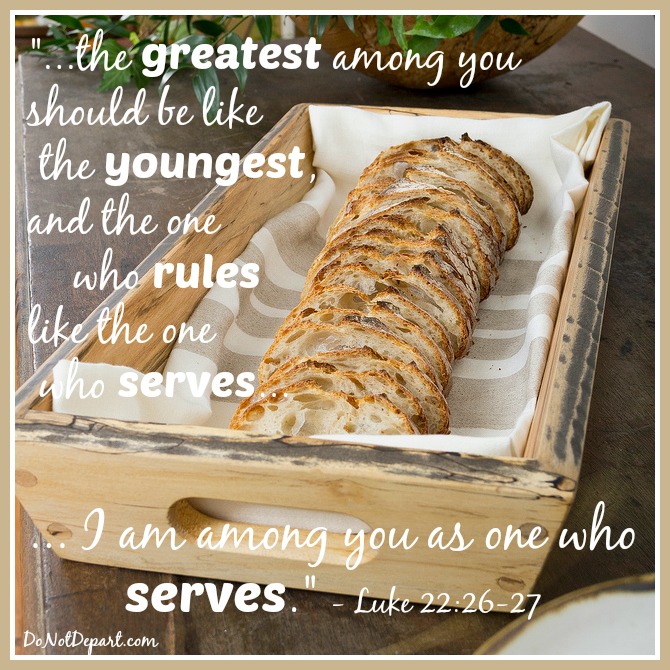
Like One Who Serves {Spread the Word Printable Graphic}

April 2, 2015 by Caroline Leave a Comment

Luke 22:26-27
Luke 22:26-27
Original photo credit

“When the hour came, Jesus and his apostles reclined at the table. And he said to them, “I have eagerly desired to eat this Passover with you before I suffer. For I tell you, I will not eat it again until it finds fulfillment in the kingdom of God.”

After taking the cup, he gave thanks and said, “Take this and divide it among you. For I tell you I will not drink again from the fruit of the vine until the kingdom of God comes.”

And he took bread, gave thanks and broke it, and gave it to them, saying, “This is my body given for you; do this in remembrance of me.”

In the same way, after the supper he took the cup, saying, “This cup is the new covenant in my blood, which is poured out for you. But the hand of him who is going to betray me is with mine on the table. The Son of Man will go as it has been decreed. But woe to that man who betrays him!” They began to question among themselves which of them it might be who would do this.

A dispute also arose among them as to which of them was considered to be greatest. Jesus said to them, “The kings of the Gentiles lord it over them; and those who exercise authority over them call themselves Benefactors. But you are not to be like that. Instead, the greatest among you should be like the youngest, and the one who rules like the one who serves. For who is greater, the one who is at the table or the one who serves? Is it not the one who is at the table? But I am among you as one who serves. You are those who have stood by me in my trials. And I confer on you a kingdom, just as my Father conferred one on me, so that you may eat and drink at my table in my kingdom and sit on thrones, judging the twelve tribes of Israel.” – Luke 22:14-30 (NIV)

Feel free to save and share this graphic for Scripture memory, sharing with others, and reminding yourself of His Word during this Easter week.

If you have questions about how to download images, just ask in the comments. (Be sure to tell us what type of computer/device you are using.)

Visit DoNotDepart.com for more shareable scripture graphics! #SpreadTheWord

A shareable graphic on Luke 22:26-27 as part of this month’s #SpreadtheWord series:

Click To Tweet

It’s Holy Week, and today @DoNotDepart is sharing a printable graphic with Luke 22:26-27:

Click To Tweet

Trembling Faith

October 29, 2013 by Caroline 15 Comments

Imagine bleeding. For years. Without a discernible cause.

All the local doctors can’t figure it out. You’ve spent your life savings trying to find someone who had an answer.

And nothing.

You’re broken.

You’re exhausted.

You’re rejected.

Trembling Faith {Nameless Women in the Gospels} - DoNotDepart.com
Photo Credit

But, there’s this Man. One Man who comes as a Savior for all. It’s your last bit of hope.

You feel worthless. You don’t mean anything to the community around you anymore because of your ailment.

Why would this Man even want to look at you, much less heal you?

But you know His power. And you think, “If I could only touch His cloak. I know I’d be healed. Because I have hope of who He is” (expounding of Matthew 9:21)

And you receive more than you even expected. Instantly.

Courageous Faith, Graceful Healing

The women subject to bleeding (Luke 8:40-48, Matthew 9:18-26, Mark 5:22-43) endured this circumstance. Another nameless woman, her story even occurs in the middle of someone else’s story.

Almost as an aside: “…And a woman was there…” (Luke 8:43)

Much of our own stories are in the middle of others’, aren’t they? But that doesn’t leave our own stories worthless.

This woman didn’t even want to be seen. Perhaps she feared she would be deemed unworthy and rejected once again. Or maybe told nothing could be done for her as other doctors had for twelve years.

But with one touch, she was “immediately” healed (Luke 8:44).

Would you expect instant healing? I wouldn’t. And yet it was so dramatic within her and so instant, she felt the change.

But, just as instant, Christ felt the change, too.

He asked who touched him.

You can almost hear the disciples smirk. Of course people touched Him. They were surrounded by pressing masses of people.

I imagine Christ didn’t really need to ask who touched Him. He knew. But, He gave the opportunity for our nameless woman in this story to come forward on her own.

And come forward she did… trembling (Luke 8:47).

Would Christ take this healing away? Because she touched Him without asking, would she be punished? Because, by touching Him, she ceremonially defiled Him because she was unclean herself?

I would think questions like these.

Who am I to think I’d be worth Christ’s healing?

But that’s grace. It’s undeserved, as is any of the love Christ gives. And all the more beautiful.

Maybe this woman trembled because of fear of how Christ would respond or because of the ramifications of an ostracized, unclean person touching Someone so great. Instead, He told her to “Go in peace” (Luke 8:48) and continue with the courageous faith that carried her to Him.

Maybe she also trembled because of the amazing gift she had just been given. She believed, she knew He could heal her. And He did. Instantly. She was freed from suffering (Mark 5:29).

I would tremble, too.

I pray to have this woman’s faith and trust in a God who gives.

“I do believe; help me overcome my unbelief!” – Mark 9:24

How have you persevered in your faith over long-standing trials? How does this woman’s story, and Christ’s reaction, inspire you?

Not your average king

December 14, 2011 by Julie 1 Comment


The news from 2011 will reflect a wave of uprisings washing across Europe and the Middle East, crashing onto cities like London, Jerusalem, Cairo, and Athens. With an election year in the United States, voices of discontent call out and seek a champion for change. The port of Oakland, California was shut down Monday, Dec. 12 due to protests related to the Occupy Wall St/Oakland/Portland/… Movement.  Mankind has always sought rulers to lead well, measuring success in peace, prosperity, and power. As Israel awaited her prophesied Messiah’s coming, it was no different. They looked for a king to break the bondage of Rome and restore the glory days of earthly man-kings like Solomon and David. They weren’t looking for a Jesus.

www.theblaze.com

Jesus was not your average king, and yet Hecame to be King and bring even more than Israel asked for. He came to bring truth. He came to be “a light for revelation to the Gentiles, and for glory to your people Israel” (Lk. 2:32).


Word that the King of the Jews had been born somehow trickled down to all ears, despite the absence of YouTube and Twitter. Herod wanted to know where the reported king was, because a Jewish King was a threat to the heavy hand and unbending control of Rome. To the people of Israel, however, His coming meant a glimmer of hope.


After the arrest of Jesus, Pilate drilled the question at Him that all wanted to know: “Are you king of the Jews?” (John 18:33-37) The King himself said His kingdom is “not of this world;” He did not come for earthly dominion … yet. His kingship is spiritual, and He will ultimately bring all things under His rule. He was not arriving to bring a reign of immediate prosperity or even peace; He was coming for much greater riches than that. “For this purpose I was born and for this purpose I have come into the world— to bear witness to the truth” (John 18:37).


Jesus was not your average king. He WAS born to reign, but not merely over things like economies and governments. When Herod searched for Him and Pilate questioned Him, He was no threat to their immediate future. And when some people followed and some people mocked, there was no question He would reign over their eternity.


He was born to reign, but not as they expected. He is the Son of God who will sit on the throne of David to reign forever, with no end to His kingdom (Luke 2:32-33).  Jesus came to be King and bring the truth.


So who will reign over the governments of Europe and the Middle East and Asia and the United States in unsettled cities in 2012? No one knows. Men await rulers to free them, bring peace, and create prosperity.


Let’s not be so consumed with looking for “average kings” to make our “here and now” what we want that we miss the One who came to rule and reign.


  • – Are you living like Jesus is the King of your life? Do you know the truth He came to bring?
  • – We can all start a campaign in our hearts for “Occupy ME!”


Calling All Sinners!

December 5, 2011 by Sandra Peoples Leave a Comment

Levi was at work, sitting in his tax booth, when Jesus walked by and said, “Follow me” (Mark 2:14). The Bible says Levi rose and followed Him. Then Jesus went to Levi’s house and many “tax collectors and sinner” were there, along with Jesus’ disciples. The scribes and Pharisees observed the scene and asked Jesus’ disciples, “Why does he eat with tax collectors and sinners?” Jesus heard them and answered, “Those who are well have no need of a physician, but those who are sick. I came not to call the righteous, but sinners” (Mark 2:17).

I think of Jesus’ words when I feel like I’ve done too much to ask for His forgiveness again.

I think of Jesus’ words when I think I’m not good enough.

I think of Jesus’ words when I want to give-up on praying for someone else to come to know Him.

Jesus loves sinners. He loves that moment you realize you are a sinner for the first time. That’s why He came—to call you into a relationship with Him that’s not based on your resume of good works, but your need for Him.

Jesus loves you even as you continue to sin. As you wrestle and struggle and try to do better, He continues to call you to Himself. He provides forgiveness and He also provides rest. In this passage in Luke, Jesus is hanging out, caring for the sinners and tax collectors. They are comfortable in His presence because they can feel His love for them. He loves them enough to call them to turn from their sin and follow Him, as He called Levi to do.

Jesus came to save sinners. Praise Him today for your salvation and for the continued process of sanctification in your life. Pray for those who still believe they are well and don’t have need for a physician.

He Came to Proclaim

December 2, 2011 by Julie 3 Comments

visualbiblealive.com

Sometimes it’s easy to feel like we just here to do things like laundry, drive carpools, and empty the dishwasher.  People pull us into the black hole of meeting needs. Other times it’s easy to wonder why we exist at all. Do you know why you’re here? So much about Jesus’ coming was unique, including the fact that He knew exactly why He was on earth.


After healing crowds of desperate and hurting people, Jesus slipped away for some solitude and rest, apart from the black hole of needs. But they found him, longing for their Healer to stay with them. So relieved by His help, Capernaum wanted exclusive rights to Jesus. Even He faced pressure to keep His purpose the priority.

 “I must preach the good news of the kingdom of God to other towns as well; for I was sent for this purpose” (Luke 4:43).

It was necessary and right for the Messiah to announce the glad tidings that the Kingdom of God was coming. For people long focused on physical agony or even oppression by demons, the real life-changing news was the rule of Almighty God over all things. Unlike the words of prophets until that point, Jesus brought word that grace would reign because of the one time sacrifice of His life. By taking on human form without sin, Jesus provided for God’s mercy and rule. Though the crowds didn’t know it, hearing about the Kingdom and the news of salvation was the main message they needed.


Found in the solitary place by the grateful but greedy and needy crowds, Jesus did not waver in knowing why He came to earth.  “I was sent for this purpose,” to preach “the good news of the kingdom of God” to all. He was intentionally sent by God His Father to an appointed destination, earth, as Savior and Proclaimer to the world.


We’re here for so much more than laundry or shopping for presents or making cookies or addressing cards. Just as Jesus knew why He was sent here, we’ve been commissioned to “Go into all the world and preach the gospel to every creature” (Mark 16:15, NKJV).  Maybe we’ll use laundry or a gift or a cookie or a card to do it, but whatever we do, let’s do as Jesus did.  Let’s proclaim the good news. That’s why we’re here.


~ Is there someone in the “crowd” around you who needs you to proclaim good news to them this Christmas?

The Older Brother & The Father’s Love

July 21, 2011 by ScriptureDig 1 Comment

We saw that the older brother didn’t see himself as a sinner, wanted to dispense justice rather than forgiveness, and felt entitled based on his good works. But the last words in the parable are from the father–an invitation. We don’t know what the older brother decided, but we can look at the real life of another Pharisee and see how he accepted the invitation from the Father.

Paul wrote, “…though I myself have reason for confidence in the flesh also. If anyone else thinks he has reason for confidence in the flesh, I have more: circumcised on the eighth day, of the people of Israel, of the tribe of Benjamin, a Hebrew of Hebrews; as to the law, a Pharisee; as to zeal, a persecutor of the church; as to righteousness, under the law blameless” (Phil. 3:4-6).

Look at all the reasons he had to boast, feel proud, and even feel entitled. How did Paul keep from sinning after looking at his impressive resume?

He wrote, “But whatever gain I had, I counted as loss for the sake of Christ. Indeed, I count everything as loss because of the surpassing worth of knowing Christ Jesus as my Lord. For his sake I have suffered the loss of all things and count them as rubbish, in order that I may gain Christ and be found in him, not having righteousness of my own that comes from the law, but that which comes through faith in Christ, the righteousness from God that depends on faith–that I may know him and the power of his resurrection, and may share his suffering, becoming like him in his death, that by any means possible I may attain the resurrection from the dead” (Phil. 3:7-11).

Paul combated the sins of pride and entitlement with the power of the cross. He goes on to say in Philippians that he is not perfect and forgets what had already happened, focusing on what was to come. Like Paul, my list of accomplishments pales in comparison to the life of Christ. When I compare all my good deeds to His death on the cross, I am reminded of what a sinner I am. I’m also reminded of His grace and love. I must continue to preach the gospel to myself.

At the end of the story of the prodigal son, we know the younger brother returned home, repented, and was forgiven by his father. We don’t know if the older brother repented and joined the party. But when I see myself in this story, I can make the choice to stay in my sin or be restored to a right relationship with God.

The Older Brother: The Sin of Entitlement

July 20, 2011 by ScriptureDig 3 Comments

The sin of the older brother that hits me most personally is that of entitlement. The older brother felt he was entitled to more from his father. He saw the party in his brother’s honor and felt he deserved a party with his friends too. He was so angry and resentful, he stood outside the celebration and refused to go in (Luke 15:28). I struggle with this too, friends. I look at the lives of others and think I deserve what they have. Entitlement in my life sounds like, “This isn’t fair,” “You owe me more,” and “I deserve better.”

Entitlement has its roots in pride. You look at something in your life that God says is a  “good and perfect gift” (James 1:17) and tell Him it’s not good enough. God has really brought me through sanctification in this area. When our youngest son was diagnosed with autism my pride and entitlement rose to the top. I told God, “I have a special needs sister. I’ve been a Christ-follower since I was a child. I went to seminary. I’m married to a pastor. I’ve done everything right and this is how you repay me–with pain, struggling, and a son who will likely live with me forever (in addition to a sister who will live with me forever when my parents are no longer able to care for her).” And I haven’t totally overcome this sin. It creeps up when I see a typical three year old doing typical three year old things that my son cannot do.

“Elder brothers’ inability to handle suffering arises from the fact that their moral observance is results-oriented. The good life is lived not for delight in good deeds themselves, but as calculated ways to control their environment.” –Tim Keller. The Prodigal God

Like the older brother, our Father comes to us in the middle of our pity parties. He hears our complaints and lovingly reminds us, “You are always with me and everything I have is yours” (Luke 15:31). Trust those words today. Repent with me if you’ve felt entitled based on your spiritual resume. Find God’s grace through repentance and the freedom that comes with not having a performance-based relationship with Him.

The Older Brother: Justice over Forgiveness

July 19, 2011 by ScriptureDig 5 Comments

The younger brother is the primary character of the beginning of the story in Luke 15. But the older brother is the primary character of the end. Let’s focus in on the end of the story together today.

When the younger brother returned, he was met with his father’s forgiveness and grace, “But while he was still a long way off, his father saw him and felt compassion, and ran and embraced him and kissed him” (v. 20). The younger brother was also met with his older brother’s plea for justice. Speaking to his father, the older brother said, “Look, these many years I have served you and I never disobeyed your command, yet you never gave me a young goat, that I might celebrate with my friends. But when this son of yours came, who has devoured your property with prostitutes, you killed the fattened calf for him!” (vv. 29-30).

How do I see evidence of that same behavior in my life? When I refuse to forgive and call for justice instead. When I ask myself, “How will she learn her lesson if I am nice to her after what she did to me?” The problem with this demand for justice is that it is not ours to give. Isaiah 30:18 says, “For the Lord is a God of justice.” We cannot execute justice because we are not the ultimate Judge. As we learned yesterday, we often compare our “righteousness” to others’ “sinfulness” and think we are qualified to dispense justice. But only God is holy, and therefore able to be truly just.

(image from microsoft)

So if we aren’t called to provide justice, we are we called to do? The command we are given is to forgive, “Forgive so that your Father may forgive you” (Luke 11:25). When our desire for justice over shadows our ability to forgive, we sin. Forgiveness is not easy. Gary Thomas writes, “Forgiveness involves the total person–everything, in fact, that makes us human.” That is why he says it is a process by which we replace negative thoughts, emotions, and behaviors with positive thoughts, emotions, and behaviors toward the other person.

Can you join me today by putting this into practice? If there’s an area of unforgiveness in your life, ask the Holy Spirit to help you forgive and not seek your own justice. The older brother disrespected his father and missed out on a relationship with his brother because he could not forgive. Let’s not make the same mistake.

Lessons from the Life of the Older Brother

July 18, 2011 by ScriptureDig 1 Comment

A few weeks ago here at Scripture Dig we shared our favorite Bible characters. My favorite is Paul, because I can relate to his struggle with wanting a works-based salvation to realizing he’s the chief of sinners who is fully dependent on God’s grace. There’s another Bible character I can empathize with also. But he wasn’t a real person. He’s the personification of so many of us who grew up in church, following all the rules. He is the older brother in the story usually referred to as “The Prodigal Son.”

This week I’d like to take a fresh look at this story from Luke 15:11-32. But we will look at lessons we can learn from the older brother’s actions and responses. If you are like me, it will be convicting. But it is also a story of God’s grace–and that is always good news!

When we look at this story from Luke in its context, we see that the audience was not only a group of “prodigal sons,” but also “Pharisees and the teachers of the law.” It was the second group who was grumbling about Jesus’ relationship with sinners. So Jesus tells them a story about two brothers and their father.

“The parable of the two sons takes an extended look at the soul of the elder brother, and climaxes with a powerful plea for him to change his heart.” (Timothy Keller, in his book The Prodigal God)

The first lesson from the life of the older brother is a lesson the Pharisees and teachers missed when Jesus told this story–we are all sinners.

The “older brothers” in the audience were mad because Jesus was eating with sinners. Those sinners. People who do x, y, z….. Not people like us who do everything right. When you compare yourself to others, it’s easy to become prideful. You don’t struggle with the same obvious sins they struggle with. You make a check list that you know will make you look good:

Go to church- check.

Read my Bible- check.

Pray- check.

Volunteer- check.

Be faithful to my husband- check.

Love my kids- check.

And even on those rare bad days when maybe you don’t read your Bible or pray, at least you do it more often than that other guy. Maybe you did complain about your husband and kids to a friend, but at least you cooked them dinner and served it with a smile.

But God doesn’t judge you on a sliding scale. Matthew 5:48 gives His standard, “Be perfect as your heavenly Father is perfect.” So even on those days you’re feeling “better than _____”, you’re still not perfect.

The audience listening to Jesus’ parable that day didn’t get it. But we can get it. We can see through the wall between “us” and “them” and realize we’re all sinners. Sinners in need of God’s grace. When we realize that need we are able to experience God’s forgiveness and love.

Please have an open heart this week as we look at lessons from the life of the older brother. We can rejoice that not only did the prodigal son return to the open arms of the father, but that there’s room for the self-righteous older brother as well.

Joseph- Forgotten Father

December 30, 2010 by ScriptureDig 6 Comments

Driving home one night last week I noticed a nativity scene in front of a church. Joseph had been blown over by the wind so you could really only see Mary and Jesus. No big deal, I thought to myself. It’s just Joseph. Then I got home and watched this video:


Joseph’s side of the story has never been so real to me. His love for Mary, his pain, his joy, and his devotion to his wife and son.

We don’t know a lot about the life of Joseph, but one characteristic that stands out in the verses that describe his life is his obedience.

  • He was obedient to take Mary as his wife after he heard the word of the Lord in a dream.
  • He was obedient to circumcise Jesus and present Him in in the temple, according to Jewish law.
  • He was obedient to take his family to Egypt to protect Jesus from Herod.
  • He was obedient to take his family back to Israel and settle in Nazareth.
  • He was obedient to take his family to Jerusalem for the Feast of the Passover each year.

Even though Joseph was not Jesus’ biological father, he was obedient to the call God placed on his life to raise Jesus as his own. As my family moves through the adoption process and hopes to have our new son home from Ethiopia by next Christmas, the story of Joseph touches me in new ways. May we all be obedient to raise the children God has blessed us with to honor Him!

Scripture-Centered Traditions

December 14, 2010 by ScriptureDig 4 Comments

From Christmas trees to candy canes, stockings to Santa Claus, Christmas is a holiday fraught with tradition.   While there are countless articles and blogs that explain the history of each tradition for this season, at Scripture Dig we want to share with you a few traditions and ideas that focus on the Word of God while sharing the beauty of the Word-become-Flesh.

Our desire here is to encourage you to dig into Scripture and use that as the foundation for every aspect of your life.  And during this time of year, we want to continue to point you back to the Bible as you celebrate this most precious holiday … the birth of our Lord.

The Advent Wreath

The Advent wreath is one of my favorite Christmas traditions.  I remember the weekly lighting of the candles at my church growing up.  There is something so beautiful about setting aside time to anticipate the Coming of the Christ.  While the particular details of the Advent wreath vary in different church backgrounds, the foundation is the same.  Beginning with the First Sunday of Advent, the lighting of a candle can be accompanied by a Bible reading and prayers. An additional candle is lit during each subsequent week until, by the last Sunday before Christmas, all four candles are lit. Some Advent wreaths include a fifth, “Christ” candle which can be lit at Christmas.

The Scriptures read with each candle are as follows:

  1. The Candle of Hope: Representing the hope and promise of the coming Lord, this candle reminds us of the hope we have in Christ and the promise of eternity with Him.  Scripture associated with this candle includes Isaiah 11:1-10 and/or Isaiah 7:10-14, 9:6-7; Isaiah 11:1-5 and/or Jeremiah 33:14-16.
  2. The Candle of Preparation: Representing His light and our preparation, this candle affirms our own need to prepare for His coming.  Scripture associated with this candle includes Psalm 25:1-10 and/or Psalm 27:1-7, 18-19 and/or Micah 5:2 and/or Matthew 2:1-12.
  3. The Candle of Joy: This candle reminds us of the joyful news the angel brought for all man.  Scripture associated with this candle includes 1 Thessalonians 3:9-13 and/or Romans 15:4-13 and/or Matthew 1:18-25; Luke 1:26-38
  4. The Candle of Love: Representing the love of the Father, this candle reminds us of the great gift of God the Father and His love for us in sending His Son.   Scripture associated with this candle includes Matthew 3:1-12 and/or Luke 21:25-36 and/or Luke 2:8-20.

Many traditions also include a fifth, center candle which is the Christ Candle.  Representing the incarnation – the very meaning of this season – this candle reminds us of the Christ, the Spotless Lamb of God sent to pay for our own sin.  Verses read with this candle include Luke 2:1-20; Psalm 100; Revelation 3:20-21.

The Jesse Tree

The Jesse Tree is a depiction of the lineage of Christ through Jesse, the father of King David.  This beautiful tradition walks us through the genealogy of Christ and helps us gain an understanding of how all of Scripture breathes His name … from Genesis through Revelation, it is Him – Logos, the Word-become-Flesh – who is the promise and the fulfillment of the promise all in one.

The beautiful, full-of-grace Ann Voskamp has created an incredible {and FREE!} devotion book and set of ornaments to be used for a Jesse Tree and I highly recommend that you read the devotions even if you choose not to create an actual Jesse Tree.  Walking through Scripture in this manner is a powerful way to prepare your own heart for the wonder and beauty of THE Gift of Christmas.

The Gospel of Luke

Last year, my husband mentioned he was reading the Gospel of  Luke throughout December.   There are 24 chapters of this book and so he would finish on Christmas Eve.  I joined him in that endeavor last year and have continued that practice again this year.   Reading through the life of Christ as we move closer to the celebration of His birth has been a transforming experience for me.   I cannot begin to explain the depth of meaning I found last year as I took Communion during our church’s Christmas Eve service having just read of Christ’s resurrection earlier that day.

I encourage you to make Scripture an integral part of your Christmas preparation and tradition … and would love to hear from you of other ways you have incorporated the Word into your celebration.

{Image from msormann via flickr}

The Virgin Birth

December 9, 2010 by ScriptureDig 4 Comments

The virgin birth. It’s not really a hotly debated topic in Christian circles. We learn it, we accept it, we almost forget about it. But each Christmas, we’re reminded that Jesus was conceived by the power of the Holy Spirit, not by the seed of a man.

Even though Christians accept this as truth, the world does not. It’s often debated this time of year. Magazines Newsweek and Time have run articles in the last decade claiming the virgin birth is a myth, and even quoted “Christians” who say it’s a myth, or that it’s not necessary to believe in the virgin birth to be a Christian.

So why is it important to believe that Jesus was born of a virgin? What is the implication for us today?

Before our conception we did not exist. But Jesus existed before Mary was with child. Galatians 4:4 says, “But when the fullness of time had come, God sent forth His Son…” God didn’t create His Son, He sent Him forth. The virgin birth was prophesied in Isaiah 7:14, “Behold, the virgin shall conceive and bear a Son, and shall call His name Immanuel.”  This prophecy was fulfilled when the angel told Mary she would give birth to Jesus and she answered, “How can this be, since I do not know a man?” (Luke 1:34).

Romans 5:12 says that through one man sin entered the world and through him, sin spread to all men, because all sinned. But Jesus was born without sin. He lived a sinless life. Paul goes on to write in Romans, “…through one Man’s righteous act the free gift came to all men, resulting in justification of life (5:18).

The world doesn’t want to believe in the miraculous conception of Jesus because then they want to deny every miraculous detail of His life. Pastor John MacArthur writes,  “[A}ny rejection of Christ’s supernatural origin leaves His supernatural life and His supernatural death and His supernatural resurrection inexplicable. You gotta have it all, or any of it to make sense. And if Jesus wasn’t virgin born, then the claim that He can save is highly questionable.”

Remember this Christmas not to just read over the fact that Mary was a virgin when she conceived Jesus. She gives all praise to God for the gift of Christ, and we can as well when we pray with Mary, “For He who is mighty has done great things for me, and holy is His name” (Luke 1:49). His name is holy because Christ is without sin–at birth, in life, and when He conquered death!

image source: ArtBible

This Month’s Theme

  • Jesus is the Way
  • And He Shall Be Called Series Intro

Enter your email address to have new posts emailed to you:

We’ll come to you

Enter your email address to have new posts emailed to you

Categories

Bible Memory – Lent 2021

Memorizing Isaiah 12

Let the Children Come

Let the Children Come

Want more #HideHisWord resources?

Memorizing Psalm 1

Find Us on Facebook


Search

Recent Posts

  • Series Wrap-Up: The Lord Is My Light
  • His Marvelous Light
  • When the Darkness Deepens
  • Though I Sit in Darkness…
  • Let Your Light Shine
  • Life-Giving Light

Archives

© 2026 · Pretty Creative WordPress Theme by, Pretty Darn Cute Design