• Home
  • About
    • Our Contributors
    • Our Beliefs
  • Blog
  • Bible Studies
    • Scripture Dig
  • Archives
  • Shop
  • Advertise
  • Contact
    • Email
    • Facebook
    • Instagram
    • Pinterest
    • Twitter

Do Not Depart

Encouragement and Tools to Abide in God's Word

You are here: Home / Archives for New Testament

3 Myths about Your Good News – How Luke Overcame Them & You Can Too

May 11, 2017 by Lisa Burgess 12 Comments

Myths-Telling-Good-News_DoNotDepart

Myths-Telling-Good-News_DoNotDepart

Same Story, Different Verse

Let’s say a publisher wants a book about your mother. He asks for three versions.

  • Version 1
    Author: You, her daughter
    Audience: Your children and grandchildren
  • Version 2
    Author: Your dad
    Audience: His business co-workers
  • Version 3
    Author: Her friend
    Audience: The orphans she teaches in Guatemala

While each version may contain similar facts, the highlights and stories would be very different. Your mother’s life would be told from different perspectives and for different reasons.

In a similar way, God wants stories told about His Son.

Four writers gave narratives of Jesus’s life through the gospels (literally, “good news”). We know them as the Gospels of Matthew, Mark, Luke, and John.

But now God wants to hear your words. We’re going to look at the New Testament writer Luke to explore this.

Immediately we make our excuses. We each have our own reasons for not sharing the good news.

Could Luke also have had reasons not to tell the story? Perhaps. Yet he told anyway. We can, too. Here’s how.

Debunking 3 Myths

• Myth 1 •
I don’t know enough

Sometimes we think we should be able to recite all 66 books of the Bible, have a working knowledge of each Old Testament prophet, and trace Paul’s missionary journeys before we can share why we believe in Jesus.

Not so.

Luke never even met Jesus in person, yet he wrote an entire gospel about Jesus and the Acts of the Apostles. Luke heard the stories from others. He traveled with the apostle Paul (who himself only met Jesus in a vision) on Paul’s missionary journeys. And likely talked with Mark (who wrote the Gospel of Mark) along the way.

Still, Luke’s gospel ended up being the longest of the four, and combined with the book of Acts, his writings account for over one-fourth of the New Testament.

• Truth 1 •
You do know enough

We’ll never know the complete story while we’re here. But if we’ve encountered Jesus at all, we can tell others about Him. Continue learning and growing, yes. But we don’t need a PhD in theology to share good news.

Tell what you do know.

• Myth 2 •
I’m not good enough

Do you still sin? We all do. We need Jesus every day. Our goodness is like filthy rags compared to His righteousness.

But Christ’s goodness is what counts. Not ours.

Luke could have said “not good enough” about himself as well. He was not even a Jew. Likely a Greek physician (Colossians 4:14), Luke was the only non-Jewish writer of the New Testament. He could have taken a pass on writing a history of the Jewish King Jesus. He had been educated in Greek scientific culture.

But Luke wrote about Jesus anyway, and talked little about himself.

• Truth 2 •
Tell of Christ’s goodness

What are your favorite things about Jesus? Those are things people need to hear anyway, not facts about our presumed holiness because we “grew up in the church.”

Luke wrote about Jesus: about His compassion for the poor, healing of the sick, freedom for the oppressed. We can tell specifics of how Christ has been good in our lives as well.

• Myth 3 •
I have no one to tell

You’re not a preacher with a podium? You don’t have a podcast fan base? You haven’t published a book?

Neither had Luke.

Luke dedicated both the gospel of Luke and the book of Acts to one person: Theophilus. Scholars assume Theophilus was a real person (the Greek name means “lover of God”). See Luke 1:3, Acts 1.1 But Luke’s broader audience ended up being the larger Gentile world—Jesus came for all mankind.

• Truth 3 •
Talk to who you already know

If God wants you to have a big audience, He’ll provide it. But until then, we share our joy in Jesus with those we talk to normally. Our coworkers, our family members, our circle of friends. Ordinary people. People like us. People we love.

They are the ones who most hear our hearts and see our lives. Why not tell them as well about the most powerful Friend we also talk to?

Original Stories

Luke could have given many excuses for not sharing about Jesus. But thankfully he didn’t use them.

Without Luke, we wouldn’t have the parables of the Good Samaritan, the Lost Sheep, and the Prodigal Son (along with 18 other parables found only in his gospel). We wouldn’t know the story of the ten lepers or the stories about the beginning of the church in the book of Acts.

Just as you know stories about your mother that no one else knows, so you have stories about Jesus that only you know.

For example, your original stories include:

  • How you came to know Jesus
  • How He put your family together
  • How He brings you healing from a bad experience
  • How He is guiding you now in a difficult relationship

As we share the good news from our perspective, God is glorified. Our faith is strengthened. And others are blessed.

Good news is always relevant. Both the old stories and our new ones. Jesus is personal.

Tell your side of His story.

3 Myths about Your Good News. How Luke overcame them & you can too. #NewTestamentWriters

Click To Tweet

Learn more about Luke: “5 Things to Know about Luke from the Bible” from Crosswalk.com

What prevents you from sharing your good news? What helps you? Do you have a favorite New Testament gospel? Please share in the comments.

Extra Reading:

  • No Voice Can Substitute for Yours
  • Is Your God Worth Sharing?
  • How You Are a Priest
  • You’re Still Here Because…

Join us for a series on the men whom God inspired to write the words of the New Testament

Lessons We Can Learn from New Testament Writers – Matthew

May 9, 2017 by Lindsey Leave a Comment

Lessons we can learn from New Testament Writers - Matthew

Have you ever felt completely humbled by something God called you to do? Have you ever felt like you were undeserving or unworthy of a task He gave you?

My guess is, Matthew probably felt like that a time or two.

Matthew is the writer of the biblical book that goes by his name. But, before he became the writer of the first book in our New Testament, he was a despised tax collector.

Lessons we can learn from New Testament Writers - Matthew

In that time period, the Romans appointed people to collect taxes from citizens. Matthew was a Jewish man appointed to collect taxes from his fellow Jews.

Tax collectors were expected to take a commission from the taxes, but many of them collected more money than necessary. Tax collectors like Matthew were therefore hated by the Jewish people. They were not only supporting Rome, but were also likely stealing from their fellow Jews.

Nonetheless, this man – this Jewish tax collector who was hated by his neighbors – was chosen by Jesus to become one of His 12 disciples.

In Matthew 9:9-12, Matthew records how it happened:

As Jesus went on from there, he saw a man named Matthew sitting at the tax collector’s booth. ‘Follow me,’ he told him, and Matthew got up and followed him. While Jesus was having dinner at Matthew’s house, many tax collectors and sinners came and ate with him and his disciples. When the Pharisees saw this, they asked his disciples, ‘Why does your teacher eat with tax collectors and sinners?’ On hearing this, Jesus said, ‘It is not the healthy who need a doctor, but the sick.’

Matthew gave up a lot that day when he followed Jesus. He gave up a lucrative career that he could probably never return to. Many of the other disciples could have returned to their professions later on if they chose to. Matthew didn’t have that luxury.

Even still, he gave up his career and followed Jesus.

The transformation in Matthew is astounding.

  • Once a hated tax collector   –   Then a disciple of Jesus
  • Once a sinner – Then forgiven
  • Once a man with a reputation for cheating and stealing – Then a man used by God to write the first book in our New Testament

God can do amazing things with people who have shady pasts, can’t He? 

God used Matthew’s attention to detail (that he likely learned as a tax collector) to help him record the details of Jesus’ life in the first book of our New Testament.

Here are some important facts about the book and person of Matthew.

Facts About Matthew, the Book and the Person:

  1. Matthew was once a despised tax-collector, but then became one of Jesus’ 12 disciples and the writer of the first book of the New Testament.
  2. Matthew was also known as Levi.
  3. Matthew wrote his book especially for the Jewish people.
  4. The book of Matthew connected the Old and New Testaments by proving how Jesus fulfilled prophecies.
  5. The book of Matthew is full of Old Testament references (53 quotes and 76 other references, according to the NIV Life Application Study Bible).

Lessons from Matthew’s Life:

  1. God will use anyone – no matter his or her past – if they’re willing to be used by Him.
  2. Our gifts and talents (like Matthew’s attention to detail) can be used for the good of the Kingdom if we’re willing to give them to God.
  3. Radical transformation is possible!
  4. Jesus is worth the cost. Matthew gave up a lot when he chose to follow Jesus, but I think he would tell us today it was absolutely worth it. Following Jesus is always worth the cost!

What other lessons have you learned from Matthew (the man or the book)? 

Join us for a series on the men whom God inspired to write the words of the New Testament

God can do amazing things with people who have shady pasts…And other lessons from #NewTestamentWriters

Click To Tweet

We can learn a lot from#NewTestamentWriters Here are some lessons from Matthew via @LindseyMBell

Click To Tweet

New Testament Writers {Intro}

May 2, 2017 by Patti Brown Leave a Comment

Join us for a series on the men whom God inspired to write the words of the New Testament

The Word of God is inspired by the Holy Spirit. And, as with so much of what He does on earth, God used mere men to record the precious words that give us hope and guidance.

Join us for a series on the men whom God inspired to write the words of the New Testament
For students of the Word, history and context give deeper insight into the heart behind the words we examine. This month we will be discussing the men whom God used as His scribes to write the letters which now comprise the New Testament.

From a poor fisherman to a highly educated Roman citizen, the writers of the New Testament varied greatly in background, personality, and writing style. But all were chosen of God for the express purpose of recording the holy Scriptures. Understanding more about each of them can help us dig even deeper into what God has for us in His Word.

Do you have questions about the writers of the New Testament? Share in the comments, or in the Do Not Depart Facebook community, and we will help you find answers.

Join us for this month’s series on the #NewTestamentWriters

Click To Tweet

From a poor fisherman to a highly educated Roman citizen, the #NewTestamentWriters varied greatly.

Click To Tweet

Painting of Luke by Andrea Mantegna (1430-1506)

Save

Key Greek Words of the New Testament

April 5, 2016 by Ali Shaw 3 Comments

This month we'll be studying key Greek words of the New Testament. Join us at DoNotDepart.com

This month we'll be studying key Greek words of the New Testament. Join us at DoNotDepart.com

Do you love words as much as we do? We hope so! This month here at DoNotDepart we’re going to be looking closely at words… Greek words, to be exact!

The New Testament was written in Greek, with the exception of a few words here and there that appear in Aramaic (the language spoken by Jews amongst one another). But because at the time of Jesus’ birth Judea had been largely influenced by the Hellenistic culture, the books of the New Testament were put to paper in the familiar, common koine Greek. This was the form of the Greek language that pretty much everyone could speak and understand.

Many things had to happen historically before the Bible could be penned in a language that a large part of the known world at that time could read and understand.

Pretty amazing timing, isn’t it? (God was definitely at work there!)

And interestingly, the koine Greek language is very rich. Each word has deep meaning and subtle nuances that enhance the message of the words.

So, we hope you’ll join us this month as we look at some of the key Greek words of the New Testament. We’ll talk about why they interest us, how God has spoken to us through them or used them in our lives, and we’ll show you a few verses where each word we’re studying is used. We’ll even provide some printables for you along the way.

Ready to explore with us?

This month we’ll be looking at Key Greek words of the New Testament. Join us! #NTGreekWords

Click To Tweet

Holy habits for everyday life

June 17, 2014 by Julie 6 Comments

Holy habits everyday life

We’re already practicing holiness, to one degree or another. People might say you’re “all in” when it comes to letting God’s holiness drive your habits.  Others might say you’re one of those who keeps God’s holiness and your habits in separate categories.

But what does God say? Does He leave it up to us to decide how holy we want to be, practically speaking? Or does He gives us any kind of a picture to show us how holiness looks in the everyday life of His followers?

The first part of Ephesians spells out our identity in Christ; the second illustrates how that identity matters. As we change who we were, contrast who we are, and imitate who the Father will always be, our new holiness in Jesus changes everything.

Holy habits everyday life

Holy habits due to change

Do you describe your dietary choices with words like “vegan, gluten free, dairy free, vegetarian, or sugar free?” A lifestyle change impacts how we spend, what we talk about, what decisions we make, and how we think. A lifestyle change is no small choice … if it’s authentic.

True followers seek “to put off your old self, which belongs to your former manner of life and is corrupt through deceitful desires, and to be renewed in the spirit of your minds, and to put on the new self, created after the likeness of God in true righteousness and holiness.” (Ephesians 4:22-24)

No one follows Christ without making a genuine change. Ephesians 4:22-32 shows us how a life of loving the Holy One requires putting off our old self and putting on the new. Old habits like lying, sinful anger, stealing, corrupt talk, and unforgiveness have to be put away. Like cleaning out Twinkies when we choose to go sugar free, past routines fall away as we take on holy habits in their place. True followers of Christ Jesus change.

Holy habits due to contrast

Sports seasons inspire fans to bring out team flags, wear jerseys, do cheers, and follow players. Devotees don’t follow every team; just their own. They may be aware of others, but they don’t buy into others. Real followers want their loyalty to be known. It’s the same for real Christ followers, “for at one time you were darkness, but now you are light in the Lord.” (Ephesians 5:8)

Instead of continuing to let darkness reign in our practical life, new life in Christ means the light of the Lord shines into every area of our personal everyday. The fruit of the Spirit within us comes out in how we talk to customers, discipline of our children, respond to hardships, solve financial problems, react to our mate, view our computer screen, deal with family relationships, see our culture, choose reading material, conduct our sexual life, participate in our local church, and get dressed daily. God’s light where darkness once reigned shines into every crack of our lifestyles.

The contrast brought by Christ can’t help but create holy habits where darkness once reigned.

Holy habits due to imitation

Reflection reveals the authenticity of our admiration. After all, isn’t imitation the highest form of flattery? A child’s mimicry on Fathers Day shows how much they watch, idolize, and strive to follow dad … or not. God’s unchanging holiness only requires a change in those who call Him “Abba,” Father. Our imitation brings Him praise.

For the children of God, holiness in practical living is the only believable response to the Father. “Therefore be imitators of God, as beloved children. And walk in love, as Christ loved us and gave himself up for us, a fragrant offering and sacrifice to God,” (Ephesians 5:1-2).  Our growth in practicing holy living reveals the genuine nature of our adoption as sons of God.

Before we joined God’s family through Christ’s holy sacrifice, we were “sons of disobedience.“  When our father was the Devil, we imitated him. Once we’re adopted into God’s holy family, covered in a righteousness not our own, our Father is God, and we imitate Him through obedience. Like a child who grows older, revealing more and more of their father’s nature in the way they look, talk, walk, smile, laugh, and do life, so a child of God imitates the heavenly Father in holiness more and more.

A child of God has changed, lives in contrast to the world, and imitates the Father through holy habits in practical ways in everyday life.

Would you be willing to pray this prayer?

Father, You are my Father. I want to imitate You, like a genuine child who reflects Your nature. Would you make me alert to practical areas of my life where I need to mimic You more? Help me see where I’m acting more like the old me than the new me. Show me how to apply holiness in all of my life habits.

The Missional Resource of Me

February 18, 2014 by Guest Post 3 Comments

The Missional Resource of Me

Every original follower of Christ had a unique, one-of-a-kind combination of skills, experiences, and gifts to carry out the command to multiply the gospel throughout all of the peoples of the earth. When Jesus delivered the directive to “Go therefore and make disciples of all nations,” (Matthew 28:19a) he was speaking to a group of 11 varied individuals. “Now the eleven disciples went to Galilee, to the mountain to which Jesus had directed them,” (Matthew 28:16). While on the mountain, the Son of God filled the imagination and vision of the disciples as they heard the missional imperative to reach people with the gospel. Matthew may’ve been thinking about the funding, and Peter may’ve been thinking about traveling by boat.

What skills, experiences, and gifts has God woven into the fabric of your being as resources for reaching the world?

  • Do you know how to deliver a baby and treat illnesses?
  • Do you know how to teach a lesson effectively so people understand?
  • Do you know how to start a small business and manage money?
  • Do you know how to learn languages and relate in other cultures?
  • Have you known what it is to lose a child or suffer a great loss?
  • Have you experienced poverty or struggled with unemployment?
  • Have you faced oppression or experienced prejudice or persecution?
  • Have you made choices that have left you guilty?
  • Do you have citizenship that opens doors for you around the world?
  • Do you have financial resources that meet your needs and then some?
  • Do you have the ability to read and a Bible to explore?
  • Do you have an understanding of God’s truth?

God equips those He calls The Missional Resource of Me

God doesn’t call us without equipping us. Every disciple of Christ is a resource for reaching those who have yet to experience God’s forgiveness. No one who calls themselves by the name of Christ is exempt from a part in the grand plan of getting out the word of the truth.

God has a heart for all nations

The great giver of grace has a heart for all people, every tribe and tongue. He declares, “Let the heavens be glad, and let the earth rejoice, and let them say among the nations, ‘The Lord reigns!'” (1 Chronicles 16:31). God plans for all nations to be included in the scope of salvation born when “God so loved the world,” (John 3:16).

God includes all disciples in the plan

In sounding out His plan for all nations to know of the salvation brought by His Son, He strategically equipped individuals, churches, and nations to spread the gospel so all will hear. “How then will they call on him in whom they have not believed? And how are they to believe in him of whom they have never heard? And how are they to hear without someone preaching.” (Romans 10:14)

If you are a disciple of Christ, you are a resource to reach others. The disciples who stood around Jesus on the Galilean mountain had one thing in common with one another and with every follower of Christ since: “Everyone to whom much was given, of him much will be required, and from him to whom they entrusted much, they will demand the more.” (Luke 12:48)

How will God use the RESOURCE of YOU?

  • Will He use you to send others?
  • Will He use you to pray?
  • Will He use you to train others about His plan?
  • Will He use you to open doors for others?
  • Will He use you to support national believers in their own nations?
  • Will He use you to be the one to go?

How has God gifted you? How has He gifted your church? How has He gifted your nation for this time in history? YOU ARE A RESOURCE TO REACH THE WORLD.

May God entrust us with much as He sends out His truth and multiplies grace among the peoples of the world.

Tweetables to share:

  • God doesn’t call us without equipping us http://wp.me/p1Su7F-2NH #MissionalLiving @donotdepart  <  Tweet this!
  • YOU are a resource to reach the world. http://wp.me/p1Su7F-2NH #MissionalLiving @donotdepart  <  Tweet this!

New beginnings start with history

January 21, 2014 by Julie Leave a Comment

new beginnings start with history

Based on reliable information, I was destined to be a real hell-raiser. But before I could grow up to write a long, empty, broken history, God spared me and drew me to Himself. Like many others who began a relationship with Jesus as a child, I don’t have many sordid tales to convince you I was on the path of destruction. Maybe you have a testimony of early salvation and you’ve struggled with how to tell a story of life change and new beginnings that seems rather dull compared to those of dramatic transformation.

Look no further than your own family history for the answer to your dull dilemma.new beginnings start with history

With the ease of accessing information, there has been a resurgence of interest in genealogy and family history. God can use this to reach people! Online sources like Ancestry.com have taken away the barriers of discovering our ancestors. Author George Orwell spoke truth when he said,  “The most effective way to destroy people is to deny and obliterate their own understanding of their history.”  Without looking at our history, both recent and far, we fail to shape a solid case for sin. As we uncover our lineage, we trace the pathway of the footsteps we were destined to follow.

Who were you on track to become before you began a new life in Christ?

Out of a love for history and a longing to connect with family, I began a search for my history, hoping to find something noble and redeeming.  What I found was evidence left to me by generations back to the late 1500’s. Instead of a long line of saints, I found a yearbook of lost, empty, broken, lives. I needed a new beginning.

I was not only born to “look” like them, but to LIVE like them.

“Or do you not know that the unrighteous will not inherit the kingdom of God? Do not be deceived: neither the sexually immoral, nor idolaters, nor adulterers, nor men who practice homosexuality, nor thieves, nor the greedy, nor drunkards, nor revilers, nor swindlers will inherit the kingdom of God. And such were some of you. But you were washed, you were sanctified, you were justified in the name of the Lord Jesus Christ and by the Spirit of our God.” (1 Corinthians 6:9-11, emphasis mine)

I know we’re all born as sinners and destined to die because of it, but my family history proves I was born onto a trajectory that set me on a course for vices like alcohol, anger, and abuse. I had no hope of being a fine, upstanding citizen on my own. You?
When God intervened in the life of my parents and then in my life, He saved me from a future that was as sure as my history. He washed me, changed me, and declared me righteous because of what Jesus did. He is the God of new beginnings. Only Jesus can change the course of a life.

Praise God He can and does change the course of lives every day!

So, what’s in your story? Who were you destined to become?

New Beginnings Series - donotdepart.com

Christ in our conversations

December 17, 2013 by Julie 3 Comments

Sharing Christ

We don’t need an official calendar holiday in order to use the gift of words well. You might not even celebrate Christmas, but if we believe the account of the Babe in the manger, we must be inspired to share the good tidings.Good tidings in modern times

Christ belongs in our conversations. We’ve talked about some of the challenges of having the story of the Word who became flesh heard in our modern times. We’ve talked about using God’s gift of words to praise Him, and we’ve considered how to tame our tongues and  how to take care and caution in sharing responsibly in the social media age. But how do we use our words to naturally weave Jesus into our conversations? The sight of manger scenes, talk of peace on earth, and sounds of Silent Night open doors of opportunity to talk about the Prince of Peace, regardless of our take on the Christmas season.

If Jesus can find a place in an unlikely manger, it shouldn’t be so hard to find a place in the chatter of those who know Him. A simple, but intentional, question or comment may be the pivotal point to bring up “the Jesus” in our conversations.

Christ in our conversations

  • Q:  So do you have a favorite image that says “Christmas” to you?
  • A:  I love to imagine the manger scene. It’s hard to grasp that God became a helpless baby for me, but He did. Have you ever wondered why Jesus had to become a man?
  • Q:  What’s your favorite Christmas carol?
  • A:   I’ve sung a lot of them without even thinking. Recently, I paid attention to O Holy Night. “Long lay the world in sin and error pining ’til He appeared and the soul felt His worth.” I thought about how I was pining away for something to bring me hope before I knew the worth Jesus brings to my life.
  • Q:  So after Christmas comes the New Year. Do you have hopes for the year ahead?women chatting over coffee
  • A:  I’d love to pray about that for you. God says that if we give God the right place in our lives, He will direct our paths. I’ll ask Him to show you what good things He has for you.

Some day, our friend or relative may come to know Jesus as their personal Savior. While we’re rejoicing, they might be wondering why we didn’t speak up and turn our common conversations to spiritual things, life-changing things. News that the Word became flesh and lived among us, full of grace and truth (John 1:14).

“but in your hearts honor Christ the Lord as holy, always being prepared to make a defense to anyone who asks you for a reason for the hope that is in you; yet do it with gentleness and respect,” (1 Peter 3:15 ESV).

When we use our gift of words to share the true events of the coming of Christ, we honor Him as holy. It’s not as complicated or frightening as we often make it. After all, the Word in us gives us hope, and that’s something amazing to talk about!

(Here is a printable sheet of more examples and reminders to help us include Christ in our conversations this Christmas and in the New Year.)

Do you have a way that works for you to turn conversations to Christ?

Good tidings in modern times

December 3, 2013 by Julie 5 Comments

Good tidings in modern times

I emerged from the gauntlet of perfume counters and white coated clerks thrusting sample cards under my nose. Pausing in a forest of mitten covered racks, I caught my breath and surveyed the scene, searching for it. A mention of Christmas? Evidence Christ was born? Suggestion of a manger? There was none.

Other than giant-sized posters of happy people dressed in red beneath a single word in large script saying “BELIEVE,” little proof existed to say the day was anything other than a national shopping day. “Believe what?” I wanted to shout. No one would’ve heard me over the din of doorbusters and “Next!” and crying children covered by packages in strollers.

But department store shouldn’t have to tell me what to believe. They exist for shopping days; they know their goal and they stay focused. So who’s the one to declare good tidings in these noisy, modern times?

For Christians, the Christmas season celebrates the incarnation of God’s Son, the earthly birth of the heavenly Savior. Known as “the Word,” even His name promised the giving of a message, news of hope for all mankind. And in the very story of His arrival, words took center stage.

  • announcements were made
  • government decrees were sent out
  • prophecy’s fulfillment was spoken
  • a baby was inspired by a greeting
  • good news of great joy was declared
  • songs were sung by united hosts
  • threats were sent out by Roman rulers
  • rejection was delivered by a busy innkeeper
  • worship was humbly spoken in the night

Good tidings in modern timesAlong with the gift of “The Word,” God gave us the gift of words of our own. He entrusted us with the power of voice, whether spoken, written, signed, painted or played. He gave us the power to convey a message. His message. We have the potential to declare the Good Tidings.

“And the Word became flesh and dwelt among us, and we have seen his glory, glory as of the only Son from the Father, full of grace and truth.“ John 1:14

Modern times are noisy times and times with more modes of delivering tidings than ever before.

With all of the words out there, people still want to know, “Believe what?”

And that’s where those entrusted with the power of words join with the shepherds and the angel host and the wise men to declare good tidings. Our modern times count on US to sound out the good news that the Word became flesh and dwelt among us.

Will you join Do Not Depart this month as we explore the gift of words and rediscover the power and the joy of good tidings in modern times?

Bondage broken after 18 crippled years

October 8, 2013 by Julie 10 Comments

crippled woman set free

If you’re bent over, all you can see is the dirty ground, the earth from which we came. It would be hard to lift your eyes and look up with hope if your view excludes the faces of people, the landscape, or the horizon. Even work would be mostly out of reach, not to mention community life and relationships, without the ability to look into the eyes of another person or reach forward with purpose.crippled woman set free That’s how we meet one unnamed woman in the Gospels.

Bent over for eighteen years, the crippled woman of Luke 13:10-17 had been “kept bound” by Satan himself. Unable to even straighten up, she waited at a house of worship, a synagogue. When Jesus came to her synagogue on a Sabbath day and saw the woman’s condition, he set her on a path to change the course of her life.

Freedom from bondage

On that day, the woman long bound by Satan was unbound.

The Devil is a supplier of sickness, a developer of diseases, and an ambassador of affliction. He loved taking a woman made in the image of God and twisting her with an infirmity as a trophy of his bondage. But then Jesus saw her, called her forward, and said, “Woman, you are set free from your infirmity.” Jesus laid his hands on her and right away her gnarled spirit-bound body straightened up. Right away, she praised God, because that’s what a genuinely unbound woman does.

Staying in bondage

On that day, a religious ruler long bound by tradition stayed bound.

The Devil has planted the sickness of legalism in the hearts of the religious ruler and his friends. Though not visibly bent in body, their hearts were gnarled by their regard for rules. As quickly as the freed woman stood to her full height in praise, the synagogue ruler was overcome with indignation, blurting out rebuke to the Healer for healing on the Sabbath day. Instead of a declaration of worship, he responded by defending the same hollow tradition that was unable to free the woman during any of her bent up, eyes down, infirmity ridden eighteen years. Jesus rebuked him in return, allowing the crowd to hear His heart for setting captives free. Instead of lifting up His opponents as He had the crippled woman, “all his opponents were humiliated” (v.17b).

The Devil despises the image bearers of God, but Jesus came to “free captives”(Isaiah 42:6-7) from the bondage of the Enemy. Has the supplier of sickness, the developer of disease, the ambassador of affliction bent you down physically, spiritually, or emotionally? Do you feel like all you can see is the dirt of the road you walk? Are you finding it hard to lift up your eyes and see a hope-filled future?

Jesus sees you, calls you, and wants to free you from what the Enemy is using to bind you. What do your shackles look like? He is the true Bondage Breaker who can take a gnarled heart or twisted relationships or a downcast life and raise them up for His glory. Ask God to unbind you and help you walk in newness of life. Let yours be the next voice to praise Him, because that’s what a genuinely unbound woman does.

Has God given you freedom from bondage in your life? Leave a comment and share a praise.

Click to tweet about this post

Family Vacation Faith Journal

June 18, 2013 by Julie 8 Comments

You have such good intentions, but then you get swamped by the list of things to do to get ready to go:  stop the mail, give the neighbor the key, set your vacation email response, take out the trash, turn off the water, pack the Epi-pen, get sunscreen, print off the reservation … And so by the time you get in the car, you’re just so glad to be driving away from it all. You can’t wait to get out of cell phone range so you can really relax.

You wanted to memorize together, do a devotion together, and simply pray together, but maybe you need to invite a member of the Do Not Depart team to go with you on vacation for that!  (We would LOVE to!  We pack light and don’t take up much room! Just contact us through our FB page :) ) What you need is a journal to guide you on the journey.

This month we’ve given you some golden practical printable tools to use when you travel.  If you use them, you will be BLESSED to make the truth a sweet part of your vacation experience. That, we can guarantee, even if you don’t invite us to go with you!

But today I want to give you a 10-page journal to guide your journey. Family Vacation Faith JournalHere are some ways to use it.

5 Way to Use the Family Vacation Faith Journal

  1. Take a look at the pages together before you even start to pack.
  2. Take it into a restaurant with you to use, instead of those coloring pages.
  3. Take a clipboard and let the “back seat dwellers” use it as you travel.
  4. Take a few minutes over breakfast each day of your trip to do a page.
  5. Take it “on location” for when you need 5 sitting down min. at the beach/park/camp.


You can print out your copy right now, or print out a copy for each family member, but make the  Family Vacation Faith Journal a part of your next family journey. Single or without kids? No matter … we can all use a Faith Journal in our travel bag. You will be blessed, even if the journal helps you focus on a solo trek. Use your other printable tools to go with your journaling times.

Remember, “Vacations are not only times for adventure, rest, and relationship. Vacations are also opportunities for a fresh infusion of truth into our tired lives.”

A Bible study recap: The Resurrection

March 30, 2013 by Julie Leave a Comment

This month we’ve enjoyed Bible study about the Resurrection. Resurrection Series on www.donotdepart.com

Bible study tools for the Resurrection:

We’ve looked at the records of people who came back to life.

Psalms provided opportunity for reflection.

We looked at spiritual resurrection.

During Passion Week we used a printable reading list of scripture.

Patti shared Passover’s Path to the resurrection.

Easter Printables: 

Count Down to Easter – 3 week Bible study plan

Bookmarks of resurrection scripture & prayer

A timeline of the crucifixion and resurection events Thursday through Sunday

We pray that this season has given you fresh reminders of why the Resurrection gives us cause to celebrate new life in Christ.

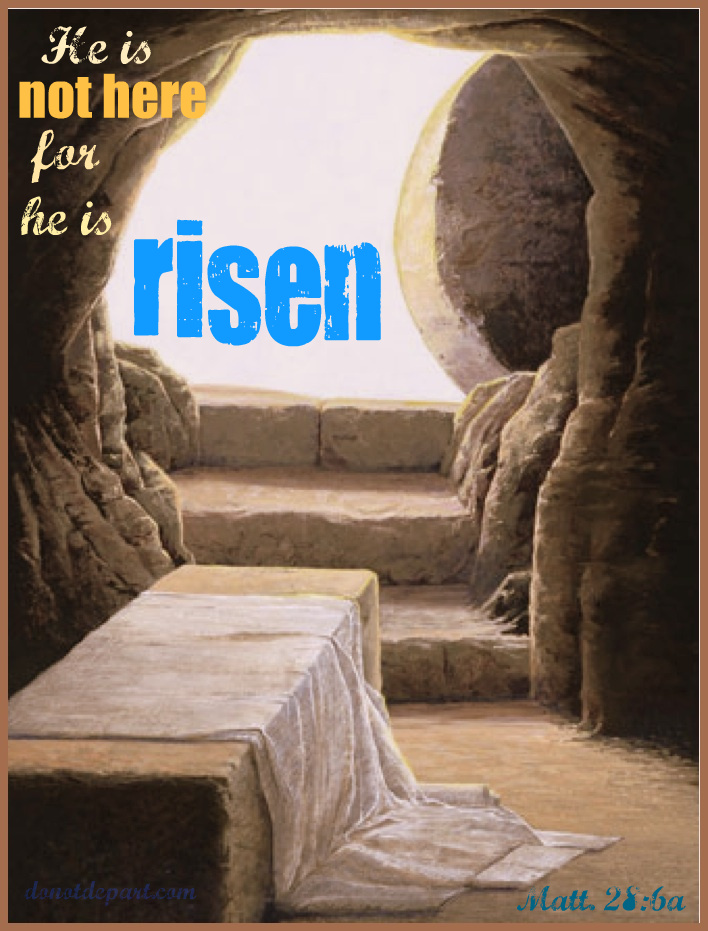
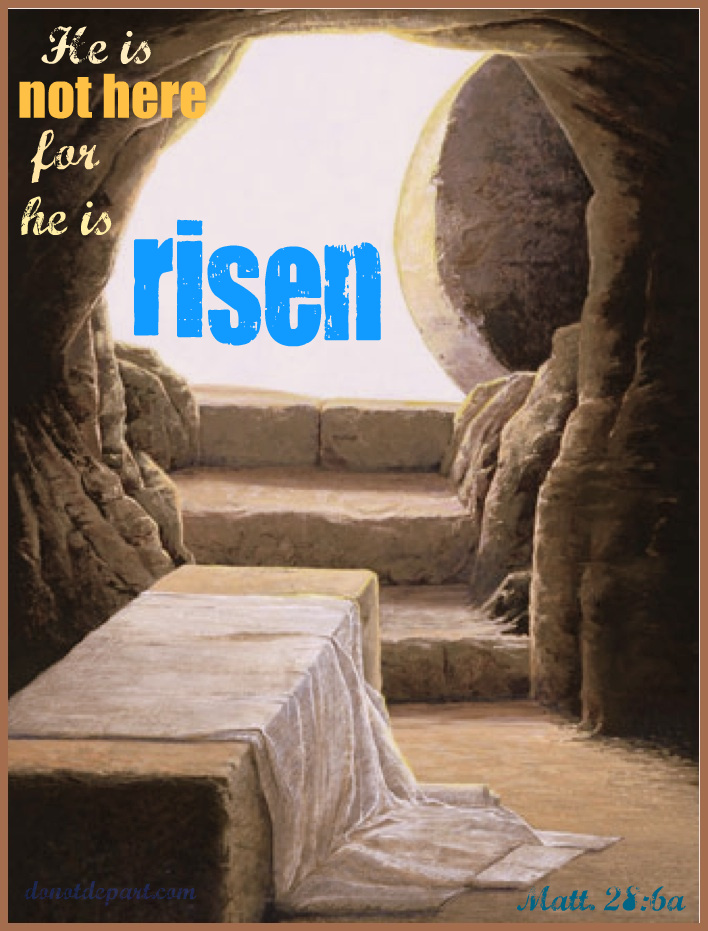
He is Risen!  He is risen, indeed.


Resurrection: Preparing our hearts to celebrate Easter

March 5, 2013 by Julie Leave a Comment

Resurrection Series on www.donotdepart.com

We’re born wanting something we can’t have. Have you ever lost a loved one? Have you ever battled for your own life? Since death was announced in Genesis 3:19, people have searched for ways to prolong life, live forever, and outwit death. After all, Adam’s judgment echoes through the ages to all of us: “Therefore, just as sin came into the world through one man, and death through sin, and so death spread to all men because all sinned.”   (Romans 5:12)

From tombs full of riches for the afterlife to quests for the fountain of youth to modern medical technology, the hope of life and fear of death spurs men on to find the key to eternal life. Losses, disappointments, and decay tasted in earthly life point to our shared ultimate end: “And just as it is appointed for man to die once, and after that comes judgment” (Hebrews 9:27).

Only One has power over death. There have always been skeptics; even the Sadducees of Jesus’ day scoffed at the thought of immortality. Scripture records the stories of a few who were powerless over death, but they saw God intervene and do the unimaginable: restore life.

Brought to Life In the Old Testament

  • The Widow of Zeraphath’s Son (1 Kings 17:17-24)
  • The Shunnamite Woman’s Son (11 Kings 4:20-37)
  • The Man thrown into Elisha’s Tomb (II Kings 13:21)

Brought to Life In the New Testament

  • The Widow of Nain’s Son (Luke 7:11-16)
  • Jairus’ 12 year old daughter (Mark 5:35-43)
  • Lazarus (John 11:1-44)
  • Tabitha (Acts 9:36-41)
  • Eutychus (Acts 20:7-12)
  • Saints buried near Jerusalem (Matt. 27:51-53)

These people did not raise themselves, but they were raised by God. His power worked independently, and occasionally through His servants, to defeat death itself. As foretold in Genesis 3:15, the Enemy’s plan suffered a fatal blow when the gospel triumphed in the risen Savior. The resurrected life of Jesus makes our abundant life possible. What man could never do, God did.

Resurrection is the conquering of death, the overcoming of the Enemy’s plan to thwart God’s gift of life. Jesus said, “The thief comes only to steal and kill and destroy. I came that they may have life and have it abundantly.“ (John 10:10)

This month we celebrate the Resurrection victory over loss and pain and death. With “Easter” at the end of this month, we want to prepare our hearts with fresh appreciation for the Resurrection. All month long, we will share Bible Study tools to help you focus on this greatest of all mysteries that makes abundant life possible.

Behold! I tell you a mystery. We shall not all sleep, but we shall all be changed … the dead will be raised imperishable, and we shall be changed. For this perishable body must put on the imperishable, and this mortal body must put on immortality…“Death is swallowed up in victory. O death, where is your victory? O death, where is your sting?”… thanks be to God, who gives us the victory through our Lord Jesus Christ.
(Excerpts from 1 Corinthians 15:51-57)

Join us this month on Do Not Depart as we share Bible Study Tools to prepare our hearts for a celebration of the Resurrection.

Faithful in community

February 7, 2013 by Julie 5 Comments

Created for Community

The believers were scattered and facing persecution when James wrote to them to encourage them in their trials. They struggled to have joy, well aware of their need for wisdom in the difficult things of life. Have you ever been alone in the midst of trying times? Trials are hard enough, but facing them without community is harder.

Accept His community challenge

Created for Community
The message of the book of Hebrew resonates with the echo of encouragement to be full off faith in trials. Tucked inside the tenth chapter of the book, God reveals a key choice that may determine how steadfast we are as individuals. Choose to regularly assemble in one place with others who follow Him.  He challenges us to practice this habit in order to be faithful in hard times.

“Let us hold unswervingly to the hope we profess, for he who promised is faithful. And let us consider how we may spur one another on toward love and good deeds, not giving up meeting together, as some are in the habit of doing, but encouraging one another—and all the more as you see the Day approaching” (Hebrews 10:23-25).

Accept the community urgency

As followers of God recognize the Day of His return coming closer, they will face hardships that tempt them to move from hope to hopeless. Just identifying themselves as a member of His Body may come with a price tag, and they may give us coming together. Some Christ followers will drift away from a culture of love and doing kingdom things. More than ever, God wants the community of faith to gather together to encourage each other to be firm in their faith.  By gathering together as His people, we remember who we are in Christ, who God is, why we have power instead of fear, and how light overcomes darkness.

Accept no community substitute

In this day, a scattered community of believers has more ways than ever to overcome isolation. It’s never been easier to network globally, but it’s never been easier to give up “meeting together,” which has the idea of assembling together in one physical place. Technology complements and creates community networks, but it doesn’t take the place of “meeting together.” There’s power in physical presence. We can not experience in reality what we only envision virtually.

Just as God became “God with us,” He urges us to be with each other. He set the precedent of relationship in community. Let’s keep on:

  • gathering together regularly
  • in local communities of believers
  • to spur each other on
  • to living out our faith
  • right up until the Day is here!

We will be faithful to the faithful One when we meet together faithfully.

Love Like Him: Love bows low

July 2, 2012 by Julie 1 Comment

Return visit to my village servant-friend

Coffee bushes and papaya trees encircle her cinder block home; stitched tribal garments hang near the door, distinguishing her as an honored citizen and village elder. When I first visited, she was adorned in her finest, spending the hottest part of the day as our self-appointed caretaker. Highly regarded, she chose to lower herself in humble servitude, preparing trays of fruit, refreshing our water, inviting us to sit so she could give. Setting aside her own needs, she ministered to our fatigue. 1 Corinthians shows how love is patient and how it looks when I am full of love.  Love is in its glory when a person of honor bends low to serve another.

Jesus bowed Himself all the way from the throne of heaven to a woman’s womb, so He could serve mankind.  Humility is the opposite of rivalry and pride, intentionally putting oneself below your rightful level or position. While we usually frown on making comparisons, to take hold of a first-Corinthians-kind-of-love, let’s discover and embrace the comparisons of Philippians 2:1-8.

Love takes hold when God’s people are the same … united in mind and love. (v. 2) Paul invites readers to compare themselves and see if they agree and share the same humble thoughts and passions. Opinions direct our actions; we only strive together in humility when we choose to go low together.

Love counts others more significant than self … “more than” how we count our self. Despite His perfect nature and divine sonship, Jesus valued our lives above His own. To “count” is to contemplate and direct attention to the needs of another. How do your thoughts about your own value and your own life’s concerns compare to how you think about those of others?

Love includes the interests of others … not only our own. We do look out for own interests, but “not only” our own interests. Humility requires measuring how much energy, time, and passion we allot for our interests in comparison to looking out for others = not easy in a world empathetic to our right to “be good to yourself.” If “self” dominates our attention, we need a change of heart and mind.

Love has this mind … not the other mind. “This mind” is a mind like Christ. Our opinion of self and others drives the way we strive in life. Jesus so valued man that He lowered Himself into a human embryo, grew up through the life stages of a man, and offered His perfect self to the very ones He created. In an ultimate act of humility, He was “obedient to the point of death, even death on a cross” (Phil. 2:8). Jesus did the comparisons and saw that we are totally sinful, while He is totally perfect. Though the Person of greatest honor, He served beyond our wildest hope. He chose to be low. He chose to be obedient.

Jesus’ lowest moment was Love’s most glorious moment.

This summer I revisited my tribal friend to find her weak and suffering. Her hands trembled as she welcomed us into the coolness of her dim home with mat covered floors. With great effort, she brought trays of fruit and a costly bottle of water to minister to our needs, and she lowered herself to the floor to be with us. Love doesn’t insist on the place of honor. Our tongues spoke different words, but the language of her love was clear and strong. Love bows low in humble service to ones it values.

Following my humble friend home


When it comes to love, comparison challenges the hearts and minds of ones like me:  given to looking out for myself, seeking my own way, happy to give a “piece of my mind.” Do you dare to compare?

  • Do I have the “same mind” as other followers of Christ?
  • Do I think I’m “more significant” than others?
  • Do I look out for the interests of others, “not only” mine?
  • Do I have “this mind” of Christ or a selfish mind?

Let’s dare to compare with ones who bow low in love’s stance.  We’ll be in good company.


Love Like Him: 1 Corinthians 13:4-7

June 4, 2012 by Katie Orr 2 Comments

I’ve shared this before over on my personal blog, but I saw so many of these great, personal versions of 1 Corinthians 13:4-7 this week shared in the #LoveLikeHim stream on Twitter, I thought I would share mine again.

IF I AM FULL OF LOVE…

I will persevere the offenses of others.

I will show kindness to those who have offended me.

I will not boil with envy.

I will not put myself on display.

I will not put my desires above the needs of others.

I will not demand my own way.

I will not be irritable towards those that I love.

I will not resent those that I love.

I will not enjoy sin, but take joy in what is right.

I will be a protective covering over those around me, as we weather together the storms that come our way.

I will choose to believe the best of those I love.

I will keep a confident expectation for good things to come

I will remain and not run away, even when the unthinkable happens.

1 Corinthians 13:4-7 — as how I want this passage to be made true in my life


I would LOVE for  you to share yours as well! Just leave a link to your post, or copy out your “re-write” of these verses in the comments.


What is God teaching you about LOVE through your studies?

Next Page »

This Month’s Theme

  • Jesus is the Way
  • And He Shall Be Called Series Intro

Enter your email address to have new posts emailed to you:

We’ll come to you

Enter your email address to have new posts emailed to you

Categories

Bible Memory – Lent 2021

Memorizing Isaiah 12

Let the Children Come

Let the Children Come

Want more #HideHisWord resources?

Memorizing Psalm 1

Find Us on Facebook


Search

Recent Posts

  • Series Wrap-Up: The Lord Is My Light
  • His Marvelous Light
  • When the Darkness Deepens
  • Though I Sit in Darkness…
  • Let Your Light Shine
  • Life-Giving Light

Archives

© 2026 · Pretty Creative WordPress Theme by, Pretty Darn Cute Design