• Home
  • About
    • Our Contributors
    • Our Beliefs
  • Blog
  • Bible Studies
    • Scripture Dig
  • Archives
  • Shop
  • Advertise
  • Contact
    • Email
    • Facebook
    • Instagram
    • Pinterest
    • Twitter

Do Not Depart

Encouragement and Tools to Abide in God's Word

You are here: Home / Archives for Old Testament

Beloved Stories – Old Testament {Wrap-Up}

June 2, 2018 by Patti Brown 1 Comment

Beloved Stories: Old Testament WRAP UP. A new series from DoNotDepart.com. Stories help us understand our world, and understand ourselves. What is YOUR favorite Old Testament story?

We spent May looking at stories in the Old Testament, and stories from our lives. Research shows that people learn differently when we learn through stories. Stories activate the brain in ways that help us remember the lesson! Isn’t it wonderful how God designed us?

Beloved Stories: Old Testament WRAP UP. A new series from DoNotDepart.com. Stories help us understand our world, and understand ourselves. What is YOUR favorite Old Testament story?
Here is a recap of the stories we explored in our series:

  • In And the Lord Heard It: A Story for Parents from Numbers 12, Jaime wrote about how God shows mercy and patience to his wayward children.
  • Lisa shared in Can I Have Yours? {Dagon’s Story and Ours} (1 Samuel 4-6) what can happen when we try to grab God’s promise for someone else and make it our own.
  • Alyssa showed how the story of Joseph (Genesis 37, 39-47) reminds us that When God Puts a Dream in Your Heart the outcome may be different than you are expecting, but it is always filled with blessing.
  • Exodus 33 is a comfort to those who feel like they are wandering. Ali wrote in Seeking God’s Presence – 3 Simple Lessons from Exodus 33, “We don’t need to wander aimlessly, afraid or lonely. We can pray for God to show us His ways, His presence, and ask to see His glory revealed in Christ!
  • Patti reminded us that you don’t have to know what is going to happen because You Can Trust Your Future to God (1 Samuel 16:1-13)

Do you have a favorite Bible story that has impacted a chapter of your life story? Share in the comments!


Beloved Stories: When God Puts a Dream in Your Heart

May 22, 2018 by Alyssa Howard 1 Comment

Beloved Stories: When God Puts a Dream in Your Heart | DoNotDepart.com

My favorite Bible story as a child was the story of Joseph. (His story can be found in Genesis 37, 39-47.) His life was full of promise and victory, yet he also encountered humiliation and defeat. Little did I know as a child that this story would inspire and encourage me so much as an adult. As I have faced my own share of ups and downs, Joseph’s life reminded me that God always keeps His Word. At a young age, God put a dream in the heart of Joseph and then carried it through to completion. Has He put a dream in your heart as well?


Beloved Stories: When God Puts a Dream in Your Heart | DoNotDepart.com


Joseph was a dreamer…

Joseph had high hopes for his life because God put dreams in his heart. At an early age, God gave him actual dreams about his future as a ruler. He didn’t know how it all would play out, but he knew in his heart that God had a unique plan for his future. Has God put a dream in your heart? Has He inspired you towards action in some way? Perhaps you’re like Joseph and are unsure how God is going to get you from point “a” to point “b.” Trust that He will get you there and don’t lose hope.


Joseph was betrayed by his own brothers…

Have you ever been betrayed by someone you trusted? In their jealousy, Joseph’s brothers did the unthinkable. They sold their own brother into slavery and then faked his death. Not only was this cruel towards Joseph, but can you imagine being their father Jacob? The grief he would experience would leave him broken for many years to come.


Joseph endured trials and periods of waiting…

Being sold into slavery wasn’t his only dilemma. Joseph was also wrongly accused and thrown into prison. And even though God gave him favor in prison and never left his side, he still had to endure a time of waiting and wondering.


Joseph received his promise…

When reading the story of Joseph, it’s easy to forget how many years pass before God’s promise was finally realized in his life. But the truth is that everything Joseph endured prepared him for all that God had planned for his life.


Joseph forgave…

God worked all things together for his good and for the good of the Israelite nation. When face to face with his brothers once again, Joseph made the decision to forgive them. In the end, his entire family came to Egypt, which is right where God needed His people to be for all He had planned for their future.


When I was younger, God put dreams in my heart. They weren’t actual dreams like Joseph, but they were dreams nonetheless and I knew that God had inspired them. But I faced opposition in my life. Betrayed by close friends, I found myself beaten up and without hope. I spent several years of my life working through what had happened to me. I have to wonder if I experienced some of the same emotions Joseph undoubtedly felt in prison. Did God still have a plan for my life? Had He forgotten about the dreams He placed in my heart? Would I ever recover?

Today, my life looks very different. I find myself in awe of the healing God has done in my life. It wasn’t overnight, but rather it took time. I had to take things one day at a time. And when I look back, I can’t help but wonder if everything I went through was exactly what needed to happen to get me from point “a” to point “b.”

You see, if Joseph’s brothers hadn’t betrayed him and sold him into slavery, he would have never seen his dream realized. Did it break God’s heart when Joseph faced struggle and hardship? The Bible doesn’t say for certain… but knowing the character of God, I believe it did. And what the enemy meant for harm, God turned it around and used it as part of His plan for Joseph’s life.


Has God put a dream in your heart?


God works all things together for the good of those who love Him… even the things that are difficult and don’t make sense. Our journey in life can seem complicated and messy at times, but God is faithful to use every part of our story to bring us closer to Him.


Has God put a dream in your heart? #BelovedStoriesOT

Click To Tweet


Can I Have Yours? {Dagon’s Story and Ours}

May 17, 2018 by Lisa Burgess 30 Comments

Can I Have Yours?

When I want what you have but God didn’t intend it for me, it will fall flat. Like Dagon. We’re connecting our stories with Old Testament stories this month.

Can I Have Yours?

I’ll Have What They’re Having, Please

She was born this January.

As typical grandparents, we were thrilled to get out first grandchild. As expected, she was beautiful and sweet and the best thing ever.

But the problem was location.

When I was younger and raising my own small children, my parents lived down the road. Even though I was a stay-at-home mom, if I had a dentist appointment or a dinner date with my husband, I could drop the girls off at my parents’ house at a moment’s notice. And because they lived so close, my parents came to our girls’ school functions and saw them often, along with their other grandchildren who all lived nearby.

I dreamed for the same proximity with my own grandchildren. It’s what I see with my brother and his grandchildren who live in the same town. It’s also true for my sister and her first grandchild born last year.


I want what they have.


But that’s not my reality.

Bring Me the Box

It reminds me of this story from the Old Testament book of 1 Samuel (read the whole thing in 1 Samuel 4-6; it’s a crazy story!).

It was a time of war between the Israelites and the Philistines. The Philistines were dominating. After the Philistines killed 4,000 Israelites in battle, the Israelites brought in their secret weapon: the ark of the covenant.

The ark was a portable sacred chest, the Israelites most prized possession. It was covered in gold. It contained a copy of the Ten Commandments and a sample of manna. Its lid was the Mercy Seat.

This holy box signified the very presence of God. It was their protective talisman.

The Philistines knew this about the ark, too. When they saw it coming, they were thrown into a panic. But instead of the ark’s presence bringing them bad luck, the Philistines continued to win. In addition to killing 30,000 Israelites, they also stole the ark of the covenant for themselves.

They wanted something that was not theirs. They thought they could grab God’s promise for someone else and make it their own.

But God and His promises don’t work that way.


The details God plans for one person are not the same as He plans for another.


What God planned for my siblings—to have their grandchildren live close by—is not the plan He is working in my life.

Dagon Falls Down

Here’s what happened next to the ark.

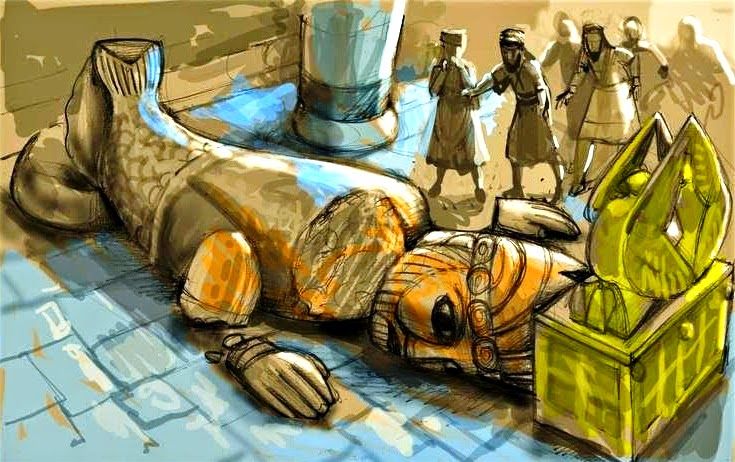
The Philistines returned home. They placed the ark in their own sacred temple, at the feet of their own god, Dagon, the pagan deity of corn and the father of the god Baal. Dagon was half-man, half-fish.

dagon-fish

But surprise!

The next morning, the people walked into the temple to discover Dagon on the ground. Dagon now lay at the foot of the ark.

They propped Dagon back up, only to discover him bowing in the same position again the next morning. Dagon’s head and hands were broken off, again at the foot of the ark.

dagon falls down at ark

What could this mean? Bad news followed more bad news. The Philistines became stricken with tumors. Rats began to overtake their city. Fear ensued.


They no longer wanted someone else’s treasure.


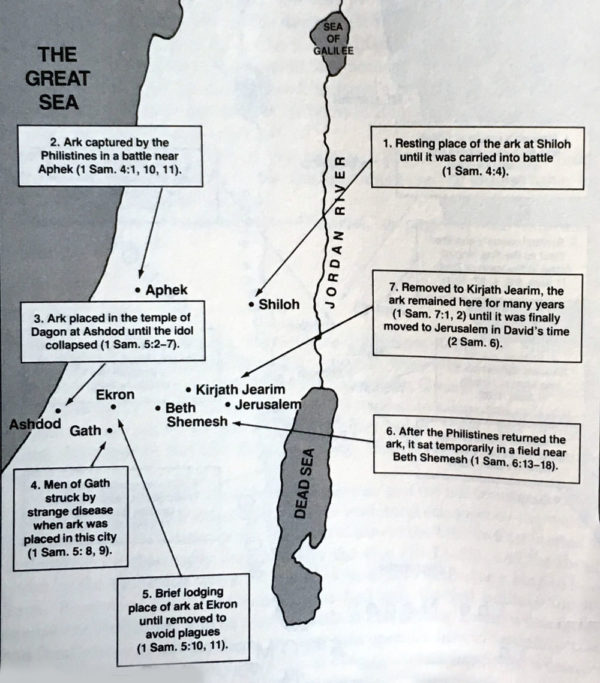
They passed off the ark to other Philistines in the city of Gath. But again, tumors came. People died. They moved the ark to another city, Ekron. But the same thing happened to them.

ark captured dagon
Nelson’s Complete Book of Bible Maps and Charts 1993 by Thomas Nelson, Inc.

After seven months, the religious leaders held a meeting. How can we get rid of this ark? It’s not good for us. It brings no blessings to our people.

They decided to send it back to the Israelites, along with a gift of five golden rats and five golden tumors. (Yes, this story gets better and better; read the remainder yourself.)

A Lesson for Us?

God puts individual gifts in each of our lives. These gifts are personally designed uniquely for us.

When we want other people’s gifts for ourselves instead, those gifts will fall flat, just like the imitation god Dagon fell flat at the foot of the ark.

  • What God intends for others is for their good.
  • What God intends for you is for your good.
  • Be content with your own treasures.

That’s what I’m learning with my granddaughter.

While she doesn’t live in my hometown like I’d prefer, she’s only three hours away. (I’ve learned to say “only” because many grandparents live across the world from their grandchildren.)

Maybe I’ll be better as a 3-hour away grandmother than I would be as a 3-mile away grandmother. Maybe I’d be too smothering or intrusive if she lived closer. Maybe, maybe there are reasons I can’t understand.


I don’t have to know details. I only have to trust God.


Three hours is close enough for me to drive down often. My daughter and son-in-law invite me frequently for overnight visits. So far, I’ve likely totaled more hours with our grandbaby living at a distance than I might have spent if she lived next door.

grandbaby 2018

Our relationship may not look like the one my own children had with their nearby grandparents. Or that my siblings have with their grandchildren.

But that’s okay. I don’t need to idolize the plan God has for their lives. I don’t need to wish it were my own.

I want instead to be grateful for the grace God keeps giving me (which includes a dependable vehicle, money for gas, and available time).

May we each worship God in the life He’s put before us, not in a dream He has for someone else.

Whether or not these plans look like we imagined, we can trust God to be in them with us.

His presence is the holy thing we need.

When we want what isn’t ours, it falls flat. Look at Dagon. #BelovedStoriesOT

Click To Tweet

When have you wanted what someone else has? What happened? Please share in the comments.

(P. S. If you’re a long-distance grandparent, please share any tips you have! I love hearing your ideas.)

Beloved Stories: Old Testament

May 8, 2018 by Patti Brown Leave a Comment

Beloved Stories: Old Testament. A new series from DoNotDepart.com. Stories help us understand our world, and understand ourselves. What is YOUR favorite Old Testament story?

Beloved Stories: Old Testament. A new series from DoNotDepart.com. Stories help us understand our world, and understand ourselves. What is YOUR favorite Old Testament story?
When our oldest son was small, the final piece of his bedtime routine was reading time. My husband or I would lie in his bed and read to him… not one, but five stories of his choosing. His literary tastes were broad—he was as happy to have us read nonfiction about trucks as he was to listen to anthropomorphised stories about bear families.

Five chores would have elicited complaints, but five stories were never too many!

Our little guy grew up to be an avid reader, immersing himself in stories, not only through books, but also via movies, television shows, and even games.

Stories help us understand our world, and understand ourselves. We are wired to process life through narrative. Jesus knew this and frequently taught using parables.

The Bible is filled with stories. Tales of hardship, of hope, of despair, of triumph. Stories of ordinary, flawed human beings rising to something greater than themselves with God’s help.

“On a general theological level, much has been made of the importance of story or narrative as a peculiarly appropriate vehicle for conveying theological truth. The basic reason for attaching importance to theology in story form is the fact that a story is so widely accessible to young and old, to educated and uneducated alike. Everybody likes a good story; and stories linger in the mind long after other things are forgotten. To say this is, of course, not to say anything new but rather to state the obvious. Followers of Jesus, whose favoured means of teaching was the parable, should find nothing surprising in the idea that stories are a particularly effective means of communicating theological truth. Generally speaking, a recognition of the value of story can be a valuable corrective to the dominant tendency in western theology to abstract and to analyze.” – RWL Moberly

We see ourselves in Jacob’s jealousy, or Sarah’s lack of faith. And we are inspired to be more devoted to God like Joseph, or persistent in prayer like Hannah. The stories of the Bible convict and inspire.

This month the writers here at Do Not Depart will be sharing some of our favorite Old Testament stories, and how those tales helped us understand the narrative of our own lives.

What is your favorite Old Testament story?

Stories help us understand our world, and understand ourselves.The stories of the Bible convict and inspire. #BelovedStoriesOT

Click To Tweet

[Tweet “What is your favorite Old Testament story? #BelovedStoriesOT]

Is It Dangerous to Know God? Yada, Yada, Yada

August 17, 2017 by Lisa Burgess 26 Comments

Know-God-Hebrew-Word-Yada_DoNotDepart

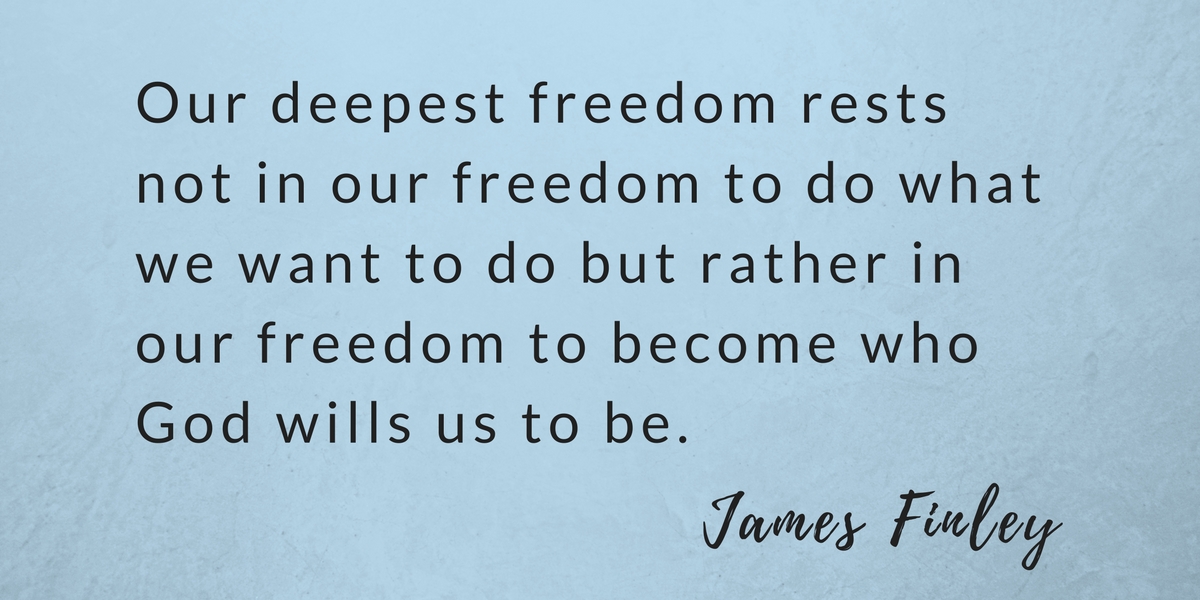
Our deepest freedom rests not in our freedom to do what we want to do but rather in our freedom to become who God wills us to be.

Yada, Yada, Yada

What does “yada” mean to you?

Certain generations of us remember the 1997 “The Yada” episode of the Seinfeld sitcom. “Yada, yada, yada” was the replacement for an explanation. Instead of giving details, just skip over them by saying yada, yada, yada.

Seinfeld Yada Video

But the real meaning of yada?

It’s actually the exact opposite.

Instead of keeping someone in the dark with skimpy details, the Hebrew word yada used in the Old Testament primarily means “to know.”

  • yada = to know

H3045 - Yada - Hebrew word

Yada first appears in the Bible in a quote from the serpent in Genesis 3:5, “For God knows that when you eat of it your eyes will be opened, and you will be like God, knowing good and evil.”

Does this real definition of yada (knowing) make us anxious?

Know-God-Hebrew-Word-Yada_DoNotDepart

God Knows You

Are you comfortable with God knowing every detail about you? We know it can be ugly in there.

  • Do I really want anyone to know the bad parenting decisions I’ve made?
  • To know the judgmental thoughts I’ve had of friends?
  • To know the words I’d like to say in an argument (even if I won’t say them)?

Like it or not, God knows us. We’re to feel good about that?

And You Know God?

And when we think about us knowing God, that, too, can feel troublesome.

(1) We may grow arrogant, proud that we “know” God because we know facts about Him. We’ve all seen (and perhaps been) that person who has much head knowledge about God but who isn’t godly.

Or (2) we may be fearful of knowing God better. Relationships are hard enough with people, but with God? Wouldn’t it be easier to keep Him at arms’ length so we won’t be called on to do anything challenging or uncertain? His standards are so high.

A Healthy View of Yada

But here’s a different way to think about yada.

(1) Being known by God is a gift of grace.

On a busy Saturday last weekend, I was feeling overwhelmed between events, wondering how I would have the energy for the last appearance of the night. But because my husband knows me, he encouraged me to take a break on the final drive, even from talking with him, and just read a book and recharge. It worked.

Being known is a blessing.

“O LORD, you have searched me and known me! You know when I sit down and when I rise up; you discern my thoughts from afar.”
Psalm 139:1-2

Because God knows our every strength AND our every weakness, He knows how to work best in our lives. Just as we benefit when our doctor understands our bodies and illnesses, so we also benefit when God knows all about us. He never takes advantage of our vulnerabilities.

  • It’s good that God knows what we can bear and what we can’t.
  • It’s good that He knows when we need a gentle push and when we need a restful break.
  • It’s good that He knows the gifts we need and those we couldn’t handle.

Because He knows us inside and out—and loves us anyway—we can rest in His provision and His healing.

“By this I know that you delight in me: my enemy will not shout in triumph over me.”
Psalm 41:11

We need to be known by God. Be grateful for it. Discover peace through it.

(2) Our knowing God brings freedom.

What advantages come from our knowing God?

The more we know God, the more we can trust and love God. Knowing God opens us up to an improved relationship with Him.

“And those who know your name put their trust in you, for you, O LORD, have not forsaken those who seek you.”
Psalm 9:10

Often we learn more about God through study. We think, then feel, then do.

But knowing God doesn’t come only through head knowledge (although we definitely need that). Often the most profound ways we know other people are by doing things with them. We also need to do with God. Live life together, not just study Him from a distance.

So occasionally reverse the process. Do, feel, think.

  • Do something fresh and daring with God.
  • Discover that it makes you feel more trustful.
  • Then think about and thank God that you are knowing Him more fully as a result.

“[King Josiah] judged the cause of the poor and needy; then it was well. Is not this to know me? declares the LORD.”
Jeremiah 22:16

Take a step of faith.
Engage in an unfamiliar situation.
Love someone different from you.

Open Invitation to Know

Being known by God and knowing God are what we are made for, how we are designed. It opens us up to receiving all the grace He longs to give us.

Instead of being dangerous, knowing God allows us to live with more security, more satisfaction, more hope.

Truly knowing and experiencing God is our open invitation to the greatest freedom imaginable.

Unlike George Costanza in Seinfeld, let’s not use yada, yada, yada to skim over our lives. Instead, let’s yada God to go deeper.

Should we fear being known by God? Or of knowing God better? Look at yada. #OTHebrewWords

Click To Tweet

Are you comfortable with God knowing everything about you? How do you get to know God better? We want to hear your thoughts.

See all the words in our Hebrew series here.

Notable Hebrew Words of the Old Testament - a month long series at DoNotDepart.com

Notable Hebrew Words of the Old Testament

August 8, 2017 by Ali Shaw Leave a Comment

Notable Hebrew Words of the Old Testament - a month long series at DoNotDepart.com

Not only am I a Word lover, I’m a word lover. (Ha! See what I did there?)

On a serious note, I really enjoyed the series we did last year on Key Greek Words of the New Testament. If you missed that series, make sure you click the link to read what words we covered. I learned so much!

This month, we’re going to dive into the Old Testament for a look at some notable Hebrew words— we’ll discover their rich meanings, learn where to find them, and we’ll even share with you why we find them worth knowing.

Notable Hebrew Words of the Old Testament - a month long series at DoNotDepart.com

But we won’t be pulling words from certain portions of Ezra or Daniel.

Do you know why? Several passages in those books were written in Aramaic (the language used by the Assyrians during that time period and introduced to the Jews).

But with the exception of a few other verses and a word in Genesis, the remainder of the Old Testament was written in the expressive language of the Jews, Ancient Hebrew.

I don’t want to spoil any surprises, but we may look into words such as “shalom,” “chesed,” “amen,” “shama,” “hallelujah,” and others.

So, are you ready to dive in and learn with us? Let’s go!

Do you know any Hebrew words? If so, which ones mean the most to you and why?

Ali

Notable Hebrew Words of the Old Testament this month on the blog #OTHebrewWords

Click To Tweet

Jesus, Our Forever High Priest

July 19, 2016 by Kelli LaFram 1 Comment

our forever High Priest

So also Christ did not glorify Himself to become High Priest, but it was He who said to Him:

“You are My Son, Today I have begotten You.”

As He also says in another place:

“You are a priest forever according to the order of Melchizedek.” (Hebrews 5:5-6, KNJV)

The writer of the book of Hebrews was addressing a group of Christian Jews. These Christians, because they had grown up Jewish, would have been quite familiar with the Levitical priesthood. Meaning, they believed that the high priest must come from the line of Aaron (Exodus 28-29). They also knew that the high priest had the responsibility to offer “both gifts and sacrifices for sin” (Hebrews 5:3). To them, these were the religious practices needed to honor God.

Then enters Jesus.

Put yourself in the shoes of these Christian Jews for a minute. They were being told “it is finished” (John 19:30). That their works of righteousness were not good enough and no longer needed. That this Man named Jesus, who wasn’t even from Aaron’s family line, had offered thee ultimate sacrifice on their behalf. That every sin they had committed, were committing or would commit was atoned for. The old covenant they had grown up with, everything they thought they knew about pleasing God was done away with. And a new covenant was in it’s place.

This may have been a hard pill to swallow, right?

So what did the author of Hebrews do with this hard pill, this hard truth? He didn’t sugar-coat it, he Scripture-coated it. And the Scripture he used they most likely knew by heart.

“You are My Son, Today I have begotten You.” (Psalm 2:7)

The Levites were servants of God, but Jesus was His Son. And He was begotten, at the day of His resurrection, for this purpose — to be the High Priest. God had appointed many high priests in the past, but this time it was different. This time He appointed His Son and His Son was more than special. How? We see it in the next coating of Scripture.

“You are a priest forever according to the order of Melchizedek.” (Psalm 110:4)

Jesus wasn’t a temporary high priest. He was (and is!) the forever High Priest because He was according to the order of Melchizedek. Jesus may not have been a Levite as the Jews thought all high priests needed to be, but that didn’t disqualify Him. Jesus, a Priest forever, was according to an order that had been around much longer than the Levitical order.

For this Melchizedek, king of Salem, priest of the Most High God, who met Abraham returning from the slaughter of the kings and blessed him, to whom also Abraham gave a tenth part of all, first being translated “king of righteousness,” and then also king of Salem, meaning “king of peace,” without father, without mother, without genealogy, having neither beginning of days nor end of life, but made like the Son of God, remains a priest continually. (Hebrews 7:1-3, also see Genesis 14)

Why is this important?

You may be wondering why all this is important. You may be thinking yeah, I already know all this. So what? Well, the what is in the why. Why was the letter to the Hebrews even written? Why did these Christian need to be told about Christ as their High Priest?

Why? Because they were beginning to question what Jesus did for them. They were beginning to wonder if what He did really was enough. They wanted to know if they need to go back to the old way of doing things, the old works-based way to make up for their sins and attempt to please God. And I know many Christians today who begin to question and wonder and want to know the same thing — is more needed?

I doubt many of us would consider reinstating the sacrifices from the Old Testament, but we are still very similar to these Jewish Christians. There is a deep rooted belief in many of us that says we must do more if God is to be pleased with us. This belief simply isn’t true.

Instead of animal sacrifices we often think we need to do things like read our Bibles, pray, go to church, be kind, be patient, etc in order to make God happy. We stress ourselves out working and working for something we already have — God’s approval.

Don’t get me wrong, reading our Bibles, praying and attending church are all wonderful. They are necessary for fellowship with our Savior, but they are not what earns us salvation. They are not what justify us before God. It is only through faith in Jesus Christ that we are saved and pleasing to God the Father.

It is my prayer today that we understand this: that because we have Jesus, our forever High Priest we have a forever smile from our Father in heaven. No more is needed. Our sins are washed away. We have right standing before God. There is nothing left to do. It truly is finished.


Friends,

Please remember that I am human and flawed and my thoughts on this passage and others may not always be right. Please hold what I write up against the Word of God and listen to the Holy Spirit as He speaks to you directly.

Only by grace,

Kelli


Action steps:

  1. Jot down a few of things that you “do” for Christ. Consider your motives. Are you trying to earn favor or are these things done in response to His love?
  2. Read more on the order of Melchizedek. Check out Hebrews 7, Genesis 14, and this mini Bible study.
  3. Listen to and sing old hymns, such as What Can Wash Away My Sin, There Is Power In the Blood, and How Deep The Father’s Love For Us.
Why was the letter to the Hebrews even written? http://wp.me/p1Su7F-3Sp @donotdepart

Click To Tweet

You’ve Been Called – Light Up as a Priest

July 14, 2016 by Lisa Burgess 32 Comments

Dark-Times-Bright-Light

When times seem darkest, your light—however small or dim—shines brightest.

We’ve been asked to arrive at church on Sunday mornings at 8 a.m. for a final practice of our worship songs. It means I set my alarm a little earlier than I’d like. But when I arrive at 8, it seems they’re not ready for us.

Should I just sleep later and arrive later, despite the request? I’ve been considering it. Until last Sunday . . . .

When times seek darkest light shines brightest

Priestly Duties

Sometimes we look around us and see a mess. Fighting in the streets. Mud-throwing from political candidates. Hatred on social media.

Is there any point in trying to make a difference? Or should we all just sleep in?

I wonder how the high priest felt back in the old days. Twice every day—every single day, rain or shine—he had to enter the tabernacle and light the candles in the holy place (Exodus 30:7-8). Who would even notice? Could he slide by and just do it once a day if he was sick or tired or busy?

He had other duties, too. Important ones, like offering sacrifices for the people’s sins. Offering gifts to God on their behalf. Remaining ritually clean beyond anything required by other people.

Yet the sincerest of the priests did it. Why? Because he was called by God to do it. And he took that call seriously.

Called, Not Self-Appointed

As we continue our study in Hebrews 4:14-5:14 this month, we come across these two verses:

“Because of this he is obligated to offer sacrifice for his own sins just as he does for those of the people. And no one takes this honor for himself, but only when called by God, just as Aaron was.”
Hebrews 5:3-4

We read that the high priest (beginning with Aaron) was invited by name, by God, to lead the people to God Himself.

He had holy garments put on him, was anointed, and consecrated so he could serve the Lord as a priest (Exodus 40:13).

What an honor! In times of trouble and confusion, he was to be a light for the people, shining the presence of God.

Me, Too?

But it gets crazier . . . These also are messy days of trouble and confusion. Who is God calling to shine His presence into the dark places now?

You and me!

We are priests, too.

  • A royal priesthood (1 Peter 2:9)
  • Children of light (Ephesians 5:8)
  • City on a hill (Matthew 5:14)

As believers in Jesus we have been washed with water, clothed with righteousness, anointed with Jesus’s blood, and set apart for His work so we can serve Him as a priest.

What are our opportunities? Like the priests of old, we are:

  • To shine brightly (Matthew 5:16),
  • To offer thanks to God for the good gifts He’s given (Hebrews 13:15),
  • To point others to Jesus (Ephesians 3:9), the Highest Priest of all (Hebrews 7:27), who heals our pains and washes our sins.

Is becoming a priest an honor we bestow on ourselves? No. We have been invited to wear the Name, not self-appointed. We’ve been called by God to love our family, our friends, even our enemies. Not through our goodness, but through His grace.

We have been strategically positioned to answer the world’s call for help.

When our lights shine, those around us can see clearer themselves, can feel more hopeful about their own lives, and can live more purposeful lives for the glory of the Father.

Priesthood of Honor

Being a priest isn’t always easy. Such as getting up earlier when we’re asked to.

I was reminded last Sunday that arriving at 8 a.m. was about more than singing practice. It was about being a true priest. Arriving early in the sanctuary, we could straighten up the chairs, clean paper off the floor, walk the aisles and pray for souls that would soon be seated there.

We were to prepare the place where God’s people would be gathering.

Be a priest. It’s an honor. And a responsibility.

But we’ve been chosen. Let’s light up and go do it.

To Do This Week

  1. Read by candlelight.
    Light a candle to remember to shine as you read Hebrews 4:14-5:14.
  2. Write it out.
    If you’re writing the text by hand this month (see Ali’s suggestion), add in Hebrews 5:3-4.
  3. Three Dark/Three Light.
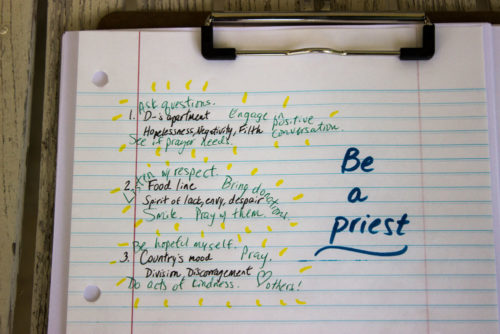
    Write down 3 dark places in your sphere of influence. Pray about 3 or more things you can do this week to bring the light of Jesus to those dark places. Write them brightly on top of and around the dark places.
    be-a-priest
  4. Advance it.
    Spread hope in your conversations and be a light in your actions this week!
  5. More priestly material?
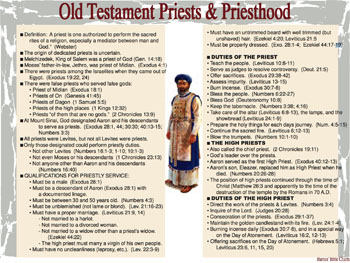
    Check out this chart, “Old Testament Priests & Priesthood.”

    Old Testament Priests
    Barnes Bible Charts
You’ve been called. Light up. Be a priest. #Hebrews5 #JesusAsHighPriest

Click To Tweet

Do you feel like a priest? Where do you see hopelessness? Where would you most like to shine a light?  Please share your thoughts in the comments.

Jesus as High Priests - new series on Hebrews 4:14-5:14

Our Valued Savior: Despised and Rejected

March 3, 2016 by Ali Shaw 3 Comments

Our Valued Savior: Despised and Rejected... read more and find Easter in the Old Testament at DoNotDepart.com

Our Valued Savior: Despised and Rejected... read more and find Easter in the Old Testament at DoNotDepart.com

1Who has believed what he has heard from us?
And to whom has the arm of the LORD been revealed?
2For he grew up before him like a young plant,
and like a root out of dry ground;
he had no form or majesty that we should look at him,
and no beauty that we should desire him.
3He was despised and rejected by men;
a man of sorrows, and acquainted with grief;
and as one from whom men hide their faces
he was despised, and we esteemed him not. (Isa 53:1-3)

He was despised and rejected by men. It’s hard to believe that something so valuable could go unesteemed. It’s bewildering to see preciousness rejected.

One morning many years ago I was cleaning my cutting board after making biscuits. I scraped all the bits of flour and dough into the trash. One bit of flour was stuck to the inside of my hand. Without looking, I pressed harder and rolled my thumb against the hardened flour in attempts to pry it off.

It wouldn’t budge.

I looked at my hand in hurried frustration. Why couldn’t I throw this bit of dough away? A good look revealed that it wasn’t dough at all.

My wedding ring had twisted around to face the palm of my hand, and I was feeling the diamonds. I was trying to throw my beloved diamond in the trash as if it were just scraps of unwanted biscuit dough.

How many times have I done similarly in my life? How many times have I taken the precious and overlooked it? Rejected it? Or even despised it? How many times has the beautiful, the sacred, the holy, gone unnoticed or unesteemed?

Or, how many times has God given me a gift but I missed it because I was looking for something wrapped in a different package?

I can’t understand how our Savior would come to earth in such a humbled state. It’s hard to wrap my human mind around it. Why didn’t our powerful God come as Mighty King and demand the respect, honor, and adoration He deserved. (Answer: Because He doesn’t force, He offers.)

But he didn’t. He came quietly, demanding nothing. He came like a “young plant”, growing up before the Lord. Tiny, frail, and fragile.

My mind is completely befuddled by this.

Yours?

My heart breaks for my precious Savior that came from Heaven to rescue His lost sheep and instead of being greeted with open arms was met with angry fists, hammer, and nails.

Our Valued Savior was “despised and rejected by men.” The Beautiful One went undesired.

Truly, I have few words.

Reading from these first few verses in Isaiah make me turn inward and upward. They make me focus on the Savior, Jesus, who came in the form of a servant. And I look into my own heart to make sure I have no traces of rejection… that I’m esteeming Christ as He deserves to be esteemed. That I place value on the gifts, mercy, forgiveness, and hope He gives so freely as an expression of His character and love. (After all, if I don’t esteem them, I’m not truly esteeming Him.)

Though these verses are heavy and sad, we can take heart because, as Believers, we know that things didn’t end sorrowfully. We know the miracle, power, and joy of a Risen Savior! (Luke 24:5-6)

Lord, help me to focus on You. Help my heart respond to your coming in adoration and praise. Let me rejoice in you, Living Savior! Revive my soul in any areas that have become deadened to the mystery and miracle of the Easter story— the story in the Bible, and the story of resurrection in my own life. You’ve raised this sinner to walk in newness of life. Help me never take that for granted, but to look at that miracle with childlike wonder, appreciation, and gratitude. Amen.

For more study and reflection:

  1. Read Isa 53:1-3. What specifically does Isaiah prophesy in these verses about Jesus? Using a cross-reference Bible, can you find their fulfillment in the Gospels?
  2.  Read Isa 53:1-3. Are there any areas of your life where you need to pray, “Lord, help me esteem you better in this?”
  3. Read Luke 22:63-65. What specific things did the men do to Jesus? Read Luke 23:34. Thank God for His forgiveness and love! Ask Him to show you any areas in your life where you need His forgiveness and renewal.
Our Valued Savior: Despised and Rejected. Are you esteeming Him today? #EasterInTheOT

Click To Tweet

Our Valued Savior, part one of our EasterInTheOldTestament Bible study. #EasterInTheOT

Click To Tweet

Easter in the Old Testament {a month-long series}

March 1, 2016 by Caroline 2 Comments

Easter in the Old Testament {DoNotDepart.com}
Original photo credit (image has been altered following terms)

It’s coming.

We’re in this period of waiting now. Of repenting and preparing and hoping.

But Easter is just under a month away.

When we study Easter, we often read much more in the New Testament since it’s there that we follow Christ and His steps, His story.

But, we know that God had all of this planned before creation. So can we find Easter in the Old Testament, too?

This month, we will study a few passages in the Old Testament to see the hints at resurrection and restoration there.

What We Will Study

We will spend a majority of our time this month in Isaiah 53, reading about the prophecy of the Messiah. But, we will also look briefly at part of Ezekiel’s story of new life.

We invite you to join us, share with us, and grow with us in seeing the hope of Easter in everything we read, see, and do.

“As for me, I know that my Redeemer lives, and at the last He will take His stand on the earth.” – Job 19:25

Other Easter resources here at DoNotDepart:

  • A free printable of Passion Week Scripture readings (plus a list of other resources around the internet)
  • An Easter devotional for families
  • A list of resources for faith-based Easter resources and activities for families
  • Easter bookmarks
  • 4 ways to prepare your heart for Easter Scripture readings
  • Easter events timeline

What verses in the Old Testament make you think of the resurrection and hope of Easter? Share in the comments below.

Can we find Easter in the Old Testament? Join @DoNotDepart for a look at finding the hope and resurrection of Easter in Old Testament verses:

Click To Tweet

A new month-long series is starting at @DoNotDepart! Join us for a look at Isaiah 53 and Ezekiel for #EasterintheOT:

Click To Tweet

Where does Jesus live? Then and now

December 10, 2015 by Lisa Burgess 22 Comments

1-Corinthians 6-19

1-Corinthians 6-19

GOD BESIDE US

From the beginning, walking in the garden of Eden with Adam and Eve, God wanted to live among His people.

But we know the story: our sin and His holiness created a gap in our relationship (Genesis 3:8).

It was temporarily patched during the time of Moses by God’s bold move to allow His presence to travel alongside His people through a special box, the Ark of the Covenant (Exodus 25:8-22).

[Side note for us word geeks . . .  “Ark” doesn’t mean boat, but rather container.

→   The “ark” of the Covenant is the Hebrew word aron, meaning chest or coffer (yes, also used for “coffin”) for holding something valuable.
→   Baby Moses was placed into an “ark” of bulrushes in the river, a different Hebrew word tebah, meaning box.
→   Noah’s “ark” is also the Hebrew word tebah, meaning box.
→   Jews today place the Torahs in their synagogues in a “holy ark” (Aaron Kodesh), a special box made to preserve its contents, facing toward Israel.

Interestingly, all these “arks” are containers that protect things. They are places of refuge.]

But what the Israelites couldn’t have known then (we can barely grasp it now), is that the symbolism of the Ark of the Covenant would one day become our reality—God living inside of us.

GOD IN A BOX?

It seems strange to us now. God in a box? The Ark was a small chest made of acacia wood, covered in purest gold. Around 4 feet tall and around 2½ feet wide, it was kept in the Holy of Holies in the tabernacle, and later in Solomon’s temple.

Its lid—called the mercy seat—was a heavy gold plate with two gold cherubim on top, facing each other, wings spread out.

God would appear in a cloud between the wings of the cherubim (Exodus 25:22).

WHAT WAS IN THE ARK…THEN AND NOW?

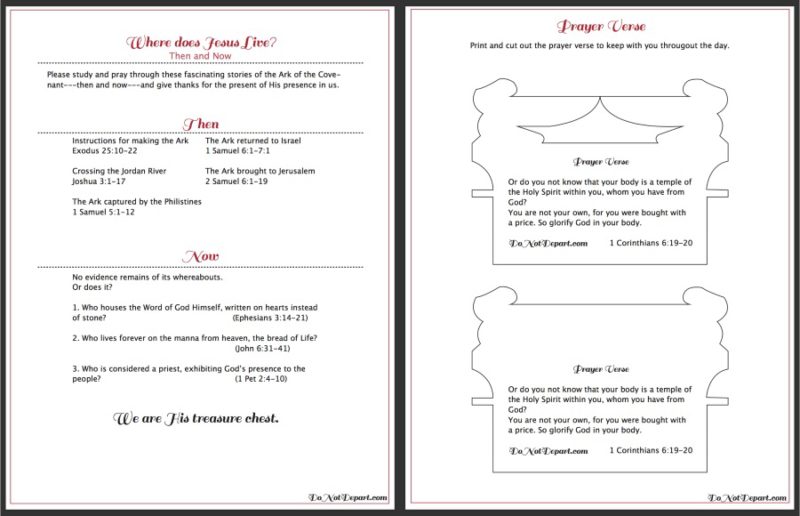
Three important items were inside the Ark. Can we uncover the foreshadowing of Jesus in them? And discover the living reality of them now in us? [Print this list of scriptures to study for yourself in more detail.]

1. Words

  • Then . . . enclosed in the ark were the two tablets of stone, the Ten Commandments. They symbolized God’s covenant with His people.
  • Now . . . Jesus (the Word became flesh) lives in us, the temple of the Holy Spirit.

2. Manna

  • Then . . . the Ark contained a gold jar of unspoiled manna to remind the Hebrews that God provided for them during their wilderness wanderings.
  • Now . . . we have the living Bread inside of us, again reminding us that God continues to meet our daily needs, today and forever.

3. Aaron’s rod

  • Then . . . Aaron’s walking stick with its miraculous buds was kept in the Ark to symbolize God’s power.
  • Now . . . God’s very Spirit lives on in His priesthood of believers, each one of us together who declare His praises, shining light in dark places.

WHERE DOES JESUS LIVE NOW?

No one knows for sure what happened to the physical Ark of the Covenant (despite the famous movie, Raiders of the Lost Ark). When the Babylonians plundered Solomon’s great temple in Jerusalem in 597 BC, many presume Nebuchadnezzar’s men stole the Ark. It’s presumably never been seen again, although theories continue to abound about its location.

So where is the true home of the Lord’s presence?

We know where He lives now—in His followers. Can there be any greater honor than to house the Lord’s presence in us, having Him go wherever we go, always bringing His presence to others when we show up?

May we never take this gift lightly, this privilege of being a living treasure chest of the Lord Jesus Christ.

And may we be extra mindful this Christmas to carry Jesus in us with love, joy, and peace.

I have been crucified with Christ. It is no longer I who live, but Christ who lives in me. And the life I now live in the flesh I live by faith in the Son of God, who loved me and gave himself for me.
Galatians 2:20

Please print, study and pray through these fascinating stories of the Ark of the Covenant—then and now—and give thanks for the present of His presence in us.

Where-does-Jesus-live-thumbnail

God in a box? Not anymore. Free printable: Where does Jesus live? Then and Now #JesusInTheOT

Click To Tweet

Where is the Ark of the Covenant now? Is there a living treasure chest? Free printable

Click To Tweet

How often are you aware that you carry the Lord’s presence everywhere you go? How can you be more mindful of it? Please share in the comments.

Finding Jesus in the Old Testament. With printables resources for you... at DoNotDepart.com

The Prince of Peace with Peace for Today…

December 8, 2015 by Ali Shaw 1 Comment

Finding Jesus in the Old Testament, The Prince of Peace... with a printable Christmas ornament

Out of the many themes that are associated with Christmastime, this one resonates in my heart. Something inside me greatly desires peace.  I thrive on routine and habit… because, well there’s peace in that. I tend to get anxious when life’s hiccups happen.

And because that’s how God wired me, I’m so thankful to know the Prince of Peace Himself. I need Him… and I certainly need His peace.

Finding Jesus in the Old Testament, The Prince of Peace... with a printable Christmas ornament
And I’m not the only one who needs His peace– our restless world does. There have been so many tragedies lately. So much heartache. Whether it’s a massacre in Paris or San Bernardino on the news, a child sick with cancer on a Facebook feed, or personal unrest in any painful shape, I think we can all see a God-sized hole we could label “Peace Missing.”

But before we despair, we can turn to God. He is ever near us and He’s waiting to comfort us with His love, wisdom, and might.

And that’s what God did for the Israelites when they were at their most unrestful state. His chosen people were spiritually wandering away from Him and their sin invited both danger from the enemy and discipline from the hand of God (Dan:5-7). The northern tribes had been conquered by Assyria, and the Kingdom of Judah would soon be conquered by Babylon. The majority of the inhabitants would be driven as captives into Babylon, far away from the Promised Land, far from their homes, their culture, and from everything they knew.

Unrest. Lack of peace. Heartache.

But God stepped in. Through the encouraging words of Isaiah, God reminded His children that He hadn’t forgotten them and His peace hadn’t truly left. He had a plan that would bring joy and peace to each heart. His plan was personal, powerful, and would change the whole world!

6For to us a child is born,
to us a son is given;
and the government shall be upon his shoulder,
and his name shall be called
Wonderful Counselor, Mighty God,
Everlasting Father, Prince of Peace.
7Of the increase of his government and of peace
there will be no end,
on the throne of David and over his kingdom,
to establish it and to uphold it
with justice and with righteousness
from this time forth and forevermore.
The zeal of the LORD of hosts will do this.

Oh, Jesus, the Messiah! What a promise of peace to the restless, fearful, broken heart!

Peace for You, Today

That’s why Jesus came down from Heaven 2,000 years ago to reach us. He didn’t want us to continue to stumble blindly. He wanted to offer the whole world His marvelous light. And while the Israelites had to wait about 700 years from these prophecies of Isaiah for Jesus to be born, today, we have ready access to the saving, peace-giving knowledge of Christ.

If we are ever on the brink of despair, we can remember that Jesus is our Wonderful Counselor. He is our Mighty God. He is the Everlasting Father. And He most certainly is the Prince of Peace.

“Peace I leave with you; my peace I give to you. Not as the world gives do I give to you. Let not your hearts be troubled, neither let them be afraid.” (John 14;27)

Jesus came to establish His heavenly kingdom. Many Jews mistakenly thought that the Messiah was coming to be a warrior King who would lead them to freedom from Roman rule– to bring physical peace between governments. But instead, Jesus came to offer each heart on earth (past, present, and future) eternal peace. Peace not like the world gives, but peace that comes from having the truth of His presence living right inside us.

And that peace within us flavors the way the think, the things we say and do, and the way we interact with others.

Peace gives us hope, satisfies us, and fills us with joy.

If you’re craving the peace of Jesus today, find encouragement in these verses:

“I have said these things to you, that in me you may have peace. In the world you will have tribulation. But take heart; I have overcome the world.” (John 16:33)

“And the peace of God, which surpasses all understanding, will guard your hearts and your minds in Christ Jesus.” (Phil 4:7)

“For he is our peace…, And he came and preached peace to you who were far off and peace to those who were near.” (Eph 2:14 a, Eph 2:17)

“You keep him in perfect peace whose mind is stayed on you, because he trusts in you.” (Isa 26:3)

I pray that whatever your circumstances, His presence in your heart would bring you great Peace this Christmas.

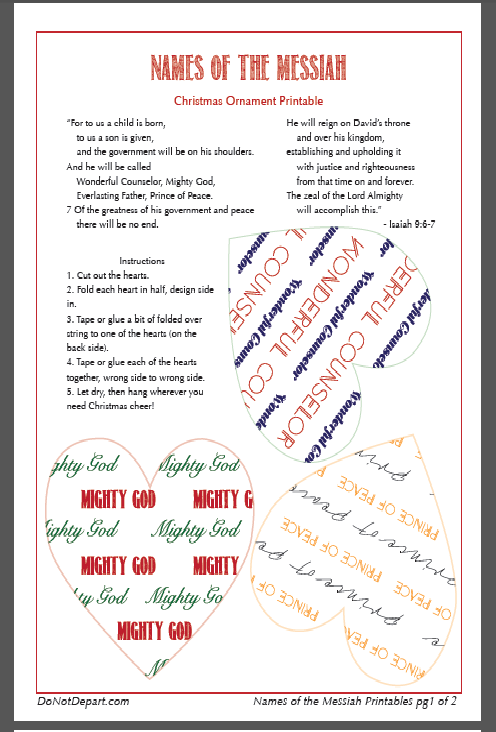
Names of the Messiah - Printable paper Christmas ornament
And, as a physical reminder of who Jesus is (as described in Isa 9:6-7) our friend, Ashely Taylor, has made an elegant Christmas ornament as a gift for you. It’s very simple to print and assemble. We hope you’ll hang it on your tree — or wherever you need a little Christmas cheer!

How has knowing the Prince of Peace affected your heart and spirit?

Finding Jesus in the Old Testament: The Prince of Peace offers peace for you today! #FindingJesusInTheOT

Click To Tweet

Finding Jesus in the Old Testament

December 1, 2015 by Ali Shaw 1 Comment

Finding Jesus in the Old Testament. With printables resources for you... at DoNotDepart.com


Did you know that the whole Bible points to Jesus? Even the Old Testament…

The entire Old Testament points toward Jesus as Savior, and if you miss that, you’ve missed the entire point of the Scriptures. Jesus is the Messiah and the fulfillment of prophecy.” -Adrian Rogers

If you look, you can easily find Him there. Not only does the Old Testament point to Him, but He was present, as part of the Godhead.

Finding Jesus in the Old Testament, with Printables for you from DoNotDepart.com

As one of the triune parts of God, Jesus created {and sustains} all things (John 1:3, Col 1:16-17), was the Rock that accompanied Israel through the desert (1 Cor 10:4), some scholars say He was the fourth person who walked with Shadrach, Meshach, and Abednego in the fiery furnace (Dan 3:25), Jesus refreshed Elijah in the wilderness (1 Ki 19:5-7), and Himself claims to be the Great I Am of the Old Testament (John 8:58).

I find it amazing that the very first verse in our Bible points to Jesus. Genesis 1:1 says, “In the beginning God created the heaven and the earth.”

The Hebrew word for God used in this verse is Elohim. …A plural word that allows for further expansion of the concept of a triune God revealed throughout the gospels and New Testament.

And not only was Jesus present, but the Scriptures also prophesied both a physical-Jesus-with-us-in-the-flesh coming, and the purpose He would accomplish by putting on flesh and taking our sins. Without the putting on of human flesh, being born in the humblest of states to Mary and Joseph over 2,000 years ago, the work of our Messiah and Savior could never be accomplished. And matter of fact, the Bible contains over 300 prophesies concerning the coming of Jesus.

And He fulfilled them all. (That befuddles the best of mathematicians!)

Jesus Himself met with disciples on the road to Emmaus, in His post-resurrection form, “And beginning with Moses and all the Prophets, he interpreted to them in all the Scriptures the things concerning himself.” (Luke 24:27)

This month at Do Not Depart, we’ll be looking into specific scriptures of the Old Testament that show us Jesus. We pray that the more we look at Him as Christmas draws near, the more our hearts will warm in adoration, worship, and praise!

And since this is a printable tools month, each post will contain a special something you can print and use to help you remember all we’re discussing.

Be blessed, and Happy Advent!

Finding Jesus in the Old Testament. A new topic with printables for you! #JesusInTheOT

Click To Tweet

Want to find Jesus in the Old Testament? Prepare your heart for Christmas! #JesusInTheOT

Click To Tweet

God’s Chesed… How He Loves

February 5, 2015 by Ali Shaw 6 Comments

Learn about God's love for you and what the Hebrew word chesed (steadfast love) means at www.donotdepart.com

  Learn about God's love for you and what the Hebrew word chesed (steadfast love) means at www.donotdepart.com

Each February it seems one can’t escape the topic of love. I love it that we’re focusing on God’s love in our Love Song series this month! In Kathy’s introduction post, she got us thinking about what real love really is.  She reminded us that the Bible tells us that God is love. (1 John 4:16)
Yes, God is love and His love is illustrated in every single action toward mankind.

In the last post, we learned about the New Testament Greek word agape. And there’s another word that describes God’s love that’s used about 250 times in the Old Testament. There, the Hebrew word transliterated chesed is used to identify the type of love God has toward us.

Chesed has no direct translation in English but it’s defined as favor (toward man), lovingkindness, steadfast love, loyalty, and mercy. Chesed  is a love that involves action and great depth. It implies that those in the love relationship belong together. It’s a love that rescues and forgives. It eclipses the noise of the world around us, the noise inside ourselves, and our afflictions. It lifts us up because of its beauty.

It is love that values its prize… And its prize is you!

Are you in need of that kind of love? I know I am!

Jeremiah the Prophet suffered much as he not only prophesied (much to the Jews’ anger) about the coming destruction of Jerusalem and the Temple, but also lived to see it.  Though emotionally hurt over what he knew, witnessed, and experienced Jeremiah tells us about the hope he had (and we can have) in The Lord.

He had this hope because he knew of God’s chesed love.

Remember my affliction and my wanderings,
the wormwood and the gall!
My soul continually remembers it
and is bowed down within me.
But this I call to mind,
and therefore I have hope:

The steadfast love of the LORD never ceases;
his mercies never come to an end;
they are new every morning;
great is your faithfulness.
“The LORD is my portion,” says my soul,
“therefore I will hope in him.”

The LORD is good to those who wait for him,
to the soul who seeks him.
It is good that one should wait quietly
for the salvation of the LORD. ~ Lam 3:19-26

Like Jeremiah, we too can know and therefore have hope in the “steadfast love” and “mercy” (both chesed) of the Lord! God’s mercies never, ever come to an end! They are new every single morning! God’s loving faithfulness to you is great, dear Christian sister. That, my friend, is truth. And that’s what real love looks like. You have freedom from bondage because of that rescuing, soul-loving chesed! You may safely place all your hope and trust in His goodness and unwavering love for you. 

He loves you so much. After all… He is love!

When I think about God’s great chesed love for me, the love song that comes to my mind is David Crowder’s How He Loves… Here’s a video for you that shows all the lyrics. I pray that you’ll sit back, watch, listen, and meet with God over the melody and lyrics and be reminded of His great faithfulness, and His steadfast love, and tender mercy. His chesed.

{Wanting a few more verses that tell you about God’s chesed love? Look up Psa 23:6. The word “mercy” in the ESV is chesed. David could place all his trust in the Good Shepherd because he knew God’s chesed. Also look at Hos 2:19 where God longs to betroth Israel in chesed love. And also, Psalm 136, which is a beautiful illustration of God’s hope and mercy and mentions a form of chesed love in each verse.}

How does your heart respond to the depth of God’s chesed love for you? Has His love ever surprised you? We’d love to hear about it in the comments.

Do you know about God’s “chesed” love for you? Oh, How He Loves! #RealLoveSongs

Click To Tweet

You can hope and trust! God loves you with an unwavering, steadfast love. How He Loves! #RealLoveSongs

Click To Tweet

Rahab: common woman, uncommon faith

July 22, 2014 by Julie 4 Comments

Rahab Uncommon Faith

How does a common woman who makes a living using her sensual skills end up in the faith chapter of Hebrews? If there’s hope for Rahab to be praised for living by faith and to end up in the family line of Jesus,  there’s hope for women today.  Common women can live by uncommon faith.

If you’ve ever wondered if Rahab’s deal with the two spies was really an act of faith or simply good business, you’re not alone. As a woman of the night who strategically lived on the city wall, she was no stranger to transient men.  After all, even the King knew Rahab provided lodging for the two young men. But, she willingly deceived him when he commanded her to give them up. So where does faith emerge in the lustful, lying ways of Rahab from idol-loving Jericho? We find the answer in the book of Joshua.

Rahab’s simple Faith

Rahab didn’t know of God’s plans for Israel, His promise of a redeemer, or His holy character, but what she knew was enough to produce simple faith and boldness.  She declared her new faith to the two spies as they lay hidden on her rooftop. “I know that the Lord has given you the land, and that the fear of you has fallen upon us, and that all the inhabitants of the land melt away before you.”   She had heard about Yahweh, and she believed He was all-powerful. Unlike the gods of Jericho, He has the authority to give land and remove nations, and she admitted her fear of Him. “And as soon as we heard it, our hearts melted, and there was no spirit left in any man because of you, for the Lord your God, he is God in the heavens above and on the earth beneath,” (Joshua 2:8-11).

When confronted with God’s actions, Rahab had the uncommon faith to believe in God’s supremacy.

But believing is common, since “Even the demons believe,” (James 2:19).

Rahab’s uncommon faith

Choosing to actively put our faith in what we believe is uncommon. Before she had all of her questions about Yahweh answered, before she knew what would happen after the defeat, before she knew if she would be accepted by the people of God, before she knew how anyone could have such power … she chose to believe. She didn’t have to know it all to put her faith in God. It was enough to know “he is God in the heavens above and on the earth beneath.” True faith is demonstrated by the works we do, “And in the same way was not also Rahab the prostitute justified by works when she received the messengers and sent them out by another way?” (James 2:25)

When confronted with what God has done, Rahab had the uncommon faith to act on who He is.

Rahab Uncommon Faith

She put the survival of those she loved in God’s hands.  As Rahab stood with all of her relatives “outside the camp of Israel,” (Joshua 6:23) watching the dust settle from the fallen walls of her hometown Jericho, she must’ve had no doubt that she had chosen the right side.  “By faith Rahab the prostitute did not perish with those who were disobedient, because she had given a friendly welcome to the spies.” (Hebrews 11:31)

Is your faith uncommon?

God used the uncommon faith of a once-common woman to accomplish His story of bringing grace through faith to mankind. Hers is a story of redemption, born out of simple belief, resulting in bold action. Oh, that we would be uncommon women today! Common women can live by uncommon faith.

Who do you believe God is? Are you boldly acting on who you believe He is?

Come thou Fount: a song for wanderers

April 15, 2014 by Julie 3 Comments

Come Thou Fount of Every Blessing

Mighty truths and stirring melodies often meld in the forge of pain. Englishman Robert Robinson wasn’t the first boy to habitually wander from the narrow path. He only went to a meeting to hear George Whitefield so he could mock it, but instead, he changed. As a young adult trying to etch out a new path for life, he wrote down the anthem of his heart. It’s an invitation, a declaration, and a confession that resonates with anyone likely to drift off course and long to return.

Invitation to COMECome Thou Fount of Every Blessing

Having learned Jesus is the Fountain of every blessing and the changer of hearts, Robert invites Him to “Come” tune his heart to produce a song of God’s grace and mercy. Though writing in the 18th century, Robert recognized that God’s character calls “for songs of loudest praise.” This is the chorus of those who want more Jesus, who long to have the Living Water fill them to an overflow of praise. Robert longed to produce a song of praise.

“Come, Thou Fount of ev’ry blessing, tune my heart to sing Thy grace.”

Declaration of FAITH

“Jesus sought me when a stranger,” Robert admitted, but he declared recognition of how God helped him in his times of trouble. He had been wandering and in danger, but the blood of Jesus rescued him. In the Old Testament, Samuel set up an “Ebenezer stone” after God delivered the nation of Israel. Robert’s hymn was an “Ebenezer stone” of God’s rescue in his life. If you’ve experienced personal rescue, the words to this song may give your heart the voice of expression you long for.

“Then Samuel took a stone and set it up between Mizpah and Shen and called its name Ebenezer; for he said, “Till now the Lord has helped us.” (1 Samuel 7:12)

Confession of NEED

Truth and music often meld in the forge of pain. This hymn is no different, revealing the writer’s desperate need for grace and his struggle not to wander from His Lord. No matter how much I want to cling to the Fount of every blessing, I know that I have a tendency to leave the Lord I love, to wander from the close fellowship I’m meant to have with Him.

“Prone to wander, Lord, I feel it; prone to leave the God I love,” he wrote.
Robert Robinson did stray from the Fount of every blessing after he wrote this hymn. He later recognized his folly, and in reflecting on the words he once penned, he confessed, “I would give a thousand worlds to enjoy the feelings I had then.”

Mighty truths and stirring melodies often meld in the forge of pain.

  • Every day must bring a fresh invitation for the Fount to “Come” tune our hearts to his praise.
  • Every day must resound with a declaration of our faith in God’s help for our trouble.
  • Every day must bring us down on a bended knee, where we beg God to come.

“Let that grace, Lord, like a fetter, bind my wand’ring heart to Thee. Here’s my heart; Lord, take and seal it; seal it for thy courts above.”

Download a printable Worship Worksheet: Come Thou Fount  Bible Study Tool.

Click to TWEET and share this > Mighty truths and stirring melodies often meld in the forge of pain. http://wp.me/p1Su7F-2Tp #ComeThouFount #WanderersSong

Next Page »

This Month’s Theme

  • Jesus is the Way
  • And He Shall Be Called Series Intro

Enter your email address to have new posts emailed to you:

We’ll come to you

Enter your email address to have new posts emailed to you

Categories

Bible Memory – Lent 2021

Memorizing Isaiah 12

Let the Children Come

Let the Children Come

Want more #HideHisWord resources?

Memorizing Psalm 1

Find Us on Facebook


Search

Recent Posts

  • Series Wrap-Up: The Lord Is My Light
  • His Marvelous Light
  • When the Darkness Deepens
  • Though I Sit in Darkness…
  • Let Your Light Shine
  • Life-Giving Light

Archives

© 2026 · Pretty Creative WordPress Theme by, Pretty Darn Cute Design