• Home
  • About
    • Our Contributors
    • Our Beliefs
  • Blog
  • Bible Studies
    • Scripture Dig
  • Archives
  • Shop
  • Advertise
  • Contact
    • Email
    • Facebook
    • Instagram
    • Pinterest
    • Twitter

Do Not Depart

Encouragement and Tools to Abide in God's Word

You are here: Home / Archives for tips

Scribbles & Doodles & Reading Aloud

October 13, 2020 by Jaime Hilton Leave a Comment

Making Time to Study the Word


Life often moves at a breakneck pace. Whatever season you’re in, I imagine you’ve got a lot on your plate, calling for your attention. 

I am in a season of raising children (toddlers, teens, and a few in between!) and developing my career. The latter, I am grateful to admit, calls for some pretty dedicated time to study the Bible. But in this season of busyness (which is not so different from other seasons of busyness) I find I must make time to cultivate my relationship with Jesus. Like every other important relationship in life, I have to be intentional about how I spend my time and carve out opportunities to enjoy and engage with the One who is my Savior, Redeemer, and Friend. Thankfully, unlike other relationships, He is willing to meet me where I am. 

Here are three things I’m doing to make time and space in my heart and mind.

Scribbles

My first step when I approach a text, either for personal study or professional, is to read it with fresh eyes and rapid log, aka Scribble, my initial thoughts, questions, and impressions. Rapid log is a term from the Bullet Journal tradition. It means jotting down your thoughts, bullet-point style, as it occurs to you. 

This initial step serves to clear my mind of any assumptions or associations I have. I stress that it is an initial first step because it is essential to go back through those notes and seek out the truth about what those stories mean. As Ali mentioned in her post, sometimes all we have is a few moments to jot down our thoughts, but someday we will get the time to dig deeper. 

My scribbles are a way to engage with the text with an open heart. Sometimes I will paraphrase what I’ve read, to see if I’m understanding it. Sometimes I will write down the exact Scripture, and occasionally I will…

Doodle!

When it comes to art, I’ve always been better with words and speech. My ability to communicate visually is somewhat lacking. I can sketch a pretty decent snail when called upon to do so, but even that is hit and miss. 

Yet my hands love to be busy, especially when I’m listening to a sermon or podcast, or even going back over my scribbled notes.  I find my pen working over the letters, making shapes, and sketches of things that are standing out to me. 

What surprised me one day was realizing that what appeared to be mindless doodling was actually helping me remember and connect to what I was studying! The doodles help me to slow down and sit in the words. 

Like scribbling, doodling it is only a piece of Bible study, incomplete on its own, but part of a rich, intentional, process of growing closer to the Lord.  

Reading Aloud

Finally, another way I like to engage with the text is by reading it out loud.  I do this in my room or at the table while my children are eating breakfast. Sometimes they listen, sometimes they don’t, but I speak the words anyway.  

In this text from Deuteronomy, the Lord instructs future kings to engage with Scripture by writing and reading it:

“When he is seated on his royal throne, he is to write a copy of this instruction for himself on a scroll in the presence of the Levitical priests. It is to remain with him, and he is to read from it all the days of his life, so that he may learn to fear the LORD his God, to observe all the words of this instruction, and to do these statutes.” Deuteronomy 17:18-19

The Hebrew word for “read” (here and in many other verses) is “qara” (pronounced car-uh). It means “to call out, summon, invite, name, utter aloud”. It’s a hugely different picture than what I usually have in my mind when I think of reading, which is what I have always done when I want to be alone! 

Like scribbling and doodling, reading the words out loud helps me to slow down and take them in, allowing me to engage fully with whatever it is the Holy Spirit is teaching me. 

How do you engage with Scripture? #SnapshotsofBibleStudyClick To Tweet

I love the Word of God. I love learning the history and culture of the people in the ancient world. I love digging into the language and discovering how God is timeless and unchangeable. Mostly, I love that He chooses to engage with us, where and when we are if only we will take the time to engage with Him. 

“For the word of God is living and active, sharper than any two-edged sword, piercing to the division of soul and of spirit, of joints and of marrow, and discerning the thoughts and intentions of the heart.” Hebrews 4:12

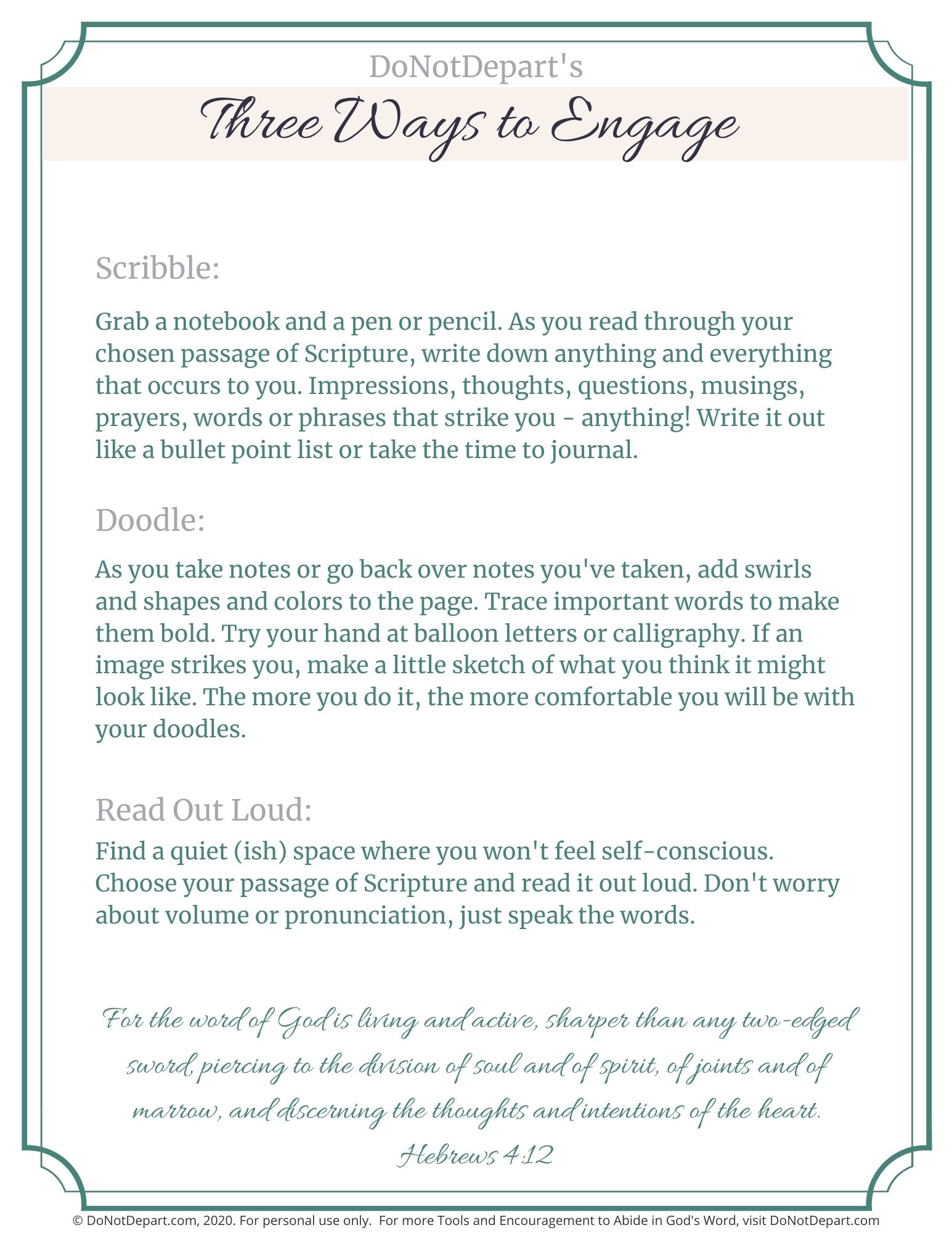
Are you willing to give one of these tricks a try? Here is a Three Ways to Engage Printable to help you incorporate scribbling, doodling, or reading aloud into your time with the Word. Share your experience with us in the comments or on the Facebook Community Page!
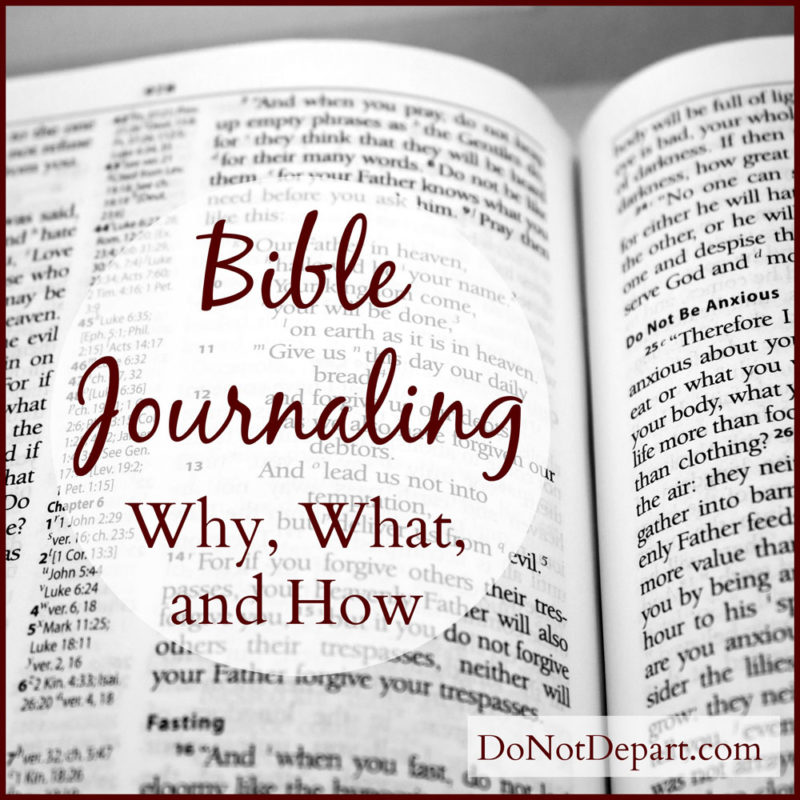
The Why, What, and How of Bible Journaling

January 14, 2016 by Lisa Burgess 24 Comments

Bible-Journaling_Why-What-How_Do-Not-Depart

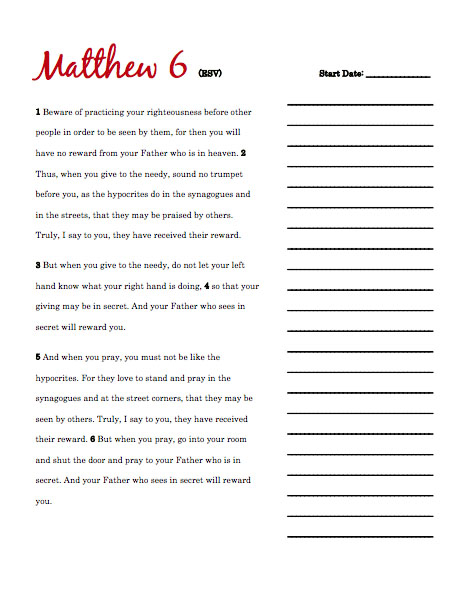
[NOTE: For Matthew 6 memorizers, get your printable journaling page here]

Bible-Journaling_Why-What-How_Do-Not-Depart

You read the Bible. Pray through some of the Psalms. Maybe memorize favorite verses here and there.

But have you ever tried journaling through the Bible?

Why journal?

Journaling is a spiritual discipline that leaves a tangible footprint.

Writing helps hone your thoughts now, clarifying and capturing the swirling ideas that rumble loose in your head. It’s listening and recording how your heart is hearing God’s love for you.

But journaling has the added benefit of laying down a record for later, too. Today’s lessons can be reused in future circumstances if you’re ever doubting God’s promises or need reminders of how He’s brought you through a tough time or want to celebrate again a victory He won for you.

What is Bible journaling?

At its most basic, journaling is simply writing down what the Spirit whispers to you as you read through scripture. There are no rules or requirements.

However, you have many options to guide you along the way.

• Journaling Bibles
Easy to find online or at bookstores. They have wider margins than a regular Bible, specifically designed to record your notes, prayers, or questions.

• Artistic Journaling
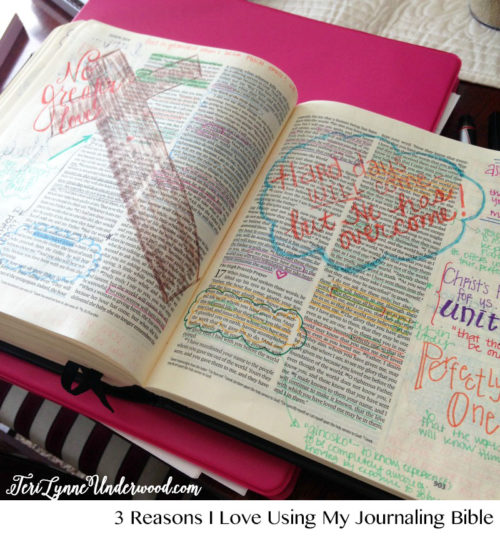
A hot trend. [Google “bible journal” and see.] Don’t just record words, but create your own art in the margins of your regular Bible or Journaling Bible. You don’t have to be an artist to do it. [Read Teri Lynne Underwood, “Three Reasons I Love Using my Journaling Bible”]

Journaling-Bible-Teri-Lynne-Underwood

• Digital Journaling
If screens are your preferred medium, keep a digital journal as a regular Word document or via an app created specifically for Bible journaling.

• Notebook
Use a spiral bound notebook, a decorative journal, or loose-leaf paper in a binder to record your Bible reading and thoughts.

How to Bible journal

1. Write side by side in the margins

As you’re reading your Bible, jot down any insights or questions directly beside the verse you’re on. This has been an effective method for years and still works beautifully for many.

2. Pick one verse from many

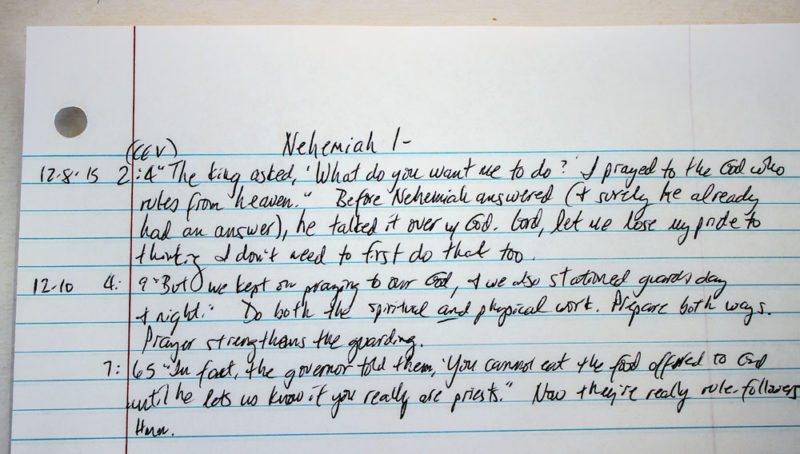
I keep two kinds of separate Bible journals. For my daily Bible reading, I use my Kindle before I get out of bed each morning, highlighting verses of interest as I go. Later in the day, I return to the highlighted verses, and choose only one verse out of three chapters to journal about.

I copy that verse by hand on notebook paper, then write a few sentences about why it stood out to me. Perhaps it was reassuring or particularly relevant or maybe even confusing. I then file these pages in my Bible notebook (details on how to make your own Bible notebook). The whole process is quick but meaningful.

Nehemiah-bible-journaling

3. Go deeply with only one verse

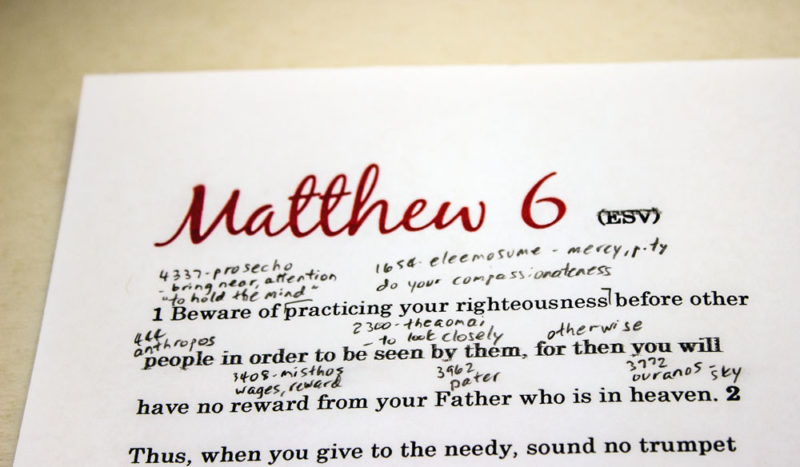
The second type of journaling I do coincides with what I’m memorizing or studying. Here I look at only one verse for several days, writing on a double-spaced, printed copy of the chapter. On day 1 I write brief notes about the Hebrew or Greek roots using e-Sword.net or StudyLight.org. On day 2 I record anything significant from commentaries about the verse. Day 3 is when I record my own thoughts and experiences with the verse. Again, it doesn’t take long, but it creates a record of what God is teaching me.

matthew-6-bible-journaling

But for you, what’s the best way to journal?
The one that you’ll use.

And one that you’ll occasionally re-read. It’s valuable to look back on your own personal history with God alongside the Biblical narrative from ancient times.

Experiment with different methods to find one that works for you. [Pinterest has tons of ideas.] It might include sharing on social media: Use Twitter as a 140-character journal about the verses you’re reading. Or blog or Instagram about the study you’re doing. Or keep it private: Write a one-line-a-day diary of love notes between you and God, tucked quietly in your sock drawer for no eyes but yours and His.

  • Journal the lessons you want to remember.
  • Write down memories of God’s goodness you don’t want to forget.
  • Record the insights the Spirit gives you to use.

Your growing relationship with God is worth treasuring.

[Printable “Bible Journaling through Matthew 6” ESV]

Matthew-6-Bible-Journaling-Pages

The Basics of #BibleJournaling – Why, What, and How #PlantoAbide

Click To Tweet

Do you journal? What works for you? We’d love to hear your ideas in the comments.

RELATED LINKS

  • How to Make a Bible Notebook
  • Tips and Printables to Organize your Bible Notebook
  • Journaling in Your Bible by Lizzy Jeffers
  • Five Ways to Flourish in Journaling by David Mathis

Plan to spend more time this year in God's Word and pursuing a growing relationship with Jesus Christ. Find resources to help you plan in this month's series "Plan to Abide."

How to make your “to-do” list holy

June 12, 2014 by Lisa Burgess 25 Comments

How to make your to-do list holy @DoNotDepart

WHAT’S YOUR PLAN?

What’s on your to-do list today?

Maybe you have an intricately scheduled plan. Or scribbles on a napkin scrap. Maybe your plans are just floating loose in your head. Regardless of how you keep up with them, most of us have some sort of list of actions to accomplish each day.

But here’s the problem: Other people get in the way. Life gets in the way. Interruptions, distractions, conflicts.

How are we to work efficiently with the clock when the world seems to be working against us?

Or in other words, as believers, how are we to be in the world, but not of the world?

When Jesus was talking to His Father on the night before His death, He said, “I don’t ask that you take them [the disciples] out of the world.”  

Instead, Jesus sent them—and now us!—straight into the world (John 17:15-18).

For our sakes, He made Himself holy that we also might be holy (John 17:19).

DO YOU LOOK HOLY?

But does a Christian’s to-do list look any holier than anybody else’s list? Sure, we may add a few extras: Read Bible, Pray, Attend church. But otherwise, it’s similar: Take a shower. Pack lunches. Go to work. Put gas in the car. Wash clothes. 

How are we set apart?

Because God’s Spirit lives inside us, we are different. We work from a higher power and with a different motive. Our goal is to love others in such a way that the world will know Jesus is real (John 17:21).

So perhaps we need to highlight something different on our lists. . . .

TRY THIS

Pull out your to-do list. Under each item, can you add someone’s name? Who are you loving through what you’re doing?

  1. Pay the bills
    (my family)
  2. Answer emails
    (my coworkers)
  3. Practice memory verse
    (my friends, me)
  4. Weed the garden
    (my family, me, neighbors)

Each task now represents a person. A relationship. A soul to share God’s love with. Including ourselves.

It’s not the what on our to-do list that matters. It’s the who.
And it’s not the how. It’s the why.

It won’t come without a cost. You might not cross as many things off your list. But the dividends are rich. With greater purpose, you’ll have greater peace, more compassion, and reflect more glory back to God.

So when you make your next to-do list, ask better questions beyond, “What do I have to do today?” Also ask:

  • Why am I doing this?
  • Who can benefit from it?
  • Will I honor God through it?

It might just set apart your to-do list—and your day—as holy.

Want to share this?

“Make your to-do list more than what you will do: Add who you will love. http://wp.me/p1Su7F-2Ym @DoNotDepart #Holiness”
click here to tweet

“It’s not the what that matters, but the who. Not the how, but the why. http://wp.me/p1Su7F-2Ym @DoNotDepart #Holiness”
click here to tweet

Are you a list maker? How do you prioritize your to-do list? Please share your tips and comments here.

Series on Holiness

More reading:

  • You’re a saint: Don’t cringe at the title
  • Is holiness boring?
  • What does holy look like?


Word Travels Fast – Send Responsibly

December 12, 2013 by Lisa Burgess 14 Comments

“Let no corrupting talk come out of your mouths, but only such as is good for building up, as fits the occasion, that it may give grace to those who hear.”
Ephesians 4:29

You’re often told to watch your words. To think before you talk. To be slow to speak (James 1:19). And it’s wise advice. Words spoken with no thought can do great harm.

But that doesn’t mean you have to keep quiet. Your words are gifts to be handed out to encourage and help others (Ephesians 4:29).

And you’ve never had greater opportunity to say more words to more people with greater speed than today.

facebook-status-update

Gone are the days of Joseph and Mary when word didn’t travel fast. Back then, even though the Roman roads were great for their time, communication was only as fast as the messenger could travel.

When Caesar Augustus sent out his decree for census registration (Luke 2:1), prompting Joseph and Mary to travel to Bethlehem, the message was probably delivered via a rider on horseback. There may have been a station every ten miles for trading in fresh horses, and every twenty-five miles for new riders or for lodging.

And with the exception of the angels shouting glad tidings from the sky itself, the news of Jesus’s birth couldn’t have traveled quickly either.

Shepherds on feet couldn’t compare with a Facebook status—including photos from your iPhone!—for speed of a birth announcement.

Today, with a single click on a keyboard, the whole world can have instant access to your words.

So should you be wary of using words because they can so easily go viral, with no retrieval once “send” is hit?

While there are always things you’ll need to ponder and pray over before saying, other things are safe to send anytime, anywhere. People still need a now word from the Lord as much as ever!

And if the Spirit gives words to you to share, don’t be stingy. Send them on.

Here are 4 things you can send out daily–and quickly–with no worries.

1. Thank you

Never hesitate to tell someone thanks for a job well done or for doing you a favor. You can’t go wrong with gratitude.

For this reason, because I have heard of your faith in the Lord Jesus and your love toward all the saints, I do not cease to give thanks for you, remembering you in my prayers.
Ephesians 1:15-16

2. I’m sorry

Apologies are always welcome, too. As soon as you can mean it, say it. The quicker you admit you’re wrong, the quicker the healing can begin.

Therefore, confess your sins to one another and pray for one another, that you may be healed. The prayer of a righteous person has great power as it is working.
James 5:16

3. God bless you
Most people won’t refuse a blessing. So be generous in praying God’s best for those you’re around. What a powerful way to show you care and that God does, too.

The LORD bless you and keep you; the LORD make his face to shine upon you and be gracious to you.
Numbers 6:24-25

4. I love you
Can anybody hear this too much? Your purpose on earth is to love God and love others. So do it, but also say it. Telling others you love them is a word you can send quickly and frequently.

A new commandment I give to you, that you love one another: just as I have loved you, you also are to love one another.
John 13:34

So if you have something good to say today, let those words travel fast.

May your words of faith, hope, and love go viral!

Good tidings in modern times

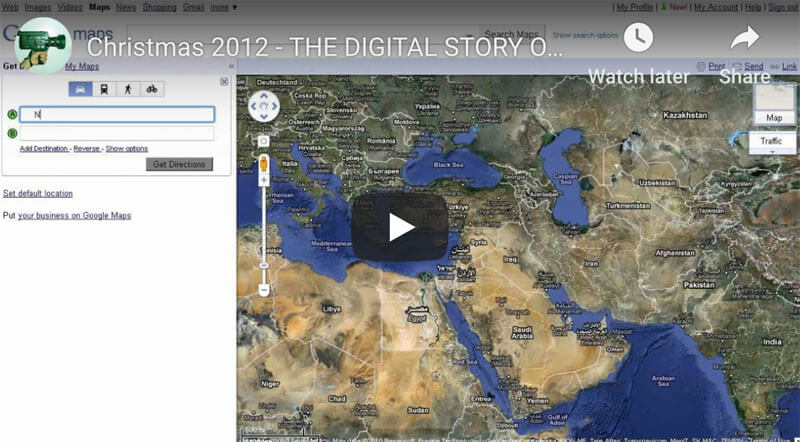
Here’s a fun video if Jesus had been born in our digital age:

Digital Story of Nativity

Which social media are you quickest to reply to?
Have you ever sent an email you wish you could take back?
Who can you encourage today with your words?

Please leave a comment below.

More verses here for using your words well

Cultivating the Habit of Prayer

August 28, 2013 by Patti Brown 7 Comments

Cultivating the Habit of Prayer - donotdepart.com

Disclosure: Affiliate links are present in this post. Please see the Bookstore page for full disclosure details.

If you are convinced of the importance of prayer you may already have strategies for making prayer a more regular part of your daily life.

But perhaps you still need ideas for ways to incorporate prayer into the ebb and flow of each day. Having a plan can help you develop the habit of praying regularly.

Cultivating the Habit of Prayer - donotdepart.com

Associate prayer with an activity

If you associate prayer with something else you do regularly, you may find it easier to remember to do, and soon you will develop a habit.

  • pray as soon as you wake up
  • pray before meals
  • pray while folding the laundry
  • pray while riding the bus
  • pray while walking or jogging
  • pray in the shower
  • pray while washing dishes
  • pray as you are falling asleep

Use a prayer calendar

Weekly or monthly prayer calendars can help you remember to pray consistently for certain things. You can create your own, or find one online.

  • Create your own weekly rotation of people and circumstances to pray for. My mother in law has 7 sons and prays for one of them, and his family, each day of the week. You can use this form to keep track.
  • Monthly prayer calendar for your children from Inspired to Action
  • Monthly prayer calendar for your husband from Inspired to Action
  • Monthly prayer calendar for mothers of boys from The MOB Society

Pick up a topical book about prayer

There are many books on prayer in general, but for developing a habit of praying, you might find helpful one of these books with specific topics and scriptures to pray through:

  • [amazon_link id=”0805444203″ target=”_blank” ]Praying God’s Word Day by Day[/amazon_link]
  • [amazon_link id=”0736919260″ target=”_blank” ]Power of a Praying Woman[/amazon_link]
  • [amazon_link id=”0736919244″ target=”_blank” ]Power of a Praying Wife[/amazon_link]
  • [amazon_link id=”0736919767″ target=”_blank” ]Power of a Praying Husband[/amazon_link]
  • [amazon_link id=”0736919767″ target=”_blank” ]Power of a Praying Parent[/amazon_link]
  • [amazon_link id=”0736920862″ target=”_blank” ]Power of Praying for Adult Children[/amazon_link]
  • [amazon_link id=”031027351X” target=”_blank” ]Praying the Scriptures for Your Teens[/amazon_link]

Pray with others

Making a plan to meet with someone else to pray, whether at home or away, helps hold you both accountable.

  • Find a prayer partner and set a regular schedule for praying together in person or over the phone. If you can’t think of anyone, ask God to show you whom you might ask. You don’t even have to live in the same country! My prayer partner and I live in different countries and have prayed together weekly via Skype for the past three and a half years.
  • Make family prayer a normal part of every day. Most Christian families say grace before meals, but what other family prayer times could you add to your day?
  • Pray with your spouse. For ideas on making prayer with your spouse a reality, check out Lisa’s post Five Tips for Praying with Your Spouse or Friend
  • Join a prayer group. Your church may have a prayer group, or you can join one like Moms In Prayer that has groups around the world. If you can’t find a group, start one!
  • Start a prayer triplet. Pray regularly with two other people, each of you choosing three unsaved people for whom to pray. Learn more about prayer triplets from Evelyn Christenson here.

Keep a prayer journal

Keeping track of prayer requests in a dedicated journal can be a huge blessing. Not only does a journal help you keep track of requests, it will serve as an amazing encouragement in days and years to come. I sometimes sit with my prayer journal, reading prayer requests from years ago, and marvel at what God has done!
  • Buy a blank notebook. I use a pocket-sized Moleskin-like notebook that I keep by my bedside. It looks a lot like [amazon_link id=”8862930003″ target=”_blank” ]this[/amazon_link], except pink, because pink makes me happy!
  • Create a prayer mini-album. Julie shares instructions, as well as a free printable for divider tabs, in her post Prayer Album for Women on the Go.
  • Create a prayer jar. For a twist on the prayer journal idea, make a prayer jar. Keep the jar in a prominent place in your home and add scraps of paper with prayer needs to it. Set a daily time when you pull a prayer need out of the jar to pray over. This is a prayer activity that especially appeals to children.

 There are many more ways you can help grow the habit of spending time in prayer.
What tips would you add to our list?
Do you use a prayer calendar or book that you would recommend?
We love to hear from you – please share in the comments!

10 Tips for Making the Most of Online Community

February 14, 2013 by Lisa Burgess 29 Comments

Let no corrupting talk come out of your mouths, but only such as is good for building up, as fits the occasion, that it may give grace to those who hear.
Ephesians 4:29

Maybe we’re in our pajamas. Maybe it’s 3 a.m. Maybe we’re not even in town.

But in our new world, these are no longer limitations.

For example, in this little corner we gather any time, from many different countries, to memorize scripture together.  We come to encourage or share a photo or ask a question (what does “portent” mean in Psalm 71:7?).

It’s online community. It’s relatively new to us all. And it’s quite an opportunity.

With only a keyboard and screen, we can type out love for God and others from wherever we are to any person with internet connectivity. While online encounters should never replace in-person ones, they are legitimately useful in our modern lives, a positive addition to our global neighborhood.

Here are ten tips to make the most of your online community:

1. Be you
Whether you’re an introvert or extrovert, have lots to say or little, you now have a turn to talk. Your voice—be it quiet or loud—has never had greater opportunity to be heard as widely as now. So be authentic and give what only you can—you and how you are seeing the Lord in our world. Stay within boundaries of comfort, safety, and appropriateness when you share, but do be real.

2. Genuinely listen
Turn up the volume to hear what others have to say. It’s tempting to quickly scan what others write, but tune in to their stories. Listen to their comments. Hear their hearts. Just because they can’t see whether or not you’re paying attention, read thoughtfully anyway.

3. Talk back
One-way communication doesn’t create community. If you want to establish relationships, leave a grateful comment after reading an encouraging post. Answer a question on Twitter. Message a Bible verse that would be helpful. Skype for back and forth conversation.

4. Pray
And don’t just say you will; do it. If an online friend shares a prayer request on a forum, pray as you read so you won’t forget. Or type out your prayer and email it out to them as well as up to God.

5. Go deep
Invest in a handful of online friends that you truly connect with by giving them extra attention. Nurture a smaller community within a larger one, such as the small groups of six in the Soli Deo Gloria community.  Stick with the same blogger’s link-up for several weeks until you recognize who’s who.

6. Spread wide
Just as with face-to-face friends, you can only go deep with a few, but you can say a kind word to many—a quick “like” or “Happy Birthday” on a Facebook page keeps connections alive. I communicate with just a few words to many Spanish-speaking friends in El Salvador (thanks to Google Translate).

7. Accept limits
Monitor your time online; don’t sacrifice in-the-flesh companions because you’re tied to your iPhone. Don’t publish what you might regret; online words are documented and permanent. Slow down to respond; just because you can reply immediately doesn’t mean you have to. Honor confidences shared privately. Create appropriate boundaries with opposite-sex relationships.

8. Take it offline
Surprise an online friend with a card in your handwriting or a small gift via snail mail. If you’ve established a trusted relationship, and an opportunity arises, meet in person at a conference or restaurant or church.  Talking online is good, but worshiping side by side—hearing each other sing praises or praying together—brings you even closer.

9. Be a resource
Recommend relevant sites, software tools, Pinterest boards to others who can benefit from them. Retweet helpful links. Welcome newbies to an online group you’re already in. Post helpful book reviews on sites like Amazon or reading groups like Goodreads.

10. Above all, love
The greatest command applies online as well as off—love God, love others (Matthew 22:36-39). Let this question be the final one you ask before you hit send or publish: “Am I loving God and loving others with these words?”

Our advancing technologies continue to provide new mediums to nurture friendships and build faith. Now that we’re online, let’s stay connected . . . for God’s glory and each others’ good.

Created for Community

Share your experience with online community. What social media do you use for community? Have you met online friends in person? Please leave a comment below.

Memory Verses: 3-Step Review to Remember

June 14, 2012 by Lisa Burgess 25 Comments

scripture memory review

Don’t lose what you fought to gain.

Embedding words from a page to words in a brain isn’t quick or easy. If you’ve memorized one scripture or one thousand, you understand. After putting in time, energy, and prayers, you don’t want those words to fade away.

Keep god's word in your heart

But with a little planning, you can keep them in your heart with much less work than it took to put them there in the first place.


Here are 3 steps so you can review to remember:

1. Gather verses in one place.

You may prefer a computer program like ScriptureTyper or MemVerse or a phone app. As long as you capture all your verses in one location, that’s great.

I prefer a binder as home base for all my verses. I print out the chapter I’m learning with margins wide enough to write notes on the side or in between lines. There I jot down meanings of Greek words or alternate translations or special insights as I memorize. I also add a starting and ending date (when I remember, ironically).

Then I file all the chapters together in the binder in the books-of-the-Bible order.

For individual verses, I print out a running list on continuous pages, also in Bible order. I reprint the whole document periodically to include the newest verses I’ve learned.

Once you’ve gathered your verses all in one location, you’re ready to move on to scheduling.

2. Make a review schedule.

This step is crucial. Without a plan, you may find your verses disappearing from your brain.

There are many approaches to scheduling review, and if you use an online system, they’ll likely have a review plan for previous verses. But the simplest approach for me (and thus the one I’m most likely to use), is to work through the pages in my binder in the order I’ve filed them.

I review one chapter and one sheet of individual verses per day, four days a week (give or take), for about 5-15 minutes.

Sometimes my review is nothing more than a quick read-over. That’s not ideal, but it’s better than nothing, and I’ll come back around to each page soon enough.

What works better is reviewing each verse of the chapter or page a minimum of five times. What you don’t remember the first time or two, you’ll likely remember by the fifth.

3. Use the heart.

The most important place to keep your verses active is your heart. Without sinking them deeply here, they’ll remain only words.

The heart is where Spirit-work takes place. On you. Through you. Here you realize word-for-word accuracy isn’t as important as the meaning behind those words. Here is where you let the heart of God change your heart for God.

This is the review-on-demand, as needed, anytime, anywhere. Middle of the night awakenings are a common time for me to mentally recite a chapter. Also in waiting rooms. In conversations with friends. In hard times. And in happy times. Let your heart use these words to express itself.

But remember…

Don’t be discouraged when you do forget some. Because you will. While we all desire word-for-word retention of everything we’ve learned, heart transformation is what God is after.

Consider your review time as an invitation for the Lord to change your thoughts through His thoughts. That’s the goal.

In reviewing His words, you’re valuing what He values. And with that, He is honored.

I will meditate on your precepts and fix my eyes on your ways.
I will delight in your statutes; I will not forget your word.
Psalm 119:15-16

How do you retain verses you’ve memorized?
Please share what works (and even what doesn’t) for you
.

I Praise Because He is Worthy (Run to Him – Psalm 148)

April 14, 2012 by Katie Orr 2 Comments

Praise the Lord

We’ve been in Psalm 148 this week. Everytime I read it, I get this Seeds Family Worship song stuck in my head. (Click here if you can’t see the video.) It’s my daughter’s favorite Seed’s song, and she asks for it almost every time we get in the car. So I’ve listened to it…a lot.

Praise the Lord!

There is no mistaking the main command in Psalm 148!  We are to praise the Lord.

Praise the Lord

I looked at the Hebrew word for praise this week; it is halal. I love the insight looking at the original language gives:

…to shine…to make a show, to boast; and thus to be (clamorously) foolish; to rave…celebrate, commend…glory, give (light)…(sing, be worthy of) praise…renowned, shine. (Strong’s Concordance via eBible)

How to Praise the Lord

One fun Bible study tool is to insert these synonyms into the verses, to get a fuller meaning of the text. Let’s try it together!

Shine the Lord!
Make a show about the Lord!
Boast about the Lord!
Be clamorously foolish about the Lord!
Rave about the Lord!
Celebrate the Lord!
Commend the Lord!
Give glory to the Lord!

Doesn’t this give a better idea of what it means to praise the Lord?

Let them praise the name of the Lord!

What can you praise God for today? Share it in the comments below!

Oh sing to the Lord a new song;
sing to the Lord, all the earth!
Sing to the Lord, bless his name;
tell of his salvation from day to day.
Declare his glory among the nations,
his marvelous works among all the peoples!
For great is the Lord, and greatly to be praised!
(Psalm 96:1-4 ESV)

(And by the way, the picture above is the perfect dimensions for a free Facebook cover. To download it for free, just right click the picture to download!)

Intentional Bible Study in Fifteen Minutes a Day

March 22, 2012 by Katie Orr Leave a Comment

The Bible is so much more than just another book. It is living. Active. Life-changing.

That’s why you are here, at Do Not Depart. You love the Word. You know it’s value. You crave time with your Savior.

Announcing a New Study Series

I’ve created a new Bible study series to help you in your time with God in His Word.

Many of you have been enjoying the Run to Him study.

I am thrilled!

Lara and I appreciate the positive feedback about the study, and we JUST LOVE hearing about how God is using the selected Psalms to speak truth to your soul.

Focused 15: Intentional Bible Study in Fifteen Minutes a Day uses a method of study similar to the studies of the past, but I’ve taken it up a notch.

Through the use of different “lenses,” Focused15 will teach you how to dig even deeper.

  • Day 1 – Portrait Lens – Seeing the big-picture through cross-referencing.
  • Day 2 – Immersion Lens – Discovering the original language.
  • Day 3 – Zoom Lens – Finding truths, promises, and commands.
  • Day 4 – Wide-angle Lens – Looking at the sentence structure.
  • Day 5 – Personal Lens –  Looking for God’s plan for us in these verses.

Focused15: 1 Corinthians 13 The first study—a four week study of 1 Corinthians 13—has “officially” launched today, and I would love to know what you think!

You can read all about it at the Focused15 site.

This Focused15 Bible study is available for immediate PDF download for only $3.99!

Add to Cart

It is also available for Kindle and Nook, and every Kindle and Nook ebook contains a free download link to the PDF, for easy printing!

My prayer for this book is to equip you to study the Bible on your own—to take one more step toward becoming a self-feeder—so you can enjoy Him more and more every day!

Why Use a Bible Dictionary?

March 14, 2012 by Lisa Burgess 8 Comments

Little time, Big results

You barely have time to just read your Bible. Why would you add reference books on top of that?

Would you if the rewards outweighed your effort?

While there’s no guarantee that acquiring more knowledge will translate to greater insights or to spiritual transformation (it takes a work of the Spirit to do that), you can position yourself to be more open to growth.

That’s one reason I love Bible dictionaries. For a small investment of time, you can reap big benefits.

What is a Bible dictionary?

Bible dictionaries are concise reference tools that, at a minimum, provide a short definition of an English word. But they can also give definitions of the original Hebrew or Greek words. Some add scripture references, pronunciation guides, parts of speech, word derivations, synonyms, and brief contexts. There are also dictionaries for Bible names, subjects, places, backgrounds, and themes.

While a few are written specifically for scholars, the most popular ones are easily understood by those of us with no formal theological training.

Some well-established dictionaries include Strong’s Bible Dictionary, Smith’s Bible Dictionary, The Complete Word Study Dictionary, Vine’s Expository Dictionary, and Thayer’s Greek-English Lexicon.

Many dictionaries are free online from a direct site (ex: Easton’s Bible Dictionary) or embedded in broader Bible study sites (such as Bible Gateway or Bible Study Tools). [See resource list below]

My favorite source is the free Bible software from e-Sword.net. They offer fourteen free dictionaries and three paid ones, plus multiple other resources.

How to use

Here’s a simple example. I saw an interesting post here on “came” (translated “rushed” in ESV) in Judges 14:19. I wanted to know more.

So I looked up the verse in e-Sword and clicked on the Hebrew word tsalach, which is Strong’s number 6743 (each Hebrew and Greek word is assigned a number). Strong’s Hebrew Dictionary showed me the Hebrew spelling (okay, useless to me but maybe helpful to you?) and several definitions.

I then typed in 6743 in my favorite online Hebrew dictionary to hear the pronunciation, learn more definitions, see other words translated from this one, and get a quick glance at other verses where it’s used.

Faith-building

So what? Well, understanding more fully how the Spirit didn’t just “come” upon Samson in a passive way, but “pushed forward; rushed; advanced; broke out” teaches me I can be more confident in how He’s capable of working in me, too—all from a small piece of information easily accessed in a Bible dictionary.

While a dictionary won’t provide an all-encompassing study and won’t give you much context (other resources are available for that), it is a great starting point and is often all the extra information you need.

Understanding God’s message more clearly can help you see God Himself more clearly. The more you see, the more you’ll love and want to share His love with others.

So the next time you see an interesting word in your Bible reading (maybe one of these?), I encourage you to go look it up. See what new treasures you will find to build your faith to ultimately honor the Father!

Quick Links for Bible Dictionaries

  • Bible Gateway – Easton’s Bible Dictionary, Hitchcock’s Bible Names Dictionary, Smith’s Bible Names Dictionary
  • Bible Study Tools—Baker’s Evangelical Dictionary of Biblical Theology, King James Dictionary, more
  • Blue Letter Bible—multiple search tools
  • E-Sword – free downloadable software with 14 dictionaries
  • Katie’s Top 10 Online Bible Study Tools
  • Study Light—Hebrew and Greek lexicons based on Thayer’s Bible Dictionary and others

Do you have a favorite Bible dictionary? How do you use it? Please share comments and questions below.

10 Tips for Young Moms

February 20, 2012 by Julie 7 Comments

They left on Friday morning with duffle bags, spending money, and an all-too quick kiss and not-so-convincing promise to try to remember to text me during the youth retreat. My  two teenagers. Weren’t they just going to pre-school and working on speech problems last summer? Who put away Chutes and Ladders? How did they get so independent? Have they grown up enough? Have I steered them well?

A woman’s heart has hopes for those she calls “children” or those she calls “spiritual children.” The youngest years are ripe with potential to influence. While we may still pick out their cereal at the store, God’s wants them to grow up, physically and spiritually. As my two drove off, I sat with my Bible and coffee cup and reflected on how I’ve influenced my children. Some victories, some struggles. I sifted out 10 Tips for Young Moms that make a difference in the life of a child.

10 Tips for Young Moms

  1. Sing scripture songs ~ God’s Word becomes imprinted on your hearts as you sing truth and children will hear that you love God’s word.
  2. Stop and pray  ~ Don’t hesitate to pull over, stop in an aisle, or find a bench to stop, bow, and pray out loud when prompted by hurt feelings, a passing ambulance, crying child, lost kitten, or homeless person.
  3. Talk about creation ~ Instead of hurrying past a nest or driving through fall leaves without comment, let your children heart you marvel at creation and point it back to God’s hand.
  4. Give children’s Bibles ~ Nurture reading readiness by giving your child a Bible early, teaching them God wants them to know and love it.
  5. Carry your Bible ~ Children need to see parents take their Bibles to church and open them at home.
  6. Journal their lives ~ Start a journal while your kids are in the womb, or if that time is passed, start now. Journal what you see as their life unfolds and God works.
  7. Journal their salvation ~ If they start a relationship with Christ as a child, write the story and the details, so that you can help them remember it in vivid color one day.
  8. Pray for them ~ This might seem obvious, but we can get so busy that we neglect to pray intentionally, regularly, and boldly for the hearts and futures of our children.
  9. Feed your heart ~ What mom isn’t tempted to let fatigue, laundry, or discouragement crowd out devotions? Our time with God is the source of encouragement, wisdom, and strength.
  10. Be hospitable early ~ Don’t let a little house, a tight budget, or a cluttered floor keep you from serving people into your home.

I’m so thankful for every time I sang scripture with my two, stopped to pray to God “on demand,” opened our Bibles together, had my own private time with the Lord, wrote about their lives in their journals, and served guests in our home. I think I’ll stop and text them both a verse & blessing. Every investment is well spent.

God intends that we and our kids should, “no longer be children, tossed to and fro by the waves and carried about by every wind of doctrine, by human cunning, by craftiness in deceitful schemes.  Rather, speaking the truth in love, we are to grow up in every way into him who is the head, into Christ,” (Eph. 4:14-15). A young mom’s choices during the sippy cup years can steer the future pathway of those she calls her children.  

  • What’s one thing you can do today to steer your child or a child in your life for the future?

If you’re a mom who would love some encouragement and mentoring, stop by the MOM Initiative, a site dedicated to helping moms be the best moms they can be.  I’m sharing there today about “Expecting Stretch Marks.”

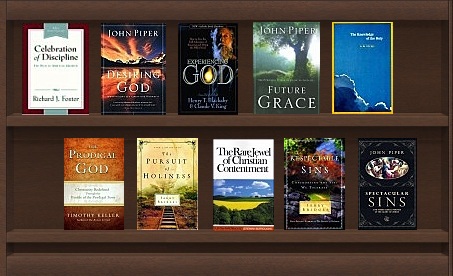
Top 10 Books to Read to Love

February 8, 2012 by Lisa Burgess 21 Comments

And to love to read.

Other than the Bible (it’s # 1), what book has helped you love God more? Driven you to a higher level of spiritual growth? Inspired in you a greater passion to serve others?

Here are ten favorite books among a few of the writers at Do Not Depart (in an incredibly informal poll—sorry, no Barna statistics here).


1. Celebration of Discipline: The Path to Spiritual Growth
by Richard J. Foster

A gift from her dad, this is the book that sparked Teri Lynne’s interest in spiritual disciplines and the study of Christian classics. It’s one of my all-time favorite books, too, because of its practical approach listing things we can do to grow spiritually, yet its insistence upon a total dependence on God for that spiritual growth.

2. Desiring God: Meditations of a Christian Hedonist
by John Piper

Heather says this classic Piper book opened her eyes to a different view of God, how He desires good for us, and how our enjoyment of Him brings Him glory. I agree. It taught me through multiple scriptures that the more I love God, the more joy I have.

3. Experiencing God: Knowing and Doing the Will of God
by Henry and Richard Blackaby, Claude King

First published in 1990, this book has helped people all over the world listen to God more attentively, and respond to His voice more actively. The more we experience Him, the more we learn to trust and love Him. This is one of Kathy’s favorites.

4. Future Grace
by John Piper

Because I can be a worrier about the future, I re-read this book for a second time last year because of its strong urging to trust God not only for grace in the past, but also for grace in the future. I will continue to turn to its truths for practical scriptural advice on how to overcome a variety of sins and trust God’s grace more. God has, is, and will help us—past, present, and future.

5. The Knowledge of the Holy: The Attributes of God and Their Meaning in the Christian Life
by A. W. Tozer

Perhaps you’re familiar with this quote: “What comes into our minds when we think about God is the most important thing about us.” It’s from this 1978 book from Tozer about characteristics of God, all of which are worthy of our study and our honor. Learning more about God gives us more reasons to love Him.  This is another favorite of mine and Kathy’s.

6. The Prodigal God: Recovering the Heart of the Christian Faith
by Timothy Keller
I’ve yet to read this one (it’s on my list), but Sandra says it was a life-changer for her when she realized that the older brother in the story of the prodigal son was just as sinful as the younger brother. As a good-girl, rule-follower, she says this book showed her she was too much like the Pharisees, and like Paul, was “the chief of sinners.” Discover a message of grace here.

7. The Pursuit of Holiness
by Jerry Bridges

After Julie was given this book in high school, she realized for the first time that God’s Word should impact her thought life first, then everything else would flow from that. Realizing that God’s standard of holiness is a goal to be pursued changed the way she runs her race as a believer.

8. The Rare Jewel of Christian Contentment
by Jeremiah Burroughs

Being discontent with your life’s circumstances isn’t just a modern-era problem. Burroughs wrote this as a Puritan in the 1600s but its strong message to find contentment in Christ alone is just as relevant today. I first read it two years ago and immediately felt its judgment in my own life (and I thought I was fairly content already!). It’s a challenging read—both in vocabulary and in conviction—but it is well worth the effort.

9. Respectable Sins: Confronting the Sins We Tolerate
by Jerry Bridges

Sandra and Kathy both were impacted by this book that shines light on the more “acceptable” sins (like unthankfulness, lack of self-control, irritability, judgmentalism). Bridges navigates through these to lead you back around to the gospel message of God’s forgiveness and grace.

10. Spectacular Sins: And Their Global Purpose in the Glory of Christ
by John Piper
This book can help you better appreciate and rely on the beauty of God’s sovereignty in all situations, good and “bad.” Seeing His hand at work through various stories in the Old and New Testaments can strengthen your faith that He is still active in the situations of your own life. Sandra and I both picked this one.

It’s hard to stop at just ten!
Please add your favorites in the comments—what books have influenced your faith?

Disclosure: Some links are affiliate links. Do Not Depart will receive a small percentage of your purchase, at no additional cost to you.

Ten Verses for Trying Times

February 6, 2012 by Caroline 9 Comments

What do you do when you start feeling anxious, troubled, scared? Do you pray? Do you run to a spouse, a friend, a family member?

I wish I could say I always cry out to Him first. But I don’t.

I feel like it’s up to me to fix something, deal with trouble, solve a problem.

But it’s not.

God is always there.

How can I focus every bit of my heart – in every moment of life – on Him first, rather than on worry or “self-sufficiency.” How do I train my heart to seek His shelter rather than scrounge for my own?

A few ways helping me so far (and maybe able to help you?): Store up His Word in our hearts! Seek out verses to memorize, leading to quick recall when those trying times occur. Place His Word first in our hearts over and over and over again so we form a habit of going to Him first.

How can we find these guiding verses?

  • Pray first for God to open your heart to His leading and heighten your awareness of applicable verses for your situation.
  • Use a concordance (found in most study bibles) to find a topic (I searched for grief, trouble, fear, worry…) and read verses listed.
  • Use online bible study resourcesto search a specific topic.

    Image from Microsoft Clip Art
  • Study one passage (a chapter, a book) for several days in a row, asking God to lead you to needed truths at the right times.

Ten Verses for Trying Times

Here are ten verses I’ve found helpful in getting through hard times:

  1. Hebrews 12:7 – Hardships train us.
  2. Psalm 27:13-14 – Wait for and trust in Him in all things.
  3. Psalm 16:7-8 – God counsels.
  4. Psalm 34:2-5 – God hears.
  5. Psalm 34:18 – Brokenhearted? He remains near. (Our Run To Him reading for this week speaks on His redeeming us from troubles!)
  6. 1 Thessalonians 5:8-11 – We need not hold on to grief for we have His hope and joy in the midst of grief.
  7. Psalm 10:14 – God sees our troubles and helps.
  8. John 16:19-24, 33 – Grief caused by this age will be wiped away in the age to come. (John 16:33 is one of my personal favorites.)
  9. 2 Corinthians 1:3-7 – God comforts our troubles, and then we can share His comfort with others going through similar troubles.
  10. 2 Corinthians 4:16-18 – These troubles, no matter how severe they are, are nothing compared to the eternal glory coming. I have to remind myself of this perspective sometimes.

How does God share what you need through His Word?

Which Bible Translation Is Right for You?

January 23, 2012 by Sandra Peoples 15 Comments

Last year I worked at a popular Christian bookstore chain. We were asked more questions about Bible translations than anything else.

“What are the differences in all these translations?”

“Why are there so many different Bibles?”

“How do I know which one to get?”

Here’s the basic information about different Bible translations and how to choose the best one for you!

The types of Bible translations are referred to as “word-for-word” and “thought-for-thought.” Word-for-word translations try to remain as close as possible to the early manuscripts. Thought-for-thought translations seek to communicate the original thoughts of the biblical writers.

Here are the most popular versions on a scale, beginning with word-for-word, and moving to thought-for-thought:

Word-for-word

  • New American Standard Bible
  • English Standard Version
  • King James Version
  • New King James Version
  • Holman Christian Standard Bible
  • New International Version
  • God’s Word Translation
  • New Living Translation

Thought-for-thought

(The Message is a paraphrase version of the Bible, not a translation.)

When choosing which translation of Bible is right for you, consider these questions,

  • Will I be using this Bible for devotional reading? If so, you may want an easier to read, thought-for-thought translation.
  • Will I be using this Bible for inductive study? If so, you may want a word-for-word translation.
  • Will I be taking this Bible to church? If so, what version does your pastor use? You may want to get the same one so it’s easier to follow along.
  • Will I be using this Bible to teach others? If so, you may want to pick a popular translation so more people in your audience will have the same version.
  • Will I be using this Bible with my children or to teach children? If so, consider getting a translation that is easier for children to understand. (Two translations specifically for children are the New International Reader’s Version and the International Children’s Bible.)

Knowing what you will use your Bible for and understanding the types of Bible translations will help you choose the right Bible translation for you.

What’s your favorite Bible translation? Why do you like it?

How to talk to God with His words

January 11, 2012 by Lisa Burgess 18 Comments

Whose words?

We know God’s words are powerful. When He speaks, things happen (Psalm 33:9).

So what happens when we speak His words? Are things more likely to change if we pray His exact words?

Well, they’re not meant to be a magical “Abracadabra!” It’s only God’s power behind the words that make them work anyway. But when we reflect His words back to Him through our prayer conversations, we are ensuring we’re in agreement with His will.

Jesus said if we abide in Him, and His words abide in us, we can ask whatever we wish, and it will be done for us (John 15:7). Whose words? His words.

I’m not suggesting we forgo original prayers. God forbid. We need to talk things out using our own words with our heavenly Father just like we do in earthly relationships.

But we can effectively supplement those times by occasionally praying scripture.

How?

1. Pick out a scripture.
Find scriptures that speak to you. (Can you stop reading and go find one right now?)

2. Make it personal.
Personalize it by substituting “I” and by addressing God directly, instead of as “He.” For example, Isaiah 55:6 says, “Seek the LORD while he may be found; call upon him while he is near.” You can pray that back to God by saying, “I will seek You, Lord, while You may be found; I will call upon You while You are near.”

3. Write it down.
Put a few in writing so you can pray more directly instead of converting in your head on the fly. Keep a notebook or a document on your computer with several scripture prayers you can automatically turn to.

4. Say it aloud.
You may find it helpful to say these prayers aloud. There’s something about hearing your own voice repeating God’s truths to Him that makes them even more real.

Where to find texts

1. Psalms
It’s easy to begin with Psalms. Many are already in the form of prayers. As you read them, address them to God. My personal favorites include Psalm 16, Psalm 27, Psalm 139, and Psalm 145.

2. Jesus’ example
Jesus was the master prayer. The example He gave His disciples to pray—including us—is in Matthew 6:9-13.

3. Other Bible prayers
By substituting their specific circumstances with yours, you can adapt the principles in prayers found throughout the Bible (2 Timothy 3:16-17), including King Solomon’s prayer at the temple dedication (1 Kings 8:22-30), King Hezekiah’s prayer of deliverance from enemies (2 Kings 19:15-19), Elijah’s prayer for God to reveal Himself at Mt. Carmel (1 Kings 18:36-37), as well as the apostle Paul’s prayers in the epistles, including Ephesians 1:15-23, Ephesians 3:14-21, and Colossians 1:9-12.

4. Favorite scriptures
But don’t limit yourself to scriptures already clearly articulated as prayers. Do you have a favorite Bible verse that proclaims truths or promises? Be careful not to take it out of context, but if it does apply, let God know you believe His words by exclaiming them back to Him.

5. Prayer books
You may already have a favorite book (please share below!); many are available straight from scripture. My favorites are compiled by Kenneth Boa in his Face to Face books: Vol 1: Praying the Scriptures for Intimate Worship, and Vol. 2: Praying the Scriptures for Spiritual Growth.

Benefits

By grounding your prayers in God’s living and active words (Hebrews 4:12), you will honor the Father, you will pray effectively (James 5:16), and you will strengthen your faith, drawing closer to God through His truths, being transformed into the woman of God you are designed to be.

Use Spirit-inspired words for Spirit-filled prayers.

Lord,
Your word that goes out from Your mouth does not return to You empty. May it accomplish that which You purpose, and succeed in the thing for which You sent it.
~ Isaiah 55:11

Do you do pray with scripture? Have a favorite verse? A useful prayer book? Let’s share our experiences.

Run to Him Study Guide

January 8, 2012 by Katie Orr 34 Comments

Psalms Bible Study

The Study Guide is here!

This study guide includes a 5-day weekly quiet time plan, studying one Psalm a week, with options to add on scripture memory and 2 additional days of study. There is also a printable bookmark for easy access to the study schedule.

Anyone is welcome to join us in this study of the Psalms. We will be posting a supplemental Bible study on each Psalm on Friday afternoons. The study guide plan starts Monday, January 16th.

Click here to download the free Bible study printable.

Psalms Bible Study

Praying He uses this study to help us run to Him.

Next Page »

This Month’s Theme

  • Jesus is the Way
  • And He Shall Be Called Series Intro

Enter your email address to have new posts emailed to you:

We’ll come to you

Enter your email address to have new posts emailed to you

Categories

Bible Memory – Lent 2021

Memorizing Isaiah 12

Let the Children Come

Let the Children Come

Want more #HideHisWord resources?

Memorizing Psalm 1

Find Us on Facebook


Search

Recent Posts

  • Series Wrap-Up: The Lord Is My Light
  • His Marvelous Light
  • When the Darkness Deepens
  • Though I Sit in Darkness…
  • Let Your Light Shine
  • Life-Giving Light

Archives

© 2026 · Pretty Creative WordPress Theme by, Pretty Darn Cute Design