• Home
  • About
    • Our Contributors
    • Our Beliefs
  • Blog
  • Bible Studies
    • Scripture Dig
  • Archives
  • Shop
  • Advertise
  • Contact
    • Email
    • Facebook
    • Instagram
    • Pinterest
    • Twitter

Do Not Depart

Encouragement and Tools to Abide in God's Word

You are here: Home / Archives for tools

4 Ways to Give Away the Word

October 11, 2011 by Lisa Burgess 9 Comments

Behold, I bring you good news of great joy that will be for all the people.
Luke 2:10

We’re diligent to take the Word in. Through daily Bible readings, sermons, books, memorizations, songs.


But how diligent are we to give it back out?

The Gospel—it is Good News!—isn’t meant to sit passively inside us. The Word is alive and active (Hebrews 4:12). What God gives to us He wants us to share with others, not hoard for ourselves.

Do not neglect to do good and to share what you have, for such sacrifices are pleasing to God.
Hebrews 13:16

So how can we give the Word away?
How can we bless others with the words of God so they also can be encouraged and equipped?

4 Ways to Give Away the Word

1. Give through casual conversations

Some believers are naturals at weaving in scriptures throughout their conversations with others. They make relevant connections between everyday conversations and applicable Bible verses, without being preachy. It doesn’t come as naturally to me, but we all can grow in this by becoming more intentional to share what we’ve received.

2. Give through writing

When we’re writing an e-mail or a birthday card, can’t we also jot down a scripture that would be meaningful to the recipient? We have opportunities multiple times a day—either on paper or on-line—to sweeten our correspondence with holy words. Think Facebook, blogs, Twitter, texts, letters, post-it notes. My friend Linda even writes scriptures on her blue jeans. We can let scriptures decorate our homes, our cars, our t-shirts, testifying for Jesus everywhere we go.
3. Give through teaching

This one may seem obvious, but sometimes we drift from using the Word even in Bible classes. Let’s check our curriculum periodically to make sure God’s Word is receiving top billing. Whether teaching straight from a book in the Bible or with the aid of another’s writings, studying scriptures with others is a direct way to pour out biblical truths, strengthening each other’s faith.

4. Give through worship and prayer

God has blessed us with His words; can’t we bless Him back with them? We can include His inspired words in our praise to Him and our prayers to Him, either alone or when we’re gathered with others. It’s easy to find songs that come straight from scripture or we can create our own. As we read through the Psalms or any text, we can echo the words as our own prayers, straight from the heart.

Let’s keep the rivers of living water flowing, not just into us, but through us and out to others.

Jesus cried out, “If anyone thirsts, let him come to me and drink. Whoever believes in me, as the Scripture has said, ‘Out of his heart will flow rivers of living water.'”
John 7:37-38

How do you spread the Word?
Which ways are hardest for you? Easiest?
Related:

Look into The Seed Company. They translate the Bible into native tongues for people around the world.

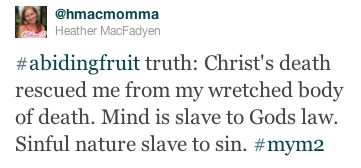
Abiding Fruit :: Twitter Style

October 6, 2011 by Do Not Depart 4 Comments

Photobucket

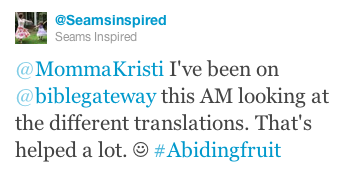
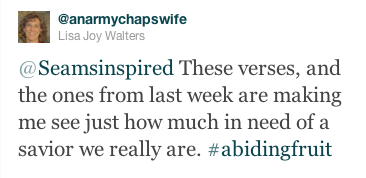
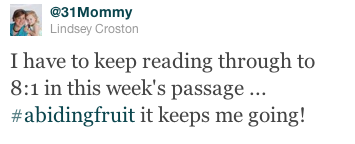
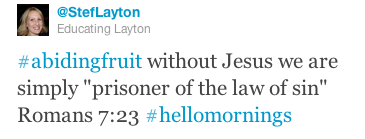
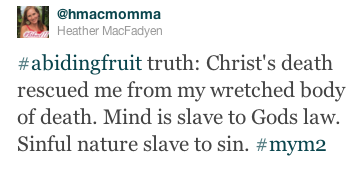
We’ve been having our own little small group, this week on Twitter, as we work through the Abiding Fruit study.

Love it!


He can use social media for His glory!

Are you on Twitter? We’d love for you to join in the #AbidingFruit discussion!


Welcome to the Story {Book Review}

September 18, 2011 by Katie Orr Leave a Comment

When you read the Bible do you wonder how all the pieces of scripture are related to one another?

Do you struggle with understanding how the whole of God’s Word can apply to your life?

Are you a bit intimidated by theology? Do the words soteriology and eschatology make your head spin?

If so, I have just the book for you!

Welcome to the Story: Reading, Loving and Living God’s Word is an easy-to-read, enjoyable book which hits on the big picture of what the Bible is all about.

Creation. Fall. Redemption. Restoration.

These four pieces to the plotline pop up all over the pages of Scripture. Getting the big picture of this biblical narrative helps make sense of all the various details in Scripture, as well as all the details of theology.

If you are unfamiliar with these major themes and how they are weaved throughout all of the Bible, this will be a helpful read for you. As we understand better how all of Scripture fits into these themes it affects our reading, studying and applying of the Bible.

In Welcome to the Story, Nichols also hits on important doctrines such as “already/not yet,” the cultural mandate, incarnational ministry and more. If these are foreign concepts to you, this book will be a great introduction for you.

After giving us a bird’s-eye-view, Nichols then gives us helpful tips on how to read and apply God’s story to our lives.

Included are tips on how to learn to love the Word of God, steps towards a transformed mind, and a “cheat sheet” for reading the Bible.

Welcome to the Story is available for purchase over at Crossway.

Disclosure: I was given a copy of Welcome to the Story, in exchange for my review. Opinions stated are mine.

Abiding Fruit

September 15, 2011 by Katie Orr 19 Comments

I long for my life to be one which bears the unmistakable mark of a Christian. When people interact with me, I want them to see Christ and His characteristics in me.

But when the baby is crying, my oldest is trying to tell me every detail of his very important dream, my toddler is…well, being a toddler, I’ve lost track of time and we need to be in the car, like NOW, but no one seems to carry the same urgency that I have, and, oh my gosh, I’m still in my pajamas…well, I’m not sure there is much evidence of Christ in me in those moments.

Why is it so hard to do what I desire to do?

If you know this familiar struggle then I’m glad you are reading this. Not (only) because it makes me feel less alone, but because this Fall we are going to take a journey through the Bible to find out how we can have the abiding fruit of Christ in our lives.

We’ve partnered yet again with Inspired to Action’s Maximize Your Mornings Challenge, and have hand-picked thirteen different passages of Scripture to help us understand how the fruit of the Spirit can become evident in our lives. Each Monday, beginning September 19th, we will have weekly Bible study posts for you!

If you are not already diving into a specific study in the Word, we would LOVE for you to join us in making the Abiding Fruit study part of your time with the Lord. You can download the study guide here. Anyone is welcome to join in the study, regardless of whether or not you are doing the Maximize Your Mornings challenge.

This study guide is unique in that we will be guiding you to new passages and YOU will be doing the studying! Each week we will read and study the same passage over the course of five days. Using different study questions, we will observe the passage with a new set of “glasses” each day to help us dig through another layer of Scripture.

If you will be doing the study we’d love to hear from you! Just give us a shout out in the comments and let us know what you are looking forward to as we dive into the fruit of the Spirit. And, if you haven’t already, go ahead and subscribe to Do Not Depart so you can receive the Bible Study posts straight to your inbox!

We are excited about getting to dig into the Word with you!

_______________

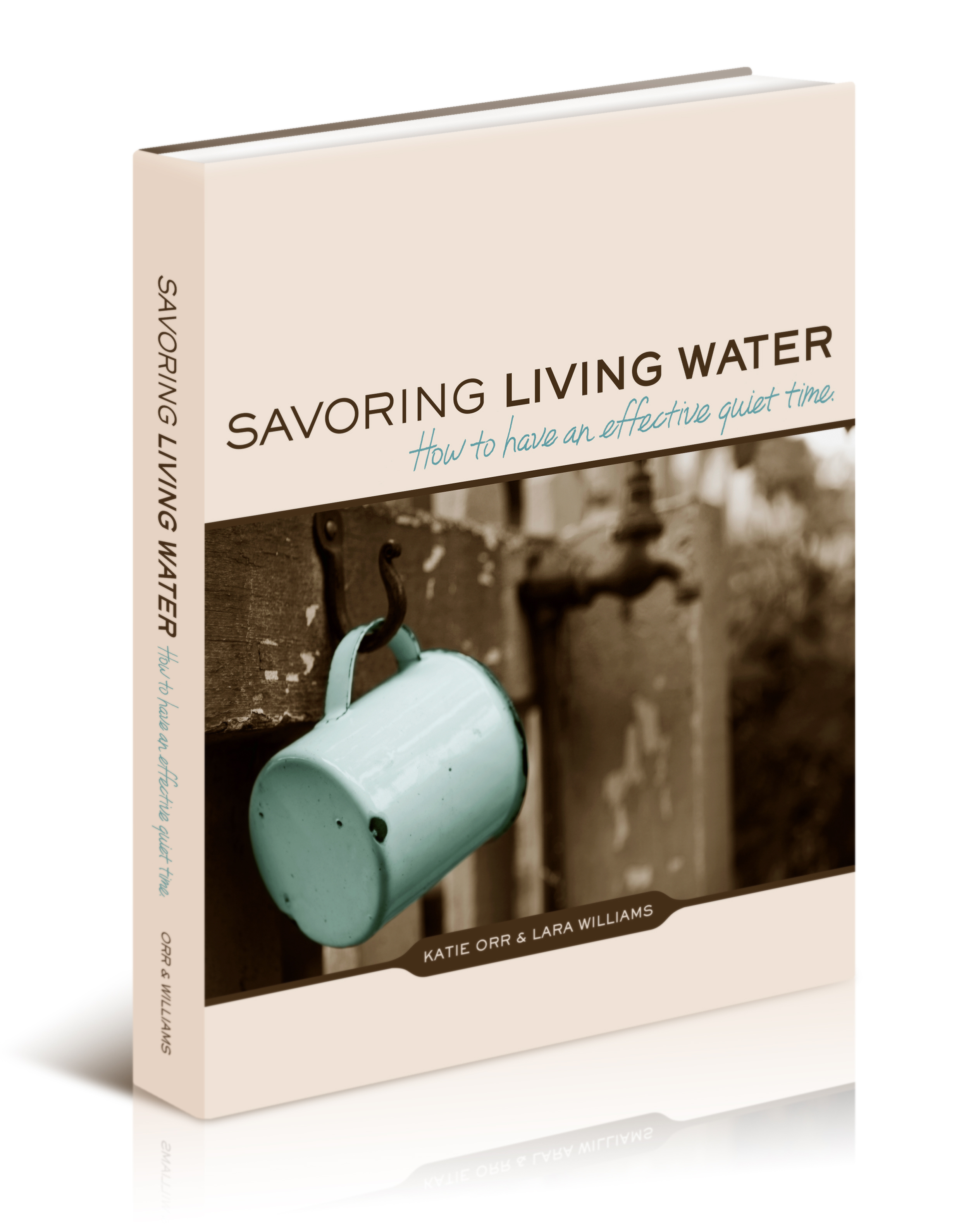
P.S. Don’t forget about the AMAZING giveaways over at To Overflowing and Living Devotionally. We’re having a party to celebrate the release of our ebook Savoring Living Water: How to have an effective quiet time. Here is a list of all the greatness you can win:
Grace for the Good Girl by Emily P. Freeman (a signed copy!)
A “HelloMornings” coffee mug (I LOVE that the verse on the back is Psalm 143:8!)
Parenting from the Overflow by Teri Lynne Underwood
Two “Clipsie Daisy” super-cute hair clips
ESV Study Bible
31 Days to Clean by Sarah Mae
Classic Bible Commentary
Warrior Prayers, with Leader’s Guide by Brooke McGlothlin
An embroidered tote bag

The party ends Friday night, and nine winners will be chosen, so run and enter while you can!

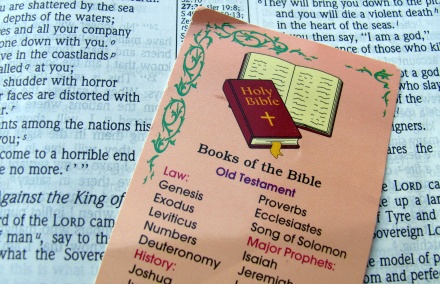
Do you know the bones of your Bible?

September 13, 2011 by Lisa Burgess 17 Comments

I stayed in a hotel last week. I wanted to know the weekend’s weather. But I couldn’t find The Weather Channel.

So I had to laboriously flip through the channels, one by one, until I found it.

Do you ever drive through a new city but can’t find a radio station you want?  Or go to your library but can’t locate Juvenile Biographies?

Or been asked to read Micah 6:8 aloud in Sunday School, but you can’t find it (it’s after Jonah, before Nahum)?

Just how well do we know the bones of our Bible?

But this is 2011, we whine. My Bible is on my iPhone; I look up a verse by typing in the name.

Or I can google a few key words and find the scripture I need. Or if I have to, I can always flip to the Table of Contents in my hardcopy Bible.

Who needs to memorize the books of the Bible anymore?

We do!
And now as much as ever.

When we trade in our human memory for a digital one, we lose advantages of knowing our way around a Bible.

Why learn the bones?

1. See the big picture
Without knowing the overall skeleton, you can lose sight of the central theme of God’s consistent love that holds the Bible together. When you work a jigsaw puzzle, you look at the picture on the box first–and often, then you put the edge pieces in place for its structure.

2. Delight in details
But while the Bible is one big love story about God, it’s also a series. Many smaller stories are captured in its 66 individual books. Each story holds value. By keeping books in context (Song of Solomon is a book of poetry; Ezekiel is a major prophet), you can more accurately interpret what you’re reading and can better apply it to your life.

3. Look for help
Once you know the general order of the books, you can look more efficiently for specific helps. If you have a friend in deep mourning, direct her to the Psalms for comfort. Or if you’re struggling with a child’s rebellion, turn to Proverbs for wisdom.  Be prepared for opportunities.

4. Use it easier
The more familiar you are with the books (Luke come before Acts), the easier it is to find your way around. You’ll be less frustrated when looking up verses to share and you’ll waste less time in your studies.

5. Find your story
Will you be more Christlike by memorizing the books of the Bible? Probably not. But the more you know the book, the more you’ll know the Author.  And you’ll discover easier how he wants YOU to participate in the story.

Where to start

Begin with the big bones. Memorize how the library is set up: two main divisions (Old and New Testaments), then subdivided into smaller sections (books of Law, books of History, etc). While these are man-made categories, they’re still helpful in interpreting that poetry books are more metaphorical, for example, and that Pauline epistles are doctrinally-rich and very practical.

Then, if you haven’t already, memorize all 66 books. It’s not too late. And it’s not that difficult (music helps greatly!).

To go even deeper, learn a summary from each book; read more about the approximate 40 authors; put together a timeline.

God has breathed life into the bones of the Bible.
It’s his book for our lifetime.
Let’s put it in our heart for eternity.

“For where your treasure is, there your heart will be also.”
Matthew 6:21

Resources

Some of my favorites:
Bible Gateway – a searchable online Bible in over 100 versions
E-Sword – free downloadable Bible study software
Katie’s top 10 online Bible study tools
66 Love Letters by Dr. Larry Crabb
What the Bible Is All About for Young Explorers based on the classic by Dr. Henrietta Mears
Reproducible Maps, Charts, Time Lines & Illustrations by Gospel Light

How familiar are you with the overall structure of the Bible?
Are you teaching your children the books of the Bible?
What’s your favorite Bible study resource? Please share!

Savoring Living Water is (Almost) Here!

September 12, 2011 by Do Not Depart 2 Comments

Lara and Katie have been busy working on their new ebook, Savoring Living Water: How to have an effective quiet time.

The ebook releases tomorrow, and they have loads of fun things planned. You’ll want to be the first in line to snag your copy of Savoring Living Water as soon as it is available!

Be sure to check out their (Lara’s and Katie’s) posts today for more info on what’s in store. (It may involve prizes!)

Free Online ESV Student Bible

August 29, 2011 by Katie Orr 3 Comments

Happy Monday! Here are some fun tools I wanted to share with you today.

ESVBible.org

Have you checked out esvbible.org yet? It is an online Bible where you can add notes, highlights and bookmarks and access free daily devotionals, reading plans and study tools.

Through esvbible.org you can also purchase the online versions of different study Bibles and study tools which can be accessed online from any computer, through your esvbible.org account.

I love the potential here. I have a few favorite Bibles but if I want to do some studying those big Bibles pile up quick. And forget bringing them all with me on my “retreat” days. Having them all online, in one place, is a very attractive thing! Plus, each Bible module is a fraction of the cost of a paper copy. I’ve been looking into getting an ESV Study Bible with my birthday money, and am seriously considering getting the online version instead of the paper Bible. However, if I do decide to go with the paper version, access to the online version also comes with the purchase!

I’ve also had my eye on the ESV Greek Tools module that can be added…decisions, decisions.

Free Online Study Bible

Ok, so there is an new module out on esvbible.org. It is the ESV Student Bible, and Crossway has a great offer which I am super excited about. You can get the ESV Student Bible for free! All it takes is sharing it with five of your friends or family. I’ve already shared the offer with friends and family and immediately received access to the online version of the study notes, maps and other study tools.

I thought many of you might be interested in this! This free offer is a great chance to try out the ESV Bible and the great study tools in the student version for yourself. Hop on over to Crossway’s blog to read about all the details.

More About the English Standard Version

If you are unfamiliar with the ESV, or the English Standard Version, it is a wonderful translation of the Bible.

The ESV is an “essentially literal” translation that seeks as far as possible to capture the precise wording of the original text and the personal style of each Bible writer. As such, its emphasis is on “word-for-word” correspondence, at the same time taking into account differences of grammar, syntax, and idiom between current literary English and the original languages. – About the ESV Translation, esv.org

The bottom line here is that it is a great translation to use for studying while still being very readable. When you want to get into the nitty-gritty of what the author intended the verse to mean, it is important to use a version that was translated word-for-word. The ESV is also the trusted, go-to Bible of most of my favorite preachers and teachers.

ESV Trusted By Leaders from Crossway on Vimeo.

Where did that song come from?

July 12, 2011 by Lisa Burgess 12 Comments

There are certain songs I just can’t sing anymore (the above isn’t one of them).

I may love the style and may even have beautiful memories attached to them, but when I really think them through, I don’t want to hear those words leaving my mouth headed to God’s ear.

Because they’re bad theology.

And I am talking about religious songs here. Granted, most songs that make it into our church services are there (hopefully!) because they hold God’s truths. And many songs that we sing along with on our Christian radio stations are also God-honoring.

But you can’t depend on it. Before you let the words stream out of your mouth, think them through. Are they pleasing to God? Are they true? Do they echo scripture?

This isn’t about worship wars, the debate between traditional hymns versus contemporary praise music. This is bigger than that. This is about accurate content versus false. Truth versus lies.

Lyrics matter.

Songs we sing will either reinforce good theology or perpetuate bad theology.

Use songs as prompts for more Bible study. Take a song you absolutely love and trace its message back to its biblical roots. Then jot the scripture reference in your hymnal or CD insert, and write the song title in the margin of your Bible by that verse.

While songs that come straight from scripture are easiest to track (I love those!), don’t rule out studying those whose themes don’t necessarily match word for word passages.

Stuart Townend is a current songwriter who expounds on the central gospel theme in many of his songs. He has penned such greats as “In Christ Alone”, “The Power of the Cross”, “The King of Love”, “Beautiful Savior”.

“How Deep the Father’s Love” is one of my favorites for the way Townend weaves the story of redemption in his strong and emotional lyrics. Here are a few stanzas and a few scriptures:

How deep the Father’s love for us
How vast beyond all measure
That He should give His only Son
To make a wretch His treasure
(See Ephesians 3:18-19; John 3:16; Psalm 135:4)

How great the pain of searing loss
The Father turns His face away
As wounds which mar the chosen One
Bring many sons to glory
(See Matthew 27:46; Luke 23:35; Hebrews 2:10)

I will not boast in anything
No gifts, no power, no wisdom
But I will boast in Jesus Christ
His death and resurrection
(See Galatians 6:14)

In contrast, when I was a child my church sang many songs about “work.”

…Work thro’ the morning hours
Work while the dew is sparkling
Work ‘mid spring flow’rs

…O land of rest, for thee I sigh!
When will the moment come

…To the work! To the work!
Toiling on, toiling on, toiling on

…Thro’ the long and toilsome day
‘Neath a blazing, burning sun
Bear the heat, pursue your way
Till your task is done
Work, work for Jesus
Work, work today

Yes, we are to work for Jesus (1 Corinthians 15:58). Many scriptures point to this. But the message I picked up from these songs was to work for my salvation instead of rest in Christ’s work of salvation (Hebrews 10:10,14; Matthew 11:28-29).

So when I hear those songs now, I can’t sing them in good conscience.

Some songs might only need a word change here or there to make the song biblically sound. At my church we’ve tweaked “Days of Elijah” from:

And these are the days of Your servant David
Rebuilding a temple of praise

to

And these are the days of Your servant Ezra
Rebuilding a temple of praise

because we know King David wasn’t allowed to build the temple even the first time (1 Chronicles 22:8), and Ezra was in charge of rebuilding the second temple (Ezra 7).

Occasionally I’ll just drop out from singing a stanza if I can’t sing the lyrics sincerely. And my friend Linda often changes the group pronouns to the more personal “I” when she sings.

So be diligent and study the words you sing to yourself, to God, to others. We’re just as accountable for the words we sing as the words we speak. Let’s use words of songs as the powerful tools they are to teach and encourage each other (Colossians 3:16) as we praise and give thanks to our Father.

Further reading:
10 Principles for Congregational Singing, Part 1, Part 2

How has a song helped you? What is one of your favorites?

How to Make a Bible Notebook

June 14, 2011 by Lisa Burgess 101 Comments

UPDATE: Want more information on building a Bible notebook? Please see our newest posts and printables here.

* * *

Why do you study the Bible?

If you’re like me, you have many reasons. To know God more. To be transformed into his image. To learn to love others better. To build a stronger faith in Jesus. To reflect his glory. To solidify truth in your heart.

But if you read the Bible and immediately forget what you learn, how effective is that (James 1:23-24)?

God often commanded the Israelites to write things down, and their faithfulness to the written Word means we have accurate scriptures today.

We all know that one effective way to retain what you read is to write it down. In a place you can find again.

Creating a personal Bible notebook works for me. While I still keep separate notebooks for specific purposes (like my Philippians memory book), I use one 3-ring binder to hold the bulk of my daily studies.

For example, eight years ago I began copying by hand and journaling one verse per day from my daily Bible reading. I wrote what the truth revealed about God and how it applied to me at the time.

Now that I’m going through the Bible for the fourth time with this method, I am benefiting from having all my previous notes sorted by book/chapter so I can easily flip through my notebook and be reminded of what I learned from the past three readings.

Having easy access to lessons God has already taught us through his Word in past situations builds our confidence in his faithfulness in our current and future circumstances.

Things you need:

  • 3-ring binder
  • Notebook paper
  • Insertable tab dividers
  • 3-hole punch
  • Sheet protectors (optional)

Decorate your binder to make it personal, then pack in plenty of paper and several dividers.

Next, decide on the categories you want and make tabs for each. I use these.

Tabs:

  • Bible Notes
  • Memory Verses
  • Greek
  • Prayers
  • Book Studies

The Bible Notes section includes my daily verse journal that I write by hand on loose-leaf notebook paper. I also keep an extra copy of my Daily Bible Reading plan here.

Under the Memory Verse section, I keep a printout of all the verses and chapters that I’ve (tried to) learn. Then each day I review one sheet before I begin working on my current verses. This assures all the verses get reviewed periodically.

I started the Greek tab when I took a Wednesday night class on Greek from a retired university professor at church. I write down interesting words and definitions that bring new light to scripture as well as words that I want to study more later. I keep a copy of the Greek alphabet here and a list of key words that I don’t want to forget.

The Prayer section holds both prayer lists as well as prayers I’ve written for special occasions, such as the beginning of a school year. Having a record of requests, answers, and praises will motivate you to continue seeking the Lord.

The Book Studies section includes notes from books I’ve studied on my own as well as with friends. This is also a great place to capture book suggestions for future studies.

You could also include sections for sermon notes, blog posts, writing ideas, quotes, devotionals, photos, drawings, song lyrics, Bible maps, etc.

Use pockets in the front and back of your binder or use sheet protectors to store church bulletins, loose notes, or small clippings you don’t want to lose.

Keeping everything in one place, at your fingertips, can make your study times more fruitful, less scattered, and more faith-building.

How do you keep track of what you’re learning? What works for you? For your kids? Please share!

Finding Living Water

June 9, 2011 by Katie Orr

There is no other way to describe it. I thirst. And in my thirst, I have wasted time searching this world for something to ease the dry. But my thirst goes deep, past the physical, into realms undefinable with mere words.

I entertain the deep down longing for more. More peace. More joy. More life. Then I look to a man or a dream or my closet, desperate for the need to be met. And even after I have some filling—even after the man loves me reckless or the dream takes shape in my now—I awake with the thirst. Again.

I could have been that woman at the Samaritan well, filling her thirst with things of this world. Things that leave us parched. But He graciously gave me a drink of His “living water” and I’ve never been the same.

Over the last few months Lara and I have together been dreaming, planning, praying and writing. The Lord has set our hearts towards putting together a book which will help you in your relationship with Him. Specifically, guidance in how to study the Bible on your own. Our hope and prayer is that through these words you will encounter God in a deeper way as you learn to experience Him through His word.

Photo Credit

This book will be available, as an e-book, early this fall. We are incredibly excited about it!

As we continue to put together this e-book, it would be helpful to us to get your input! If you have a moment, will you fill out this quick 1-minute survey? After you fill out the form, please leave us a comment to let us know that you took the survey. If you fill out this form by the end of today, you will be entered to win one of 10 free, pre-released copies of the e-book!

Thank you, friends!

Top Ten Online Bible Study Tools

May 23, 2011 by Katie Orr 15 Comments

Photo Credit

We are blessed tremendously by the loads of online tools we have at our fingertips! Here are the top ten sites I use to help me study the Bible.

  1. The ESV Online Bible This is my favorite version of scripture to study from. Love that this site also has an audio version!
  2. DesiringGod.org This is a treasure chest. Seriously. Decades of sermons, articles and even free books. There are over 50 books by John Piper and other authors that are free to download. This is my go-to place when I am studying something and want to hear good teaching on it. If you are wondering about how to interpret a particular passage, you can look up the passage by reference and find tons of resources.
  3. BlueLetterBible.org I really like this site. You can look up a verse and see the original greek for each verse. No, I don’t know greek! This site makes it easy to find the original greek word (just click the “C” box to the left of the verse.) There is much to be opened up to us, as we read the original meaning of the word choices by the authors of scripture. This site also has charts, diagrams and maps that are helpful towards understanding the original context of the text. Highly recommend this site!
  4. Theopedia.com This is like Wikipedia, but all about the Bible, theology and the history of Christianity. From the site: “Theopedia is a growing online encyclopedia of biblical Christianity. Theopedia uses wiki technology, which is essentially a community-driven, information-management system.”
  5. Bible.cc An online parallel Bible. Great for when you want to see one verse in a bunch of different translations, quickly.
  6. BibleGateway.com I like this for a quick lookup of a verse, or a key word. Just about any version you would be looking for is here. It also has a topical index and a few commentaries
  7. Crosswalk.com This is very similar to biblegateway.com, but you may find you prefer the layout of one over another.
  8. BibleStudyTools.com This is “sister site” of crosswalk.com. It has commentaries, Bible encyclopedia and dictionary, parallel Bible…loads of stuff here!
  9. PreceptAustin.org A new-to-me site, but I like what I see so far. Especially helpful if you are looking for commentary on a specific verse.
  10. What online sites do you use to help you study scripture? Leave a comment and share them with us!

Linking up with Amanda! Top Ten {Tuesday}

Prayer Theme Recap

August 30, 2010 by ScriptureDig 3 Comments

In case you missed any of these incredible posts, here is a recap of the past month here on Scripture Dig.

What is Prayer? Introductory post to this series.

Jesus’ Prayer Lesson: Kathy spent three days examining the Lord’s Prayer.  Part One gave us some general principles about prayer.  Part Two covered three of the six components of the prayer – Our Father, Hallowed be Your Name, Your Kingdom Come.   Part Three discussed the remaining three components of this prayer – Give us each day our daily bread, Forgive us our debts, Lead us not into temptation.

Using Prayer Cards:  Sandra shared how she uses prayer cards to guide her prayer time.

Write … in a Prayer Notebook? Julie gave some counsel about using a prayer notebook to organize your prayer life.

Double Whammy:  Teri Lynne shared how to gain the power of using Scripture as a foundation for prayer.

Prayer:  Graphic Organizers:  Julie offered four different organizers – downloadable as PDF files – to use as tools for praying for others.

The Type A Person Prays:  Teri Lynne shared how she uses a prayer calendar to organize her prayer life.

Praying for Your Spouse:  Kathy gave insight into the types of prayers we can offer for our husbands and the significance of doing so.

Praying for Your Children:  Stephanie shared parental prayers for children of all ages and situations.

Praying for Your Church:  Kristi encouraged us to remember how necessary our prayers for our churches are.

Repentance:  The Power of Painful Prayers:  Examination of David’s prayer in Psalm 51 by Teri Lynne.

Confidence: Finding Rest in the Sovereignty of God:  Looking at Hannah’s prayer in 1 Samuel 2 with Kristi.

Intercession:  Pleading for Undeserved Mercy:  Kristi gave insight into the reality of intercession by studying Nehemiah’s prayer.

Jesus Prays for You:  Sandra took us through Christ’s prayer in John 17.

Which of these posts was your favorite?  Any ideas you have put into practice yet?

Prayer: Graphic Organizers

August 13, 2010 by Julie 15 Comments

Our lives have become broader than ever; we can literally touch people around the world. So much information can become heavy, even a burden, when we genuinely want to pray, but feel overwhelmed with praises to lift up and petitions to remember. We say, “I’ll pray for you,” and we really mean it, but the shear number of needs we know threatens to sabotage our best intentions.
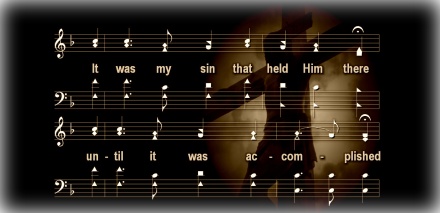
Somewhere in all the needs, praises, concerns, and ever-present confessions, we must return to where Jesus’ pattern of prayer begins:  worship of Who God is. We may leave out worship of the One Who hears our prayers, because we are in such a hurry to tackle the mountain of information. Kathy helped us understand Jesus’ index prayer here,when she shared 3 lessons on what we know as the “Lord’s Prayer.”

Here are four ideas to help manage your prayer times and make it fruitful:

Four Square Family Prayer ~ This breaks down concerns into 4 areas, beginning close to home and moving “outward.” Use it 4 days or for a whole week.  The exercise of writing new info each week helps you to reflect on God’s power and answers. Write down needs, but also jot down answers and applicable promises from Scripture. Hole punch sheets to include in a Prayer Notebook.

One Month of Praying for People ~ This sheet is specifically designed to help you focus on all of the “others” in your life. Jesus’ prayer in Matthew 6 uses all plural pronouns; isn’t that interesting? Use this tool in your Prayer Notebook to help you manage the bigger picture of the work of prayer.

Letter of Response to My Father ~ This letter writing tool helps us express ourselves in personal letter style to our Father in heaven.  Great tool to use once a week, or use it every day for a week to sweeten your prayer life. The notes help to indicate the parts of Jesus’ pattern of prayer.

One Week of Responding ~ 7 Days of response sheets take you through a week, along with suggestions for what to focus on, space to journal, and an inset reminder of the elements Jesus included in the Matt 6 pattern. These 1/2 sheets are ideal for printing off and putting into a binder or carrying in your Bible.

I invite you to find a tool that looks like it may work for you. Like a menu on a fridge or a planner in your bag, these tools are meant to make your prayer life more fruitful and effective as you spend time communicating with your Lord.

We’d love to hear if you plan to try out one of these tools and let us know how it goes. Do you have another great tool you’d like to share?

Thank you to Tara, who designed these for our Women’s Ministry and for others who long to spend time with their Father.

Digging Tools ~ Bible Basics

June 18, 2010 by ScriptureDig 6 Comments

Websites:

Just One Word

Many different Bible translations and simple search tools.  You can also register here which enables you to highlight and underline in passages as well as take notes just like you would in your own Bible.

Bible Study Tools

Crossway.com’s online Bible search engine.

Search God’s Word

Another online Bible search with several translations and a Bible study tools.

Bible History

Drawings, photos, timelines, archeology, calendars

www.biblegateway.com

20 English versions of the Bible with keywords and topical index; Several commentaries, dictionaries, lexicon, and more

www.crosswalk.com

Harmony of the Gospels; Easton’s Bible Dictionary; Nave’s Topical Bible; Several commentaries and dictionaries

www.bible.lightsource.com

Lots of tools. Similar to Crosswalk

www.blueletterbible.org

Outlines, charts, maps, Strong’s, Commentaries, Lots of misc.

www.christianitytoday.com/bible

11 Bible versions connected to reference tools; Lots of apologetic info; History and more

www.e-sword.net

This must be downloaded, but it is free, there is a ton of stuff on this site, it looks well worth it.

Books:

Rick Warren’s Bible Study Methods: 12 Ways You Can Unlock God’s Word Rick Warren helps readers learn 12 simple, step-by-step approaches to Bible study. Each will help you grow in your understanding of God’s Word.

New International Bible Dictionary, J.D. Douglas and Merrill C. Tenney, editors. Full of information about historical, chronological, archaeological, geographical, social, and biographical aspects of the Bible

Mounce’s Compete Expository Dictionary of Old & New Testament Words, William D. Mounce, editor.  Useful tool for anyone with limited or no knowledge of Hebrew and Greek who want to do biblical word studies.

Tyndale Concise Bible Commentary, Robert B. Hughes and J. Carl Laney. Provides biblical scholarship and commentary on every passage of the Bible in a user-friendly format

The IVP Bible Background Commentary: New Testament, Craig S. Keener, and The IVP Bible Background Commentary: Old Testament, Walton, Matthews & Chavalas. These companion resources help you understand the crucial cultural background of the Bible.

The Strongest NIV Exhaustive Concordance, Goodrick & Kohlenberger III. Exhaustive index of every word in the NIV translation; includes the Strong’s numbers and definitions for every Hebrew, Aramaic, and Greek word in the Bible

Ebooks:

God’s Big Story by Kristi Stephens

“God’s Truth Revealed: Session One” – Free download of the first chapter of Kathy Howard’s Bible study on the basics of the Christian faith. This first chapter deals with the existence of God, the relevance and reliability of the Bible, and the unique claims of Jesus.

Resources:

Bible reading plans & quiet time tips, free downloads here


« Previous Page

This Month’s Theme

  • Jesus is the Way
  • And He Shall Be Called Series Intro

Enter your email address to have new posts emailed to you:

We’ll come to you

Enter your email address to have new posts emailed to you

Categories

Bible Memory – Lent 2021

Memorizing Isaiah 12

Let the Children Come

Let the Children Come

Want more #HideHisWord resources?

Memorizing Psalm 1

Find Us on Facebook


Search

Recent Posts

  • Series Wrap-Up: The Lord Is My Light
  • His Marvelous Light
  • When the Darkness Deepens
  • Though I Sit in Darkness…
  • Let Your Light Shine
  • Life-Giving Light

Archives

© 2026 · Pretty Creative WordPress Theme by, Pretty Darn Cute Design