• Home
  • About
    • Our Contributors
    • Our Beliefs
  • Blog
  • Bible Studies
    • Scripture Dig
  • Archives
  • Shop
  • Advertise
  • Contact
    • Email
    • Facebook
    • Instagram
    • Pinterest
    • Twitter

Do Not Depart

Encouragement and Tools to Abide in God's Word

You are here: Home / Archives for Bible translations

Which Bible Translation Is Right for You?

January 23, 2012 by Sandra Peoples 15 Comments

Last year I worked at a popular Christian bookstore chain. We were asked more questions about Bible translations than anything else.

“What are the differences in all these translations?”

“Why are there so many different Bibles?”

“How do I know which one to get?”

Here’s the basic information about different Bible translations and how to choose the best one for you!

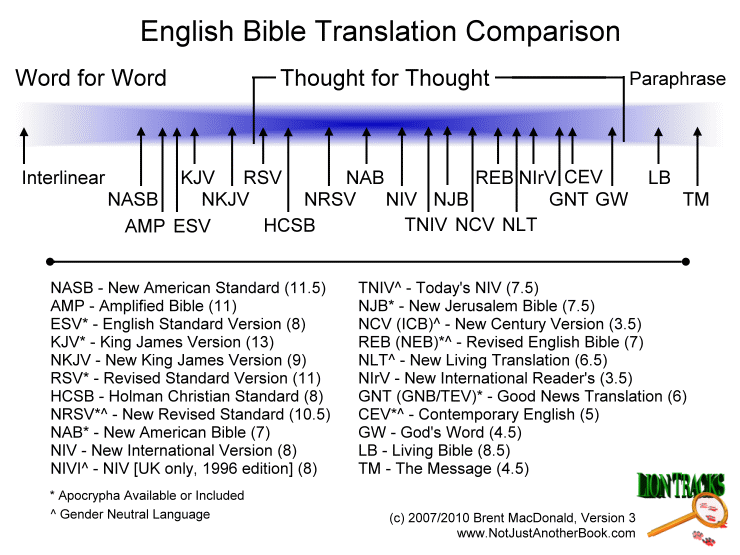
The types of Bible translations are referred to as “word-for-word” and “thought-for-thought.” Word-for-word translations try to remain as close as possible to the early manuscripts. Thought-for-thought translations seek to communicate the original thoughts of the biblical writers.

Here are the most popular versions on a scale, beginning with word-for-word, and moving to thought-for-thought:

Word-for-word

  • New American Standard Bible
  • English Standard Version
  • King James Version
  • New King James Version
  • Holman Christian Standard Bible
  • New International Version
  • God’s Word Translation
  • New Living Translation

Thought-for-thought

(The Message is a paraphrase version of the Bible, not a translation.)

When choosing which translation of Bible is right for you, consider these questions,

  • Will I be using this Bible for devotional reading? If so, you may want an easier to read, thought-for-thought translation.
  • Will I be using this Bible for inductive study? If so, you may want a word-for-word translation.
  • Will I be taking this Bible to church? If so, what version does your pastor use? You may want to get the same one so it’s easier to follow along.
  • Will I be using this Bible to teach others? If so, you may want to pick a popular translation so more people in your audience will have the same version.
  • Will I be using this Bible with my children or to teach children? If so, consider getting a translation that is easier for children to understand. (Two translations specifically for children are the New International Reader’s Version and the International Children’s Bible.)

Knowing what you will use your Bible for and understanding the types of Bible translations will help you choose the right Bible translation for you.

What’s your favorite Bible translation? Why do you like it?

Friday Favorites: Bible Translations

July 8, 2011 by ScriptureDig 3 Comments

Ever wonder which Bible translations we like best?  Everybody has a favorite and we wanted to share ours with you.   And if you are curious about the differences in translations and translation methods, we encourage you to read How to Judge a Book by its Cover.

Teri Lynne:  Oh so hard!!  I love the English Standard Version (ESV) for study and that’s what I carry to church.   But I also use the New Living Translation (NLT) for devotional reading.  So those are the two that I turn to most often … but I can’t deny my fondness for the Amplified Bible (AMP) or the New American Standard Bible (NASB) which is what I grew up with.

Julie:  I’ve been using the English Standard Version (ESV) as my primary translation for the past couple of years. Not only have I appreciated the word for word translation, I’ve also really enjoyed the study notes in my particular version. Much of what I have memorized and studied until now has been from the New American Standard (NASB). I logged most of my early spiritual growth in the NASB.

Sandra: My go-to Bible translation is the English Standard Version. I think it’s easy to read while sticking close to the original text. I especially love the study Bible version (it’s heavy though so it stays home!). I get this question every week because I work at LifeWay, and I always recommend the ESV.

Kathy:    I use the NIV and the ESV for study, but I love to use the New Living Translation for my devotional reading. The NLT is a “dynamic (or functional) equivalence” translation, which translates thought-for-thought rather than word-for-word as in the formal equivalence. Although not as literal, it makes for easier devotional reading since it updates idioms and figures of speech.  (Here is a great article about the kinds of translations and how to choose one.)

Stephanie: Amplified. Since I’m a studier and a word girl, my hands-down favorite is always the Amplified. I read the New King James for my quiet time and I use the New Living Translation when I want to convey something in modern terms. Yet, I still love the King James Version – especially when I’m reading through the Psalms.

Kristi: For serious study, I love my NASB! Just this past year I have begun using the ESV for study, also, and I’ve really enjoyed it. My most common go-to is the NIV, however. I grew up on the NIV, have memorized most consistently out of the NIV, and just find it comforting and familiar. Speaking of… my favorite well-marked, well-traveled, well-loved NIV disappeared after church a few weeks ago, so if you’ve seen it send it back. I miss it. :)

How to judge a book by its cover

June 10, 2010 by Kristi Stephens 49 Comments

Aka: What’s the deal with all of these different Bibles?

If you wander into a Christian bookstore or browse online looking for a Bible, it can be confusing as you are inundated by a storm of different Bibles.  NIV, KJV, NKJV, NASB, ESV, NLT… what?

First things first: it is important to understand that the Bible was not originally written in English!  The majority of the Old Testament was written in Hebrew, and the most of the New Testament was written in Greek.  There are a variety of translations from the original languages into English available on the market today – because they are all translations, none of them are exact.  The translators have done their best to give us the most accurate English versions possible, but because there is not always an exact equivalent between the ancient languages and our modern English, and because their methods and purposes vary, the translations will differ from one another.

Used with permission from Brent MacDonald, http://www.notjustanotherbook.com

Some versions focus on providing the most accurate word-for-word translation from the original languages to English.  These translations are highly respected and very accurate, but can be choppy or more confusing to read.  Commonly used “word for word” translations include NASB (New American Standard Bible), KJV (King James Version), and NKJV (New King James Version).  These versions are reliable and excellent choices for serious Bible study.

Other translators have attempted to look at the original text and translate it “thought for thought.”  Instead of looking at individual words, they look at larger phrases and attempt to translate the thought the original author was communicating in Greek or Hebrew into an equivalent thought in English.  The NIV (New International Version) is a “thought for thought” or “dynamic equivalence” translation.   Many people find the NIV to be easier to understand and smoother to read, making it a very popular choice.  The NIV is largely trustworthy, although there has been debate over portions of the text – it’s a good choice for devotional reading, Scripture memory, or to read aloud, but it would not be my choice for serious Bible study.  If you do use the NIV for daily Bible study, I would recommend that you use it alongside a more precise word-for-word translation.

A third general category for Bible translations would be paraphrases – some Bible students despise them and others love them!  In a paraphrase, the author interprets the passage based on his understanding of the passage, rather than on the original language and its English equivalent.  This makes a paraphrase much more prone to error or the author’s theological bias.  Examples of paraphrases would be The Message and The Living Bible (TLB).  Paraphrases can be useful – I enjoy pulling them out to read passages that are very familiar to me in the NIV or NASB; suddenly reading them in different wording often gives me a fresh perspective.  Some people like to use them for devotional reading.  Just be aware that a paraphrase is more like a devotional than a translation – the person writing the paraphrase is often seeking to explain it in a new way, rather than just present exactly what the text says.  This can limit the text and add a spin or bias from the author.

The issue of translations can be a hotly debated one.  Ask ten solid Christians which translation you should purchase and you will end up with a huge variety of answers.  Keep in mind that no matter what you purchase, each version has strengths and weaknesses. Make an informed decision, use them as tools, lay them out side by side.  You can even look verses up in a wide variety of translations using only your computer and internet access – BibleGateway.com or the Online Parallel Bible are great places to start comparing translations and noticing the differences between them.

What an amazing privilege we have – not only do we have access to the Scriptures in our own language, but we have access to it in a mind-numbing array of options!  Be thankful, and dig in!

This Month’s Theme

  • Jesus is the Way
  • And He Shall Be Called Series Intro

Enter your email address to have new posts emailed to you:

We’ll come to you

Enter your email address to have new posts emailed to you

Categories

Bible Memory – Lent 2021

Memorizing Isaiah 12

Let the Children Come

Let the Children Come

Want more #HideHisWord resources?

Memorizing Psalm 1

Find Us on Facebook


Search

Recent Posts

  • Series Wrap-Up: The Lord Is My Light
  • His Marvelous Light
  • When the Darkness Deepens
  • Though I Sit in Darkness…
  • Let Your Light Shine
  • Life-Giving Light

Archives

© 2026 · Pretty Creative WordPress Theme by, Pretty Darn Cute Design