• Home
  • About
    • Our Contributors
    • Our Beliefs
  • Blog
  • Bible Studies
    • Scripture Dig
  • Archives
  • Shop
  • Advertise
  • Contact
    • Email
    • Facebook
    • Instagram
    • Pinterest
    • Twitter

Do Not Depart

Encouragement and Tools to Abide in God's Word

You are here: Home / Archives for Ruth

Ruth Recap

March 31, 2011 by ScriptureDig 1 Comment

We have come to the end of our month of study in Ruth! We pray you have been blessed and challenged to dig deeper on your own into this beautiful gem in Scripture!

Background

  • Sandra reminded us of important guidelines as we approach narrative passages of Scripture.
  • We walked through the cultural context surrounding this book in the time of the judges.

Chapter 1

  • Julie gave us some insightful background into the life of Naomi.
  • Teri Lynne looked at the unique relationship between Ruth and her mother-in-law.
  • Kathy reminded us that the real love story in this book is between God and the people He loves and pursues.
  • Stephanie gave us a powerful description of what this journey home was like for Ruth and Naomi.

Chapter 2

  • Teri Lynne gave us a great look at the “3 G’s” of Submission
  • Julie discussed the beginning of Ruth and Boaz’s relationship and their “learn at first sight”
  • Stephanie looked at how Ruth found refuge in God
  • Kathy overviewed the idea of “gleaning” and how God provided for the poor and needy through His people’s generosity

Chapter 3

  • Sandra helped us dig into the original languages and taught us about our Deliverer!
  • Kathy gave us some great insight into the cultural background and intent of what was happening at the threshing floor.
  • Stephanie looked at Ruth and gave us a beautiful sketch of Biblical femininity in Scripture.
  • We dug into Biblical masculinity and how godly men like Boaz are the real “manly men.”

Chapter 4

  • Sandra decoded the strange interactions at the city gate.
  • Julie gave us a great reminder of how God turns our empty into full.
  • Teri Lynne looked at the women in the line of Christ and looked at how God gives hope for the broken.

Thank you for joining us on the dig!

Tomorrow, it’s “your turn” again! We’re looking forward to hearing what you’ve learned in this study, so please come back and share your thoughts!

Hope for the Broken

March 30, 2011 by ScriptureDig 7 Comments

An neglected, abused,  forgotten wife.

An influential courtesan.

A poor foreigner.

A heartbroken adultress.

An unwed teenage mother.

From Matthew 1:

A record of the genealogy of Jesus Christ the son of David, the son of Abraham:

… Judah the father of Perez and Zerah, whose mother was Tamar,

… Salmon the father of Boaz, whose mother was Rahab,

… Boaz the father of Obed, whose mother was Ruth,

… David was the father of Solomon, whose mother had been Uriah’s wife,

… and Jacob the father of Joseph, the husband of Mary, of whom was born Jesus, who is called Christ.

Five women, chosen by God, noted  in Scripture, mothers in the genealogy of the Messiah.   I’ve read their stories and often wondered about the details we don’t find in the Bible.   How did they feel?  Were they judged for actions and even situations they did not have full control of?   What moved them into the type of faith that earned them mention in the patriarchal recording of Christ’s ancestors?   And why did the Lord choose these women, most with checkered pasts that would make great Lifetime movies?

Tamar’s story is found in Genesis 38. Take time to read the account of her life … of the manner in which she was treated by the men in her life, of the extent she was willing to go to fulfill her obligation to bear a child for her husband Er.  In the end, Judah says, “She is more righteous than I” (v. 26).

Rahab, the brave prostitute who risked her own life to save the two spies, became the wife of Salmon.   She was spared and was able to save her whole family because she recognized the power of God. “I know that the Lord has given this land to you and that a great fear of you has fallen on us, so that all who live in this country are melting in fear because of you” (Joshua 2:9).  Because of her faith, she was saved and she became the mother of a true manly man, Boaz, who we have learned so much about this month.

Next is Ruth, our beautiful example of biblical femininity.   Ruth is the only woman in Scripture described as virtuous using the same word as given in Proverbs 31:10. Faithful beyond the call of duty, submissive with a gracious heart, Ruth was honored by these words of Boaz, “May the Lord repay you for what you have done.  May you be richly rewarded by the Lord, the God of Israel, under whose wings you have taken refuge”  (Ruth 2:12).  {I often wonder if Ruth had the opportunity to know Rahab and what their relationship was like … sharing in the blessing of being grafted into the chosen people of God.}

Bathsheba’s story breaks my heart. Summoned to the palace, she was undoubtedly not really at liberty to say no to the king.  Did she love Uriah?  Based on Uriah’s words to David, he was obviously a man of integrity.  {Read the whole story in 2 Samuel 11 – 12.}  How did she feel when she found she was pregnant?  When Uriah was killed?  Was it difficult to move into the palace surrounded by people who knew what had happened?   She buried a husband and then she buried a child.  The Bible says, “Then David comforted his wife Bathsheba, and he went to her and lay with her.  They gave birth to a son, and they named him Solomon.  The Lord loved him” (2 Samuel 12:24). I imagine that knowing the Lord loved Solomon was great comfort to Bathsheba, an assurance of the Lord’s love and mercy to her.

No woman is named in the genealogy through the years of the divided kingdom, the captivity, and the interbiblical period.   The next woman we find was hardly a women … likely a girl 14 or 15 years years old, in Luke we meet Mary.

Mary, the mother of Jesus, whose faith is summed up in a short sentence spoken to an angel, “I am the Lord’s servant.  May it be to me as you have said” (Luke 1:38). Mary raised the boy who, at twelve, participated in discussions with the teachers in the Temple.  Mary watched her son turn water into wine and then embark on a journey that would lead to rejection by His family and ultimately a cross where He bore the weight of all sin.  Mary prepared His body for burial … and I wonder, as she wrapped Him in cloths, did she long for the night, 33 years before when she had wrapped a newborn baby in similar strips of cloth?  Mary who knew her son was not only hers but also HIS … the Son of God.   But did she really understand?

These five women offer us hope … that God chooses the broken, the betrayed, the foreign, the fallen.  Perhaps you feel unloved, unworthy, unusable, unneeded.   Read over the stories of Tamar, Rahab, Ruth, Bathsheba, and Mary and know that just as He used them, He will use you.

Which of these five women do you most connect with?   How do their stories encourage you?

{May I recommend reading Lineage of Grace by Francine Rivers?  This compilation of her five novellas written about the women we have just discussed is a beautiful way to consider their stories in light of Scripture and the context of the times.}

Empty into full

March 29, 2011 by ScriptureDig 9 Comments

She arrived empty handed, shuffling into Bethlehem, far from her homeland, away from her relatives, without possessions, bringing only memories of the pain that sent her there and the hope that got her there. Naomi made it clear the likelihood of rescue was nil. All knew she was a foreigner from the land of idol worshipers. Who could redeem the widowed, barren, pagan Ruth? And if one could, would he?


Boaz was able to change Ruth’s empty to full. The humble kinsman became obedient  and willingly acted on his love for the unprotected outcast stooping in his field. Knowing her journey was a choice to embrace His God, Boaz knew she was taking shelter under the refuge of Jehovah’s wings. Boaz was able and willing to give her refuge under the shelter of his “wings,” (2:12,3:9) purchasing her as his own through marriage and redemption. Drawing Ruth into his world, he protected her purity, restored more than she lost, and insured her future reward. Boaz willingly changed her empty to full.


As a kinsman, Boaz was able to provide rescue to the helpless woman, but he was also willing to do his duty of redemption as “Kinsman-Redeemer.” He took an empty foreigner with no hope, calling her “accepted,” and lifting her to be his bride with secure blessings and a glorious future.

In the same way, Christ was able and willing to act on behalf of the lost in need of redemption. “But when the fullness of time had come, God sent forth his Son, born of woman, born under the law, to redeem those where under the law, so that we might receive adoption as sons” (Gal. 4:4-5).  Our rescue required His humanity, and he “humbled himself by becoming obedient to death — even death on a cross!” (Phil. 2:8) The Son of God, our Kinsman, acted to rescue us from our desperate condition, making us pure, restoring more than what was lost, insuring future reward.


In his book Twelve Extraordinary Women, John MacArthur says, “Ruth is a fitting symbol of every believer, and even of the church itself – redeemed, brought into a position of great favor, endowed with riches and privilege, exalted to be the Redeemer’s own bride, and loved by Him with the profoundest affection” (p. 85).

Our pain sends us searching for Jesus, and hope gets us to Him. When the helpless stoop before Him, we cannot fathom the love extending His wings of refuge, joyfully taking us from wretch to bride. In heaven a song is sung to the Lamb of God, Jesus, because “with <his> blood <he> purchased for God  persons from every tribe and language and people and nation” (Rev. 5:9b). Our Redeemer changes our empty to full.


We thought we faced a future of scraping for refuse in the fields, but our loving Lord has given us the inheritance reserved for His beloved. Just like Boaz purchased the unclaimed and destitute woman of Moab as his bride, so Christ purchased us to make us His own and restore to us a glorious future.


Without the love of our able and willing Redeemer, we would still be suffering in the field. Gwen Smith shares the story of Christ’s rescue in her song Broken into Beautiful. Reflect on what Boaz did for Ruth and rejoice in what Christ does for the broken as you listen to Gwen’s testimony in song. When Jesus takes us from empty to full, we must never cease to be gratefully amazed.

Will the real manly man please stand up?

March 24, 2011 by ScriptureDig 12 Comments

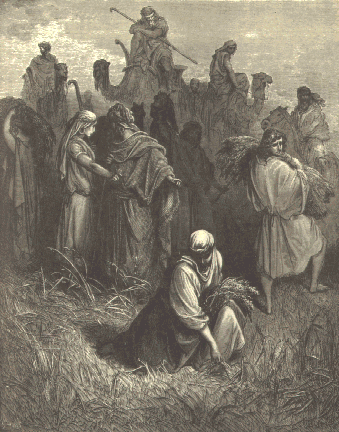
Ruth and Boaz by Gustave Dore

Yesterday, Stephanie gave us a beautiful look at femininity from the perspective of Ruth. Today, we are digging into one of my favorite lessons from this book: Biblical ‘manly men’ don’t always appear the way our culture describes “manliness.”

Our culture is certainly confused when it comes to gender identity, and sadly this confusion is vividly present around us in the church. Just as women are pressured to reject traditional femininity and pushed toward gender neutrality, it seems that men often are forced into more effeminate roles, or encouraged to embrace a caricature of “manliness” that is cheap and shallow. Manly men, our culture teaches us, love sports, hunting, big trucks, big guns, and have women hanging on them everywhere they go.  They are terrible listeners, aren’t nurturing, don’t really care about people, and sit around drinking beer and grunting at one another.

As I think through the men described in Scripture, few seem to fit this description of pseudo-manliness like Samson. Samson is a perfect example of perverted masculinity. He is a man who was set apart by God from birth, given super-human strength, and commissioned for leadership among God’s people. Instead of embracing his calling, Samson uses his strength to humiliate and destroy. He flagrantly ignores God’s calling of purity on his life. He treats women as objects, spends the night with a prostitute, and tells his parents about a woman he desires to marry with the phrase, “I have seen a woman. Get her for me.”

I want my sons to be manly men. I do not want them to be Samsons who demand and take and destroy. I want them to be men who fight for what is good and right, tenaciously cling to what is holy, protect the weak and vulnerable, nurture those under their leadership, love even when it is inconvenient. I want LB to understand that it is not his love of NASCAR that makes him masculine ;); his masculinity is an integral part of who God created him to be. It is a high calling to be a manly man like Jesus and lay down his life for others. So, what does this kind of manly man look like?

During this corrupt time period of the judges, we find in Boaz a real manly man. A man with undeniable godly masculinity along the lines of great men like Joshua, David… Jesus.

Boaz is a giver, a server of those even beneath his own social status. Every time Ruth comes to him empty and vulnerable, and he sends her away full and protected (Ruth 3:15). He is known as a spiritual leader. Notice even the way his workers greet him when he meets them in the fields! Just then Boaz arrived from Bethlehem and greeted the harvesters, “The LORD be with you!” “The LORD bless you!” they called back. (Ruth 2:4) He always refers to Ruth with utmost tenderness and respect, and seeks to spare her any embarrassment or disgrace (Ruth 2:15-16, Ruth 3:10-13). He is aware of the needy around him (Ruth 2:5), encouraging and affirming (Ruth 2:10-11), arranges provision (Ruth 2:14-16), provides protection (Ruth 2:8-9). I love that Boaz makes a point to present Ruth’s situation to the kinsman-redeemer who is a closer relative, offering him the opportunity to redeem before marrying Ruth himself (Ruth 4:1-6).

Manly men protect, give, sacrifice, shield; they are considerate, aware of others, willing to be inconvenienced to do what is right.

God uses this one godly man to preserve and bless both Naomi and Ruth, and then we find at the conclusion of the book that he would become the great-grandfather of King David. (and therefore Jesus is in his line, as well!)

Ladies, we need to raise our sons with a better understanding of their masculinity. May God raise up a generation of Boaz-men- deep, strong, godly men committed to do what is right; Samson-men are destined to be blind-sighted and crushed beneath the weight of a culture that appeals to them, enslaves them, and ultimately will destroy them.

What do you think? What version of masculinity do you see being promoted both inside and outside of church culture?

What a Woman – A Look at Biblical Femininity

March 23, 2011 by ScriptureDig 16 Comments

You don’t hear a lot about femininity these days. In our modern society where feminism is touted and gender neutralism is championed, femininity has been misunderstood, misconstrued and even shunned. Because of that, it has become increasingly difficult for women to understand and appreciate their own femininity.

But Ruth leaves us a beautiful legacy of biblical femininity. She was not only bold, brave, selfless and strong, she was also submissive, steadfast, vulnerable and loyal.

Yesterday, Kathy did a wonderful job expounding on the significance of Ruth’s journey to Boaz’s feet. It wasn’t a brash attempt to take a man’s role by asking for his hand in marriage – it was a humble, very modest and feminine request for the kind of protection which is only found in the context of marriage.

Notice how the Amplified gives clarity to her request:

“And he said, Who are you? And she answered, I am Ruth your maidservant. Spread your wing [of protection] over your maidservant, for you are a next of kin.” Ruth 3:7

In submission to her mother-in-law’s instructions, Ruth placed herself at the feet of the one she knew had the power to redeem her. It was at his feet that she asked for protection. It was at his feet that she was willing to make a fool of herself and risk rejection. It was at his feet that she humbled herself in hopes that he would make her his.

Although we never have to risk rejection, it is at our Savior’s feet that we find redemption and protection. It is at His feet that we humble ourselves and He makes us His.

Perhaps it’s just misunderstood, but femininity is anything but a demonstration of weakness. Somehow masked behind a certain kind of dignity, it becomes a manifestation of strength and grace.

Look at Boaz’s response in the Amplified…

And now, my daughter, fear not. I will do for you all you require, for all my people in the city know that you are a woman of strength (worth, bravery, capability). Ruth 3:11

The Bible is full of women who have given us inspiring examples of femininity to follow. Let’s look at just a few:

Sarah – a submissive yet strong woman 1 Peter 3:6

Deborah – a wise, brave and bold woman who was submissive yet strong Judges 4:14

Abigail – a wise and brave woman who sought mercy for her ungodly husband 1 Samuel 25:3

Proverbs 31 Woman – strong, wise, brave, bold, industrious, faithful, fervent and virtuous – let’s just say she had it all! Proverbs 31:10-31

Mary – a humble, submissive and courageous young lady Luke 1:38

History has also left us a legacy of beautiful femininity to follow:

Susan Wesley – strong, wise, dedicated and disciplined – mother of John and Charles Wesley

Catherine Booth – strong, wise, faithful, bold, visionary, mission-minded, benevolent – cofounder of the Salvation Army

Betty Greene – bold, brave, smart, mission-minded, industrious, giving – cofounder of Missionary Aviation Fellowship

Elizabeth Elliot – brave, bold, strong, wise, mission-minded, faithful, fervent

In a conversation Elizabeth Elliot once had with Betty Greene, Elizabeth asked Betty how she had been so successful in the man’s world of aviation. Betty replied, “I made up my mind that if I was going to make it in a man’s world, I had to be a lady.”

In our study of Ruth, we have seen a wise, strong, steadfast, loyal, brave, bold and benevolent woman who knew exactly what it meant to act like a lady. May we boldly be what we are – ladies!

I can’t help but think that if we start wearing our biblical femininity well, it will become the new black! :-)

Do you struggle with understanding or living out biblical femininity?

RESOURCE: Elisabeth Elliot’s transcripts of The Gift of Femininity from Gateway to Joy

Matchmaker, matchmaker, make me a match

March 22, 2011 by ScriptureDig 10 Comments

My girls & their guys

God has blessed both my daughters with godly young men to spend their lives with – and I love them both. However, before Jeremy and Justin came along, there were times I wanted to play matchmaker. Times when I thought Kelley or Sarah needed my help in finding the right husband! As always, God knew which men He had prepared for my two girls all along.

Every mother longs for their daughter to be well-cared for, protected, and loved. Naomi was no different. Although Ruth was technically Naomi’s daughter-in-law, Naomi considered her a daughter. In Ruth chapter 3, Naomi assumes a responsibility for Ruth that parents in that culture had concerning their daughters – securing her future by finding a good husband.

In Ruth 3:1, Naomi states her intention of finding a “place of rest” for Ruth.

The Hebrew word manowach, which is translated as “home” in the NIV, means “a place to settle down; a home.” For Jewish women, a “place of rest” specifically referred to the security they wanted to find with a loving husband. Naomi had one lofty purpose in sending Ruth on this nighttime mission – long-time provision for her daughter through marriage to a kinsman redeemer, an honorable man named “Boaz.” (For more about the role of the kinsman redeemer, check out yesterday’s post by Sandra.)

Naomi told Ruth to bathe, put on perfume, and dress. Then Naomi gave her specific instructions on how to approach Boaz and what to do, including “uncovering his feet and lying down” after he had gone to sleep near his pile of grain. There are some variations among biblical scholars on exactly how to understand the events that night. Unfamiliar customs of an ancient culture fill this secretive meeting.

The third chapter of Ruth is one of those Bible passages we must deal with carefully. Context and purpose are vital to understanding exactly what transpired on the threshing floor. (If you have time, read Ruth 3:1-18 now to get the story.) The following information and facts will guide us in coming to a conclusion about this encounter:

  • The character of those involved – Naomi, Ruth, and Boaz were all honorable people who feared Jehovah.
  • Intent – Naomi’s intentions were also honorable and long-term. A one-time, sexual encounter would not meet Ruth’s need.
  • Ruth’s dress – The word “dress” in 3:3 is simla. It normally refers to an outer garment that covered everything but the head. Poor people, like Ruth, also used this garment for a blanket, making this appropriate preparation for spending a cool night outside. Definitely not the dress of a woman with plans for seduction.
  • “Uncovering his feet” – this phrase has been used of seductive behavior, but not in all cases. Given the context and Naomi’s intentions, it seems more likely that Naomi’s plan was simply to gently wake Boaz when the temperature dropped in the night.
  • Ruth’s request – “Spread the corner of your garment over me,” was a Hebrew euphemistic idiom for marriage. The Hebrew literally translates “to spread one’s wing over.” (See Ruth 2:12.) Ruth asked Boaz to take her under his care, assume responsibility for her, and provide for her.
  • Boaz’ response – Boaz’ reaction speaks volumes. He obviously understood Ruth’s words and actions as a request for marriage. In fact, he considered her request a “kindness” and promised to act on it immediately.

Naomi sent Ruth on a dramatic and risky adventure. But as they say: drastic times call for drastic measures. Ruth was a poor, foreign widow in Israel. Without a husband to care for her, her future was bleak. Naomi lovingly longed to secure provision for her “daughter.” Boaz had not made any moves in that direction – possibly because Ruth had been in mourning. But now Ruth’s mourning was completed and Naomi did not want to waste any more time. Boaz needed to know that Ruth was available and willing to marry him.

Naomi selflessly focused on Ruth’s needs and took action. Who needs your action on their behalf today?

Our Deliverer

March 21, 2011 by ScriptureDig 7 Comments

One of the benefits of studying the original biblical languages is to really dig deeper when the word translated into English just can’t fully encompass the meaning in Hebrew or Greek. One of the most rich and meaningful words I remember studying in Hebrew class is go’el. As we learn more about Ruth’s go’el today, we can also praise God for our Redeemer.

When Ruth returned home to Naomi with enough barley to sustain them for days, Naomi asked where she had gleaned. Ruth replied that it was Boaz’s field. Naomi said, “Blessed be he of the Lord, who has not forsaken His kindness to the living and the dead….This man is a relation of ours, one of our relatives” (Ruth 2:20). The word translated “one of our relatives” is go’el. But it means so much more than just cousin or uncle!

John MacArthur writes that a go’el was a relative who came to the rescue. The word is also used in the following passages:

  • Joshua 20:2-9 says that the go’el would avenge the blood of a murdered relative.
  • Leviticus 25:23-28 says he could buy back family lands sold in desperate times.
  • Leviticus 25:47-49 says he could redeem a family member sold into slavery.
  • And, the role most important in the book of Ruth, the go’el could marry the widow of a relative and father offspring for the deceased spouse, so his family lineage would not die with him (referred to as levirate marriage, described in Deuteronomy 25:5-10).

It’s amazing when you stop to think about it. God cares enough about the widow to provide a protector for her in His law. As we saw in Kathy’s post about gleaning, God cared for the widows, orphans, and sojourners. And He still cares for them, using His church to provide for their needs.

This story in the book of Ruth is more than “just” a love story. Remember, the hero in this book is God Himself. Keep coming back to read how Boaz became Ruth’s go’el, and how his love and care for her is a picture of Christ’s love and care for us!

Can I lick the bowl?

March 17, 2011 by ScriptureDig 9 Comments

Like most kids, my three always loved to lick the mixing bowl. Whenever I baked a cake or brownies, at least one of them would show up in the kitchen with puppy dog eyes and a sugary “please.” On the rare occasion that I got all the batter out of the bowl and into the pan before they showed up, they were highly upset. But usually, I left a little extra in the bowl on purpose so they had plenty to “clean up.” (Of course, now that they’re all grown up I get to “clean” the bowl all by myself!)

The principle of gleaning, depicted in the second chapter of Ruth, is a little like leaving some batter in the bowl. “Gleaning,” which means “to pick up; to collect, gather,” was one of God’s provisions for the poor. (See Leviticus 19:9-10 and Deuteronomy 24:19-22.) God commanded His people not to go through their fields a second time when they harvested and not to harvest the very edges.

This “extra” belonged to the orphans, widows, and foreigners. God’s hunger solution allowed the poor to pick up the crops the harvesters dropped or missed. God provided, but they had to work for it.

This law highlights God’s concern for the poor. It even comes with a promise for the farmer: “Leave it for the alien, the fatherless and the widow that the LORD your God may bless you in all the work of your hands” (Deut. 24:19). God even tells them why they should obey: “Remember that you were slaves in Egypt” (Deut 24:22). Since God rescued them, they should in turn rescue others.

Unfortunately, contrary to God’s command, the poor were often denied the right to glean. The needy had to gain permission by “finding favor” with the land owner or harvesters. This is the position in which Ruth and Naomi find themselves after arriving in Bethlehem. They are definitely “needy.” In fact, Ruth meets two of the criteria for the gleaning law – she is both a widow and an alien. So Ruth, taking initiative to feed herself and her mother-in-law, asks Naomi for permission to glean in the fields.

But will Ruth find favor? The phrase in Ruth 2:3, which reads “as it turned out” in the NIV, could also be translated something like “as luck would have it…” The author of Ruth doesn’t really believe the positive outcome is a result of luck. He says this tongue in cheek with a wink and a nudge:

  • As luck would have it… Ruth and Naomi arrived in Bethlehem at the time of the barley harvest.
  • As luck would have it… Ruth stumbled onto a field that belonged to her father-in-law’s relative.
  • As luck would have it… Ruth found favor with the relative, Boaz. (On Tuesday, Julie shared more about their first meeting.)

This had nothing to do with luck. God’s handiwork is unmistakable! He orchestrated circumstances to provide for Ruth and Naomi. And His plans included the obedience of Boaz. Because Boaz obeyed God’s gleaning law Ruth and Naomi did not go hungry.

I don’t have a barley field – or any other kind of field for that matter – but God still expects me to allow the needy to “glean my crops.”

“Share with God’s people who are in need” (Romans 12:13).

“If anyone has material possessions and sees his brother in need but has no pity on him, how can the love of God be in him?” (1 John 3:17).

Most of us in America have more than we truly need. God reminds me over and over that I keep too much for myself and give too little away.

What about you? Do you know someone today in physical need? What are some ways you practice a little “gleaning?”

Wings of Refuge

March 16, 2011 by ScriptureDig 15 Comments

When you read through the book of Ruth, you can’t help but notice that Ruth was a humble and hardworking woman. Character traits that led her on a journey that would dramatically change her life and, more importantly, her eternal destiny.

She wasn’t content to sit by and beg bread and she certainly didn’t want her mother-in-law to succumb to such shame. So she woke up with work on her mind and requested permission to take on the role as provider. With Naomi’s approval and direction, Ruth made her way to to glean the barley fields.

She may have taken ranks with the poor, but she didn’t expect a handout. Ruth was willing to work. Each step took her closer to Boaz’s field, where she was ready to pull up her sleeves and begin throwing up some chaff.

And then we read…

“So she departed and went and gleaned in the field after the reapers; and she happened to come to the portion of the field belonging to Boaz, who was of the family of Elimelech.” Ruth 2:3

Several years ago someone told me, “There are no coincidences with God. We don’t just “happen” into Boaz’s field.  The Bible says, “A man’s heart plans his way, But the LORD directs his steps.” Proverbs 16:9

Ruth may have planned her day, but it was God who ordained her steps and she wound up exactly where she needed to be to begin her journey to redemption – the field belonging to Boaz, who was of the family of Elimelech.

Boaz was clearly the “one in whose sight I may find favor”. (Ruth 2:2)

He saw that she had forsaken everything familiar to take care of her broken hearted mother-in-law. Boaz knew what it cost Ruth to be in Bethlehem.

“May the Lord, the God of Israel, under whose wings you have come to take refuge, reward you fully for what you have done.” Ruth 2:12

Bethlehem may have provided a place of shelter, but Ruth would find her refuge under the wings of the God of Israel.

Theologians often refer to Ruth’s declaration of surrender to God as a beautiful picture of her salvation. (Ruth 1:16)

Ruth’s Redeemer became her Refuge.

But her story was about to become a beautiful parallel of our ultimate Kinsman – Redeemer. When she declared Naomi’s God to be her’s, God redeemed her – soon, Boaz would too.

As we look back on the legacy Ruth leaves behind, let’s do some gleaning of our own and see what we can learn from Ruth:

♥  God rules in the affairs of men (and women) – Proverbs 16:9 Ruth left home in search of food but the Lord directed her to Boaz’s field! We may make our plans, but the Lord certainly ordains our steps. We must pay attention to the fields He places in front of us – to the opportunities to serve Him that are often found in the simple and the ordinary. We may be surprised when God chooses to turn our service into a blessing.

♥  God takes note of what we do for His glory  – Hebrews 6:10 We may not realize it, but like Boaz, God sees our labor of love. When we feel like we’re weary, weak and worn out, we need to remember that God sees what we are doing for Him. Nothing escapes the eyes of the Living God…not even that which we do behind the scenes…perhaps, especially that which we do behind the scenes.

♥ We can find rest under His wings of refuge – Psalm 57:1 – Only God can provide the shelter we need for the storms of this life. He is our Refuge and our Redeemer. We can run to Christ and find refuge under the shadow of His wings.

Which legacy left by Ruth speaks to your life today?


Gotta love him

March 15, 2011 by ScriptureDig 12 Comments

From my vantage point on the volleyball court, I noticed how he carried himself, treated others, and contributed to the team. I learned so much about my husband-to-be from watching his interactions and then paying attention to how he treated me. We usually don’t claim “love” at first sight, but we can claim “learn” at first sight.


In our first encounter with Boaz, we learn by watching his exchanges with those in his field and, ultimately, the foreign woman who came to glean there.  Strong, tender men like Boaz inspire affection.


He’s called a “worthy” man, indicating character, strength, and influence. In her study of Ruth, Kelly Minter describes the term “man of standing” from the Hebrew term “gibbor hayil,” often meaning a war hero, a capable and wealthy man.  Since it doesn’t seem like Boaz was a man of battle, the term reveals his “high social standing.” Boaz was from the tribe of Judah and the same clan as Elimelech, Naomi’s late husband. Several families from a tribe made up a clan, so having a close male relative suggested potential hope for the widow.

  • Authority – As a “worthy” man Boaz owned the field where Ruth gleaned, but he was a hands on owner who went to oversee his own field. He was actively involved in the field he cared for and in matters there.
  • Attitude– Upon arrival, Boaz didn’t get right to productivity or work schedules. Instead, he spoke to the laborers, declaring God’s presence in the field and his blessing over the workers. This isn’t an arrogant business mogul, but a wise and worthy caretaker looking to the Creator of all things.  Not surprisingly, the workers responded respectfully, “The LORD bless you.”  As early as our first encounter, we see  Boaz as a humble man of strength. Men like Boaz inspire affection.
  • Attention – With all his responsibility, we would understand if he had a hard time multi-tasking, but Boaz didn’t miss details, noticing Ruth and inquiring about her.   With tenderness, he extended grace to the foreign woman, calling her “my daughter,”  firmly telling her stay in his field, near his workers, providing for her safety.  Not surprisingly, this worthy man inspired her affection, as she bowed at his feet in gratitude.
  • Appreciation – When Ruth wondered at his kindness, Boaz described reports he heard about how she cared for Naomi in their hardships. He knew of Ruth’s sacrifice and loyalty and declared his hope that she would be rewarded by His God, the ultimate source of Ruth’s refuge. At mealtime he demonstrated his respect for Ruth, sharing the abundance of his table and affirming his protection over her. Boaz appreciated God’s care, and he appreciated the worthy way this Moabite woman responded to her circumstances.


What began as a day in the field became “learn” at first sight for Ruth and Boaz. The strong and tender kinsman known for his godly authority, humble attitude, attention to people, and appreciation for things of great value is a man who inspires our affection as we read Ruth’s story. He also inspired the devotion of a young widow in a foreign land as she hoped someone would see beyond her status and respond to her need.  “Learn” at first sight was just the beginning.

Encountering such a redeemer is irresistible.


What first encounter quality in Boaz draws you most to him?

Submission: 3G

March 14, 2011 by ScriptureDig 8 Comments

"Ruth in Boaz's Field" by Julius Schnorr von Carolsfeld

Do you know any bitter people?  Complainers, self-pitiers?   These are not the kind of people we generally choose to spend time around … and especially not the sort we want to accompany on a long journey.   And yet, that’s just what Ruth chose.   Naomi was so bitter, even she knew how bitter she had become!

“Don’t call me Naomi,” she told them.  “Call me Mara, because the Almighty has made my life very bitter.” ~ Ruth 1:20 NIV

Naomi renamed herself in her bitterness … and yet, as I shared with you last week, Ruth was loyal to her mother-in-law.   In fact, she went beyond any reasonable expectation and did more than provide for Naomi, she honored and esteemed her.   Can you imagine graciously submitting to your deceased husband’s mother who had become a crabby woman?   And yet, Ruth did just that!

And then, this foreign widow, at the encouragement of her mother-in-law, offers herself to a man she barely knows … willingly trusting his judgment and submitting to his directions.   Certainly Boaz had extended Ruth great kindnesses and been more than generous in his dealings with her, but her attitude toward him went far beyond gratitude, she submitted herself to him and trusted him to act on her behalf.

Why?  Why would she trust these two people who were so very different culturally and religiously from her?  What would motivate her to submit herself to their authority?   While Scripture provides us no clear-cut answers to these questions, a quick examination of Ruth chapter 2 provides us with insights into the nature of Ruth’s character and confidence in placing herself under the protection and authority of Naomi and Boaz.

  1. Ruth’s Gentleness. Her demeanor was gentle.  So much so, that other noticed – from Boaz’s field workers to others in the community (2:11).
  2. Ruth’s Generosity. She chose to provide for her mother-in-law and was a hard worker to do so.  In addition, she saved a portion of her meal to give to Naomi (2:14).
  3. Ruth’s Gratitude. Ruth expressed her genuine appreciation for Naomi and for Boaz’s kindness to her (2:13).

Aren’t those the keys to any heart of submission?  A gentle demeanor that offers grace and kindness to others.   A generous heart that seeks the well-being of others before its own.   And a grateful spirit that expresses appreciation and love for the gifts and graces given.

As this new week begins, perhaps the Lord is speaking to your heart about this idea of submission.   Maybe this is a concept you have struggled with or fought against … but may I encourage you with this one idea:

Submission is not about actions completed, words spoken, or arguments won … submission is about a heart changed to love others more than self.

Submit to one another out of reverence for Christ.  Ephesians 5:21 NIV

What is the Lord speaking into your life about submission?

Naomi’s Journey Home

March 10, 2011 by ScriptureDig 11 Comments

I remember watching The Wizard of Oz where Dorothy had just ran away from home in hopes of finding a better life somewhere over the rainbow. When her wildest dreams turned into her worst nightmare, all she wanted to do was click her heals and go home.

A story all too familiar for those who find themselves wandering, wanting, wanton or wounded.

Much like Dorothy, Naomi and her family ran away from home full of hopes and dreams. But with the death of her husband and both of her sons, Naomi’s dreams were dashed and her hopes were gone.

Widows had it hard in a land where they were considered to be of the lowest class beggars.

“Then Naomi heard in Moab that the Lord had blessed his people in Judah by giving them good crops again. So Naomi and her daughters-in-law got ready to leave Moab to return to her homeland. With her two daughters-in-law she set out from the place where she had been living, and they took the road that would lead them back to Judah.”  Ruth 1:6-7

All it took was a word from home that God had shown up and blessed His people with food and all that dear woman wanted to do was to click her heals and go home.

Naomi, Ruth and Orpah began the 30 or so mile journey from Moab to Bethlehem, but somewhere along the way (the Bible doesn’t say), Naomi thought about those two young women. Why should they leave the familiar to enter a new land with a different culture and a different God?

She knew what that was like. She had done it herself. But as a widow who was considered too old to remarry and possibly too old to bear children, she knew Ruth and Orpah would be destined to a life of solitude.

Orpah finally relented and agreed to Naomi’s pleas that she return to her own people and her own land.

Ruth could not.

She was determined to stay with the woman who had lost everything. She knew what that felt like and they were in this thing together.

And so they began to make the 7-10 day journey from the plains of Moab to the town of Bethlehem. It was only a little over 30 miles. It seemed so close but the dry, dusty and treacherous terrain seemed to mirrow what was in Naomi’s heart.

It was a dangerous journey for the two women to take. They were vulnerable widows taking a trip few women dare to take without a man during those chaotic and often violent days when judges ruled. For Naomi and Ruth, there were no street lights, no paved roads, no rest stops and no security. They were easy prey for the bandits in the bushes – and then there was the Jordan River to cross and the 2,000 foot slope they had to climb – but these women were determined to make it home.

Naomi was going home. Home to her land. Home to her people. Home to her God… and so was Ruth.

Let’s take just a minute to examine a few of the countless lessons that parallel Naomi’s journey home:

When we get away from God, we seldom return the same. Naomi had left Bethlehem full of life, but what a difference a decade makes away from God, away from His people and away from His promises.

The journey home is always better with someone to help you along the way. No matter how far we stray, coming home is easier when we walk hand-in-hand together. Teri Lynne covered that truth beautifully in Tuesday’s post – My Mother-in-Law Rocks!

Going home may take humility and it may be a treacherous trip, but it’s always worth it! Naomi left in search of food during a famine, but now she was returning with empty arms and a broken heart. Perhaps she was wondering if she should have ever went to Moab in the first place. But the minute her foot stepped on Bethlehem soil, she was home and like Dorothy, Naomi knew – there’s no place like home!

Where are you on your journey? Have you wondered far from God in search of something somewhere over the rainbow? Are you in the middle of your journey home and in need of a helping hand? Or are you glad you never left your Bethlehem in the first place? What other lessons can we learn from Naomi’s journey home?

A divine love story

March 9, 2011 by ScriptureDig 6 Comments

Photo by MrBirdNerd Nature Photography

The book of Ruth is a love story. On the surface, it’s a love story between a young Moabite woman named Ruth and the Israelite, Boaz. But on a much deeper, spiritual level, it’s a love story between God and people. God is the hero, the true lover in the book of Ruth. The story beautifully demonstrates how God woos Ruth to Himself.

Ruth grew up in a pagan nation worshipping a pagan god. Although the Moabites were polytheistic (worshipped multiple gods), the primary Moabite god was Chemosh. The Moabites viewed Chemosh as a god who destroyed and subdued. On an ancient stone inscription, the Moabite king, Mesha, attributed victories in battle to Chemosh.

Pagan women who married Israelite men normally continued to worship their national gods. In fact, in direct disobedience to the true God, King Solomon helped his foreign wives cling to their pagan gods. He even built a “high place for Chemosh, the detestable god of Moab” (1 Kings 11:7). Jehovah disciplined Solomon by taking the kingdom away from his descendants (1 Kings 11:11-13).

But Ruth acted differently than most pagan women. When she returned to Israel with Naomi, Ruth forsook Chemosh. Yesterday, Teri Lynne showed us Ruth’s commitment to Naomi. Her vow of devotion to Naomi included a vow of devotion to Naomi’s God.

“Where you stay I will stay. Your people will be my people and your God my God.” Ruth 1:16

In the very next verse, Ruth voiced her desire for the LORD to hold her accountable for keeping her commitment to Naomi. “May the LORD deal with me, be it ever so severely, if anything but death separates you and me.” “LORD,” in Ruth 1:17, is translated from the Hebrew name for God, “Jehovah” or “Yahweh.” Ruth used God’s covenant name. Her commitment to Him was real, not superficial or reactionary.

Others recognized Ruth’s faith in the One, True God. For instance, Boaz acknowledged Ruth’s trust in Jehovah. “May you be richly rewarded by the LORD, the God of Israel, under whose wings you have come to take refuge” (Ruth 2:12). Boaz’s words paint the picture of a tiny bird snuggling under its mother’s wings. Ruth knew God as protector and provider. She depended on Him to supply her needs and keep her safe.

Why did Ruth choose to worship Jehovah over Chemosh? Even though the story does not specifically answer this question, we can draw some conclusions. Scripture tells us that no one seeks God on her own (Romans 3:11). We cannot come to Him unless He draws us (John 6:44). God wooed Ruth. He used Naomi’s faith and testimony to display His character. He planted belief in her heart. God drew Ruth with cords of love.

Yes, Ruth is a love story. A love story between a young Moabite woman and the Great I Am.

How is God wooing you? In what ways is He drawing you to Himself to experience His love?

My Mother-in-Law Rocks!

March 8, 2011 by ScriptureDig 11 Comments

tee available from cafe press

Mine really does rock … she has treated me as her own daughter from the first time we met.  And though we don’t always agree, I am thankful every day for her.   She is a wonderful mother, a fabulous Nana, and a compassionate daughter.   But, even with all that, if my husband had passed away and she told me to go back to my family, I would do just that.

When I read the first few verses of Ruth, I find myself understanding Orpah’s decision and relating to her.  Going back to what was familiar, where was familiar, who was familiar.   Returning to her mother’s home rather than building a new home with her mother-in-law.  I imagine many would make that same choice.

Ruth’s story is so compelling, her love for Naomi so amazing, because she left her home, her family, the only life she’d ever known to accompany her mother-in-law to a place where she would be unwelcome if not totally ostracized.  Yesterday, Julie beautifully described the qualities in Naomi that likely caused Ruth to make this most bizarre choice.

Today, I want to consider a few ways Ruth expressed her loyalty to Naomi and some practical applications we can find for our lives.

  1. Ruth stayed, even when the reason for staying was gone. Though her husband had died, Ruth chose to stay with Naomi.   How often are we guilty of leaving a relationship too quickly, without allowing God to work on us and through us?   We serve a relational God and we need to be committed to building and sustaining relationships … even when the people we are around have become bitter and difficult.
  2. Ruth journeyed with Naomi. The journey of life is full of twists and turns, ups and downs, and yet the people who come alongside us are important to the fullness of the experience.   We need to invite people to join our journey, accept the invitation of others to join them, and share the paths of life together.
  3. Ruth provided for Naomi. Ruth met social, emotional, and physical needs for Naomi.   As we journey, we need to be need-meeters.  Far too often, the Body of Christ fails in this area.   Helping others, providing for others, is a duty for the believer and it is also a blessing.   We must be diligent in this pursuit … seeking opportunities and embracing them as they come.
  4. Ruth respected Naomi. Certainly they had diverse backgrounds and there was most certainly a generation gap, and yet Ruth treated Naomi with the utmost respect.   We must be respectful – kind, courteous, and gracious – to others if we are live in the fullness of life in Christ.

Certainly we can learn much from Ruth’s example of loyalty to Naomi.  Traveling life’s road with others can be difficult … but it is also a beautiful gift we are given.   How have you been blessed through your relationships with others?

Home where I belong ~ Naomi

March 7, 2011 by ScriptureDig 6 Comments

Image from biblepicturegallery.com

In auditions for the parts of Ruth and Naomi, Naomi’s line would be shorter. Kristi revealed what it meant to live “in the days when the judges ruled,” helping us understand why well loved Naomi, whose name meant “pleasant,” became embittered and empty. She is the only one in the story who experienced both journeys, to Moab and back to Bethlehem.

She had no idea of the high price they would pay for “flagrant disregard to the standards of the God who redeemed them.” It couldn’t have been easy for Naomi’s family to decide to flee the famine by going to pagan Moab. They were from the Ephrathite clan in the city of Bethlehem, in the territory of Judah. Overwhelmed by physical needs, they abandoned spiritual faith and decided to get around God’s plan for blessing. First they “sojourned,” then “remained,” and finally “lived there.” Rejecting the land where God settled them and embracing life in Moab, Naomi watched as her husband and two sons died in the span of ten years. Faced with the pain, her mother’s heart suffered deeply. Stepping outside of God’s will left her alone, with two foreign daughters-in-law and no security.  Like many women, Naomi became disillusioned and confused by her circumstances.  But then she heard news from home; God had met the needs of His people (1:6). It was time to return.


It’s not easy for a well know lady like Naomi to humbly return to the place she never should’ve left. Once “pleasant,” she wanted to be called “bitter.”  Upon her return as “Mara,” she declared, “the Almighty has dealt very bitterly with me. I went away full, and the Lord has brought me back empty” (1:21). When she came home, “the whole town was stirred.”

When we see the defeated, worn out, bitter and embarrassed Naomi, we might be relieved she’s not our roommate, but Ruth’s responses to her mother-in-law prove otherwise.

Naomi was struggling in the fallout of rebellious choices, but even when she made up her mind to return to Bethlehem, she declared her hope for the Lord to deal kindly with Ruth and Orpah.  She hadn’t stopped believing He was God; she just lost confidence in His love for her.


Naomi was a strong influencer, but her wanderings from God distorted her perspective, and she urged her daughters-in-law to return to their pagan gods. Ruth knew better. Through the Moab years, Ruth saw Naomi’s faith and trust in Yahweh shine through the darkness of despair. Even in a foreign land, the older woman’s life pointed to the true God in the midst of their shared circumstances and pain.


Once Naomi was back where she belonged, her perspective changed. She became a wise voice of counsel to her daughter-in-law Ruth. As she watched God provide blessing for obedience, she couldn’t help declare about Boaz, “May he be blessed by the Lord, whose kindness has not forsaken the living or the dead!” (2:20) Naomi remembered the kindness of her God.

We may become discouraged by circumstances and losses of life, but when we remember the kindness of the one true God, bitterness dissolves.

Are you living life as Mara or Naomi? Are you in the place where God can bless you? If you’re empty, maybe it’s time to journey back.

Ruth’s stark surroundings

March 3, 2011 by ScriptureDig 14 Comments

Ruth und Boas, 1825
Image via Wikipedia

“In the days when the judges ruled…” (Ruth 1:1)

This short phrase as the story of Ruth begins is a loaded one. Understanding the time period in which these individuals lived gives depth and meaning to this story – and what a time period it was! Today I am going to walk you through a brief overview of Judges to give us a better understanding of this book’s context.

The book of Judges has a very clear structure. As Judges opens, we discover that the Israelites are failing to completely drive out the Canaanites from the land – direct disobedience to God’s command at the end of Joshua and ultimately a sign that they are not believing God and obeying in faith. Throughout the rest of the book, we find this lack of faith and disobedience to God continuing to plague God’s people.

Through chapters 3-16, there is a four-step cycle that repeats seven times [it shows up also very concisely in chapter 2].

  1. The people sin and fall into idolatry (2:10-13)
  2. They are oppressed by their enemies (2:14-15)
  3. They call out to God in distress (2:15)
  4. He raises up a judge to deliver them from their enemies (2:16)

Then the judge dies and they repeat step one – only worse than before. (2:17-19)

As this cycle continues the entire nation of Israel seems to be in a downward spiral, becoming more and more spiritually hardened and morally debase. As you read through the book the stories become more graphic, more violent, illustrating a nation living in complete ignorance or flagrant disregard to the standards of the God who redeemed them. Chapters 17-21 illustrate this vividly with some of the most disturbing accounts in all of Scripture.

One of the important aspects of Judges to keep in mind as the story of Ruth begins is the treatment and role of women during this time of the judges. As the overall culture of Israel decays and moves farther and farther from the fear of God, women suffer the effects most vividly. Men are failing to step up to fulfill what God has called them to. Women are vulnerable without strong and godly male headship and are often victimized or forced to assume roles God never intended for them. From Jael using her maternal instincts to brutally kill a man to a woman being gang raped, left for dead, and dismembered as a “message” to Israel, this book is hard to read. Women become increasingly brutalized and brutal as a culture moves farther from God.

“In the days when the judges ruled…” places this story into a vivid and difficult climate both spiritually and morally. Ruth and Naomi would have been vulnerable at any time in history, but their vulnerability is that much greater in this time of chaos and corruption. A godly man like Boaz would stand out even more in this broken and depraved world. God’s sovereignty in orchestrating the godly blood-line through which the Messiah would one day come seems even more miraculous.

The book of Ruth is a calm in the storm – a reminder that no matter how broken our world may seem, our God is still on the throne. He is still very much aware of the lives of even the most forgotten members of society. His plans will never be thwarted.

Want to dig deeper into the fascinating book of Judges? Dig to your heart’s content here.

Next Page »

This Month’s Theme

  • Jesus is the Way
  • And He Shall Be Called Series Intro

Enter your email address to have new posts emailed to you:

We’ll come to you

Enter your email address to have new posts emailed to you

Categories

Bible Memory – Lent 2021

Memorizing Isaiah 12

Let the Children Come

Let the Children Come

Want more #HideHisWord resources?

Memorizing Psalm 1

Find Us on Facebook


Search

Recent Posts

  • Series Wrap-Up: The Lord Is My Light
  • His Marvelous Light
  • When the Darkness Deepens
  • Though I Sit in Darkness…
  • Let Your Light Shine
  • Life-Giving Light

Archives

© 2026 · Pretty Creative WordPress Theme by, Pretty Darn Cute Design