• Home
  • About
    • Our Contributors
    • Our Beliefs
  • Blog
  • Bible Studies
    • Scripture Dig
  • Archives
  • Shop
  • Advertise
  • Contact
    • Email
    • Facebook
    • Instagram
    • Pinterest
    • Twitter

Do Not Depart

Encouragement and Tools to Abide in God's Word

You are here: Home / Blog

Time to mull, ponder, meditate

June 28, 2010 by Kathy Howard 22 Comments

Welcome to Do Not Depart! Be sure to subscribe to the Do Not Depart RSS feed or email updates to receive regular encouragement and tools to abide in God's Word.

Welcome back to Do Not Depart! If you haven't already, subscribe to the Do Not Depart RSS feed or email updates to receive regular encouragement and tools to abide in God's Word. This post may include affiliate links. To read our full disclosure policy, click here. Thank you for supporting this site!

According to Psalm 1:1-3, God will bless the woman who does not embrace the world and its ways, but instead finds her delight in God’s Word and “meditates” on it “day and night.” Sounds like we should all practice a little biblical meditation.

Unfortunately, while we are often encouraged to foster many of the spiritual disciplines, we don’t hear much about meditation. Why is that? I think many of us have misunderstood what it means to meditate on God’s Word because other forms of meditation carry a negative connotation. We don’t know what it is, why we should do it, or how we should do it. Well, let’s dig in and try to gain a little understanding of this overlooked spiritual discipline.

What is meditation?

Because of many New Age religions and practices like transcendental meditation, many of us picture “meditation” as emptying our minds of all thoughts. This is not biblical meditation. In fact, God’s Word makes it clear we are to meditate by filling our thoughts. A few things God tells us to meditate on include His law, love, mighty deeds, statutes, and promises. He also encourages us to “think on” whatever is noble, right, pure, lovely, admirable, and praiseworthy (Phil 4:8).

In his book “Spiritual Disciplines for the Christian Life,” Donald Whitney helps us understand biblical mediation. He uses the analogy of a tea bag. While reading and hearing Scripture may represent a dunk or two, meditation is like letting the bag steep. It’s the idea of “mulling” something over or “pondering” a subject.

Whitney defines biblical meditation as “deep thinking on the truths and spiritual realities revealed in Scripture for the purposes of understanding, application, and prayer.”

Why should we meditate?

Charles Spurgeon said that anyone who wanted to possess the treasure of God’s Word “must dig into Scripture as one who seeketh for choice pearls.” Meditation takes dedication, time, and hard work. So why would we want to practice this spiritual discipline?

First, as we’ve already seen, the Bible establishes meditation on God’s Word as the example for His people. Second, our meditation on God and His truth pleases God (Ps 104:33-34). And third, meditation benefits us spiritually. Meditation helps us better understand and apply the truths of God’s Word. Someone who regularly meditates on God’s Word will not simply survive in this life, she will flourish.

He is like a tree planted by streams of water, which yields its fruit in season and whose leaf does not wither. Whatever he does prospers. Psalm 1:3

Simply reading through or hearing a biblical passage will not affect our hearts, minds, and lives like steeping in its richness. We must immerse ourselves in God’s Word, holding onto it in our thoughts until its truth becomes a part of who we are. Then we will be like a tree whose roots reach down to an endless supply of living water. We will be sustained in drought and difficulty. And in God’s timing our lives will produce an abundance of fruit for His glory.

How do we meditate?

Let’s get hands on and practical so we can get a feel for how to meditate on God’s Word.

  1. Choose a passage. It may be one that God impressed on your heart during Bible reading or one that jumped out at you during a sermon. It should be small enough to work through thoroughly.
  2. Reread with different emphasis on different words and phrases.
  3. Rewrite the passage in your own words.
  4. Ask questions about what it teaches. For instance, does this passage reveal something I should:
  • Believe about God?
  • Praise or thank or trust God for?
  • Have a new attitude about?
  • Do for the sake of Christ, others, or myself?

5. Look for personal application then obey.

6. Pray through the Scripture.

7. Think on it throughout the day.

I want to be like that tree planted by streams of water. I long to please God and flourish through the truth of His Word. I think I’ll go ponder for a while.

Recommended Reading:

Spiritual Disciplines for the Christian Life, by Donald S. Whitney

Meditating on the Scriptures, by Charles Spurgeon
What’s your goal?

June 25, 2010 by ScriptureDig 26 Comments

The Bible is to us what the star was to the wise men; but if we spend all our time in gazing upon it, observing its motions, and admiring its splendor, without being led to Christ by it, the use of it will be lost on us. Thomas Adams (1583–1652), English clergyman and religious writer

We are called to use our Bibles … our time spent in Scripture must alter us if it has truly been an encounter with God. Just as Moses’ countenance glowed upon his interaction with The I AM, so to must our light shine brighter upon our meeting with the Living God revealed through the Word.

The good news is … we are all wired differently!  In our unique personality and makeup, God has created us to interact and respond to His Word in multiple ways.  Each is valuable and we should all endeavor to engage in every way; but, rest assured, it is absolutely normal and appropriate that one or two of these will be more comfortable and natural to you!!

STUDY

For Ezra had set his heart to study the law of the Lord, and to practice it, and to teach His statutes and ordinances in Israel. ~ Ezra 7:10, NASB

When we study God’s Word we are investing focused time in a passage, word, character or theme.     Study is analytical.   Study requires concentration and focus.     Richard Foster explains, “In the study of Scripture a high priority is placed upon interpretation:  what it means” (Celebration of Discipline, 69).   This reflects back to the important truth Kristi explained, “The Bible is not about us.  The Bible is about God.”    Spending time studying God’s Word is our intentional determination to grow in our understanding of Him.   Simply put, the primary goal of study is UNDERSTANDING.

DEVOTIONAL

The second method we use to engage in the Bible is devotional.  This is perhaps the most common method.   Foster contrasts devotional reading from study in this manner, “In the devotional reading of Scripture a high priority is placed upon application:  what it means to me” (69).    In no way is there an implication that devotional reading is not important, but we must make certain this is not the ONLY way we interact with Scripture; for in doing so, we risk losing the truth that ALL Scripture is useful (2 Timothy 3:16).  The goal of devotional reading is APPLICATION.

MEDITATION

But his delight is in the law of the Lord, and in His law he meditates day and night.  ~ Psalm 1:2, NASB

On Monday, Kathy will be sharing more detailed information about how to meditate.    But I wanted to share with you a few thoughts.  Again from Foster, “Christian meditation, very simply, is the ability to hear God’s voice and obey His Word” (17).   We have a tendency to make meditation a complex thing or something only the “super spiritual” can accomplish.  Or on the flip side, we shy away from this discipline because of it’s association with eastern religions.  I have heard it said that eastern meditation is the goal of emptying the mind while Christian meditation’s purpose is to fill the mind with Christ.   Honestly, I believe the goal of mediation is simple:  REFLECTION.

MEMORIZATION

Thy Word have I treasured in my heart, that I may not sin against Thee.  Psalm 119:11, NASB

Familiar verse to most of us … but a powerful, powerful promise!  We will be digging deeper into the hows and whys of Scripture memorization next week.    For today, however, it is important to understand that Scripture clearly teaches and Christ clearly models the value and necessity of embedding Scripture into our hearts and minds.   Memorizing Scripture helps us achieve the goal of DISCIPLINE. Within this goal, we find that we are more self-controlled in our actions and protected from temptation to sin.

ACTION

But prove yourselves doers of the Word, and not merely hearers who delude themselves.  ~ James 1:22, NASB

Clearly, we must be focused on DOING what Scripture teaches. For if we spend hours in study, delight in meditation, engage in devotional reading, and memorize countless passages but never DO anything in response, we have not truly encountered the Living Word of God.   We must be changed and compelled into action – whether in our thoughts and motives or our actions and mannerisms – spending time in the Word must lead us to OBEDIENCE!


Which of these five comes most easily to you?  Which is most difficult?

Sources for Further Reading or Reference:

Celebration of Discipline by Richard Foster

Sacred Pathways by Gary Thomas (a great resource for understanding how you are wired to interact with God)

Seeking the Face of God by Gary Thomas

Intimate Faith:  A Woman’s Guide to the Spiritual Disciplines by Jan Winebrenner

Why should we read the Bible anyway?

June 23, 2010 by Kathy Howard 8 Comments

Would you agree or disagree with the following statement? “The Bible answers all or most of the basic questions of life.” Well, according to a Gallup Poll, 65% of Americans agree with the statement. However, according to that same poll, only 37% of those polled read the Bible at least once a week. (Twenty-one percent read it once a week and 16% read it daily.)

What we do more accurately reveals what we believe than what we say. I can tell you I believe the Bible is vitally important, but what I do will reveal what I really believe about the Bible.

The Bible is God’s revelation of Himself and His ways to mankind – the very words of God “breathed” through divinely inspired humans (2 Timothy 3:16). Think about that truth for just a second. The one true God, the Creator of everything that exists, makes Himself known to us lowly humans. Wow!

Here are just a few of the characteristics the Bible gives us about itself:

  • Sustaining (Deut 8:3; Matt 4:4)
  • Flawless (Ps 18:30)
  • Unfailing (1 Kings 8:56)
  • Right and true (Ps 33:4; John 17:17)
  • Eternal (Ps 119:89; Is 40:8)
  • Message of life (John 5:24; Rom 10:17)
  • It also preserves, strengthens, and guides. (Ps 119:25, 28, 105).

God intercepts our lives through the Bible. We encounter His presence in His Word. Through it we are encouraged, comforted, strengthened, and refreshed. But more importantly, the Bible reveals how we can have a saving relationship with God through His Son, Jesus Christ and then helps us live lives that please Him.

God’s ultimate purpose for each of us who have entered into a saving relationship with Jesus is for us to be transformed into the likeness of Christ (Rom 8:29). God uses the Bible to shape, refine, and mold our character, thoughts, attitudes, and behaviors. God uses the Bible to carry out His purpose in our lives.

For the word of God is living and active. Sharper than any double-edged sword, it penetrates even to dividing soul and spirit, joints and marrow; it judges the thoughts and attitudes of the heart. Hebrews 4:12

The Bible is not static or time-bound. God’s Word is applicable to our lives now and tomorrow. It breaks through our pretenses, prejudices, and pride and exposes what’s underneath. Painful? Sometimes. Beneficial? Always.

All Scripture is God-breathed and is useful for teaching, rebuking, correcting and training in righteousness, so that the man of God may be thoroughly equipped for every good work. 2 Timothy 3:16-17

God applies His Word to our lives personally and specifically. He rebukes us when we sin. He teaches us what we lack. He trains and equips us to do the work He has planned for us to do. All for His glory.

But we must immerse ourselves in His Word, submitting to and cooperating with God’s transforming power. Read it. Study it. Meditate on its truths.
What do you believe about the Bible? How often do you read it?

More resources & reading:

Why should we read/study the Bible? Got Questions.org

How to Read the Bible for all It’s Worth by Gordon Fee & Douglas Stuart

Free Bible reading plans for download at kathyhoward.org

Reading God’s Word

June 21, 2010 by Stephanie Shott 22 Comments

Do you know God is jealous for you; that He sings over you…or that He yearns for you? Do you know He loves you with an everlasting love and He has given you precious promises that are yours because you’re His? Do you know God has anointed you to do something specific on planet earth? All of these wonderful nuggets of truth are unearthed when we begin our personal dig in the Word of God.

God’s Word is the life-changing source of faith, salvation, wisdom, power, purpose, peace, direction, protection, comfort, forgiveness, redemption, deliverance and direction. Our time in the Word is not something we have to do, it’s something we need!

But, if your day is anything like mine, your plate runneth over and you’re overwhelmed. So much to do, so little time and at times the Word of God sits on the table eager to be read, longing to find its proper place of prominence in your life.

Perhaps you’ve had seasons of structured, consistent time in the Word when you basked in the wonder of His presence and heard the echo of His still small voice. Or maybe you’ve never really known where to begin when it comes to reading the Bible. Wherever you are in your journey, one thing holds true…there is no substitute for time in the Word.

When I find myself drifting from the norm and struggling with my schedule, I sometimes end up neglecting my time in the Word. It’s not that I don’t want to spend time reading the Bible, it’s just hard to put the pieces of my scattered life back together in such a way that my priorities are in order. This I know…when my life is unorganized, my time in the Word tends to be the same way.

I once heard that if you aim for nothing, you will hit it every time. That’s true in life. That’s equally true in our approach to Scripture. To avoid those seasons of half-hearted, haphazard time in the Word we have to have a plan; we have to step back and reevaluate our lives and set things in their proper order.

If you’re not sure where to begin, there are Scripture reading plans readily available. In fact, Kathy Howard has a great chronological Bible reading plan on her website under “Discipleship Tools.” Another Bible reading plan can be found at Christiananswers.net.

If a “through the Bible in a year” plan is more than you can handle right now, there are other plans available. Or you can choose to tackle a specific book or group of books of the BIble. Whatever you do, be sure to set goals. Even if it’s a chapter a day…shoot for the target of time in the Word. Not for the sake of saying you did it or because you want to put a check on your reading schedule, but for your own spiritual growth, to strengthen your faith and to give you the tools and ammunition you need as you face each day.

If we’re going to prioritize our priorities then there are some changes we’ll need to make. But change is absolutely necessary if we’re going to be the women of God we long to be. And like everything else, it’s all about the choices we make.

Whenever we realign our lives to put God first and to spend time in the Word, there’s some juggling we may have to do and some choices we’ll have to make. Let’s look at the list below and begin making our way to the place where His Word takes its rightful place in our day and in our life.

QUESTIONS TO ASK MYSELF:

CHOOSE A TIME – When is the best time of the day to get alone with God? Do I have to wake up earlier?

CHOOSE A PLACE – Where is the best place to get alone with God?

CHOOSE A PLAN – What is a realistic reading plan for me during this season of my life?

CHOOSE YOUR TOOLS – What is the best way to take notes of how God speaks to my heart, directs my life and answers my prayers?

CHOOSE YOUR TEAM – Who can I talk to about God’s Word that will encourage and challenge me?

CHOOSE YOUR CHOICE – Just do it! Stay committed to the choice I make…even when I feel like I’m going through the motions, even when I’m not sure I’m getting it…I’ve got to keep reading…I’ve got to stay in the Word and continue to seek His face.

There is no substitute for the Word of God. Nothing else can change you from the inside out like the Word of the Living God. Nothing else can give you faith, strength, wisdom and courage like the Bible. So get ready to start digging…there’s nothing like it!

What helps you stay in the Word? Share your struggles or advice?

Digging Tools ~ Bible Basics

June 18, 2010 by ScriptureDig 6 Comments

Websites:

Just One Word

Many different Bible translations and simple search tools.  You can also register here which enables you to highlight and underline in passages as well as take notes just like you would in your own Bible.

Bible Study Tools

Crossway.com’s online Bible search engine.

Search God’s Word

Another online Bible search with several translations and a Bible study tools.

Bible History

Drawings, photos, timelines, archeology, calendars

www.biblegateway.com

20 English versions of the Bible with keywords and topical index; Several commentaries, dictionaries, lexicon, and more

www.crosswalk.com

Harmony of the Gospels; Easton’s Bible Dictionary; Nave’s Topical Bible; Several commentaries and dictionaries

www.bible.lightsource.com

Lots of tools. Similar to Crosswalk

www.blueletterbible.org

Outlines, charts, maps, Strong’s, Commentaries, Lots of misc.

www.christianitytoday.com/bible

11 Bible versions connected to reference tools; Lots of apologetic info; History and more

www.e-sword.net

This must be downloaded, but it is free, there is a ton of stuff on this site, it looks well worth it.

Books:

Rick Warren’s Bible Study Methods: 12 Ways You Can Unlock God’s Word Rick Warren helps readers learn 12 simple, step-by-step approaches to Bible study. Each will help you grow in your understanding of God’s Word.

New International Bible Dictionary, J.D. Douglas and Merrill C. Tenney, editors. Full of information about historical, chronological, archaeological, geographical, social, and biographical aspects of the Bible

Mounce’s Compete Expository Dictionary of Old & New Testament Words, William D. Mounce, editor.  Useful tool for anyone with limited or no knowledge of Hebrew and Greek who want to do biblical word studies.

Tyndale Concise Bible Commentary, Robert B. Hughes and J. Carl Laney. Provides biblical scholarship and commentary on every passage of the Bible in a user-friendly format

The IVP Bible Background Commentary: New Testament, Craig S. Keener, and The IVP Bible Background Commentary: Old Testament, Walton, Matthews & Chavalas. These companion resources help you understand the crucial cultural background of the Bible.

The Strongest NIV Exhaustive Concordance, Goodrick & Kohlenberger III. Exhaustive index of every word in the NIV translation; includes the Strong’s numbers and definitions for every Hebrew, Aramaic, and Greek word in the Bible

Ebooks:

God’s Big Story by Kristi Stephens

“God’s Truth Revealed: Session One” – Free download of the first chapter of Kathy Howard’s Bible study on the basics of the Christian faith. This first chapter deals with the existence of God, the relevance and reliability of the Bible, and the unique claims of Jesus.

Resources:

Bible reading plans & quiet time tips, free downloads here


Unbroken Link From God to Us!

June 17, 2010 by Julie 6 Comments

Acid covered strings allow plastic balloons full of verses to release slowly, so empty and eager hearts can receive them across restricted borders, and it’s been happening since the 1970s.  Prison cells around the world hold those who risked their lives to hold, know, and share the Bible’s words.  How has God’s Word been preserved despite attempts to eliminate it?

Many books have been hated or censored, but no other book has been the subject of such determination to annihilate it, proving its power and influence.  Even the Enemy knows it is God’s revelation to man. Attempts to destroy it began before Christ became flesh and continue today at the hands of governments in places across Asia, the Middle East, Africa, Europe, and the Americas.

Isaiah 40:8 testifies that, “The grass withers, the flower fades, but the Word of our God stands forever,” and it has, indeed, survived the onslaught of the ages.

Before invention of the printing press by Gutenberg in 1450, copies were painstakingly made, but largely illegal, so most existed in pieces, often hidden and protected.  Old Testament books were written on stone, clay, and leather, while New Testament books were written on papyrus, then copies were made on vellum and parchments of animal skins. When translations made God’s Word available for common men to read for themselves, it resulted in rulers ordering the burning of copies produced by men like William Tyndale and Martin Luther.

Translated now into over 2,000 languages, work continues to get the Gospel out to all nations. In the last decade Bibles have been burned in Jerusalem itself, confiscated during the Chinese Olympic Games, and pronounced illegal in countries like Morocco and North Korea.  The Voice of the Martyrs reports that believers walk for days to obtain and distribute Bibles for those longing to know the one true God and His truth.  Some copy passages repeatedly, so they can keep God’s Word in the “safest place of all – their heart,” able to quote it at meetings “without the danger of having a Bible at the meeting.” (VOM, March 2010) Hatred for the Book of Truth extends through history and across cultural and language barriers, but God has preserved His Word.

While men accept classical Greek and Roman literature such as the Iliad of Homer, there are fewer than 1,000 original sources.  Today there are more than 5,000 manuscript sources for the Greek New Testament. God has insured that enough ancient copies of His Word exist, so it leaves us confident in its preservation.  Many fragments and copies and quotes provide what Geisler and Nix call “an unbroken link of testimony.”

Few things will endure beyond today or beyond a thousand years, but God’s Word has been preserved as His truth revealed to mankind, and it will stand forever. Since it’s obvious God has guarded and protected His Word to us, there’s no mistaking He wants us to know Him and understand His truth.  Awesome motivation to dig in!

Sources for further reading or reference:

A General Introduction to the Bible by N. Geisler & W. Nix

How We Got the Bible by Rose Publishing

Voice of the Martyrs, www.persection.com

Wycliffe Bible Translators, www.wycliffe.org

Putting the pieces in order

June 16, 2010 by Kristi Stephens 25 Comments

One thing that often confuses people when they begin to read through the Bible is that it isn’t in chronological order!  The Bible is arranged somewhat in “chunks” – sometimes the ‘chunks’ are chronological within themselves, and sometimes they’re not!  [Stephanie did a great job charting out the general “genre” divisions of the Bible for us on Monday, so you might want to peek back at that post for reference.]

The first main division of the Bible is often called the “Pentateuch” – Genesis, Exodus, Leviticus, Numbers, and Deuteronomy.  These 5 books form the foundation for the rest of Scripture, and they were all written by Moses.  The narrative of these five books does occur in chronological order – although Leviticus, Numbers, and Deuteronomy are composed primarily of law.

This Pentateuch Timeline gives you the dates, chapters, and general sequence of events.

The next “chunk” also continues in chronological order.  The Israelites enter the promised land under the leadership of Joshua and the tribes begin to settle into their allotted lands.  For many years they have no human king (Israel should have been a theocracy under the Kingship of God Himself and guided by godly priests).  They did not remain faithful to God and began to be oppressed by their enemies, a consequence God warned them would come if they disobeyed.  After being oppressed the people would cry out to God and He would provide a “judge” or deliverer, and then the cycle would repeat.  Sadly, throughout the time of the Judges (which is also the time period of the book of Ruth) Israel fell further and further away from God and became largely ignorant of the law.

Eventually the people demanded a king – the prophet Samuel first anointed Saul, who was later rejected by God for his faithless disobedience.  David was then anointed and his son Solomon followed him.  Unfortunately Solomon’s son Rehoboam foolishly oppressed the people and ended up causing the nation to split into two – the Northern Kingdom, known as Israel, and the Southern Kingdom, known as Judah.

This is when the timeline of the Bible gets very, very confusing!  David and Solomon both wrote extensively, and their writings compose the majority of the books of Psalms, Proverbs, Song of Solomon, and Ecclesiastes.  (These books are often known as the “wisdom books.”)  The books of 2nd Samuel, 1st and 2nd Kings, and 1st and 2nd Chronicles all record the history of the kings of both Israel and Judah.  Also during this time period, God was sending prophets to both Israel and to Judah to call them to repentance and warn them of the judgment and exile they would face if they continued to disobey.  Eventually both kingdoms were conquered and carried into exile, and God sent additional prophets to His people in captivity to remind them of the law, of the reasons for their exile, and that He was still in control.  These books of history, prophecy, and wisdom literature are all contained in different “chunks” of the Old Testament, but they all overlap chronologically.  This timeline lays out the history and time periods well.

About 400 years after Malachi, the last prophet of the Old Testament, had written God’s message to the people God Himself entered the story.  Jesus of Nazareth, born in Bethlehem as foretold by the prophets, turned the nation upside down with His message – the narrative accounts of Jesus’ life are contained in “The Gospels” – Matthew, Mark, Luke, and John.  These books cover the same time period from slightly different vantage points.  After Jesus’ resurrection, His disciples continued to spread the good news of Jesus’ identity as the long-awaited Messiah – the book of Acts records the spread of the Gospel and the forming of local churches.

After these churches began to be established throughout the Roman empire, they needed more teaching – much of the teaching given to them is recorded for us in the “epistles” – letters written to individual churches.  The epistles are not organized chronologically, either – the letters written by Paul (the “Pauline epistles”) are included first, arranged from longest (1 Corinthians) to shortest (Philemon). Next come the “general epistles” – letters written by anyone other than Paul!  These are also arranged from longest (Hebrews) to shortest (Jude).

Revelation is obviously in it’s correct chronological sequence, as it records the end of the story!

Keeping the overall timeline of the Bible in mind is very helpful to me as I read and study, and I hope it will be for you, also!  If you’d like to read the Bible in chronological sequence, a chronological Bible can come in very handy – I enjoy reading the Gospels in chronological sequence,  and it adds further depth of meaning to read individual Psalms placed at the correct time in the narrative when most scholars believe they were written.  Kathy Howard also has a great free resource on her website – it’s a daily Bible reading plan that guides you through different passages to put the Biblical story in chronological order.

Dig in, friends – what a story we are privileged to explore!

Finding What I’m Looking For

June 14, 2010 by Stephanie Shott 20 Comments

I love digging into the Word and unearthing priceless treasures from the troves of Scripture. But when I first became a Christian, I didn’t have a clue where to start – I was just hungry for the Word of the Living God and anxious to know Him more. I wish someone would have mapped out my journey through the Word and given me a helping hand as I started my dig.

So, I’m excited about the opportunity to write this post and share with you what I wish someone would have shared with me about 23 years ago. I’d like offer a map of sorts that will help us find what we’re looking for in the Word of God. To make it cohesive, I’m going to begin with the basics and chart it out in topical chunks.

CHARTING OUT THE BIBLE

Old Testament:

Law – Genesis, Exodus, Leviticus, Numbers, Deuteronomy

Historical – Joshua, Judges, Ruth, 1 & 2 Samuel, 1 & 2 Kings, 1 & 2 Chronicles, Ezra, Nehemiah, Esther

Poetic – Job, Psalms, Proverbs, Ecclesiastes, Song of Solomon (Song of Songs)

Major Prophets – Isaiah, Jeremiah, Lamentations, Ezekiel, Daniel

Minor Prophets – Hosea, Joel, Amos, Obadiah, Jonah, Micah, Nahum, Habakkuk, Zephaniah, Haggai, Zechariah, Malachi

New Testament:

Historical – Matthew, Mark, Luke, John (a/k/a The Gospels), Acts

Pauline Epistles – Romans, 1 & 2 Corinthians, Galatians, Ephesians, Philippians, Colossians, 1 & 2 Thessalonians, 1 & 2 Timothy, Titus, Philemon

Other Letters – Hebrews, James, 1 & 2 Peter, 1,2 & 3 John, Jude

Prophecy – Revelation

Knowing the basic structure of the Bible helps point you in the right direction when you begin your own treasure hunt in the Word. If you’re not familiar with where they are, you can find them in the table of contents.

FINDING WHAT I’M LOOKING FOR

The Word of God is exciting, rich and inexhaustible. Every word on every page is a deliberate choice by the Creator of the universe to speak to us from His heart to ours. That’s why it’s so important that we not just casually read it, but thoroughly study it.

As you flip through the Bible, you’ll find that it’s broken down into easily distinguishable portions of scripture known as chapters and verses. But it wasn’t always that way. In the 13th century Stephen Langton gave us the chapter system we use today and in the 1400’s, Robert Stephanus devised the verse system that makes finding what we’re looking for much easier. Could you imagine if someone told you to find where the Bible says, “for the grace of God that brings salvation has appeared to all men.” without having it divided by chapters and verses? I’m so thankful we live on this side of the chapter and verse implementation!

There’s nothing like the thrill of turning the pages of scripture in our quest to know God more. When you’re looking for a specific word, you can turn in the back of your Bible to the concordance and find it along with several scripture references that contain that word. It’s a great tool, but the concordance in the back of your Bible is limited.

However, in the 1800’s, James Strong developed what we know today as, Strong’s Concordance. With this wonderful tool, we can now find any word in the Bible along with every chapter and verse where it is found. It’s important to note that the Strong’s Concordance is divided by the Old Testament (Hebrew) and New Testament (Greek). Each word has a coordinating number. After finding the assigned number, you turn to either the Old or New Testament section and find the basic meaning of that particular word.

Today, we have the luxury of cyberspace  where we can find just about anything with the click of a button. We can go to blueletterbible.org, biblegateway.com, crosswalk.com and a host of other sites to find what you’re looking for. If you’re not sure what chapter or verse to go to in order to find something, most website tools allow you to input a keyword or phrase.

It’s vital to  study the Bible beyond the surface. The same word that has been translated into our English Bible may have several meanings in it’s original Hebrew or Greek. That’s why the Strong’s Concordance is such a valuable tool. But I’d also like to share with you a few of my favorite study books that give us more depth to our word studies.

Here’s a sample of what’s on my bookshelf:

Spiros Zodhiates ~ “Complete Word Study Dictionary-Old Testament” ~ AMG Publishers

Spiros Zodhiates ~ “Complete Word Study Dictionary-New Testament” ~ AMG Publishers

W.E. Vines ~ “Expository Dictionary of the Old and New Testament” ~ Zondervan

Holman Illustrated Bible Dictionary ~ Holman

Interlinear Hebrew Greek English Bible

An array of commentaries on various books of the Bible

When I became a Christian in 1987, I didn’t know about all the resources that were available then. I certainly would have been stoked to have access to the tools that are now at our fingertips through the internet. We are so blessed because what we have now makes the excavation of the Word of God much easier and much less time consuming. But I also believe to whom much is given, much is required.

So, let’s all study to show ourselves approved…workers who need not be ashamed…rightly dividing the Word of Truth.

How to judge a book by its cover

June 10, 2010 by Kristi Stephens 49 Comments

Aka: What’s the deal with all of these different Bibles?

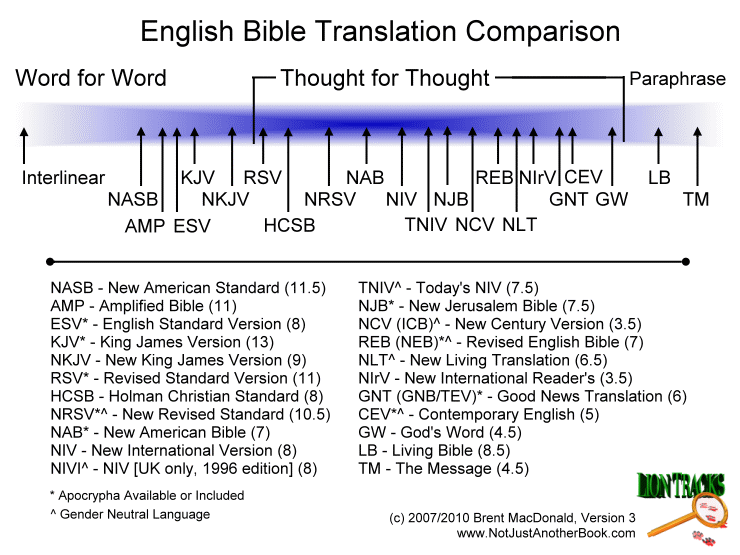
If you wander into a Christian bookstore or browse online looking for a Bible, it can be confusing as you are inundated by a storm of different Bibles.  NIV, KJV, NKJV, NASB, ESV, NLT… what?

First things first: it is important to understand that the Bible was not originally written in English!  The majority of the Old Testament was written in Hebrew, and the most of the New Testament was written in Greek.  There are a variety of translations from the original languages into English available on the market today – because they are all translations, none of them are exact.  The translators have done their best to give us the most accurate English versions possible, but because there is not always an exact equivalent between the ancient languages and our modern English, and because their methods and purposes vary, the translations will differ from one another.

Used with permission from Brent MacDonald, http://www.notjustanotherbook.com

Some versions focus on providing the most accurate word-for-word translation from the original languages to English.  These translations are highly respected and very accurate, but can be choppy or more confusing to read.  Commonly used “word for word” translations include NASB (New American Standard Bible), KJV (King James Version), and NKJV (New King James Version).  These versions are reliable and excellent choices for serious Bible study.

Other translators have attempted to look at the original text and translate it “thought for thought.”  Instead of looking at individual words, they look at larger phrases and attempt to translate the thought the original author was communicating in Greek or Hebrew into an equivalent thought in English.  The NIV (New International Version) is a “thought for thought” or “dynamic equivalence” translation.   Many people find the NIV to be easier to understand and smoother to read, making it a very popular choice.  The NIV is largely trustworthy, although there has been debate over portions of the text – it’s a good choice for devotional reading, Scripture memory, or to read aloud, but it would not be my choice for serious Bible study.  If you do use the NIV for daily Bible study, I would recommend that you use it alongside a more precise word-for-word translation.

A third general category for Bible translations would be paraphrases – some Bible students despise them and others love them!  In a paraphrase, the author interprets the passage based on his understanding of the passage, rather than on the original language and its English equivalent.  This makes a paraphrase much more prone to error or the author’s theological bias.  Examples of paraphrases would be The Message and The Living Bible (TLB).  Paraphrases can be useful – I enjoy pulling them out to read passages that are very familiar to me in the NIV or NASB; suddenly reading them in different wording often gives me a fresh perspective.  Some people like to use them for devotional reading.  Just be aware that a paraphrase is more like a devotional than a translation – the person writing the paraphrase is often seeking to explain it in a new way, rather than just present exactly what the text says.  This can limit the text and add a spin or bias from the author.

The issue of translations can be a hotly debated one.  Ask ten solid Christians which translation you should purchase and you will end up with a huge variety of answers.  Keep in mind that no matter what you purchase, each version has strengths and weaknesses. Make an informed decision, use them as tools, lay them out side by side.  You can even look verses up in a wide variety of translations using only your computer and internet access – BibleGateway.com or the Online Parallel Bible are great places to start comparing translations and noticing the differences between them.

What an amazing privilege we have – not only do we have access to the Scriptures in our own language, but we have access to it in a mind-numbing array of options!  Be thankful, and dig in!

How did we get 66? Part Two

June 9, 2010 by Kathy Howard 5 Comments

Yesterday, we began our two-part discussion on how we got the 66 books that comprise the biblical canon. If you missed it, feel free to take a look back before moving on to the New Testament discussion.

New Testament

First century Christians did not have the New Testament Canon. They relied on the Old Testament Canon and the teachings of the Apostles to guide their faith. However, they began recognizing additional writings as divinely inspired very early, even while the human authors were still alive.

In fact, NT Scripture acknowledges other NT Scripture. For example, in 1 Timothy 5:18 Paul quotes Luke 10:7 and refers to it as “Scripture.” And another example, in 2 Peter 3:16, Peter calls the writings of the Apostle Paul “Scripture.” Church leaders from the late first and early second centuries AD often quote the words of Jesus and the writings of the Apostles and refer to them as “Scripture.”

To protect from heresy and false teaching, it became necessary by the middle of the second century to compile an official list of books that the Church recognized as Christian Scriptures. Although a few discussions arose over a handful of books, it appears that there was general consensus by early in the third century AD.

As with the Old Testament Canon, the twenty-seven books of the New Testament were not chosen by men. They were merely recognized to be those God had already inspired as Scripture. Three primary criteria guided the early Church as they recognized the New Testament Canon.

  1. Apostolic connection – the author had to be one of the original apostles or closely associated with Jesus or one of them.
  2. No contradiction – the early Church leaders recognized that God would not contradict Himself in theology or ethics, so any divinely-inspired writings would not do so either.
  3. Widely applicable – from the time they were written it was clearly obvious which writings had widespread application for the Church. These were the letters and books that were greatly circulated and read again and again.

The Third Council of Carthage in 397 AD, which was attended by Augustine, officially recognized the list of 27 New Testament books we accept as canonical today. There had already been widespread, general consensus from east to west. The Council merely confirmed the writings that God had made clearly known to His church.

The following quote from “An Introduction to the New Testament,” by Carson, Moo, and Morris, emphasizes God’s selection of the canon.

Indeed, it is important to observe that although there was no ecclesiastical machinery like the medieval papacy to enforce decisions, nevertheless the worldwide church almost universally came to accept the same twenty-seven books. It was not so much that the church selected the canon as that the canon selected itself. (page 494)

God’s creation and protection of the Canon is miraculous! He has revealed Himself to His children through His written, Spirit-filled Word.

All Scripture is God-breathed and is useful for teaching, rebuking, correcting and training in righteousness, so that the man of God may be thoroughly equipped for every good work. 2 Timothy 3:16-17, NIV

Kathy Howard

For further reading:

“How and When was the Canon of the Bible put together.”

“How did we get our Bible?” (Focus on the Family)

“Is the Bible Reliable?” (Article adapted from Kathy’s book “God’s Truth Revealed.”)

Sources for this article:

An Introduction to the New Testament, D.A. Carson, Douglas J. Moo, and Leon Morris (Zondervan: Grand Rapids, 1992)

Encountering the Old Testament, Bill T. Arnold and Bryan E. Beyer (Baker Books: Grand Rapids, 1999)

Introduction to Biblical Interpretation, William W. Klein, Craig L. Blomberg, and Robert L. Hubbard, Jr. (Word Publishing: Dallas, 1993)

« Previous Page
Next Page »

This Month’s Theme

  • Jesus is the Way
  • And He Shall Be Called Series Intro

Enter your email address to have new posts emailed to you:

We’ll come to you

Enter your email address to have new posts emailed to you

Categories

Bible Memory – Lent 2021

Memorizing Isaiah 12

Let the Children Come

Let the Children Come

Want more #HideHisWord resources?

Memorizing Psalm 1

Find Us on Facebook


Search

Recent Posts

  • Series Wrap-Up: The Lord Is My Light
  • His Marvelous Light
  • When the Darkness Deepens
  • Though I Sit in Darkness…
  • Let Your Light Shine
  • Life-Giving Light

Archives

© 2026 · Pretty Creative WordPress Theme by, Pretty Darn Cute Design