• Home
  • About
    • Our Contributors
    • Our Beliefs
  • Blog
  • Bible Studies
    • Scripture Dig
  • Archives
  • Shop
  • Advertise
  • Contact
    • Email
    • Facebook
    • Instagram
    • Pinterest
    • Twitter

Do Not Depart

Encouragement and Tools to Abide in God's Word

You are here: Home / Blog

Jehovah-Tsidkenu – The LORD Our Righteousness

October 17, 2011 by Stephanie Shott 9 Comments

Welcome to Do Not Depart! Be sure to subscribe to the Do Not Depart RSS feed or email updates to receive regular encouragement and tools to abide in God's Word.

Welcome back to Do Not Depart! If you haven't already, subscribe to the Do Not Depart RSS feed or email updates to receive regular encouragement and tools to abide in God's Word. This post may include affiliate links. To read our full disclosure policy, click here. Thank you for supporting this site!

Jesus, Pilate and Job all presented questions in Scripture that every heart must answer:

And he asked them,”But who do you say that I am?” (Mark 8:29)

Pilate said to them, “Then what shall I do with Jesus who is called Christ?”  (Matthew 27:22)

“How then can man be righteous before God?” (Job 25:4)

Today, while we will concentrate on Job’s question, we will consider all three. 
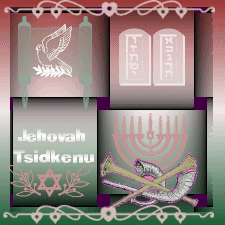
Image from Photobucket

Just on the heels of dealing with the sin of the unfaithful priest, in Jeremiah 23:6 Jehovah introduced Himself by a brand new name…Jehovah-Tsidkenu. It’s only used one other time in Scripture and is also tucked in the pages of Jeremiah (Jeremiah 33:16).  It is a name God gives Himself and a name He gives His children.

What we are about to examine is some intriguing stuff, sweet friends. No story told can equal the beauty in which God unveils Himself to His people. So stay with me as we follow the trail of truth God leaves to lead us to Himself!

Jeremiah was speaking to a nation whose king was wicked. His name was Zedekiah, which means Jehovah is Righteous. His original name was Mattaniah (Gift of God) but when his father, Nebuchadnezzar,  made him king, he changed his son’s name to Zedekiah.

It was a familiar story. God had blessed His people but it didn’t take long before they had turned their backs on Him and began to sin.

God’s eyes were not blind to Zedekiah’s wickedness and He told him through Jeremiah the prophet, “I myself will fight against you with outstretched hand and strong arm, in anger and in fury and in great wrath.” (Jeremiah 21:5)

God’s eyes were not blind to His children’s sin either and in Jeremiah 32:30, God declares, “For the children of Israel and the children of Judah have done nothing but evil in my sight from their youth. “

In both Scripture references where God uses the name, Jehovah-Tsidkenu, He gives us a astounding parallel. He is our merciful God who delights in His people and chooses to bring redemption, restoration and righteousness to His wayward children.

  • In the first mention (Jeremiah 23:6) God promises to exchange the one who should have lived up to his name as a righteous king who trusted Jehovah (Zedekiah) with THE LORD WHO IS OUR RIGHTEOUSNESS. That promise was fulfilled in Jesus Christ who the Bible states – is our righteousness (1 Corinthians 1:30, 2 Corinthians 5:21, Philippians 3:9). Jesus is the New Testament fulfillment of the Old Testament name, Jehovah-Tsidkenu – In contrast to Zedekiah (the unrighteous king), Jesus is the Righteous King who is also our righteousness.
  • The second mention (Jeremiah 33:16) is to change the whole nation from wayward and wicked hearts and give them a new heart as well as a new name, Jehovah-Tsidkenu. Because of Christ, we can become just as righteous as He is. Just as the nation was named Jehovah-Tsidkenu, He names us the same.
Isaiah 64:6 tells us…
“But we are all as an unclean thing, and all our righteousnesses are as filthy rags; and we all do fade as a leaf; and our iniquities, like the wind, have taken us away.”
But because Jesus has become our righteousness, when we receive Him, we become as righteous as He is in our Heavenly Father’s site. We put on His robe of righteousness (Isaiah 61:10) and when the Living God looks at us, He sees us just as perfect and just as pure as He sees His Son (Romans 5:21).
Knowing that God is our righteousness is not only good news for the unbeliever who turns from their sin and turns to God through faith in Christ, but it is also good news for the believer, who like the children of Israel, sometimes find themselves wandering far from the One they love. Jehovah-Tsidkenu remains our righteousness – even when we aren’t behaving so righteously.
Who He is in us establishes us positionally though practically we may be acting otherwise. We remain righteous in His sight, even when we behave badly. Yet because He is in us, He changes the desires of our hearts to be righteous in deed, knowing that our righteousness came at oh-so great a cost and stems from oh-so great a love.
  • Job’s question has been answered by The LORD Our Righteousness. Only Jehovah-Tsidkenu canmake a man righteous. But we must each personally answer the eternity-deciding questions posed by Jesus and Pilate.
  • Jesus asked…”But who do you say that I am?” (Mark 8:29) (Is He the Son of God – the Righteous One with Healing on His wings – the Christ?)
  • Pilate replied… “Then what shall I do with Jesus who is called Christ?”  (Matthew 27:22) (Have you let Him be your Righteousness? If not, will you?)

Have you answered those questions yet? How does knowing Jesus is our righteousness affect your day to day actions?


 

Abiding Fruit :: 1 Corinthians 13 :: This Most Excellent Way

October 17, 2011 by Katie Orr 18 Comments

Ah, 1 Corinthians 13. A well-known, well-loved passage of Scripture. Often seen on coffee cups, wall hangings, and apparently shoes.

Source: pinterest.com via Colleen on Pinterest


I wonder how many who proudly display their love for love understand the true meaning of these verses?

The Context of 1 Corinthians 13

1 Corinthians is a letter written by the apostle Paul, in response to a letter he had received full of questions from this immature, divided church. Paul had also received reports of great immorality and divisions in the church in Corinth, and saw the need to correct and encourage the church.

After Paul addresses their lack of unity, lack of discipline, and lack of purity, he begins to answer some of the questions they had sent him. One of these questions was about spiritual gifts, specifically which ones were to be regarded as highest. 1 Corinthians 12-14 is His answer to that particular question.

In chapter 12 we find the great teaching on how believers are “one body, many parts”. He ends chapter 12 with “But earnestly desire the greater gifts. And I will show you a still more excellent way.”

Fast forward to chapter 14:1. Paul commands them to “pursue love, yet desire earnestly spiritual gifts.” He tells them that their desire for spiritual gifts is good, but they were missing the point. They had things out of order.

Tucked between these two truths is a great teaching on this most excellent way—living a life of love.

An Eternal Perspective

Out of 13 verses, Paul spends 9 of those (vv. 1-3, 8-13) making the point that love is eternal.

God has given me a role in the body of Christ, but my giftings, positions, and influence here on earth mean nothing if not done in love.

“If I {fill-in-the-blank with all the things I find my significance in}…but have not love, I AM nothing”. 1 Corinthians 13:1-2

My actions without love are worthless. All my service to the church, my giving to the poor, my “sacrifice” of doing dirty dishes and mopping nasty floors done without love is worthless, if not done out of love.

“If I {Fill-in-the-blank with all the things I am busy doing}…but have not love I GAIN nothing.” I Corinthians 13:3

Then, in verses 8-12 Paul makes the case that only love remains. My gifts will pass away. The things I find my significance in will be gone. All I have now is imperfect, impartial, and immature.

An Evaluation

After giving a solid argument for the eternality of love, Paul gives some evaluators. Some ways to know if we are people characterized by love.

  • The Essence of Love. The first test Paul gives is how to know what love is and what it is not. 

Love is patient and kind…it is not arrogant or rude…it is not irritable or resentful. 1 Corinthians 13:4-5

Patient, as it is used here means “to persevere the offenses of others.” The word kind means “to show one’s self mild”. These are reactive words. The challenge here is not to “go out and be more patient and kind”. The command here is to persevere the offenses of others, and show yourself mild.
Conversely, love is NOT arrogant (to be puffed up), rude, irritable (easily provoked to anger), or resentful; even if I have every right to be.
This word resentful comes from two greek words. The first is logizomai, meaning to count up, like you do when you balance your checkbook. Nothing is let go without an account. The second word, kakos, means wrongdoing. Put these two together, and you get resentment- counting up wrongdoings and not letting anything go.
The evaluation question here is: What do people receive from you when they wrong you?
  • The Evidence of Love. The second test Paul gives is seen in what love does and does not do.
…love does not envy or boast…It does not insist on its own way…it does not rejoice at wrongdoing, but rejoices with the truth. Love bears all things, believes all things, hopes all things, endures all things. 1 Corinthians 13:4-7
The word bear (stego) means to cover, or protect like a roof does to our house. Believes (pisteuo) implies to have confidence in and commit to. Hopes (elpizo) suggests we are to wait for with joy and full confidence. Endures (hypomeno) means to remain, not to flee, to bear bravely whatever comes our way.
The evaluation question here is: Is there enough evidence in your life to show that you love others?

A Reminder

I cannot love well on my own. Love is a fruit of the SPIRIT. In those split-second crazy moments of life, I can not make myself to love. It is only through dependance on the Holy Spirit, as He provides heart change, can I find the ability to react well, and to actively choose love.

What did you learn from your week of studying 1 Corinthians 13? What application is God leading you to?

Let us know in the comments.

Walking in the Spirit {Book Review}

October 14, 2011 by Katie Orr 2 Comments

It wasn’t until my freshman year in college that I began to understand the role of the Holy Spirit in my life. Fifteen years later, and I still have much to learn.

So when the opportunity came along to review Walking in the Spirit. I jumped at the chance. Walking in the Spirit, by Kenneth Berding, is a great resource for those who long to know better how to keep in step with the Spirit of God.

Walking in the Spirit provides solid, Biblical teaching with helpful application tips to help us understand exactly what walking in the Spirit is to look like in our own lives.

Walking in the Spirit is the central metaphor for describing what it means to live as a Christian. Life lived according to the Spirit is not simply trying to do the right thing. Nor is it simply trying to live according to God’s Law. Life as a Christian is cooperating with the Holy Spirit in a daily walk. p. 19

Filled with real-life examples and other great analogies, Kenneth Berding teaches on practical doctrines like how to be led by the Spirit, how to put to death the deeds of the flesh, and how to set your mind on the things of the Spirit, to name a few.

If you want to be someone who brings glory to God (and I pray that there is nothing you desire more!), you must learn what it means to walk according to the Spirit. p. 16

If you are, like me, desiring to figure out how you can better depend on the Spirit of God on a daily basis, this book is for you. It is also a great complement to our Abiding Fruit study!

You can head over to Crossway to purchase your copy.

You can also enter for a chance to win a copy of Walking in the Spirit over at Inspired to Action, where I am sharing about how to experience the abundant life Jesus promised.

Disclosure: I was given a copy of Walking in the Spirit, in exchange for my review. Opinions stated are mine.

What is your name again?

October 14, 2011 by Kathy Howard 3 Comments

There’s so much about God that I don’t understand. For instance, why He loves me and how He keeps the universe spinning along. But possibly the hardest thing to get my puny mind around is His eternal, self-sufficient existence.

There has never been a time that God was not, or a moment when He will not be. He exists because of Himself and He needs nothing outside of Himself.

God’s name “Yahweh” (also known by the Christian transliteration “Jehovah”) signifies His timeless, ever-present existence. The root word of Yahweh means “to exist,” “to be.” In fact, some scholars suggest that “I am that I am” in Exodus 3:14 would be better translated as “I am He who exists” or “I am He who is.”

illustration by visualbiblealive.com

This is the name God gave when Moses asked Him:

“Suppose I go to the Israelites and say to them, ‘The God of your fathers has sent me to you,’ and they ask me, ‘What is his name?’ Then what shall I tell them?” (Exodus 3:13, NIV)

Since God’s name identifies his nature, when Moses requested his “name” he was asking about God’s character. Can we trust you to be with us? Can we believe that you can deliver us?

God’s answer: “Yahweh.” I am the One who exists. I have no source, yet I am the Source of everything. If nothing else was, still I would be.

God chose the name Yahweh for Himself. It is His personal name by which He related specifically to His chosen people. It is His covenant name, particularly in His relationship with the nation of Israel.

Yahweh is first found in the second chapter of Genesis. Abraham (Gen 12:8) knew God by this name. Adam probably did as well since we are told during the lifetime of his son, Seth “men began to call upon the name of the LORD (Gen 4:26).”

Yahweh is God’s most sacred name. Scripture speaks of it as “this glorious and fearful name” (Deut 28:58) or simply “the name” (Lev 24:11). The Jews would not speak it out of reverence, but generally substituted another name such as Adonai.

Because the sacred name was not spoken, precise pronunciation is uncertain. This problem is compounded by the fact that Hebrew was written without vowels until about 850 BC. YHWH or Yahweh, the personal name of God occurs more than 5,000 times in the Old Testament. In your Bible, it is typically designated by all caps: LORD.

According to the Theological Wordbook of the Old Testament, the name Yahweh connotes “God’s nearness, his concern for man, and the revelation of His redemptive covenant.” Oh, there is much in a name!

What does it mean to you personally that God is “He who exists?”

Beyond crumbling

October 12, 2011 by Julie 3 Comments

Centuries old bricks...

Yesterday morning I met friends for coffee to talk about a ministry close to our hearts; we met in an historical building turned coffee shop, perched on a sidewalk lining a brick street that has witnessed centuries of change. I love the sound of the old wooden floors, the aged bricks like faces who once filled the rooms, and the high ceilings that have echoed generations of voices. Sitting in the soft leather chair, I reflected on how much time has passed in the seasoned structure … and yet how little.

Ancient Corinth, crumbling after 1000s of yrs ...


When we attempt to reach out to the past, the time we can touch is so recent. Time is only familiar in our own lifetime. Even when I’ve had the privilege of walking on streets that are thousands of years old, I notice they still  crumble and decay; they are not everlasting.

God is not simply “historical” or aged or seasoned; He is the Ancient of Days. The God of the universe is eternal and without end.  While a name in our day makes us distinct from another person, a name in Biblical times revealed identity and carried the weight of authority and power. As God shared His names in the story of scripture, He unveiled who He is and what He’s like. Like a person’s portrait, God’s names illustrate His character. To know His names is to know Him.


As a result of God’s blessing in his life, Abraham was recognized as prosperous; King Abimelech made a covenant with him to insure peace, since it was obvious that God was with Abraham. After the agreement was forged, Abraham planted a tamarisk tree at Beersheba and called out to God, using the name “El Olam” for the first time. (Gen. 21:22-34) He acknowledged “The Everlasting God,” the God who is eternal. “Olam” is the quality of being everlasting and unable to deteriorate, change, or crumble.


After Abraham recognized God’s “everlastingness,” God tested him with the call to sacrifice his only son Isaac. Abraham’s greatest test followed his understanding of God’s timelessness. To “get this” about God results in the ability to trust Him in the hardest places, even at an altar where we lay down our treasure. To know that God is eternal and everlasting is to know that He exists before the hardships of our past, beneath the trouble of today, and beyond the possibilities of our future.

Trust in the LORD forever, for the LORD GOD is an everlasting rock.  ~ Isaiah 26:4

In other words, be confident and believe in Jehovah the Self-Existent One, because Jehovah is the Olam rock, the Rock who is perpetual, indefinite, eternal, forever.

Someday the old walls of my historic coffee shop will buckle, the aged bricks will crumble, the preserved glass will cease to be preserved, and my body own will wear out and run down.  But our God, El Olam, has and will live unchanged forever. We can trust the God with a name like that!

Lord, you have been our dwelling place in all generations.
Before the mountains were brought forth, or ever you had formed the earth and the world, from everlasting to everlasting you are God. ~ Psalm 90:1-2


How would you finish this sentence?

I can trust El Olam with my __________________, because He is everlasting before, beneath, and beyond where I am living today.


4 Ways to Give Away the Word

October 11, 2011 by Lisa Burgess 9 Comments

Behold, I bring you good news of great joy that will be for all the people.
Luke 2:10

We’re diligent to take the Word in. Through daily Bible readings, sermons, books, memorizations, songs.


But how diligent are we to give it back out?

The Gospel—it is Good News!—isn’t meant to sit passively inside us. The Word is alive and active (Hebrews 4:12). What God gives to us He wants us to share with others, not hoard for ourselves.

Do not neglect to do good and to share what you have, for such sacrifices are pleasing to God.
Hebrews 13:16

So how can we give the Word away?
How can we bless others with the words of God so they also can be encouraged and equipped?

4 Ways to Give Away the Word

1. Give through casual conversations

Some believers are naturals at weaving in scriptures throughout their conversations with others. They make relevant connections between everyday conversations and applicable Bible verses, without being preachy. It doesn’t come as naturally to me, but we all can grow in this by becoming more intentional to share what we’ve received.

2. Give through writing

When we’re writing an e-mail or a birthday card, can’t we also jot down a scripture that would be meaningful to the recipient? We have opportunities multiple times a day—either on paper or on-line—to sweeten our correspondence with holy words. Think Facebook, blogs, Twitter, texts, letters, post-it notes. My friend Linda even writes scriptures on her blue jeans. We can let scriptures decorate our homes, our cars, our t-shirts, testifying for Jesus everywhere we go.

3. Give through teaching

This one may seem obvious, but sometimes we drift from using the Word even in Bible classes. Let’s check our curriculum periodically to make sure God’s Word is receiving top billing. Whether teaching straight from a book in the Bible or with the aid of another’s writings, studying scriptures with others is a direct way to pour out biblical truths, strengthening each other’s faith.

4. Give through worship and prayer

God has blessed us with His words; can’t we bless Him back with them? We can include His inspired words in our praise to Him and our prayers to Him, either alone or when we’re gathered with others. It’s easy to find songs that come straight from scripture or we can create our own. As we read through the Psalms or any text, we can echo the words as our own prayers, straight from the heart.

Let’s keep the rivers of living water flowing, not just into us, but through us and out to others.

Jesus cried out, “If anyone thirsts, let him come to me and drink. Whoever believes in me, as the Scripture has said, ‘Out of his heart will flow rivers of living water.'”
John 7:37-38

How do you spread the Word?
Which ways are hardest for you? Easiest?

Related:

Look into The Seed Company. They translate the Bible into native tongues for people around the world.

What’s in a Name?

October 10, 2011 by Teri Lynne Underwood 3 Comments

The name of the Lord is a strong tower; the righteous man runs into it and is safe.  Proverbs 18:10

Wordle: Names of God
Over the next few weeks, we’ll be exploring several of the names of God we find in Scripture.   We hope you will join us in learning more about the character and nature of God during this study.

What is your favorite name of God?

Abiding Fruit :: Romans 7:15-24 :: The Reality of Our Struggle

October 10, 2011 by Katie Orr 15 Comments

I identify with Paul in Romans 7. There are so many moments in which I feel completely confused and helpless.

For I do not understand my own actions. For I do not do what I want, but I do the very thing I hate. Romans 7:15

I want to live a disciplined life. Yet I find myself eating way too many cookies, letting the laundry get completely out of control, and staying up hours past a decent bedtime.

It is my desire to be a good mom, but then I do the very thing I hate. I yell at my kids. I act demanding and impatient towards them.

I set out to be a better wife only to find myself creating excuses to avoid connecting with my husband. I put my desires over his needs. Instead of being his biggest helper, I become a nagging leech.

For I do not do the good I want, but the evil I do not want is what I keep on doing. Romans 7:19

This is a completely defeating reality.

I. Am. Wretched.


Photo Credit

But, this is not the end of the story! Did you catch the hope Paul finds in the mess of his struggle? I see three glimpses of victory amidst the first-glance defeat.

It is no longer me.

Now if I do what I do not want, it is no longer I who do it, but sin that dwells within me. Romans 7:20

If I am in Christ Jesus I am a new creation. (2 Corinthians 5:17) I was dead in my sin, a child of disobedience, and an object of wrath. But God chose me, rescued me from my sin, adopted me as His child, lavished on me grace, given me new life, and sealed me with His Spirit. (Ephesians 1 & 2)

Before I came to Christ I had no choice but to sin. I was a slave to the passions of my flesh, a follower of the law of sin. Now, though my flesh still lingers in me, I have a choice. The Spirit has set me free from the law of sin and death. (Romans 8:2) By the power of the Holy Spirit in me, I can choose obedience.

I have a powerful weapon.

For I delight in the law of God, in my inner being, Romans 7:22

Blessed is the man who walks not in the counsel of the wicked, nor stands in the way of sinners, nor sits in the seat of scoffers; but his delight is in the law of the Lord, and on his law he meditates day and night. Psalm 1:1-2

The law of God, the sword of the Spirit is my offense against the flesh. (Ephesians 6:17) A sword is no good if it sits at home, lying on a shelf. We are bombarded by our flesh ever corner we turn. The word of God must be readily available for us to kill the flesh.

There is a relationship between delighting in God’s law and not walking in the way of the wicked. Our only offense against the flesh is reading, studying, knowing and delighting in the truths of the Bible.

…that you may be blameless and innocent, children of God without blemish in the midst of a crooked and twisted generation, among whom you shine as lights in the world, holding fast to the word of life… Philippians 2:15-16

I have already been delivered, but not yet.

Wretched man that I am! Who will deliver me from this body of death? Thanks be to God through Jesus Christ our Lord! Romans 7:24-25

In a sermon on Galatians 5, John Piper describes our flesh like a dragon, to whom Christ has given a mortal blow. Although it is destined for death, it is still living; our flesh is thrashing it’s tail and spewing fire at us in hopes to do as much damage in it’s final days.

Christ has taken possession of our soul. Our old self has been dealt a mortal wound and stripped of its power to have dominion. The Christian life, the fruit of the Spirit, is a constant reckoning of the flesh as dead (piling stones on its tomb) and a constant relying on the present Spirit of Christ to produce love, joy, and peace within. – John Piper, Sermon: Walk by the Spirit

Though my dragon of flesh lashes out and tries to take me down as it breathes it’s last, I have hope amidst the struggle. My sin nature is dead…it is just a matter of time before I am completely delivered from it’s presence.

So, yes, you and I struggle. The Christian life is not easy. But it is important to understand why we struggle, keep a tight grip on the truth of our victorious destiny, and fight the dragon.

What did you learn from this week’s study? 

Written a post about the Abiding Fruit study in the last few weeks? Link it up below! Be sure to comment on a few other posts, and use the Abiding Fruit button so others can find us.


Photobucket

Understanding What Matters Most

October 7, 2011 by Teri Lynne Underwood 6 Comments

Today we have very exciting news.  Our sweet Stephanie’s Bible study on Ecclesiastes is available!  We are incredibly proud of her and thrilled to share the details of this six-week study  with our readers.  {By the way, thank you for your encouraging response to our format change … we have the best readers ever!}

Understanding What Matters Most by Stephanie Shott

Do you sense the need to live for eternity but find yourself living like this life is all there is? Do you long to make your life count for more than a vapor but can’t seem to escape the dailies of each day? 

Stephanie’s new Bible study on Ecclesiastes, Understanding What Matters Most, will help you sift through the gamut of life experiences and learn to make everyday decision based on what truly matters most.

Understanding What Matters Most will:

  • Help you define your life by what matters most
  • Bring clarity to your circumstances
  • Give you insight to make your eternity intentional

Join Stephanie on a six week adventure through this often avoided and misunderstood book of the Bible. Learn why she calls it a “Heavenly Sieve” and how you find significance to these days you are given under the sun.


Will you join us in congratulating our friend on her first published Bible study? 


Steph, we are so proud of you!  And thankful that you share your wisdom and insight with us here at Scripture Dig!


Purchase your copy of Understanding What Matters Most at Amazon, Barnes & Noble, Christian Book Distributors, or Books-A-Million.

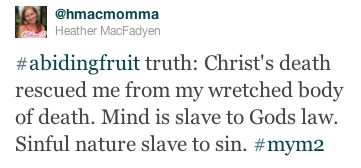
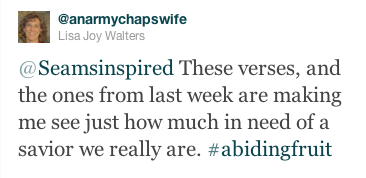
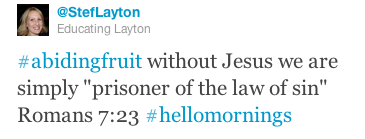
Abiding Fruit :: Twitter Style

October 6, 2011 by Do Not Depart 4 Comments

Photobucket

We’ve been having our own little small group, this week on Twitter, as we work through the Abiding Fruit study.

Love it!


He can use social media for His glory!

Are you on Twitter? We’d love for you to join in the #AbidingFruit discussion!


« Previous Page
Next Page »

This Month’s Theme

  • Jesus is the Way
  • And He Shall Be Called Series Intro

Enter your email address to have new posts emailed to you:

We’ll come to you

Enter your email address to have new posts emailed to you

Categories

Bible Memory – Lent 2021

Memorizing Isaiah 12

Let the Children Come

Let the Children Come

Want more #HideHisWord resources?

Memorizing Psalm 1

Find Us on Facebook


Search

Recent Posts

  • Series Wrap-Up: The Lord Is My Light
  • His Marvelous Light
  • When the Darkness Deepens
  • Though I Sit in Darkness…
  • Let Your Light Shine
  • Life-Giving Light

Archives

© 2026 · Pretty Creative WordPress Theme by, Pretty Darn Cute Design