• Home
  • About
    • Our Contributors
    • Our Beliefs
  • Blog
  • Bible Studies
    • Scripture Dig
  • Archives
  • Shop
  • Advertise
  • Contact
    • Email
    • Facebook
    • Instagram
    • Pinterest
    • Twitter

Do Not Depart

Encouragement and Tools to Abide in God's Word

You are here: Home / Blog

Ruth’s stark surroundings

March 3, 2011 by ScriptureDig 14 Comments

Welcome to Do Not Depart! Be sure to subscribe to the Do Not Depart RSS feed or email updates to receive regular encouragement and tools to abide in God's Word.

Welcome back to Do Not Depart! If you haven't already, subscribe to the Do Not Depart RSS feed or email updates to receive regular encouragement and tools to abide in God's Word. This post may include affiliate links. To read our full disclosure policy, click here. Thank you for supporting this site!

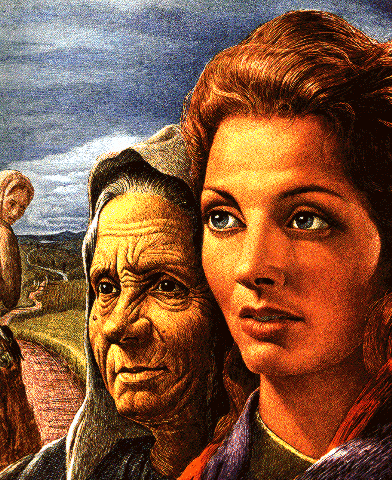
Ruth und Boas, 1825
Image via Wikipedia

“In the days when the judges ruled…” (Ruth 1:1)

This short phrase as the story of Ruth begins is a loaded one. Understanding the time period in which these individuals lived gives depth and meaning to this story – and what a time period it was! Today I am going to walk you through a brief overview of Judges to give us a better understanding of this book’s context.

The book of Judges has a very clear structure. As Judges opens, we discover that the Israelites are failing to completely drive out the Canaanites from the land – direct disobedience to God’s command at the end of Joshua and ultimately a sign that they are not believing God and obeying in faith. Throughout the rest of the book, we find this lack of faith and disobedience to God continuing to plague God’s people.

Through chapters 3-16, there is a four-step cycle that repeats seven times [it shows up also very concisely in chapter 2].

  1. The people sin and fall into idolatry (2:10-13)
  2. They are oppressed by their enemies (2:14-15)
  3. They call out to God in distress (2:15)
  4. He raises up a judge to deliver them from their enemies (2:16)

Then the judge dies and they repeat step one – only worse than before. (2:17-19)

As this cycle continues the entire nation of Israel seems to be in a downward spiral, becoming more and more spiritually hardened and morally debase. As you read through the book the stories become more graphic, more violent, illustrating a nation living in complete ignorance or flagrant disregard to the standards of the God who redeemed them. Chapters 17-21 illustrate this vividly with some of the most disturbing accounts in all of Scripture.

One of the important aspects of Judges to keep in mind as the story of Ruth begins is the treatment and role of women during this time of the judges. As the overall culture of Israel decays and moves farther and farther from the fear of God, women suffer the effects most vividly. Men are failing to step up to fulfill what God has called them to. Women are vulnerable without strong and godly male headship and are often victimized or forced to assume roles God never intended for them. From Jael using her maternal instincts to brutally kill a man to a woman being gang raped, left for dead, and dismembered as a “message” to Israel, this book is hard to read. Women become increasingly brutalized and brutal as a culture moves farther from God.

“In the days when the judges ruled…” places this story into a vivid and difficult climate both spiritually and morally. Ruth and Naomi would have been vulnerable at any time in history, but their vulnerability is that much greater in this time of chaos and corruption. A godly man like Boaz would stand out even more in this broken and depraved world. God’s sovereignty in orchestrating the godly blood-line through which the Messiah would one day come seems even more miraculous.

The book of Ruth is a calm in the storm – a reminder that no matter how broken our world may seem, our God is still on the throne. He is still very much aware of the lives of even the most forgotten members of society. His plans will never be thwarted.

Want to dig deeper into the fascinating book of Judges? Dig to your heart’s content here.

How to Study a Narrative Passage

March 2, 2011 by ScriptureDig 10 Comments

George Guthrie writes, “Large portions of the Old Testament come to us in the form of stories. They call us into a world both foreign and familiar, challenging us to find our place in a big story different from the small, boxed-in set of our personal, time-bound, culturally conditioned tales. They call us to enter God’s grand story, which tells what He is up to in the world” (Read the Bible for Life, pg 77).

Like portions of the Old Testament, the book of Ruth is a story.

It has all the elements of a story I used to have my 8th grade English students find in their reading assignments: characters, setting, plot, climax, and resolution.

It has all the qualities of a good story:  a stark setting, betrayal, disappointment, death, suffering. It has tension- racial tension, financial tension, and sexual tension. The “bad guy” at the beginning of the story turns out to be the “good guy” at the end. It is ultimately a love story.

So how do we “study” a book like Ruth? How could the simple telling of a story that happened thousands of years ago make an impact on our lives today?

First, we understand that the main character in every story in the Bible is God. When we read a passage (whether narrative, poetry, law, or epistle) we ask the question, “What does this teach me about God?”

Second, we remember that narrative passages are descriptive, not necessarily prescriptive. Meaning they describe what happened, not what should always happen. We don’t read the book of Ruth as a how-to manual for what to do if there is a drought. Or what to do if your husband dies. Or even step-by-step instructions on how to woo a man. We read it like a story, as it was intended to be read. It is a true, inspired, sanctifying story, but a story none the less.

After we find God and understand the story is not prescriptive, we are able to better see ourselves. After answering what the passage teaches us about God, we ask what God wants us to do based on what we read. We see God’s love for widows and take a minute to write a note to a widow in the church. We see His providential plan for Naomi and Ruth and trust that no matter what situation we are in, God has a plan for our lives. Ultimately, we see Christ, who is in the family linage of this poor, young Moabite widow.

God’s Word is living and active. That includes the stories written thousands of years ago. We are praying that this month’s study of the book of Ruth will teach us all more about God and His love for us!

image source

True stories are the best kind.

March 1, 2011 by ScriptureDig 6 Comments

Image from biblepicturegallery.com

The human heart seems to be programmed to respond to story.

We love a good cathartic tale where the good guy wins and love is trustworthy and everything turns out right in the end. We are drawn to tales of romance where the strong man fights to win the girl’s hand and vows to love her and protect her and soothe her broken heart. It becomes even more exciting if the world this woman faces is dangerous, cruel, and evil – and her man steps forward as the good knight in shining armor.

Did you know there was a story like that in the Bible? It’s a good one.

True, its time period and culture makes it a little hard for us to equate to a great story of romance. We lose some of the power of this story of true godly love because it is hard for us to relate to.

But this is a great tale; greater still because it is true. An amazing story because it so beautifully illustrates the sovereignty of God, the redemptive love of Jesus Christ, the care with which he orchestrates the smallest details of our lives, and the nobility He created in masculinity and femininity.

Intrigued? Join us through the month of March as we “dig in” to one of my favorite stories of all…

Ruth.

Is your faith on firm ground?

February 28, 2011 by ScriptureDig 4 Comments

Does what we believe about God, who He is, and how He works really matter in our lives? Not just yes, but absolutely yes! What we believe about God shapes our attitudes, determines our behavior, and fosters our motivations. For instance, if I believe that God is sovereign – that He has control over everything in this world – then I don’t have to fear the outcome of world events or events in my own life because I know that He is working in and through it all for His purposes.

All month long here at Scripture Dig we’ve been digging into doctrine. We examined Scripture to see what we should believe about God. Today, I want to share a resource with you that can help you use doctrine to build a faith strong enough to weather every storm of life. Unshakeable Faith is an 8-session Bible study that examines the life and teachings of Peter. God grew Peter from a fearful believer that denied Christ to a bold, fearless believer who was willing to die for his faith.

Unshakeable Faith discovers those faith characteristics God built into Peter’s life that helped him stand firm even in the face of martyrdom.

Over the last few years, many Christian women I love and admire have endured difficult circumstances such as life-threatening illness, divorce, death of a child, and financial hardship. The quality of their faith significantly affected how they endured these trials and how God worked in them for His glory. God strengthened and guided them through their close relationship with Jesus. This book includes some of their stories. Readers get to see how their faith keeps them standing firm.

A strong faith in Jesus Christ does work in real life!

This study also focuses on personal application. Learning about God, His ways, and what He desires for us is wonderful. But if we don’t apply what He teaches us, let it shape our lives, we fall short of the full purpose of study. Unshakeable Faith not only leads readers into learning God’s Word, but it also purposefully helps readers apply it. Doctrine – what we believe about God – does matter in our daily lives.

Is your faith strong enough to stand firm in trials? Do you want a faith that is truly unshakeable?

The study is available at most online bookstores and many Christian bookstores. If your local bookstore does not carry it more than likely they can order it for you. You can read a little more about the study on my website. Here are a few links to online stores.

Amazon

Christian Book

Barnes & Noble

New Hope Publishers

So What Doctrine Wrap-Up

February 25, 2011 by ScriptureDig 2 Comments

What a great month we’ve had digging deeper with you and talking about how our doctrines affect our beliefs and actions. Our goal this month was not to be wimpy women, and I think we’ve proven we’re theologians–we study God’s Word. We took on the challenge Paul gave Timothy, “Do your best to present yourself to God as one approved, as a worker who has no need to be ashamed, rightly handling the word of truth” (2 Timothy 2:15). We prayed each day this month that we would rightly handle the word of truth, and encourage our readers to also.

Here’s a wrap-up of the month:

  • Doctrine of the Word of God: “God Said It…Do I Believe That’s Enough?” by Teri Lynne
  • Existence of God: “Are You There God?” by Kathy
  • Incommunicable Attributes of God: “God Is God” by Sandra
  • Communicable Attributes of God: “In His Image” by Kristi
  • Angels: “Mighty Ones on Guard” by Julie
  • Doctrine of the Trinity: “Three-in-Oneness” by Kathy
  • The Personhood of Christ: “The Word Became Flesh and Why That Matters” by Teri Lynne
  • The Offices of Christ: “Prophet Priest & King–What the Offices of Christ Mean” by Stephanie
  • The Work of the Holy Spirit: “Holy Ghost Power” by Teri Lynne
  • The Doctrine of Creation: “Where Did Everything Come From?” by Stephanie
  • The Essential Nature of Man: “Our Deep Well” by Julie
  • The Doctrine of Sin: “Missing the Bull’s Eye” by Kathy
  • The Doctrine of Grace: “Grace in the Sky Box” by Julie
  • Conversion: “What Must I Do to Be Saved?” by Sandra
  • Justification: “The Just One Who Justifies” by Kristi
  • Adoption: “The Right to Become” by Julie
  • Sanctification: “It’s a Process (Es Un Proceso)–Or Is It?” by Stephanie
  • Baptism: “Attending Your Own Funeral” by Kristi

Did you enjoy our month on doctrine? Which topic got you “digging” the most?

Attending your own funeral

February 24, 2011 by ScriptureDig 24 Comments

An evangelical Protestant Baptism by submersio...
Image via Wikipedia

We don’t like to talk about death.

Even as Christians, even when we know where we will go, where our loved ones are… the sight of the cold casket leaves us uncomfortable. Death is the enemy. It has been stealing away our days since the Garden of Eden.

And so, Jesus came that we might have life! That life, however, comes through death.

Jesus took those nails in His hands, hung suffering on the cross, gave up His life and died… so that we could live. When the tomb cracked open early on Resurrection Sunday morning, life – real life – had triumphed. Death, where is your victory? He is risen – alive! And He offers real life to us.

This life is a free gift that requires only one thing in return – we must die.

I have been crucified with Christ and I no longer live, but Christ lives in me. The life I live in the body, I live by faith in the Son of God, who loved me and gave himself for me.

Galatians 2:20

We must repent and believe, understanding that all of our sin makes us worthy of judgment, and absolutely nothing we do can be good enough to save us. Our sinful nature, our self-righteous attempts to justify ourselves, everything we cling to must be nailed to that cross as we grasp that it is only the death of Jesus that can save us. To cling to His life, we must die with Him.

Baptism is really a funeral service – a funeral service that celebrates real life! The baptism itself isn’t what brings you this life-through-death; no one is killed by their own funeral. Baptism is a loud and vivid proclamation that we have already repented of our sin, turned to Jesus Christ in belief, and have been made new.

Therefore, if anyone is in Christ, he is a new creation; the old has gone, the new has come!

2 Corinthians 5:17

In baptism we are symbolically “buried” and “raised to new life” to publicly state that our old self has been buried – and we have received real life through placing our trust in the death and resurrection of Jesus Christ.

We were therefore buried with him through baptism into death in order that, just as Christ was raised from the dead through the glory of the Father, we too may live a new life.

Romans 6:4

John Piper says it this way:

Baptism portrays what happened to us when we became Christians. This is what happened to us: we were united to Christ. His death became our death. We died with him. And in the same instant, his life became our life. We are now living out the life of Christ in us. And all this is experienced through faith.

This is what it means to be a Christian – to live in the reality of what our baptism portrays: day by day we look away from ourselves to God and say, “Because of Christ, your Son, I come to you. In him I belong to you. I am at home with you. He is my only hope of acceptance with you. I receive that acceptance anew every day. My hope is based on his death for me and my death in him. My life in him is a life of faith in you, Father. Because of him I trust your working in me and for me. The same power and glory that you used to raise him from the dead you will use to help me. In that promise of future grace I believe, and in that I hope. That is what makes my life new. O Christ, how I glory in what my baptism portrays! Thank you for dying my death for me and giving new life to me. Amen.”

This is what it means to be a Christian – to live in the reality of what our baptism portrays. If you haven’t attended your own funeral yet, I pray you will be making arrangements soon!

This post from Ann Voskamp is probably one of the most beautiful descriptions of baptism I have ever read. It is definitely worth your time.

It’s a Process (Es Un Proceso) – Or is it?

February 23, 2011 by ScriptureDig 13 Comments

Our first year on the mission field was spent in the classroom learning Spanish. Sometimes our brains would hit a wall and we’d get so frustrated. How could we reach a nation if we couldn’t even speak the language.

Our Spanish professor would consistently remind us, “Es un proceso” (“It’s a process”).

Many believe the doctrine of sanctification is like that…a process in which we become more holy as we grow in our Christian experience. And while that’s partially true, that’s not all there is to biblical sanctification.

The word sanctify or sanctification means to be set apart or dedicated to God. In fact, the words sanctify, saint and holy all carry the same basic root and definition. They all mean to be set apart or dedicated unto God.

If we’ve been born again, we’ve been set apart unto Him – sanctified – we’re saints – and He sees us as holy.

There are three aspects to sanctification. They are Positional Sanctification, Progressive (or Experiential) Sanctification and Ultimate Sanctification.

Positional Sancatification – Being set apart by God and for God whereby He sees us as holy and wholly His regardless of our conduct. Positional Sanctification takes place when we trust Christ as our Savior and Lord, accepting what He did on the cross in payment for our sin.

“And in accordance with this will [of God], we have been made holy (consecrated and sanctified) through the offering made once for all of the body of Jesus Christ (the Anointed One).” Hebrews 10:10 Amplified

Notice the tense of the verb used in Hebrews 10:10: have been made holy – it’s used in the perfect tense meaning it’s a completed work that happened in time past and cannot be changed.

From God’s perspective, we have been set apart, we have been made holy, we have been sanctified. It was a once and for all event that altered our eternal destiny.

How humbling and reassuring to know that we’ve been sanctified through the offering of the body of Christ…once for all. Our position doesn’t depend upon our works, our faithfulness, our godliness or our own strength. It’s a divine work in which God sets us apart for Himself – once and for all.

Progressive (or Experiential) Sanctification – The continual growing process in the life of a Christian whereby we set ourselves apart for God and allow Him to have His way in our hearts and lives. It is a constant yielding of ourselves unto God and to His will. This is what we normally think of when we think of Sanctification…it’s a process (es un proceso).

The Old Testament sacrificial system mirrors the concept of Progressive Sanctification. God’s people would ‘set apart’ their offering and present it unto the Lord. That ‘sanctification’ is echoed in Romans 12:1,2 and Romans 6:13 with the phrases, “yield yourselves’ and ‘present yourselves’.

We set ourselves apart by an act of our will so that we can be led by the Holy Spirit and be changed from one degree of glory to the next (2 Corinthians 3:18).

Positional Sanctification never changes. Progressive Sanctification never stops changing as long as we’re alive.

Ultimate Sanctification – When we die we will see Jesus as He is and we’ll be like Him. Sinless – deathless and brought to full spiritual maturity.

1  John 3:2 says, “Beloved, now we are children of God; and it has not yet been revealed what we shall be, but we know that when He is revealed, we shall be like Him, for we shall see Him as He is.”

And in Jude, we’re told that one day He will present us faultless before the presence of His glory. That’s Ultimate Sanctification.

Yes, sanctification is a process, but it’s oh-so-much more!

How does understanding the Positional, Progressive and Ultimate Sanctification help you in your Christian walk?

The right to become

February 22, 2011 by ScriptureDig 9 Comments

She appeared out of her poverty at my window, smiling, filthy, fingers outstretched. She acted like our moments were stolen, while we talked and delivered precious gifts of food, a t-shirt, crayons, a book about a Heavenly Father. As a street child, she was not welcome in the restaurant, and the guard chased her away each time. Before she could answer my questions or sit down, she was signaled away to her hidden master whose cruelty kept Rona enslaved. My little friend with only a piece of a name, no family, no hope. One single declaration could’ve changed her future, a declaration of adoption.

When God responds to our faith by justifying us , He declares us acceptable. Our old identity of condemnation is cast off, while, “to those who believed in his name, he gave the right to become children of God … born of God” (John 1:12).  Instead of oppression, “The Spirit you received does not make you slaves, so that you live in fear again; rather, the Spirit you received brought about your adoption to sonship. And by him we cry, “Abba, Father” (Rom. 8:15).  From spiritual poverty we’re invited out of sin’s slavery by God’s grace and legally adopted as children who cry “Daddy” to our Heavenly Father.

Life changes when we’re adopted. We join the family of the adopted, with brothers and sisters in Christ who aren’t separated by race or language or earthly distinction (Gal. 3:25-28).  As part of this family, our Father wants to bless those He’s redeemed, so He makes us heirs of His abundance (Rom. 8:17).  We become co-heirs with Jesus Christ, meaning our current life receives new blessings and provisions, but the fullness of our adoption has yet to be realized.

“Dear friends, now we are children of God, and what we will be has not yet been made known. But we know that when Christ appears, we shall be like him, for we shall see him as he is” (1 John 3:2). Our full inheritance as adopted sons is yet to be completed. Adoption is legally declared and grants us many benefits in this life, but so much more awaits (Rom. 8:23).

From out of the impoverished darkness of spiritual captivity, adoption grants us new identity as a child of God, a new place in the family of God, a new reality for life here on earth, and a new future with a full inheritance awaiting us. For the desperate, it’s a dream come true.

Several years after I  last saw Rona, I met a little girl with similar dark eyes and tiny fingers, while helping in a classroom. But she had colorful clothes and clean hair, matching shoes and a bow. She spontaneously danced around the room, taking every opportunity to hold hands and sit close; she was used to love and trusted easily. The little girl had been found as an infant, abandoned in a field, broken and disfigured, unwanted, but she had been scooped up and rescued. She received a new identity, a new family, a new life, and a new future. After school, she was welcomed with affection by her family. She had been adopted.

Physical adoption is an earthly glimpse of a divine rescue. There’s no need to stay in spiritual rags, beg for crumbs, and scurry back to a hateful master in darkness. Once “adopted,” we should never crawl back to our desperation again. Imagine the scope of affection, inheritance, and future hope we receive once rescued out of our spiritual poverty, embraced by the One who wants us to call Him “Abba,” and welcomed safely home!


Have you seen or experienced a glimpse of earthly adoption that whispers to you of the divine?

The just One who justifies

February 21, 2011 by ScriptureDig 15 Comments

Courtroom One Gavel
Image by Joe Gratz via Flickr

What do you think of when you picture standing before God’s throne for the first time?

Perhaps you tremble at the thought. You picture your knees knocking together, your hands shaking, waiting for the deepest, darkest parts of your heart, the most shameful moments of your life to be displayed on a giant screen for all to see. You picture God as judge, glaring down at you, gavel in hand. You are unworthy. You shudder as you await the verdict.

  • God is holy. He cannot allow sin in His presence.
  • God is just. He must punish sin.
  • God is also love. He desires all men to be saved.

Truly, we have all missed the mark. We are woefully far from God’s holy standards. But because of God’s glorious grace, if we repent and believe, the scene in  heaven will look very different. God is still judge, but we have miraculously been changed. For although we were once sinners, at the moment of our salvation we were justified.

But now a righteousness from God, apart from law, has been made known, to which the Law and the Prophets testify. This righteousness from God comes through faith in Jesus Christ to all who believe. There is no difference, for all have sinned and fall short of the glory of God, and are justified freely by his grace through the redemption that came by Christ Jesus. God presented him as a sacrifice of atonement, through faith in his blood. He did this to demonstrate his justice, because in his forbearance he had left the sins committed beforehand unpunished— he did it to demonstrate his justice at the present time, so as to be just and the one who justifies those who have faith in Jesus.

Romans 3:21-26

We had no righteousness of our own. Our righteousness is like filthy rags (Isa 64:6). Since the justice of God demands punishment of sin, since the holiness of God cannot allow unrighteousness in His presence, He offers to us the righteousness of Jesus Christ. The spotless, holy Lamb of God sacrificed Himself in our place. When we place our trust in Jesus Christ and receive His sacrifice on our behalf, everything changes. The courtroom of heaven no longer looms threateningly.

When the individual receives Christ he is placed in Christ. This is what makes him righteous. We are made the righteousness of God in Him. This righteousness overcomes our desperate, sinful condition, and measures up to all the demands of God’s holiness. – Charles C. Ryrie, Basic Theology

Standing before the throne of God in our desperate, sinful condition we are certainly deserving of His wrath and judgment. But when I stand before Him dressed in the righteousness of Christ, I have nothing to fear. My sin has been atoned for. No shameful scenes will be replayed for all eternity – they are washed away, forgotten; I stand before the throne declared righteous. I could never measure up to the demands of God’s holiness – but Jesus did so on my behalf.

I have been justified. It is just-as-if-I’d never sinned.

What wondrous love is this, O my soul!

What wondrous love is this that caused the Lord of bliss to bear the dreadful curse for my soul?

When I was sinking down, sinking down;

When I was sinking down beneath God’s righteous frown, Christ laid aside His crown for my soul.

To God and to the Lamb I will sing, I will sing;

To God and to the Lamb who is the great “I Am,” while millions join the theme I will sing.

What Must I Do to Be Saved?

February 18, 2011 by ScriptureDig 16 Comments

My five year old son and I have our best conversations either in the car or at bed time. Wednesday in the car we had our best one yet!

After telling me that he is not God and I am not God, he told me that God was in heaven. I told him that actually God is everywhere. He said that God is in everyone’s hearts, “Everyone in the whole world, Mommy!” While I assured him that God has love for everyone in the whole world (according to John 3:16), that people must make a decision to have God in their lives. This brought up some big words–conversion, repentance, and salvation.

Although many of you reading are familiar with those big words, we’re going to walk through them together. The message of the gospel is easy enough for a child to understand by faith, yet deep enough for theologians to study for decades. Let’s dig deeper, friends!

Wayne Grudem writes, “Conversion is our willing response to the gospel call, in which we sincerely repent of sins and place our trust in Christ for salvation. ” The word conversion means  “to turn.” We turn from our sin to Christ. “The turning from sin is called repentance, and the turning to Christ is called faith.” So the two key steps in conversion (or salvation) are repent and believe. But what exactly are we repenting of? And what must we believe in? These are the “so what” questions in our “So What Doctrine” series. They are the questions I must answer for my son. They are the questions we have to answer when witnessing to our family and friends. And ultimately, they are the questions we have to answer for ourselves.

Repent: We repent of our sins. For salvation, I must know that I’ve done wrong, I’ve broken God’s law. Romans 3:23, “for all have sinned and fall short of the glory of God.” God’s standard is perfection. None of us are perfect. We must take personal responsibility for our sins, and recognize that we sinned against God. Psalm 51:4 says, “Against You, You only, I have sinned.” When we repent we turn from our sin.

Believe: We believe in Christ, who paid the penalty for our sins. As the sinless sacrifice, He took our punishment. Romans 4:8, “God shows his love for us in that while we were still sinners, Christ died for us.” Then Christ conquered death. Hebrews 1:3, “After making purification for sins, he sat down at the right hand of the Majesty on high.” Grudem defines saving faith as, “trust in Jesus Christ as a living person for forgiveness of sins and for eternal life with God.”

Repent and believe–that is the heart of the gospel message. It caused my son to bow his head and pray in the back seat of our minivan, “Dear God, thank you for this day. I am sorry I am a sinner. Thank you that Jesus died for my sins and came back to life.” Does he get the depth of his sin, the amazing grace God gives, or the true sacrifice of Christ on the cross? No. But he repents and believes. And that’s what God asks us to do!

For more, be sure to check out our previous series on salvation. You can read Kathy’s “Salvation Theme Review” for a summary!

« Previous Page
Next Page »

This Month’s Theme

  • Jesus is the Way
  • And He Shall Be Called Series Intro

Enter your email address to have new posts emailed to you:

We’ll come to you

Enter your email address to have new posts emailed to you

Categories

Bible Memory – Lent 2021

Memorizing Isaiah 12

Let the Children Come

Let the Children Come

Want more #HideHisWord resources?

Memorizing Psalm 1

Find Us on Facebook


Search

Recent Posts

  • Series Wrap-Up: The Lord Is My Light
  • His Marvelous Light
  • When the Darkness Deepens
  • Though I Sit in Darkness…
  • Let Your Light Shine
  • Life-Giving Light

Archives

© 2026 · Pretty Creative WordPress Theme by, Pretty Darn Cute Design