• Home
  • About
    • Our Contributors
    • Our Beliefs
  • Blog
  • Bible Studies
    • Scripture Dig
  • Archives
  • Shop
  • Advertise
  • Contact
    • Email
    • Facebook
    • Instagram
    • Pinterest
    • Twitter

Do Not Depart

Encouragement and Tools to Abide in God's Word

You are here: Home / Archives for Christmas

He Came to Proclaim

December 2, 2011 by Julie 3 Comments

visualbiblealive.com

Sometimes it’s easy to feel like we just here to do things like laundry, drive carpools, and empty the dishwasher.  People pull us into the black hole of meeting needs. Other times it’s easy to wonder why we exist at all. Do you know why you’re here? So much about Jesus’ coming was unique, including the fact that He knew exactly why He was on earth.


After healing crowds of desperate and hurting people, Jesus slipped away for some solitude and rest, apart from the black hole of needs. But they found him, longing for their Healer to stay with them. So relieved by His help, Capernaum wanted exclusive rights to Jesus. Even He faced pressure to keep His purpose the priority.

 “I must preach the good news of the kingdom of God to other towns as well; for I was sent for this purpose” (Luke 4:43).

It was necessary and right for the Messiah to announce the glad tidings that the Kingdom of God was coming. For people long focused on physical agony or even oppression by demons, the real life-changing news was the rule of Almighty God over all things. Unlike the words of prophets until that point, Jesus brought word that grace would reign because of the one time sacrifice of His life. By taking on human form without sin, Jesus provided for God’s mercy and rule. Though the crowds didn’t know it, hearing about the Kingdom and the news of salvation was the main message they needed.


Found in the solitary place by the grateful but greedy and needy crowds, Jesus did not waver in knowing why He came to earth.  “I was sent for this purpose,” to preach “the good news of the kingdom of God” to all. He was intentionally sent by God His Father to an appointed destination, earth, as Savior and Proclaimer to the world.


We’re here for so much more than laundry or shopping for presents or making cookies or addressing cards. Just as Jesus knew why He was sent here, we’ve been commissioned to “Go into all the world and preach the gospel to every creature” (Mark 16:15, NKJV).  Maybe we’ll use laundry or a gift or a cookie or a card to do it, but whatever we do, let’s do as Jesus did.  Let’s proclaim the good news. That’s why we’re here.


~ Is there someone in the “crowd” around you who needs you to proclaim good news to them this Christmas?
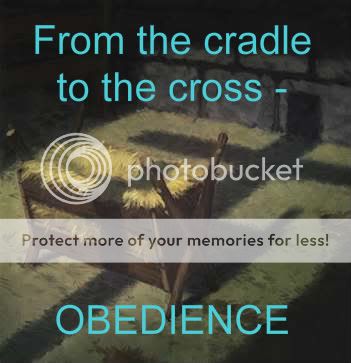
Jesus Came to Obey the Father

November 30, 2011 by Stephanie Shott 11 Comments

There is a lot about God we just don’t understand. Like how He has always existed. No beginning. No end. Just always. Or like how He knows every thought of our hearts and the number of hairs on our heads. Nothing hid. He knows it all. Or like how He is Creator and Sustainer of all that is or ever will be. No one can trump Him. Nothing can stump Him and nothing can undo what He has done. He is all powerful.

Image from Photobucket

Yet, in Philippians 2:5-8 we are told – “Have this mind among yourselves, which is yours in Christ Jesus, who, though he was in the form of God, did not count equality with God a thing to be grasped, but made himself nothing, taking the form of a servant, being born in the likeness of men. And being found in human form, he humbled himself by becoming obedient to the point of death, even death on a cross.” (Emphasis mine)

Can you fathom that?! The God of all creation demonstrated what obedience looks like when He placed Himself in a cradle to begin His journey to the cross.

As Kathy mentioned Monday, we know Jesus came to die. But He left footprints of obedience every step of the way – footprints of obedience left by a heart of humility.

In John 6:38, Jesus declared, “For I have come down from heaven, not to do my own will but the will of him who sent me.” (Emphasis mine)
And as the cross loomed largely over His earthly future, He said,“Now is my soul troubled. And what shall I say? ‘Father, save me from this hour’? But for this purpose I have come to this hour.” John 12:27 (Emphasis mine)
We all have to die. It’s just part of life. But Jesus didn’t have to. He didn’t have to come to a cradle. He didn’t have to clothe Himself with flesh. He didn’t have to tolerate those who persecuted Him. He didn’t have to endure the pain of the crown of thorns, the whips or the nails. He didn’t have to hang naked from a cross in agony as the soldiers mocked Him and those He was dying for gazed on Him with disgust.
But Jesus came to obey the Father’s will. John 4:34 says, “Jesus said to them, ‘My food is to do the will of him who sent me and to accomplish his work.'”
Jesus left a wonderful example of what obedience looks like when He went to the cross. It means we humble ourselves and die to what we want to do – even when it’s hard.
Jesus came to obey the Father – and that obedience took Him all the way to the cross. His obedience offers us hope, peace, joy and everlasting life and if He had not humbled Himself and became obedient unto the death of the cross, we would remain in our sins and we would remain without hope.
Aren’t you thankful Jesus came to obey the Father! As we approach this Christmas season let us not forget to importance of Jesus’ obedience.
Have you ever thought about the fact that Jesus came to be obedient? How should that affect our own obedience? 

Why did Jesus come?

November 28, 2011 by Kathy Howard 1 Comment

Every year at this time we begin counting the days until Christmas. Only 27 days left for shopping, cooking, and wrapping until the big day is here. Hopefully we also spend the days thinking about the reason for the celebration – the birth of Jesus.

Many churches and individual Christians observe the four-week season of Advent as a way to celebrate Christ’s birth. The word “advent” means a coming into view or arrival. For Christians, “Advent” specifically refers to the eager anticipation of the arrival of God’s long-awaited Messiah. Christian Advent officially began Sunday, November 27th. Observers may pray, fast, and read Scripture while waiting for Jesus’ “coming,” celebrated on December 25th.

With the busyness and commercialization of Christmas, Advent is a wonderful way to keep Christ in the forefront of our minds. However, we shouldn’t limit our reflection to the truth that Jesus came to earth; we should also remember why He came. That’s exactly what we’ll be doing for the next three weeks here at Scripture Dig.

Why did Jesus leave the glory of heaven to be born as a human in a stable in Bethlehem? Many times I’ve heard the statement, “Jesus came to die.” And that is true. But did you know that was only part of Jesus’ mission?

Jesus told us why He came. The Gospels record more than a dozen “I came” statements of Jesus. We will be exploring many of these over the next few weeks. Christmas took on a deeper and richer meaning for me after I first studied these statements of Christ several years ago. This year we want to share them with you. We pray God will use His Words to enrich your Christmas celebration and grow your understanding of Him.

What are some things you and your family do to help you stay focused on the true reason for the Christmas season?


Christ in Old Testament Prophecy

November 15, 2011 by Sandra Peoples 2 Comments

Remember counting down the days until Christmas when you were a child? The anticipation? There were signs Christmas was coming: decorations, Christmas songs, and gifts showing up under the tree. Even if you were too young to find December 25th on the calendar, you knew when it was getting close.

Throughout the Old Testament, God’s people were eagerly anticipating the coming Savior. Through the biblical writers, God gave clues to when the God-man would arrive. We now call those prophetic passages—they point to a time to come. Today, in our series on Christ in the Old Testament, we’re going to look at a few of these passages.

The first mention of a Savior comes in Genesis 3:15, what we refer to as the protoevangelium, or first announcement of the gospel. In giving the curse, God says to the serpent, “I will put enmity between you and the woman, and between your offspring and her offspring; he shall bruise your head, and you shall bruise his heel” (Genesis 3:15). The New Testament tells us Christ overcame Satan, just as this passage predicted (see Hebrews 2:14; 1 John 3:8; Luke 10:18; John 12:31; 1 Cor. 15:24; Col. 2:15).

The prophet Isaiah spoke of the coming Savoir, predicting many details about His birth, life, and death. Here are just a few:

  • Isaiah 7:14 says He will be born of a virgin (see fulfillment in Luke 1:26-31).
  • Isaiah 9:7 says He will be an heir to the throne of David (Luke 1:32, 33).
  • Isaiah 40:3-5 says He will have His way prepared (by John the Baptist, John 1:19-28).
  • Isaiah 53:1, 3 says He will be widely rejected (John 12: 37, 38).
  • Isaiah 53: 6, 8 says He will be our substitute (Romans 5:6, 8)
  • Isaiah 53:9 says He will be buried in a rich man’s tomb (Matthew 27:57).

The book of Psalms also foretold of events that happened hundreds of years later at the cross:

  • Jesus was crucified (Psalm 22:16; Matthew 26:56).
  • His garments were divided (Psalm 22:18; Matthew 27:35).
  • He was given wine with gall (Psalm 69:21; Matthew 27:34, 48).
  • He cried out from the cross (Psalm 22:1; Mark 15:34).
  • He had no broken bones (Psalm 34:20; John 19:33).

We can praise God today for fulfilling the promise He gave for a Savior! His Word points to Christ as the promised one, the spotless lamb, our redeemer. Thank God today, because He still fulfills His promises to us!

Primary source used: The Woman’s Study Bible

“Son of Man” for “Children of God”

November 9, 2011 by Julie 3 Comments

A name reveals much about who we are; the names of Christ are no different. The Christmas story begins in Genesis 3:15 when God told Satan the offspring of the woman would one day overcome him. At that point, He was nameless to us, except for the  “need for seed,” the seed of man.


In giving a unique promise to Abram, Adam’s descendant, God assured him of blessing. By initiating a covenant relationship with Abram, God said that in him “all the families of the earth shall be blessed” (Gen. 12: 3).  It foreshadowed the One seed who would descend from Abram to save the world:  Jesus. In chapter 15 God assured childless Abram that his descendants would multiply like stars. The flesh of an animal was cut, providing a wall of blood to pass through as the covenant was sealed. In chapter 17 God changed Abram’s name to Abraham, showing he would be the “father” of many nations. A new name often accompanies a covenant relationship of oneness and reveals a new identity. No longer was Abram simply the father of his own family; he was divinely chosen as father of many nations and ancestor of the One who would fulfill God’s Gen. 3:15 promise.  Everyone would be impacted by Father Abraham’s descendant.

Son of God became Son of Man

Like Abraham’s name changed when he entered a covenant relationship, so did that of Jesus Son of God. “And the Word became flesh and dwelt among us, and we have seen his glory, glory as of the only Son from the Father, full of grace and truth” (John 1:14).   When Jesus was born, He humbled himself in a way I can not comprehend, but He provided us the benefit of sharing in His glory. He came as the Son of God, the holy One from heaven, the Prince of Peace. Reaching out for a relationship with man meant complete humility for Him, even down to changing His name.

I’m able to take on the name “child of God,” because Jesus took on the name “Son of Man.”

“Son of Man.” Such a human name to bear, if you’re the Son of God. Such an earthly name, when you’re heavenly. Such a low name, when you’re God Most High. Yet when He entered into a covenant love with us, He took on a new name to identify with us in our flesh: Son of Man.

“And if you are Christ’s, then you are Abraham’s offspring, heirs according to promise” (Gal. 3:29).

“But when thefullness of time had come, God sent forth his Son, born of woman, born under the law,  to redeem those who were under the law, so that we might receive adoption as sons. And because you are sons, God has sent the Spirit of his Son into our hearts, crying, “Abba! Father!” So you are no longer a slave, but a son, and if a son, then an heir through God” (Gal. 4:4-7).


In the Old Testament, Abrahamreceived a new name, and God promised all of Abraham’s descendants would share in his blessing.  The name change revealed identity change! If we are Christ’s, then we’re offspring of Abraham, his heirs.


When Jesus took on the form of a man, His new name revealed a change! As flesh and blood, Jesus put on mankind and became the sacrificial Lamb, so we could put Him on. Our covenant exchange of names provided blessing for us. He took on more than our name; the Lamb of God took on our sins.  He also took on the understanding of what it means to be tempted and tried like those who are “but dust.” How comforting to know the Son of Man understands.  We can be “children of God,” because Jesus became the “Son of Man.”


Because He is the Son of Man, I am a child of God, heir of righteousness, daughter of the King, son not slave, pure not dirty, forgiven not condemned, and redeemed not guilty.  No doubt, the covenant exchange of names works in our favor, but I’m so thankful to the Son of Man through whom all the nations of the world are blessed.


How would you finish this sentence:  Because He became the Son of Man, I am ____________ instead of _____________?

Joseph- Forgotten Father

December 30, 2010 by ScriptureDig 6 Comments

Driving home one night last week I noticed a nativity scene in front of a church. Joseph had been blown over by the wind so you could really only see Mary and Jesus. No big deal, I thought to myself. It’s just Joseph. Then I got home and watched this video:


Joseph’s side of the story has never been so real to me. His love for Mary, his pain, his joy, and his devotion to his wife and son.

We don’t know a lot about the life of Joseph, but one characteristic that stands out in the verses that describe his life is his obedience.

  • He was obedient to take Mary as his wife after he heard the word of the Lord in a dream.
  • He was obedient to circumcise Jesus and present Him in in the temple, according to Jewish law.
  • He was obedient to take his family to Egypt to protect Jesus from Herod.
  • He was obedient to take his family back to Israel and settle in Nazareth.
  • He was obedient to take his family to Jerusalem for the Feast of the Passover each year.

Even though Joseph was not Jesus’ biological father, he was obedient to the call God placed on his life to raise Jesus as his own. As my family moves through the adoption process and hopes to have our new son home from Ethiopia by next Christmas, the story of Joseph touches me in new ways. May we all be obedient to raise the children God has blessed us with to honor Him!

What should I do with Jesus?

December 28, 2010 by ScriptureDig 6 Comments

Today I packed the nativity set in its boxes. The baby Jesus will spend the next eleven months safely tucked between chunks of Styrofoam. This polyresin infant has its place. I know just what to do with it and where to keep it.

But what should I do with the real baby Jesus?

Christmas is the time we celebrate His birth. The arrival of Immanuel. God with us. We celebrate the birth of Jesus during the Christmas season, but what are we to do with Jesus on December 26th?

Jesus was born in a stable more than 2,000 years ago for a specific purpose. (Check out my earlier post that details Jesus’ “I came…” statements.) In fact, Jesus’ name reveals His purpose. The name “Jesus” means “the Lord helps” or “the Lord saves.” Every person that has ever lived is in need of spiritual rescue.

The Bible says that each of us has sinned or chosen our own way over God’s perfect way. (See Romans 3:23.) The penalty for our sin is spiritual death or eternal separation from God. (See Romans 6:23.) But God loves us to too much to leave us with no hope, so He sent Jesus to provide a way of salvation. Jesus’ death on the cross provided payment for our sins. (See John 3:16.) If you’ve never received Jesus’ free gift of salvation then you’ve missed out on the real significance of Christmas.

At Christmas we celebrate the birth of a baby King. But let’s not leave Him in the manger. Let’s acknowledge His right to reign and rule in our lives every day of the year.

If you have never acknowledged your need for a Savior and given your life to Christ, do it now.

If you’ve received the eternal salvation that only Christ can give then bow your heart and knee to Him now. Thank Him for His coming. Thank Him for His death that provided payment for your sins.

He Will Go before Christ…

December 27, 2010 by ScriptureDig 2 Comments

We all dream big for our children. My husband Lee and I pray for our sons, and future children, every day. When will they come to know the Lord? What will their gifts and talents be? Will my sweet boys go to China to be missionaries or live near momma? Will they like my meatloaf or only ask for chocolate chip cookies when they come home to visit?

Elizabeth and Zacharias knew God’s purpose for their son even before he was born. Zacharias was told John would be the forerunner of Christ and that he would be filled with the Holy Spirit in his mother’s womb (Luke 1:15).

When Mary visited her relative Elizabeth who was six months pregnant, the babe leaped in Elizabeth’s womb! (Luke 1:44). Even before he was born, John was unique. He would play a special role in God’s redemptive story.

John would turn many of the children of Israel back to the Lord their God. John’s ministry was closely intertwined with Jesus’. John baptized Jesus (Matthew 3). Andrew, one of Jesus’ disciples, had previously been part of John’s ministry. And when there was a dispute among John’s disciples, he told them, “[Christ] must increase, but I must decrease” (John 3:30).

What can we learn from the life of John?

Primarily, if we follow the Lord, we will also be different from the world. James 4:4 pointedly says, “Do you not know that friendship with the world is enmity with God? Therefore whoever wishes to be a friend of the world makes himself and enemy of God.”

We should strive to lead lives that imitate Christ in every action, decision, and relationship. Author Sally Clarkson writes, “Jesus’ work in a person’s life has always begun with a call to leave behind the goals, purposes, and distractions of this world and say yes to a whole new life, a new way of thinking. ”

John’s life and even the events that caused his death are evidence of a life lived with one purpose in mind–to point people to Christ. May we all live with that purpose in mind!

image: Fra Angelico: The Annunciation (via ArtBible)

Songs of Trust

December 23, 2010 by ScriptureDig 6 Comments

Weeks ago we leaned over the edge of November’s gratitude to look into December, and we reflected on Mary’s Song of a Grateful Heart. When Mary erupted into her chorus of praise, she had just arrived at the home of her relatives, Elizabeth and Zechariah. The two were both from priestly lines of Israel, and while Elizabeth exclaimed, “Blessed are you among women, and blessed is the fruit of your womb!” Zechariah met Mary’s arrival in silence.

The aged priest Zechariah wasn’t pouting or fulfilling a vow; he was in a season of trust training. Though his visiting relative was a female, young, and pregnant, the two actually had a lot in common. Mary’s song appears in Luke 1:46-55, and Zechariah’s song appears in Luke 1:68-79.

Grounded in God’s Word

The angel Gabriel visited both of these kinfolk. First, he told childless old Zechariah his wife would conceive and bear a son with divine purpose. Next, Gabriel revealed to Mary she would bear the promised Messiah, Son of Almighty God. Though decades apart in age and distant in location, each was Grounded in God’s Word before they encountered the extraordinary. Mary revealed an understanding of God’s acts, character, and words spoken to her forefathers. Zechariah refers to Old Testament prophecies (See these shared by Kathy) and the fulfillment of God’s promises. Before they knew they would be a unique part of God’s plan, these two knew God’s truth.

Stretched to Trust

Zechariah didn’t experience the pregnancy stretch marks Mary must’ve, but because of his unbelief, the aged father-to-be was stricken with silence for the duration of Elizabeth’s pregnancy. He emerged from the temple stunned and silent. Imagine being Elizabeth when Zechariah got home from work that day! The silent months were not without purpose, though, as God took the righteous man (Luke 1:6) and kneaded trust into his heart and life. Likewise, Mary was also presented with a shock worthy message, but she was blessed for believing.  Since God became flesh, we know that Mary carried Jesus in her womb for 9 months, months in which she traveled to her relatives’ home and then to Jerusalem to be counted in the census. It wasn’t a cake walk for a young, first time mom, but the months were not wasted, as God prepared her heart for what was to come, kneading that same trust into her heart. Perhaps those months of trust training explain why we don’t read, “And lo, there was no room for them, and Mary had a meltdown on the streets of Bethlehem.” These two were grounded in God’s truth and had a strong sense of trust.

Praise Song

Maybe it was a family trait, or maybe it’s just evidence of God’s work in a yielded heart.  Despite carrying the burden of extraordinary futures, along with challenges of silence and unwed pregnancy, both Zechariah and Mary exploded in songs of praise after their angelic encounters. We don’t read a chorus of complaint or even a refrain of reluctance. We read a song of praise.  Mary expresses hers when she arrives at the home or Zechariah and Elizabeth, and Zechariah expresses his when his voice is restored at John’s birth and naming. It’s as if they couldn’t wait to rejoice and to tell us why.

Mary: “My soul magnifies the Lord, and my spirit rejoices in God my Savior, for …”

Zechariah: “Blessed by the Lord God of Israel, for …”


They weren’t super human. Though they had been scripture digging before the announcements, each had questions about the revelations. Zechariah wanted to know, “How shall I know this?”  Mary asked, “How can this be…?” Wisdom from being Grounded in God’s Word prepared them to believe.  The Stretching of their Trust prepared them for their future, and their Praise Songs worshiped God for His faithfulness.

When trust grows, it produces praise.

  • If God wanted to use you in an extraordinary way, would you be grounded in His Word and ready?
  • God may be stretching you right now through difficult circumstances. Is your trust growing?
  • Look back on God’s acts in your life this year. Ask Him for opportunities to share a song of praise for His mighty deeds.

Lights, Trees, and Glittery Things

December 22, 2010 by ScriptureDig 6 Comments

Left over. Rejected. Unchosen. Some trees at the grocery store parking lot will not be adorned or adored; they will simply stand at a tilt in the quiet lot on Christmas morning.  What makes some trees significant and other meaningless? A tree is just a tree, unless we make it something more.

This time of year there’s little shortage of lights, trees, and glittery things. To be “significant” something has to be important or have meaning.  Those who celebrate the birth of Jesus during this season may find themselves asking if what they do to deck the halls can be significant. Anyone can hang a string of lights, trim a tree, or bring in the bling, but can these things be significant in this season?


Lights … December 25th was set aside for celebrating the Feast of the Unconquered Sun during the Roman period, and others have worshiped the light of our solar system throughout history. Light has long been significant to men for various reasons; people make light significant because of the meaning we attach to it.

We know the glory of the Lord shone around the heavenly host announcing the arrival of the Baby King. A beacon star led magi to worship the Light of the World.  Light is a beautiful part of the story of our redemption, and it deserves a “spotlight” in celebrating the coming of the Light into the darkness.

Trees … Trees have been spiritually significant to mankind, including Hindus, Buddhists, and Druids, but why is a tree significant to a follower of Jesus?  Do we need a tree in our celebration?  After all, the tree itself is not our salvation.  Is it significant?

Matthew 1:1-17 tells us of the family tree that grew with divine intention to prepare the way for the rightful King of Kings. Some people refer to this as the Jesse Tree. Jesse’s descendant, Jesus, grew to be the One who gave His life for His kingdom, offering Himself on an unforgiving tree a cross shape.  The coming of the Heavenly King to the lowly earth gives us the gift of one day enjoying the Tree of Life.  A tree is a beautiful part of the telling of our story.

Glittery Things …We need look no further than our own culture to see that mankind has always been enamored by things that glitter. Reports this holiday season say luxury jewelery sales have increased by almost 3% … even in a bad economy.  People love things that sparkle and shine. Satan has always capitalized on this weakness of ours, tempting us with the lust of our eyes.  Does it mean all that glitters is essentially rotten?

Scripture describes heaven and its hosts as beautiful, and a glittering home awaits those who follow the Babe in the manger. Gold was presented to the small Jesus, because it’s a worthy of a King.


We can be surrounded by lights, trees, and glittery things that have no significance. Just as any girl can wear a white dress in a wedding, only a bride with a pure heart gives her wedding dress its significance. The decking of the halls?  If we just do what everyone else does, our decor won’t mean anything more than that around us. Anyone can be common; anyone can decorate for Christmas, but if done thoughtfully, it can reflect the significance of our Jesus’ birth.


God created lights and trees and glittery things. Let’s not be common. Let’s use what He’s made and talk about them and enjoy them in honor of their Creator and our King Jesus! One day even the kings of earth will bring their precious things to honor Jesus in the Holy Jerusalem. The glory of God will illuminate it in a way our small lights now can only suggest.

Revelation 21:24

The nations will walk by its light, and the kings of the earth will bring their splendor into it.

As we celebrate the coming of Jesus this Christmas, let’s use the lights, trees, and glittery things to celebrate the Babe that came and what is still to come!

Shepherds, Kings, and the Gifts They Bring

December 21, 2010 by ScriptureDig 3 Comments

I love to wrap gifts … finding coordinating papers and ribbons, looking for the perfect embellishments and gift tags.  I love the way my tree looks with all the presents tumbling from it and the joy of handing someone a present chosen especially for them and wrapped beautifully.

But I’ve noticed something – it doesn’t matter how lovely the paper and bows are if the gift inside isn’t meaningful.

Likewise, a thoughtful, perfect gift handed to someone in a WalMart sack can be the favorite present of the year.

We are constantly trying to impart this simple truth to our daughter:  It’s what is on the inside that matters.  In gifts and in people.

I suppose that’s why I find such grace in the gifts  brought to the Christ Child.   The first gift laid before Him was simple, wrapped in shepherd’s garb … presence.  These men, who had heard the angels sing, were there, in the stable.  That’s all … they simply came to the Babe bringing themselves.

Isn’t that the first step for all of us?  We have nothing to offer, nothing of value in ourselves.  We bring what we have – our filthy rags of righteousness – and when we lay them down wholly before Him who is Holy, we find ourselves changed, made new.

For if anyone is in Christ, he is a new creation, the old has gone, the new has come.                     1 Corinthians 5:17

But there are other gifts we find laid before the Christ Child … the presents of the Magi.   I’ve heard many explanations for why these gifts were given and what they represented.   I love that each word in Scripture is rich with meaning and detail.

However, for this day, may we consider that these gifts may also reflect the presents we bring to our Redeemer?

  • The Magi brought gold to the King of Kings, the Son whose Father owns the cattle on a thousand hills.  May we offer back to the Comforter of widows and orphans from our abundance that He will multiply in His economy the present we offer?
  • The Magi brought frankincense to the One who intercedes on our behalf, the Risen Son who sits beside His Father.  May our present be the fragrant aroma of our prayers, rising with the sacred incense as an offering to the Most High God?
  • The Magi brought myrrh to Him who was pierced for our transgressions, wore our stripes on His back.  May our present be the gifting of healing grace and words to those who are weary, weak, and burdened around us, that they might encounter the Great Physician through our faithfulness?

While our wrappings are all different, we can be assured that our Father, who has lovingly created each of us in His own image, desires what is inside each of us. When we begin by giving Him our presence, the overflow of the gifts He bestows on us will be reflected in the multitude of presents we give back to Him and to those with whom we interact.

Our Father, the Giver of every good and perfect gift, on this day we thank You for the most good and most perfect Gift of Your Son … born, crucified, raised, and reigning on high.  We lay before You what we have … our presence, our hearts to change and conform as You desire.  We offer to You the presents of our abundance – graciously given to us by You, of our prayers – continual connection of our hearts to Yours, and of our words and deeds – humbly used to point in all ways, at all times, to You alone.  In the name of Jesus, our Savior, Redeemer, and King.  Amen.

O Worship the King!

December 20, 2010 by ScriptureDig 5 Comments

What emotional response does Christmas foster in you? Joy? Peace? Love? Hope? The birth of Christ should produce these feelings in us. But what about worship? When you contemplate the arrival of the long-awaited Savior do you ever fall on your knees in worship?

The shepherds worshipped. They glorified and praised God for “all the things they had heard and seen” (Luke 2:20). The Magi worshipped. In fact, they spent several months traveling close to a thousand miles just to worship the baby King (Matt 2:2).

Today, let’s focus on two Jesus worshippers we often forget about – Simeon and Anna. Their story is told in Luke 2:21-40. (If you have time, read it now.) About forty days after Jesus’ birth, Mary and Joseph went to the temple in Jerusalem for Mary’s purification rite and to dedicate and redeem their first-born son.

At the temple, probably in the court of the women, the little family encountered these two faithful servants of God. The Gospel writer, Luke, describes Simeon as righteous and devout; filled with the Holy Spirit; and eagerly expecting the Messiah to come and rescue Israel. Luke also informs us that Anna, who had been a widow for 84 years, constantly worshipped in the temple through fasting and prayer.

As soon as they saw Jesus in the temple, Simeon and Anna realized that they had just laid eyes on the “redemption of Israel,” the promised One of God, the Messiah. They responded with worship – praise and thanksgiving to God for the fulfillment of His promise. (Here’s one of my blogs that lists OT prophecies fulfilled in Jesus.)

Simeon and Anna quickly responded with worship to God’s activity because their hearts were prepared and their eyes were open. Here are a few things I noticed about these two godly worshippers.

  • They trusted in God’s faithfulness to keep His promises.
  • They watched and waited for God’s activity with eager anticipation.
  • They were sensitive to the guidance of the Holy Spirit.

How often do we respond to God’s activity with worship? Are our hearts and minds prepared to look for and recognize His work around us?

God’s plan of salvation for all mankind was set in motion on that first Christmas. Jesus Christ, chosen to be our Savior before the creation of the world, stepped into time to carry out that plan. At just the right time and place in history he came. Without Christmas there would be no Easter. Without Jesus’ birth there would be no sacrifice for our sins. We would still be lost, separated from God for eternity. That should move us to fall on our faces in worship of the One who always keeps His promises.

Does Christmas move you to worship? How should we respond to God’s plan of redemption? Would you share your thoughts and hearts with us today?

Was Burl Ives right?

December 16, 2010 by ScriptureDig 5 Comments

Does the sound of Burl Ives’ voice take you back to childhood? “Silver and gold, silver and gold, everyone wishes for silver and gold … H ow do you measure its worth? Just by the pleasure it gives here on earth…”


Since we want Jesus to take center stage in our Christmas, we’ve considered how to celebrate in a Christ-centered way. Stephanie shared  Tips for a Christ Centered Christmas, and Teri Lynne gave ideas for Scripture-Centered Traditions.  There’s no shortage of holiday bling, and Burl Ives left no doubt silver and gold are part of complete Christmas celebrations.  Can we deck the halls and do it for God’s glory?


The people of Israel brought precious metals and jewels to adorn God’s temple. Even in the wilderness, the outside of the tabernacle was made of rough hides, but the inside was full of gold and precious things reflecting the One being worshiped.  He reveals where true value lies when He addresses our own adornment. God hasn’t put a ban on the beautiful.

Your adornment must not be merely external–braiding the hair, and wearing gold jewelry, or putting on dresses; but let it be the hidden person of the heart, with the imperishable quality of a gentle and quiet spirit, which is precious in the sight of God.  (1 Peter 3:3-4)

Instead of being wrong to deck and adorn, God wants our focus to be on a clean heart, focused on Him. He wants us to know that, while our eyes are attracted to beauty, He wants us to concentrate on what matters most.

How much better to get wisdom than    gold,    to get insight rather than    silver!    (Prov. 16:16)

Decking the halls helps us focus on the Reason for the Season, though the world’s bling can’t begin to reflect the majesty of the King who took on flesh and was born in Bethlehem.

For you know that it was not with perishable things such as    silver or gold    that you were redeemed from the empty way of life handed down to you from your ancestors,     but with the precious blood of Christ,     a lamb without blemish or defect.    (1 Pt. 1:18-19)

Instead of tossing out traditional Christmas decorations, begin with what God treasures and use beautiful things to draw attention to what’s on God’s mind.  As lovers of the Christ of Christmas, let’s be known for what we want as our centerpiece, not what we reject.

Suggestions for Decking the Halls with Meaning:

  • Show the Light has come to the world by stringing white lights, lighting a single white candle, or putting a light out in the darkness of your yard or forest.
  • The incarnation is a display of Christ’s humility. Place a golden crown on a bed of burlap as  centerpiece. Write Phil. 2:5-8 on a card and tuck it under the crown.
  • Jesus is God’s gift to the world; we see gifts of worship offered to Him. Wrap a royal gift as your table centerpiece, and when you give gifts to each other, talk about how it’s a reminder of God’s generous love gift to us.
  • Salvation rests on Christmas. Use the candy cane story to read together and discuss Jesus’ sacrifice. Use white lace on your counter top or table, placing a red amaryllis in the center to represent the blood of the baby who grew to be a man.

God doesn’t want us to eliminate adornment; He wants us to use it to celebrate what is truly to be treasured.

Burl Ives was not right. We don’t measure the value of silver and gold by our enjoyment. We can’t measure the majesty of the one it reflects, but we can celebrate Him with earthly expressions of our heavenly Babe King!

Silver and gold, silver and gold. Jesus our King deserves silver and gold.
We can not measure His worth, but we know He came to redeem men on earth.
Silver and gold, silver and gold, means so much more when we see
silver and gold decorations hung for the King of Kings!

Deck away, Scripture Dig friends, and may we glorify our Jesus in each beauty we display!

25 Tips for a Christ Centered Christmas

December 15, 2010 by ScriptureDig 15 Comments

Do you struggle with keeping Christ the focus of your Christmas? From Black Friday to Christmas day we are often distracted from the Savior we are celebrating. Why is it so easy to get caught up in it all when we know Jesus truly is the reason for the season.

During the Christmas season, we have an opportunity to reach people who are in need.

Ephesians 2:10 says, “For we are God’s handiwork, created in Christ Jesus to do good works, which God prepared in advance for us to do.”

Sometimes we just need a plan or an idea to help us shift our celebratory gears. Below are 25 ways to help us keep Christ the focus of our Christmas. Perhaps they will help us all do some of those good works God prepared for us to do.

Here we go:

1. No tree. Place a large manger scene in your living room instead. Place your gifts in front of the manger.

2. Ornaments with the various names and titles of Jesus on them. (You can create your own & make it a family time craft event)

3. Throughout the month of December, read the Bible with your family at dinnertime and focus on passages that teach who Jesus is and what He has done for us.

4. Teach your children of Jesus’ sacrificial love by taking them shopping for those who are unable to give anything in return.

5. Determine to give a tangible gift to Jesus. Put it in a box, wrap it and put it under the tree. On Christmas day, explain why  you are giving that particular gift to Jesus.

6. Give the gift of time to a particular ministry to show the love of Jesus. (A homeless shelter, a children’s home, a hospital, ect…) Or write cards or give gifts to a family of a prisoner.

7. Hold a birthday party for Jesus. (You may want to let your children know it’s not the actual “day” of His birth, but a time we celebrate Him)

8. Invite a widow or someone who is alone to spend Christmas with your family.

9. Create a family Christmas play. Practice throughout November & December. Put out flyers in your neighborhood and do the play in your front lawn on Christmas eve.

10. Play “Jesus” Christmas music all month long.

11. Organize a group to go caroling during Christmas.

12. Do random acts of giving in Jesus name. (Pay for the person’s meal behind you, rake the neighbor’s lawn, ect…)

13. Take food to a family in need.

14. Buy some gifts and take to the hospital to give to those who are in long term or critical care.

15. Put a play on or sing Christmas carols at a local nursing home.

16. Help your children earn money to buy gifts for Operation Christmas Child or a local children’s home.

17. Help your children earn money to give to a missionary.

18. Help your children earn money to buy gifts for a missionary child on the field.

19. Organize a coat and/or blanket round-up for a homeless shelter near you.

20. Make or purchase gifts to give to your neighbors. Especially the ones you are trying to reach for Christ.

21. Bake goodies for your neighbors, family and friends.

22. Make your indoor and outdoor decorations reflect that Jesus really is the reason for the season.

23. Help your church collect gifts for a family in need.

24. Send Christmas gifts and cards to military personel, their families.

25. Share Jesus with as many people as you can between now and Christmas.

Christmas is such a wonderful time of year. It’s the time the world is reminded that God loves us so much that He sent His only begotten Son so we could spend eternity with Him. It’s the time we reflect on the earthly life of Christ…from the cradle to the cross. It’s the time we celebrate Jesus and all that He is and all that He’s done.

I know you probably have a few ideas of your own. How do you keep Jesus the focus of your family’s Christmas? I’d love for you to share some of the ways you maintain a Christ centered Christmas!

Scripture-Centered Traditions

December 14, 2010 by ScriptureDig 4 Comments

From Christmas trees to candy canes, stockings to Santa Claus, Christmas is a holiday fraught with tradition.   While there are countless articles and blogs that explain the history of each tradition for this season, at Scripture Dig we want to share with you a few traditions and ideas that focus on the Word of God while sharing the beauty of the Word-become-Flesh.

Our desire here is to encourage you to dig into Scripture and use that as the foundation for every aspect of your life.  And during this time of year, we want to continue to point you back to the Bible as you celebrate this most precious holiday … the birth of our Lord.

The Advent Wreath

The Advent wreath is one of my favorite Christmas traditions.  I remember the weekly lighting of the candles at my church growing up.  There is something so beautiful about setting aside time to anticipate the Coming of the Christ.  While the particular details of the Advent wreath vary in different church backgrounds, the foundation is the same.  Beginning with the First Sunday of Advent, the lighting of a candle can be accompanied by a Bible reading and prayers. An additional candle is lit during each subsequent week until, by the last Sunday before Christmas, all four candles are lit. Some Advent wreaths include a fifth, “Christ” candle which can be lit at Christmas.

The Scriptures read with each candle are as follows:

  1. The Candle of Hope: Representing the hope and promise of the coming Lord, this candle reminds us of the hope we have in Christ and the promise of eternity with Him.  Scripture associated with this candle includes Isaiah 11:1-10 and/or Isaiah 7:10-14, 9:6-7; Isaiah 11:1-5 and/or Jeremiah 33:14-16.
  2. The Candle of Preparation: Representing His light and our preparation, this candle affirms our own need to prepare for His coming.  Scripture associated with this candle includes Psalm 25:1-10 and/or Psalm 27:1-7, 18-19 and/or Micah 5:2 and/or Matthew 2:1-12.
  3. The Candle of Joy: This candle reminds us of the joyful news the angel brought for all man.  Scripture associated with this candle includes 1 Thessalonians 3:9-13 and/or Romans 15:4-13 and/or Matthew 1:18-25; Luke 1:26-38
  4. The Candle of Love: Representing the love of the Father, this candle reminds us of the great gift of God the Father and His love for us in sending His Son.   Scripture associated with this candle includes Matthew 3:1-12 and/or Luke 21:25-36 and/or Luke 2:8-20.

Many traditions also include a fifth, center candle which is the Christ Candle.  Representing the incarnation – the very meaning of this season – this candle reminds us of the Christ, the Spotless Lamb of God sent to pay for our own sin.  Verses read with this candle include Luke 2:1-20; Psalm 100; Revelation 3:20-21.

The Jesse Tree

The Jesse Tree is a depiction of the lineage of Christ through Jesse, the father of King David.  This beautiful tradition walks us through the genealogy of Christ and helps us gain an understanding of how all of Scripture breathes His name … from Genesis through Revelation, it is Him – Logos, the Word-become-Flesh – who is the promise and the fulfillment of the promise all in one.

The beautiful, full-of-grace Ann Voskamp has created an incredible {and FREE!} devotion book and set of ornaments to be used for a Jesse Tree and I highly recommend that you read the devotions even if you choose not to create an actual Jesse Tree.  Walking through Scripture in this manner is a powerful way to prepare your own heart for the wonder and beauty of THE Gift of Christmas.

The Gospel of Luke

Last year, my husband mentioned he was reading the Gospel of  Luke throughout December.   There are 24 chapters of this book and so he would finish on Christmas Eve.  I joined him in that endeavor last year and have continued that practice again this year.   Reading through the life of Christ as we move closer to the celebration of His birth has been a transforming experience for me.   I cannot begin to explain the depth of meaning I found last year as I took Communion during our church’s Christmas Eve service having just read of Christ’s resurrection earlier that day.

I encourage you to make Scripture an integral part of your Christmas preparation and tradition … and would love to hear from you of other ways you have incorporated the Word into your celebration.

{Image from msormann via flickr}

Why Jesus Came

December 13, 2010 by ScriptureDig 7 Comments

As soon as I finished storing the leftover Thanksgiving turkey in Tupperware, I began putting up the tree and cluttering every surface of our house with nativity scenes, reindeer, poinsettias, and twinkly lights. Every year our family – like many of you – goes to great lengths to celebrate the birth of Jesus. But do we ever slow down to seriously contemplate why He came?

A couple of years ago, God drew my attention to several statements Jesus made that included the phrase “I came” or “I have come.” Of course, I had read them many times before, but had never considered them in the context of Christmas. As I searched the Gospels I found more than a dozen of these “I came…” statements. As I studied them, Christmas took on a deeper and richer meaning for me. This year, I would like to share them with you. I pray God would use His Words to enrich your Christmas celebration and foster worship of Him!

Jesus’ “I came” statements fall into three general categories, so we will look at them in those groups. I did not include all the passages themselves due to space. I encourage you to read these verses during your quiet time between now and Christmas. Use them to reflect on our gift of a Savior!

Group One: Jesus came to be the Father’s representative

Jesus made it very clear that He came to reveal the Father to the people. He never did or said or initiated anything on His own. He came in complete submission and obedience to the Father. He sought to please the Father and bring Him glory.

1. John 6:38 – Jesus did not operate from a personal agenda. He came only to do the Father’s will.

2. John 12:27 – He came to obey whatever the Father directed, even if it meant suffering.

3. Matthew 5:17 – Jesus came to complete what the Father initiated, including the Law and prophecy, not to change or abolish it.

Group Two: Jesus came to carry out the Father’s mission of salvation

Jesus came as the Father’s representative to fulfill the Father’s will. And the Father’s will was to provide redemption for all mankind. Jesus was His agent of redemption.

“For God so loved the world that He gave His one and only Son, that whoever believes in Him shall not perish but have eternal life. For God did not send His Son into the world to condemn the world, but to save the world through Him (John 3:16-17).”

4. Mark 2:17 – Jesus came to call sinners and heal the spiritually sick.

5. Luke 19:10 – Jesus came to seek and to save the lost.

6. John 10:10 – Jesus came to provide abundant life.

7. John 9:39 – Jesus came to give “sight” to those who had been blind to spiritual things. He opened their understanding so they could receive Him.

8. John 12:46-47 – Jesus came as a light to save. The Light of the world draws people out of spiritual darkness.

Group Three: Jesus came to further the Kingdom of God

Jesus came as the Father’s representative, to carry out the Father’s mission of redemption, in order to establish a Kingdom. Have you ever noticed how much Jesus talked about the Kingdom of God? He saved us so we could be a part of His Kingdom. Jesus came to reveal the truth of God’s Kingdom to the world.

9. Luke 4:43 – Jesus came to preach about the Kingdom of God. From town to town He declared the rule and reign of God.

10. John 18:37 – Jesus came to be a King and to bring truth. Jesus victoriously rules and reigns today!

11. Matthew 20:28 – Jesus came “to serve, and to give his life as a ransom for many.” He set the example for the citizens of God’s Kingdom.

12. Luke 12:51 – Jesus came to “bring division.” His offer of salvation requires a decision. Those who receive Him enter His Kingdom. Those that reject Him do not. (Find out now how to have a relationship with Jesus.)

If you are like me, when I celebrate Christmas I tend to limit my view of Jesus to a baby in a feed trough filled with hay. Yes, that’s how He arrived, but that is not why He came. As you celebrate Christmas this year, don’t leave Jesus in the manger. Remember, He came as the Father’s representative to provide a way for your salvation and establish God’s Kingdom on earth. Rejoice with exceeding great joy!

Merry Christmas!

Kathy


« Previous Page
Next Page »

This Month’s Theme

  • Jesus is the Way
  • And He Shall Be Called Series Intro

Enter your email address to have new posts emailed to you:

We’ll come to you

Enter your email address to have new posts emailed to you

Categories

Bible Memory – Lent 2021

Memorizing Isaiah 12

Let the Children Come

Let the Children Come

Want more #HideHisWord resources?

Memorizing Psalm 1

Find Us on Facebook


Search

Recent Posts

  • Series Wrap-Up: The Lord Is My Light
  • His Marvelous Light
  • When the Darkness Deepens
  • Though I Sit in Darkness…
  • Let Your Light Shine
  • Life-Giving Light

Archives

© 2026 · Pretty Creative WordPress Theme by, Pretty Darn Cute Design
