• Home
  • About
    • Our Contributors
    • Our Beliefs
  • Blog
  • Bible Studies
    • Scripture Dig
  • Archives
  • Shop
  • Advertise
  • Contact
    • Email
    • Facebook
    • Instagram
    • Pinterest
    • Twitter

Do Not Depart

Encouragement and Tools to Abide in God's Word

You are here: Home / Archives for New Testament

Love Like Him: 1 Corinthians 13:1-3

May 28, 2012 by Guest Post 10 Comments

“Love is not affectionate feeling, but a steady wish for the loved person’s ultimate good as far as it can be obtained” C.S. Lewis

The breeze blows in as the sun sags low on the horizon. Dinner’s still unmade and words twist tangled in a mess in my head and my heart. I’m dying for some peace and quiet to try to undo the knots that have accumulated throughout this day. They’re all hanging on me this this late hour and emotionally I love them but my actions speak another emotion.

Annoyance. Frustration. Irritation.

When it comes down to it it matters little to them if I make their favorite pumpkin-chocolate-chip muffins, or those stuffed peppers he’s been begging for. That’s nice of me. It makes them smile and their smiles make me feel good, but those are just actions.

Anyone can make them muffins. A restaurant could deliver the craved stuffed peppers.

Who cares?

If I just move through the motions of loving my family but don’t actually love them with the selfless love of Christ, it’s all meaningless.

In 1 Corinthians 13:1-3 Paul says,

If I speak in the tongues of men and of angels, but have not love, I am a noisy gong or a clanging cymbal. And if I have prophetic powers, and understand all mysteries and all knowledge, and if I have all faith, so as to remove mountains, but have not love, I am nothing. If I give away all I have, and if I deliver up my body to be burned, but have not love, I gain nothing.

I’ve read and re-read this scripture repeatedly–with each reading I stand convicted.

Our motives matter. Obedience out of obligation is worthless.

Obedience on the outside is easy compared to obedience of the heart. 1 Samuel 16:7 reminds us that God looks at our hearts. Christ commands us to love one another, not just for their benefit, but for our own as well (John 15:11). Paul says when we crash through life, gongs banging, we are nothing and we gain nothing. We make ourselves irrelevant by acting apart from love.

The Greek word Paul uses here for love is agape. This is not an emotional love. Agape is the love that went to the cross for us. Agape love says “I love you no matter what you do, whether you love me back or crucify me, I will love you”.

When I love selfishly, with my hand out waiting for my reward and acknowledgement, it’s worthless.

Galatians 5:22 names love as the first fruit of the spirit. 2nd Peter chapter 1, he says to add to our faith, (among other attributes) unselfish love. Peter goes on to say in verse 8, “for if these things are really yours and continually increasing, they will keep you from becoming ineffective and unproductive in your pursuit of knowing our Lord Jesus Christ more intimately.” To Paul’s point, when our motivation for our actions and behaviors is love, we are no longer clanging cymbals–ineffective, noisy nothings. Offering nothing, gaining nothing.

This term Paul uses for love is used roughly 228 times in the New Testament.

Love matters.

1 Corinthians 13:13 names love as the greatest gift. Christ demonstrated what that love looks like, as He made His way to the cross and bore our sins.

We are called to love like Christ–to love unselfishly. In John 13:34 Christ says,

“A new command I give you: Love one another. As I have loved you, so you must love one another. By this everyone will know that you are my disciples, if you love one another”.

Christians are to make Christ known to the world not by flaunting their spiritual gifts, but rather by demonstrating the sacrificial love of Christ that places others before self and willingly bends low to raise another up.

Apart from this we’re just noisy–just hollow clanging, banging emptiness with no purpose, with no effectiveness.

We make our way from yard to kitchen, kicking off shoes and lumbering a dusty-sweaty trail of half-pints upstairs to the tub, these words press hard at my heart and I catch myself before I open my mouth. I must love them, even when I am tired and aching for quiet. I must love them because that’s Christ in me. Learning to love as He loves is no simple task. A thousand opportunities present daily and love becomes a choice to be made.


If you aren’t yet, consider joining us for the Love Like Him bible study? You are welcome to jump in any time!

What did you learn from the passage this week? What is God showing you about the way you love?


Kris is just a girl who loves Jesus with her whole heart. She is a stay at home mom, MOPS Coordinator and an Advocate for Compassion International. Kris winds through her days, homeschooling 4 kids, and playing wife to her amazing husband.The floors are covered in crumbs and the washing machine never stops running (never!) but she counts each day as a gift! In her spare time (ha!) she writes, reads and plays with her camera.

DO. GO. STAND.

April 16, 2012 by Julie Leave a Comment

Open Prison Cells
Open Prison Cells
Photo by Arvind Balaraman

Three weeks ago, the news was heavy: six of our partners imprisoned in a hostile country. Their court case won’t be heard until this Wednesday, but their chances for justice are, by earthly standards, slim. If they are miraculously given their freedom, there’s no chance they’ll stay shackled. They’ll go to where the freedom is, and they’ll celebrate their release.  But until this Wednesday, we pray.

Sin imprisoned all of mankind and all of creation in corruption’s cell; even the world waits for freedom (Romans 8:19-23).

If you can … DO!

In speaking to bondservants in the position of slaves, Paul encouraged that, “if you can gain your freedom, avail yourself of the opportunity” (1 Cor. 7:21). When one who has been captive gains freedom, there’s no reason to return to the master of cruelty. We are encouraged that since, “You were bought with a price; do not become bondservants of men” 1 Cor. 7:23.  The earth and all of mankind waited for a liberator.  If you can be free … DO!

Sin bound each soul since birth, but we are not without hope. Though we once gave ourselves as slaves to evil, we can give ourselves to a new Master. Our “kyrios” is the One who owns, possesses, and controls us; He is our Lord, and “the Lord is the Spirit, and where the Spirit of the Lord is, there is freedom” (2 Cor. 3:17).

If it’s there … GO!

There is a place of freedom within our reach. “For just as you once presented your members as slaves to impurity and to lawlessness leading to more lawlessness, so now present your members as slaves to righteousness leading to sanctification” (Romans 6:19).  Freedom for one-time prisoners awaits in the presence of the kyrios, the Master. If its’ there … GO!

Why would a prisoner return to his cell? Paul asked the Galatians, “now that you have come to know God, or rather to be known by God, how can you turn back again to the weak and worthless elementary principles of the world, whose slaves you want to be once more?” (Galatians 4:9). Once the case is heard and the captives are freed, why would they return?  But some do.

If it’s done … STAND!

Christ sacrificed his perfect life for the sake of our freedom. “For freedom Christ has set us free; stand firm therefore, and do not submit again to a yoke of slavery” (Galatians 5:1).  If his work has paid the high price for our freedom, we should stand and stay in it, not turning back to our captor who would gladly re-chain us. Since we were called to be free (Gal. 5:13) we should,   “Live as people who are free, not using {our} freedom as a cover-up for evil, but living as servants of God” (1 Peter 2:16).  The payment for our release has been made, so we should stay that way and not make excuses to go back to our cell or corruption.  If it’s done … STAND!

Freedom in Christ!

We could offer to pay the price for the physical freedom of our friends. No one could offer a price high enough for Satan to free us. “For freedom Christ has set us free.”  He paid what no one else could, and the case is closed. No one has the power to recapture us; why would we ever want to give up our precious, dearly bought freedom? Why would we go back?

  • Our freedom from sin’s slavery is possible.
  • Our freedom is in the presence of the Lord’s Spirit.
  • Our freedom is completely paid for.
  • If you can … DO!
  • If it’s there … GO!
  • If it’s done … STAND!

Would you pray with me for the decision of those who will hear the case of our partners in chains? Their captors are but slaves, themselves. Oh that they would know the same freedom offered to each reader today through the Friend who paid our ransom prince. Our freedom physically and spiritually is a gift. Let’s DO, GO, STAND!

Keys to understanding

March 19, 2012 by Julie 4 Comments

It’s time to plan a summer vacation, but I dread the question of “What to do with the dog?”  When we camp, he comes, but when we travel far, he stays. And when he stays, I worry that his in-bred habit will be his fatal flaw.  Given the opportunity, he’ll bolt. Finding someone to watch Trace is a delicate business.

When his caretaker reads the following directions, they CAN NOT miss the vital meaning.

Our dog runs away. If you leave the door open, then he’ll run out. His breed has the urge to hunt, so they bolt. The front door has to stay closed so he doesn’t escape. So, above all, don’t leave the door open. He’ll slip through and run away!

To be a faithful steward of our house and dog, a house sitter must catch the key words of our message:  “run” (bolt/escape) and “door.”

When words are vital, they’re repeated for emphasis. In a Biblical book or passage, key words point to the text’s important meaning. To miss out on the repetition would be to let the most significant message escape.  Dependable caretakers notice the “If … then”  words in our directions that spell out a potential cause and effect.  “So” introduces an application we want to underscore, in light of the facts. Take a look at these examples of how God repeated key words in the text of scripture for our understanding:

  • The Gospel of John helps us understand who Jesus is by repeating “I am” throughout the book.
  • Revelation 1-3 includes the repeated phrases: “And to the angel of the church in ____ write … I know your …”  Repeatedly, John wrote the Lords words: “I know your works…”  Each letter to the 7 churches ends with, “He who has an ear, let him hear what the Spirit says to the churches,” and he specifies promises “To the one who conquers.”  These are personal letters, from the heart of an all-knowing God, longing for His followers to be “conquerors” in the face of their challenges.

Look at how the meaning of a passage stands out when we focus our attention on the repeated language, the KEY WORDS.  Key words are the keys to understanding.

7 So Jesus again said to them, “Truly, truly, I say to you, I am the door of the sheep. 8 All who came before me are thieves and robbers, but the sheep did not listen to them. 9 I am the door. If anyone enters by me, he will be saved and will go in and out and find pasture. 10 The thief comes only to steal and kill and destroy. I came that they may have life and have it abundantly. 11  I am the good shepherd. The good shepherd lays down his life for the sheep. 12 He who is a hired hand and not a shepherd, who does not own the sheep, sees the wolf coming and leaves the sheep and flees, and the wolf snatches them and scatters them. 13 He flees because he is a hired hand and cares nothing for the sheep. 14  I am the good shepherd. I know my own and my own know me, 15  just as the Father knows me and I know the Father; and I lay down my life for the sheep. 16 And I have other sheep that are not of this fold. I must bring them also, and they will listen to my voice. So there will be one flock, one shepherd. (John 10:7-16)

John 10:1-16 uses key words like sheep, sheepfold, flock, and shepherd to explain how Jesus is the good shepherd. The key words paint a picture of the relationship the shepherd has with the sheep.

It really helps me to “see” the key words in a passage when I highlight them in the same color OR draw a simple symbol over them. The most significant ideas jump off the page at me. When I see “shepherd,” I draw a simple shepherd’s staff.  “Sheep” gets a fluffy shape around it. Choose what symbol resonates in your mind to mark a key word. If you’ve been in Precept studies, you’ve done a lot of this, but you can keep it simple and make it work for you. By marking those important, repeated key words, the meaning jumps off the page and into our heart and mind.

The treasures of God’s word are too important to let them slip past us and escape our understanding. Key words are the keys to understanding. Ask God to help you discover the key words, and be a faithful steward of what He’s left in your care.

Practice looking for a key words in John 10:7-16 and uncovering the exciting truths they hold:

  • Go back to verse 9 and discover the “If/then” statement.
  • There are 4 verbs that “anyone” can do.  What is the first verb that produces the other 3? List them.
  • Look for every mention of the Shepherd. What is said about the Shepherd?
  • Go back and circle the pronouns that refer to the sheep; what do they reveal about the sheep?


Finally!

December 16, 2011 by Kathy Howard Leave a Comment

Eager anticipation dominated the Christmases of my childhood. All the traditions of the season promised the arrival of the big day – the tree, the brightly wrapped packages, the lights, and the music. These things by themselves were not Christmas, but they signaled its coming. When I woke on the morning of December 25th all these traditions found their full expression.

Although I loved all the Christmas activities, I did not appreciate their full meaning until years later. (If you’re interested, here’s a great article from the Crosswalk.com archives that gives the spiritual significance of many well-loved Christmas traditions.)

Like the Christmas activities point to Christmas, so the Old Testament points to Jesus.

The Law, the sacrificial system, the feasts, and prophecies all find their full expression in the person of Christ. The Old Covenant that God made with the Israelites anticipates the New Covenant found only in the Son.

For the last three weeks here at Scripture Dig we have been exploring the “I Came” statements of Jesus. As we celebrate His birth, we did not want to miss the reason Jesus came. Here is what we’ve discovered:

  • Jesus came to obey the Father
  • Jesus came to preach about the Kingdom of God
  • Jesus came to call sinners and to heal the sick
  • Jesus came to seek and to save the lost
  • Jesus came to give abundant life
  • Jesus came to serve and to give His life as a ransom for many
  • Jesus came to be King and to bring truth

Today, on our final post of this series, we see that Jesus came to “fulfill” the Law and the Prophets (Matthew 5:17). Everything in the Old Testament pointed to Christ. Jesus was the goal, the purpose of the Law and the Prophets. Here are a few examples:

  • The Passover – Jesus is the Lamb of God that takes away the sins of the world (John 1:29).
  • The Sacrificial System – Jesus, the “once for all” sacrifice, provided what the blood of bulls and goats never could (Hebrews 10:1-10).
  • The Day of Atonement – Jesus is our High Priest who enters the actual Holy of Holies on our behalf (Hebrews 9:11).
  • Manna, bread in the wilderness – Jesus is the Bread of Life, the true bread from heaven (John 6:30-32).

Jesus has always been God’s plan for establishing a relationship with His people. Jesus was not the backup plan when all else failed. Even before God created the world, He determined that Jesus would die to provide salvation for mankind (1 Peter 1:20). The Old Testament – the Law and the Prophets – anticipate the fulfillment of God’s plan. They find completion and full expression in Christ. Finally! He’s here!

What is your favorite picture of Christ in the Old Testament?

Not your average king

December 14, 2011 by Julie 1 Comment


The news from 2011 will reflect a wave of uprisings washing across Europe and the Middle East, crashing onto cities like London, Jerusalem, Cairo, and Athens. With an election year in the United States, voices of discontent call out and seek a champion for change. The port of Oakland, California was shut down Monday, Dec. 12 due to protests related to the Occupy Wall St/Oakland/Portland/… Movement.  Mankind has always sought rulers to lead well, measuring success in peace, prosperity, and power. As Israel awaited her prophesied Messiah’s coming, it was no different. They looked for a king to break the bondage of Rome and restore the glory days of earthly man-kings like Solomon and David. They weren’t looking for a Jesus.

www.theblaze.com

Jesus was not your average king, and yet Hecame to be King and bring even more than Israel asked for. He came to bring truth. He came to be “a light for revelation to the Gentiles, and for glory to your people Israel” (Lk. 2:32).


Word that the King of the Jews had been born somehow trickled down to all ears, despite the absence of YouTube and Twitter. Herod wanted to know where the reported king was, because a Jewish King was a threat to the heavy hand and unbending control of Rome. To the people of Israel, however, His coming meant a glimmer of hope.


After the arrest of Jesus, Pilate drilled the question at Him that all wanted to know: “Are you king of the Jews?” (John 18:33-37) The King himself said His kingdom is “not of this world;” He did not come for earthly dominion … yet. His kingship is spiritual, and He will ultimately bring all things under His rule. He was not arriving to bring a reign of immediate prosperity or even peace; He was coming for much greater riches than that. “For this purpose I was born and for this purpose I have come into the world— to bear witness to the truth” (John 18:37).


Jesus was not your average king. He WAS born to reign, but not merely over things like economies and governments. When Herod searched for Him and Pilate questioned Him, He was no threat to their immediate future. And when some people followed and some people mocked, there was no question He would reign over their eternity.


He was born to reign, but not as they expected. He is the Son of God who will sit on the throne of David to reign forever, with no end to His kingdom (Luke 2:32-33).  Jesus came to be King and bring the truth.


So who will reign over the governments of Europe and the Middle East and Asia and the United States in unsettled cities in 2012? No one knows. Men await rulers to free them, bring peace, and create prosperity.


Let’s not be so consumed with looking for “average kings” to make our “here and now” what we want that we miss the One who came to rule and reign.


  • – Are you living like Jesus is the King of your life? Do you know the truth He came to bring?
  • – We can all start a campaign in our hearts for “Occupy ME!”


Serve, Give, Tell … This Is Why He Came

December 12, 2011 by Teri Lynne Underwood Leave a Comment

But Jesus called them to him and said, “You know that the rulers of the Gentiles lord it over them, and their great ones exercise authority over them. It shall not be so among you. But whoever would be great among you must be your servant, and whoever would be first among you must be your slave, even as the Son of Man came not to be served but to serve, and to give his life as a ransom for many.”   Matthew 20:25-28, emphasis added

Serving, Service, Giving, Generosity, Sacrifice

Jesus came for specific reasons and in this passage, we find two of the most significant.

To Serve and To Give His Life as a Ransom

Jesus came to show us how to live and to give us the opportunity for eternal life.

When we serve, we look like Him.   When we give generously and sacrificially, we look like Him.

And, best of all, when we acknowledge Him as Savior and Lord, we become co-heirs with Him for eternity {Romans 8:17}.

How does this look in daily life?  How do we live out the example He has given us? 

We serve.  In our homes, in our churches, in our workplaces, in our communities, around the world.   Sometimes our service seems small – wiping babies’ faces or picking up toys for the hundredth time today.  But when we serve with a pure heart, no service is small.

We give.   In a world where top television shows celebrate hoarding and getting more and bigger, the life of one who gives stands out.    There are countless ways to give from providing a goat to family across the world to taking cookies to thank a police officer across the street … opportunities to give are limitless.   We are called, commanded, to be a people who give generously, sacrificially, willingly.

We tell.   Too many believers are afraid to share their faith.  But we have been given a spirit of power {2 Timothy 1:7} and we are called to share the gospel as we go {Matthew 28:19-20}.  Telling others about the ransom Christ paid for our sin should be a part of our daily conversation.   We must be unafraid to share the truth … we must tell.

Today, every day, will you live in the example of Christ and serve and give and tell?

A Big, Big Life

December 9, 2011 by Teri Lynne Underwood 2 Comments

When we moved to Alabama this summer, I was given a new set of dishes.  I love them!   They are part of the LIFE  collection from Day Spring.   One of my favorite verses is inscribed on them …

I have come that they may have life, and have it to the full.  John 10:10

Life … zoe.  One of my lexical aids described this life as “the very life of God, of which believers are made partakers.”

We are partakers of the very life of God!  

And not only that, He offers us this life to the full.

Abundantly … over and above, more than enough.

Friends, Jesus came so that we would be able to live the fullest, most abundant, crazy over and above, more than enough lives!

What does this big life involve?

Relationship with Him … We are invited into the very life of God, intimacy with the Creator and Sustainer of everything.   That’s big!

Relationships with others … We are offered community, fellowship, and interaction with fellow believers in order to strengthen and support one another.   We are given the opportunity to sow into the lives of unbelievers in order to point them to the Giver of all life.

Receiving blessing now … Isn’t God good?  He gives us gifts innumerable and blessings unimaginable – every. single. day.

But the best part is,

Redemption for eternity … In all of life, there is no greater gift than THE Gift – the gift of salvation and the promise of eternal life.

Jesus came to give us abundant life – now and forever!

How have you experienced life to the full?

{image from Dayspring}

Jesus Came to Seek & to Save the Lost

December 8, 2011 by Stephanie Shott 4 Comments

[Zacc+3.jpg]

Just on the heels of Jesus’ encounter with a wee little man we find these eternity-altering words… “For the Son of Man came to seek and to save the lost.” Luke 19:10

In this beautiful story of redemption we see a sinner willing to look foolish in his attempts to sneak a peek at the Savior. Could this man who told the woman at the well everything she had ever done give this tax collecting thief any hope? Had He really healed the sick and raised the dead? Was He really the long awaited Messiah?

As we examine this interesting account we find  Zacchaeus seeking to see Jesus (vs 3) and Jesus seeking (vs 10) and saving the lost. The same verb is used here and it means to seek or strive after something or someone.

While reading through these verses with this verb comparison in mind, I couldn’t help but think that although Zacchaeus thought he was seeking Jesus, it was Jesus who was seeking Him. Zacchaeus was lost, without hope and without a future. But Jesus showed up, raised a few eyebrows when he went to Zacchaeus’ home for a bite to eat and then, after listening to Zacchaeus repent, Jesus declares His purpose statement.

Zacchaeus may have scurried up a tree seeking the Savior, but the Savior left heaven to seek out Zacchaeus…to seek out sinners…to seek out you and me! The purpose our precious Lord came to this earth was so that we could be saved…so those who have have no future and no hope could find salvation.

Being lost in the city or lost in the woods is a bad thing. But it’s only temporary. Eventually you find your way out. But being lost in your sin is very different. It’s eternal unless the Savior who came to seek and save us does just that. And when we get to that place where we are finally ready to scurry up a tree to seek out the Savior, we find that He’s been the One seeking after us all the while and then we understand this eternity-altering truth…Jesus came to seek and to save the lost. Aren’t you glad He did!?

How does the truth that Jesus seeks and saves change your life? We would love to hear your own story about how Jesus sought you out and saved you!

He Came to Proclaim

December 2, 2011 by Julie 3 Comments

visualbiblealive.com

Sometimes it’s easy to feel like we just here to do things like laundry, drive carpools, and empty the dishwasher.  People pull us into the black hole of meeting needs. Other times it’s easy to wonder why we exist at all. Do you know why you’re here? So much about Jesus’ coming was unique, including the fact that He knew exactly why He was on earth.


After healing crowds of desperate and hurting people, Jesus slipped away for some solitude and rest, apart from the black hole of needs. But they found him, longing for their Healer to stay with them. So relieved by His help, Capernaum wanted exclusive rights to Jesus. Even He faced pressure to keep His purpose the priority.

 “I must preach the good news of the kingdom of God to other towns as well; for I was sent for this purpose” (Luke 4:43).

It was necessary and right for the Messiah to announce the glad tidings that the Kingdom of God was coming. For people long focused on physical agony or even oppression by demons, the real life-changing news was the rule of Almighty God over all things. Unlike the words of prophets until that point, Jesus brought word that grace would reign because of the one time sacrifice of His life. By taking on human form without sin, Jesus provided for God’s mercy and rule. Though the crowds didn’t know it, hearing about the Kingdom and the news of salvation was the main message they needed.


Found in the solitary place by the grateful but greedy and needy crowds, Jesus did not waver in knowing why He came to earth.  “I was sent for this purpose,” to preach “the good news of the kingdom of God” to all. He was intentionally sent by God His Father to an appointed destination, earth, as Savior and Proclaimer to the world.


We’re here for so much more than laundry or shopping for presents or making cookies or addressing cards. Just as Jesus knew why He was sent here, we’ve been commissioned to “Go into all the world and preach the gospel to every creature” (Mark 16:15, NKJV).  Maybe we’ll use laundry or a gift or a cookie or a card to do it, but whatever we do, let’s do as Jesus did.  Let’s proclaim the good news. That’s why we’re here.


~ Is there someone in the “crowd” around you who needs you to proclaim good news to them this Christmas?

Jesus Came to Obey the Father

November 30, 2011 by Stephanie Shott 11 Comments

There is a lot about God we just don’t understand. Like how He has always existed. No beginning. No end. Just always. Or like how He knows every thought of our hearts and the number of hairs on our heads. Nothing hid. He knows it all. Or like how He is Creator and Sustainer of all that is or ever will be. No one can trump Him. Nothing can stump Him and nothing can undo what He has done. He is all powerful.

Image from Photobucket

Yet, in Philippians 2:5-8 we are told – “Have this mind among yourselves, which is yours in Christ Jesus, who, though he was in the form of God, did not count equality with God a thing to be grasped, but made himself nothing, taking the form of a servant, being born in the likeness of men. And being found in human form, he humbled himself by becoming obedient to the point of death, even death on a cross.” (Emphasis mine)

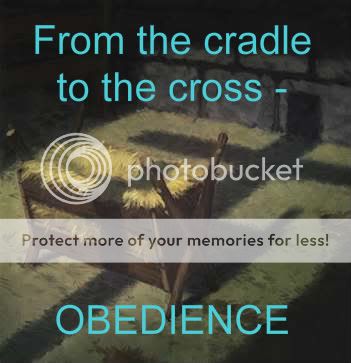
Can you fathom that?! The God of all creation demonstrated what obedience looks like when He placed Himself in a cradle to begin His journey to the cross.

As Kathy mentioned Monday, we know Jesus came to die. But He left footprints of obedience every step of the way – footprints of obedience left by a heart of humility.

In John 6:38, Jesus declared, “For I have come down from heaven, not to do my own will but the will of him who sent me.” (Emphasis mine)
And as the cross loomed largely over His earthly future, He said,“Now is my soul troubled. And what shall I say? ‘Father, save me from this hour’? But for this purpose I have come to this hour.” John 12:27 (Emphasis mine)
We all have to die. It’s just part of life. But Jesus didn’t have to. He didn’t have to come to a cradle. He didn’t have to clothe Himself with flesh. He didn’t have to tolerate those who persecuted Him. He didn’t have to endure the pain of the crown of thorns, the whips or the nails. He didn’t have to hang naked from a cross in agony as the soldiers mocked Him and those He was dying for gazed on Him with disgust.
But Jesus came to obey the Father’s will. John 4:34 says, “Jesus said to them, ‘My food is to do the will of him who sent me and to accomplish his work.'”
Jesus left a wonderful example of what obedience looks like when He went to the cross. It means we humble ourselves and die to what we want to do – even when it’s hard.
Jesus came to obey the Father – and that obedience took Him all the way to the cross. His obedience offers us hope, peace, joy and everlasting life and if He had not humbled Himself and became obedient unto the death of the cross, we would remain in our sins and we would remain without hope.
Aren’t you thankful Jesus came to obey the Father! As we approach this Christmas season let us not forget to importance of Jesus’ obedience.
Have you ever thought about the fact that Jesus came to be obedient? How should that affect our own obedience? 

Why did Jesus come?

November 28, 2011 by Kathy Howard 1 Comment

Every year at this time we begin counting the days until Christmas. Only 27 days left for shopping, cooking, and wrapping until the big day is here. Hopefully we also spend the days thinking about the reason for the celebration – the birth of Jesus.

Many churches and individual Christians observe the four-week season of Advent as a way to celebrate Christ’s birth. The word “advent” means a coming into view or arrival. For Christians, “Advent” specifically refers to the eager anticipation of the arrival of God’s long-awaited Messiah. Christian Advent officially began Sunday, November 27th. Observers may pray, fast, and read Scripture while waiting for Jesus’ “coming,” celebrated on December 25th.

With the busyness and commercialization of Christmas, Advent is a wonderful way to keep Christ in the forefront of our minds. However, we shouldn’t limit our reflection to the truth that Jesus came to earth; we should also remember why He came. That’s exactly what we’ll be doing for the next three weeks here at Scripture Dig.

Why did Jesus leave the glory of heaven to be born as a human in a stable in Bethlehem? Many times I’ve heard the statement, “Jesus came to die.” And that is true. But did you know that was only part of Jesus’ mission?

Jesus told us why He came. The Gospels record more than a dozen “I came” statements of Jesus. We will be exploring many of these over the next few weeks. Christmas took on a deeper and richer meaning for me after I first studied these statements of Christ several years ago. This year we want to share them with you. We pray God will use His Words to enrich your Christmas celebration and grow your understanding of Him.

What are some things you and your family do to help you stay focused on the true reason for the Christmas season?


Jehovah Rophe: The LORD Heals

October 19, 2011 by Teri Lynne Underwood 2 Comments

When they came to Marah, they could not drink the water of Marah because it was bitter; therefore it was named Marah.  And the people grumbled against Moses, saying, “What shall we drink?” And he cried to the LORD, and the LORD showed him a log and he threw it into the water, and the water became sweet.

There the LORD made for them a statute and a rule, and there He tested them, saying, “If you will diligently listen to the voice of the LORD your God, and do that which is right in His eyes, and give ear to His commandments and keep all His statutes, I will put none of the diseases on you that I put on the Egyptians, for I am the LORD, your healer.”

Exodus 15:23-26

Bitter water.  Doesn’t sound appealing at all, does it?

The Israelites had been freed from the bondage of slavery and now they were faced with bitter water.   Does your life ever feel that way?  One huge situation is finally resolved and then comes another … it can leave us overwhelmed and broken.

Elizabeth George writes:

What an object lesson this encounter with Jehovah-Rophe, the Lord who heals, must have been for the Israelites (and for us)!  God’s people were dying of thirst with only bitter, poisonous water on hand.  And God took their physical need and turned it into a spiritual issue.  Out of a bitter experience God revealed Himself in yet another sweet, comforting way, as “Jehovah heals.”

Jehovah Rophe, the LORD heals.   What a precious truth … and promise.

God’s healing is not just physical.   He also reaches down offers total healing … in all areas of our lives.

Consider these three ways God heals and examples of women in Scripture who were the recipients of His total healing.

1.  Physical Healing.    Remember the woman with the issue of blood?  Her story is told in Matthew 9.   She had been sick for years and used every bit of money she had to seek healing.   When Jesus passed by, she reached out and touched the hem of His garment.   I love this story!   She was healed immediately and completely!   Why?   Jesus said, “Take heart, daughter, your faith has made you well.”  (Matthew 9:22)     I am so thankful for a God who heals us physically.

2.  Emotional Healing.   Hannah.  The broken woman longing for a child, praying so fervently that the priest thought she was drunk.   Can you imagine her brokenness?    God heard the heart-felt prayers of a wounded woman.    And He answered them.  I think though the most beautiful part of this story is the change we see in Hannah … from a woman desperate to have a child to a woman willing to give her son back to the God who gave him to her.   That, my friends, is the power of God to heal us emotionally.   {You can read Hannah’s story in 1 Samuel 1 – 2.}

3.  Spiritual Healing.   The most profound healing God ever does in any of our lives is spiritual.  That moment when He moves us from death into life, when we become new creations, the old gone and the new in its place (2 Corinthians 5:17).   Mary Magdalene’s story is such a beautiful example of that total renewal, total healing.   From a woman possessed by seven demons (Luke 8:2) to the woman who first saw Christ after His resurrection (John 20:15) … Mary Magdalene offers us a poignant and powerful image of the full spiritual healing offered to each of us by Jehovah Rophe.

Are you in need of healing?   Are there some bitter waters in your life?  Will you call upon the God who heals and trust Him to mend the brokenness?

Praise the Lord!  For it is good to sing praises to our God; for it is pleasant, and a song of praise is fitting.  He heals the brokenhearted and binds up their wounds.   Psalm 147:1,3

Today, right now, Jehovah Rophe is offering you the gift of healing.   Will you embrace it?  And praise Him for this amazing gift?

~~~~~~~~~
The quote above is from this book by Elizabeth George. I highly recommend it for either personal study or for a group.

From one church to many

October 6, 2010 by ScriptureDig 10 Comments

Image from http://www.heartandsoulreflections.com/

Yesterday, Sandra gave us a better understanding of how the Church got started during the feast of Pentecost. Fasten your seatbelt today, because we are going to take a turbo-speed overview of the early history of God’s work in and through the local church through the books of Acts and the epistles!

After Pentecost, we see the Church expanding at a phenomenal rate as more and more people came to understand that Jesus Christ was the Messiah they had been looking for, the Lamb of God who died on their behalf (Acts 2:46-47). As the apostles shared boldly with the public about the identity of this controversial Jesus (an annoyance the Jewish religious leaders had done their best to rid themselves of several months earlier), they began to face increasing persecution. In response to persecution, we find the believers in Jesus not hiding their faith, but praying for boldness to continue sharing truth (Acts 4:23-31).

The number of believers in Jesus living in Jerusalem continued to blossom and this first church met daily together in the temple for worship and also assembled in smaller groups in private homes (Acts 2:46). The apostles served as the leadership of the church, distributing donated goods and money to the poor (Acts 4:32-37), performing signs and wonders (Acts 4:12-16), and devoting themselves to prayer and to teaching the Word of God (Acts 6:4). As the number of believers greatly increased and the practical demand of caring for the needy in their midst became too much for the original twelve, other men were appointed as lay leaders to serve and support the church body (Acts 6:1-7).

In Acts chapters 6 and 7 we find the dramatic account of the arrest and stoning of Stephen and are introduced to a zealous and fiery young man by the name of Saul. Full of anger at the spread of what he viewed as a blasphemous twist of Judaism, Saul began a savage one-man crusade to destroy the church (Acts 8:3). In Acts 9, God literally stopped Saul in his tracks and showed him how blind he had been to the truth of Jesus; after this one encounter with the living Jesus Saul turned from the church’s number one enemy to God’s chosen instrument to proclaim truth and establish churches throughout the Roman empire.

As persecution increased in Jerusalem, believers in Jesus began to scatter to surrounding areas, carrying the Truth with them as they went – first to fellow Jews and then also to Gentiles (Acts 11:19-26). A thriving group of believers became established in Antioch, the first place where followers of Jesus Christ were called Christians; this group of believers was also referred to as a church and was taught and pastored by Barnabus and Saul.

Throughout the remainder of the book of Acts, we find Paul and his companions traveling throughout Asia Minor to share the Truth of Jesus with both Jews and Gentiles. These believers were not expected to fend for themselves – establishing local churches with spiritually qualified leadership was a critical part of their ministry (Acts 14:23). Established churches became actively involved in ministry themselves, sending people into ministry (Acts 15:22); established leaders were entrusted with the responsibility to guard the doctrinal purity of their local bodies (Acts 20:28).

Throughout the remainder of the New Testament, we find many letters (or “epistles”) to individual churches, mostly from Paul. Scanning a list of verses which reference the term “church” in the epistles quickly shows us the following:

  • There were many local churches with independent leadership who together formed the larger Church
  • The churches were urged to strive for unity, but never at the cost of doctrinal purity
  • Believers had been gifted by the Holy Spirit with specific spiritual gifts for the express purpose of building up their local churches
  • The churches were to be orderly with clearly appointed leadership and authority
  • Local churches collected money to support ministry and missions and meet needs of other believers
  • Christ is the head of the Church, and the Church is His body

Through these churches, believers were to be spiritually built up and taught, equipped for ministry and given opportunities to serve. These churches were the front-lines of the advance of the Gospel, being a light in their local communities and also sending out members from their midst to share the gospel and plant churches in new areas.

As we will continue to discuss tomorrow, the church is close to God’s heart; it is a vital part of His plan to form us into the image of Jesus, and it is His chosen vehicle to share Truth and unconditional love with the world. Dig into His Word on your own, and ask Him to reveal to you how very much He values the church!

Double Whammy

August 11, 2010 by ScriptureDig 30 Comments

Have you loved digging into prayer as much as I have?

I must confess, this is an area in which I consider myself very weak.   When it comes to Bible study and digging into the Word – I get hyped up and ready to go.  But prayer just doesn’t come as naturally to me.

I shared my struggle with an older believer several years ago and she encouraged me to pray Scripture.    Also, through reading the Power of a Praying … books by Stormie Omartian, I learned of the great power of praying God’s Word back to Him.     What could be more useful in developing a prayer life than using the very Word of God as a foundation for our conversations? It’s sort of a “double whammy” in our prayers.

I was encouraging our senior adults at church to use Scripture in their prayers and one gentlemen said to me, “We aren’t all Bible scholars like you!”    Let me assure you – I’m no Bible scholar!  In fact, as I responded to this dear man, “I wasn’t born with this knowledge of Scripture.”   I’ve been investing in it for many years.     It’s not so much about how much Scripture you know, rather praying Scripture is realizing the truth of God’s Word and claiming it in your life.

Tomorrow, during Your Turn, we’ll be going through a passage and praying through it.  But for today, I’d like to share with you some of the ways using Scripture can build your prayer life.

Understanding God’s Character

As we study Scripture we grow in our understanding of God’s character and how that relates to our lives.   By recognizing that He is love (1 John 4:8), we can come to Him acknowledging that He loves us and desires the best for us … even when we don’t understand His ways (Isaiah 55:9).

Trusting God’s Promises

Throughout Scripture we find the promises of God and as we pray we have confidence that He will save us (John 3:16), that He cares for us (1 Peter 5:7), that He will forgive us (1 John 1:9), that His plan is for our good (Jeremiah 29:11) and so many more.  Knowing God’s promises gives us confidence in our relationship with Him and helps us trust in His care for our lives.

Recognizing God’s Faithfulness

Throughout the Bible we see that God is faithful to His people … both the Israelites in the Old Testament and the early church in the New.    We can pray to the same “God who sees me” as Hagar did (Genesis 16:13), the “God who heals me” as Miriam (Exodus 15:26),  the “Lord, my Rock” as David (Psalm 144:1), the Good Shepherd (John 10:11), the Alpha and Omega (Revelation 22:13).

Claiming God’s Provision

Throughout Scripture we find abundant reminders that God will provide for all our needs.   We find that He will give us rest (Psalm 23:2), protection (Isaiah 43:2), food and clothing (Matthew 6:25-32), wisdom (James 1:5) and so much more.

Learning to pray Scripture is an amazing way to grow your prayer life. I have specific prayers for my daughter and my husband – claiming Scripture for their lives.   And as I read my Bible each day, I use the passages I have read as a foundation for my prayers … asking God to change me to match His Word.  I have found great comfort and peace in learning to pray Scripture and I hope you will be encouraged to do the same!

How do you incorporate Scripture into your prayers?

Recommended Reading:

Praying the Names of God by Ann Spangler

Praying the Names of Jesus by Ann Spangler

Any of the Power of a Praying books by Stormie Omartian

Praying God’s Word by Beth Moore

Praying the Psalms by Elmer Towns {Mr. Towns has written several books about praying through specific passages of Scripture.}


How did we get 66? Part Two

June 9, 2010 by Kathy Howard 5 Comments

Yesterday, we began our two-part discussion on how we got the 66 books that comprise the biblical canon. If you missed it, feel free to take a look back before moving on to the New Testament discussion.

New Testament

First century Christians did not have the New Testament Canon. They relied on the Old Testament Canon and the teachings of the Apostles to guide their faith. However, they began recognizing additional writings as divinely inspired very early, even while the human authors were still alive.

In fact, NT Scripture acknowledges other NT Scripture. For example, in 1 Timothy 5:18 Paul quotes Luke 10:7 and refers to it as “Scripture.” And another example, in 2 Peter 3:16, Peter calls the writings of the Apostle Paul “Scripture.” Church leaders from the late first and early second centuries AD often quote the words of Jesus and the writings of the Apostles and refer to them as “Scripture.”

To protect from heresy and false teaching, it became necessary by the middle of the second century to compile an official list of books that the Church recognized as Christian Scriptures. Although a few discussions arose over a handful of books, it appears that there was general consensus by early in the third century AD.

As with the Old Testament Canon, the twenty-seven books of the New Testament were not chosen by men. They were merely recognized to be those God had already inspired as Scripture. Three primary criteria guided the early Church as they recognized the New Testament Canon.

  1. Apostolic connection – the author had to be one of the original apostles or closely associated with Jesus or one of them.
  2. No contradiction – the early Church leaders recognized that God would not contradict Himself in theology or ethics, so any divinely-inspired writings would not do so either.
  3. Widely applicable – from the time they were written it was clearly obvious which writings had widespread application for the Church. These were the letters and books that were greatly circulated and read again and again.

The Third Council of Carthage in 397 AD, which was attended by Augustine, officially recognized the list of 27 New Testament books we accept as canonical today. There had already been widespread, general consensus from east to west. The Council merely confirmed the writings that God had made clearly known to His church.

The following quote from “An Introduction to the New Testament,” by Carson, Moo, and Morris, emphasizes God’s selection of the canon.

Indeed, it is important to observe that although there was no ecclesiastical machinery like the medieval papacy to enforce decisions, nevertheless the worldwide church almost universally came to accept the same twenty-seven books. It was not so much that the church selected the canon as that the canon selected itself. (page 494)

God’s creation and protection of the Canon is miraculous! He has revealed Himself to His children through His written, Spirit-filled Word.

All Scripture is God-breathed and is useful for teaching, rebuking, correcting and training in righteousness, so that the man of God may be thoroughly equipped for every good work. 2 Timothy 3:16-17, NIV

Kathy Howard

For further reading:

“How and When was the Canon of the Bible put together.”

“How did we get our Bible?” (Focus on the Family)

“Is the Bible Reliable?” (Article adapted from Kathy’s book “God’s Truth Revealed.”)

Sources for this article:

An Introduction to the New Testament, D.A. Carson, Douglas J. Moo, and Leon Morris (Zondervan: Grand Rapids, 1992)

Encountering the Old Testament, Bill T. Arnold and Bryan E. Beyer (Baker Books: Grand Rapids, 1999)

Introduction to Biblical Interpretation, William W. Klein, Craig L. Blomberg, and Robert L. Hubbard, Jr. (Word Publishing: Dallas, 1993)

« Previous Page

This Month’s Theme

  • Jesus is the Way
  • And He Shall Be Called Series Intro

Enter your email address to have new posts emailed to you:

We’ll come to you

Enter your email address to have new posts emailed to you

Categories

Bible Memory – Lent 2021

Memorizing Isaiah 12

Let the Children Come

Let the Children Come

Want more #HideHisWord resources?

Memorizing Psalm 1

Find Us on Facebook


Search

Recent Posts

  • Series Wrap-Up: The Lord Is My Light
  • His Marvelous Light
  • When the Darkness Deepens
  • Though I Sit in Darkness…
  • Let Your Light Shine
  • Life-Giving Light

Archives

© 2026 · Pretty Creative WordPress Theme by, Pretty Darn Cute Design