• Home
  • About
    • Our Contributors
    • Our Beliefs
  • Blog
  • Bible Studies
    • Scripture Dig
  • Archives
  • Shop
  • Advertise
  • Contact
    • Email
    • Facebook
    • Instagram
    • Pinterest
    • Twitter

Do Not Depart

Encouragement and Tools to Abide in God's Word

You are here: Home / Archives for spiritual disciplines

Praise God {Intentional Spiritual Growth}

January 23, 2020 by Jennifer Hong 1 Comment

As we reflect on intentional spiritual growth this month, let’s take a closer look at praise. What role does praise play in your daily life?
A year ago, I was leading a woman through prayer at the conclusion of a workshop we’d attended on spiritual and emotional healing. There were so many burdens on Lisa’s heart that she wanted to give to the Lord, but she was stuck. The freedom I had seen in many others over the past few days wasn’t coming to Lisa.

As we sat quietly listening for the leading of the Spirit, one of the workshop facilitators turned on a praise song. After a few moments, Lisa stood up. She began to softly sing the familiar words. Then she raised her hands. At the chorus, she began to march circles around our chairs as she sang.

When the song finished, Lisa returned to her chair beside me. Her face was streaked with tears, but she was ready to continue. We returned to the shame and hurt she had struggled to give over to the Lord. Now, everything had changed. She laid it all at the feet of her Lord and readily received His forgiveness, acceptance, and blessing. It was amazing to see her transformation over the next hour. She walked out of the church with a new peace.

Witnessing the power that followed Lisa’s worship made a profound impression on me. In the months that followed, the Lord began teaching me more about praise.

Praise as Battle Strategy

The role of praise is so significant that it was King Jehoshaphat’s front-line military strategy in a battle described in 2 Chronicles 20. The praise singers were sent out ahead of the army.

This is what the Lord says to you: ‘Do not be afraid or discouraged because of this vast army. For the battle is not yours, but God’s.”

…As they set out, Jehoshaphat stood and said, “Listen to me, Judah and people of Jerusalem! Have faith in the Lord your God and you will be upheld; have faith in his prophets and you will be successful.” After consulting the people, Jehoshaphat appointed men to sing to the Lord and to praise him for the splendor of his holiness as they went out at the head of the army, saying: “Give thanks to the Lord, for his love endures forever.”

As they began to sing and praise, the Lord set ambushes against the men of Ammon and Moab and Mount Seir who were invading Judah, and they were defeated.
(2 Chronicles 20:15b, 20b-22) 

What a great battle cry! “Give thanks to the Lord, for his love endures forever.” Read the last verse again. As they were singing and praising, the LORD set ambushes against their enemies. The battle itself was not their responsibility. Worship was.

For the Lord is Good

Why do we praise God? The following verses give a few of the reasons the Bible tells us to praise God.

“Know that the Lord, he is God!
It is he who made us, and we are his;
we are his people, and the sheep of his pasture. 

Enter his gates with thanksgiving,
and his courts with praise!
Give thanks to him; bless his name!  

For the Lord is good;
his steadfast love endures forever,
and his faithfulness to all generations.
(Psalm 100:3-5)

Sing to the Lord; praise the Lord!
For he has delivered the life of the needy from the hand of evildoers.
(Jeremiah 20:13)

We proclaim His glory, His goodness, His everlasting love, His righteousness, His faithfulness, His mercy, and His deliverance. In short, we praise God for Who He is and for what He has done. This simple recognition has helped me examine the motives of my heart as I approach the Lord. Apart from intercession, aside from asking anything of God, am I spending substantial time in pure adoration?

Daily Praise

Praise is as vital to our daily walk with God as prayer. As we follow Jesus with intention this year, how can we add more praise to our lives? Following Lisa’s example, I’ve let myself become a bit more vocal and a bit more active in my praise. I moved my quiet reading and writing time from a local coffee shop to our guest room to allow my self to stand, to sing, maybe to dance.

What can you do to make worship a bigger part of your life?
Consider one of these possibilities in the next week:

  • Sing Psalm 118 with Shane and Shane
  • Recite or read aloud Psalm 100 as your day begins or before quiet time with the Lord.
  • Have you ever been on a prayer walk around a neighborhood or a building? Try taking a praise walk. Sing the Lord’s praises through your home. Sing in the kitchen, praise Him in the living room, and declare His goodness in the bedrooms of your home.




The Why, What, and How of Bible Journaling

January 14, 2016 by Lisa Burgess 24 Comments

Bible-Journaling_Why-What-How_Do-Not-Depart

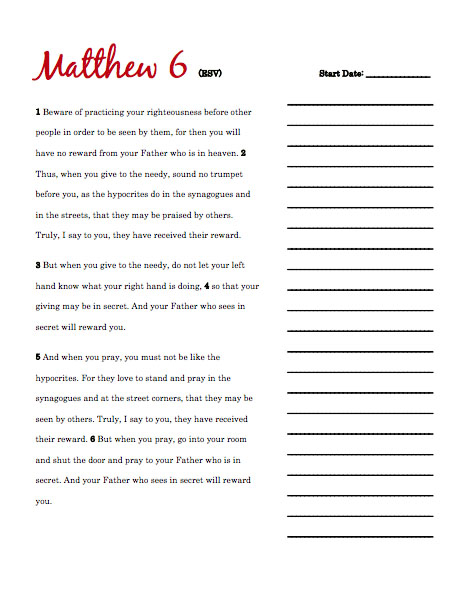
[NOTE: For Matthew 6 memorizers, get your printable journaling page here]

Bible-Journaling_Why-What-How_Do-Not-Depart

You read the Bible. Pray through some of the Psalms. Maybe memorize favorite verses here and there.

But have you ever tried journaling through the Bible?

Why journal?

Journaling is a spiritual discipline that leaves a tangible footprint.

Writing helps hone your thoughts now, clarifying and capturing the swirling ideas that rumble loose in your head. It’s listening and recording how your heart is hearing God’s love for you.

But journaling has the added benefit of laying down a record for later, too. Today’s lessons can be reused in future circumstances if you’re ever doubting God’s promises or need reminders of how He’s brought you through a tough time or want to celebrate again a victory He won for you.

What is Bible journaling?

At its most basic, journaling is simply writing down what the Spirit whispers to you as you read through scripture. There are no rules or requirements.

However, you have many options to guide you along the way.

• Journaling Bibles
Easy to find online or at bookstores. They have wider margins than a regular Bible, specifically designed to record your notes, prayers, or questions.

• Artistic Journaling
A hot trend. [Google “bible journal” and see.] Don’t just record words, but create your own art in the margins of your regular Bible or Journaling Bible. You don’t have to be an artist to do it. [Read Teri Lynne Underwood, “Three Reasons I Love Using my Journaling Bible”]

Journaling-Bible-Teri-Lynne-Underwood

• Digital Journaling
If screens are your preferred medium, keep a digital journal as a regular Word document or via an app created specifically for Bible journaling.

• Notebook
Use a spiral bound notebook, a decorative journal, or loose-leaf paper in a binder to record your Bible reading and thoughts.

How to Bible journal

1. Write side by side in the margins

As you’re reading your Bible, jot down any insights or questions directly beside the verse you’re on. This has been an effective method for years and still works beautifully for many.

2. Pick one verse from many

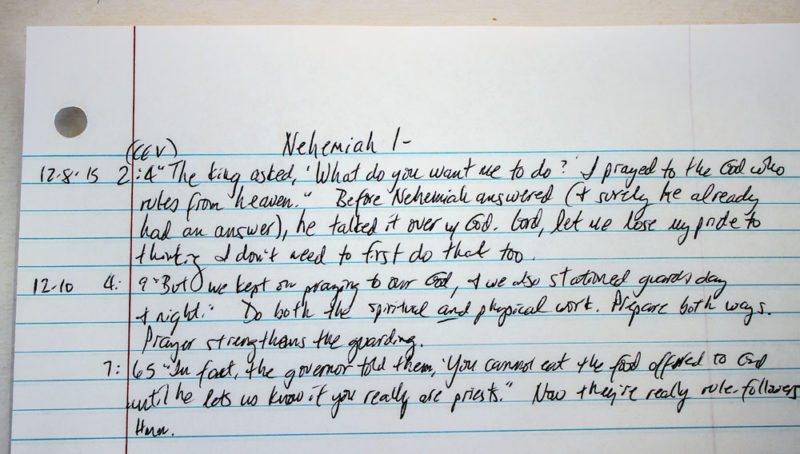
I keep two kinds of separate Bible journals. For my daily Bible reading, I use my Kindle before I get out of bed each morning, highlighting verses of interest as I go. Later in the day, I return to the highlighted verses, and choose only one verse out of three chapters to journal about.

I copy that verse by hand on notebook paper, then write a few sentences about why it stood out to me. Perhaps it was reassuring or particularly relevant or maybe even confusing. I then file these pages in my Bible notebook (details on how to make your own Bible notebook). The whole process is quick but meaningful.

Nehemiah-bible-journaling

3. Go deeply with only one verse

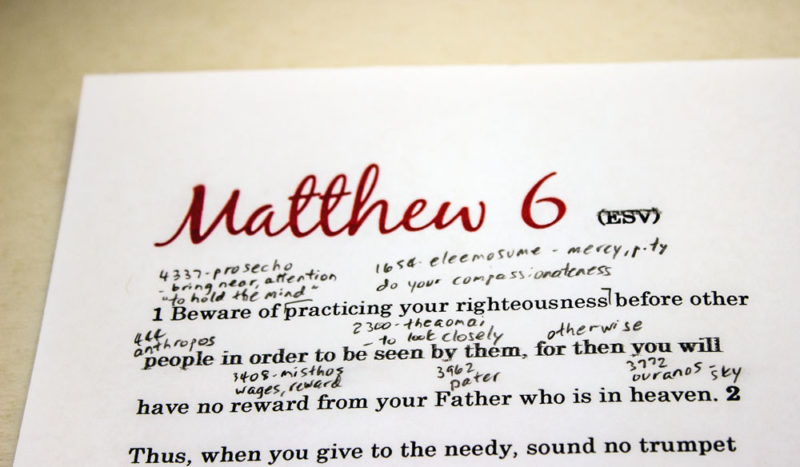
The second type of journaling I do coincides with what I’m memorizing or studying. Here I look at only one verse for several days, writing on a double-spaced, printed copy of the chapter. On day 1 I write brief notes about the Hebrew or Greek roots using e-Sword.net or StudyLight.org. On day 2 I record anything significant from commentaries about the verse. Day 3 is when I record my own thoughts and experiences with the verse. Again, it doesn’t take long, but it creates a record of what God is teaching me.

matthew-6-bible-journaling

But for you, what’s the best way to journal?
The one that you’ll use.

And one that you’ll occasionally re-read. It’s valuable to look back on your own personal history with God alongside the Biblical narrative from ancient times.

Experiment with different methods to find one that works for you. [Pinterest has tons of ideas.] It might include sharing on social media: Use Twitter as a 140-character journal about the verses you’re reading. Or blog or Instagram about the study you’re doing. Or keep it private: Write a one-line-a-day diary of love notes between you and God, tucked quietly in your sock drawer for no eyes but yours and His.

  • Journal the lessons you want to remember.
  • Write down memories of God’s goodness you don’t want to forget.
  • Record the insights the Spirit gives you to use.

Your growing relationship with God is worth treasuring.

[Printable “Bible Journaling through Matthew 6” ESV]

Matthew-6-Bible-Journaling-Pages

The Basics of #BibleJournaling – Why, What, and How #PlantoAbide

Click To Tweet

Do you journal? What works for you? We’d love to hear your ideas in the comments.

RELATED LINKS

  • How to Make a Bible Notebook
  • Tips and Printables to Organize your Bible Notebook
  • Journaling in Your Bible by Lizzy Jeffers
  • Five Ways to Flourish in Journaling by David Mathis

Plan to spend more time this year in God's Word and pursuing a growing relationship with Jesus Christ. Find resources to help you plan in this month's series "Plan to Abide."

Remembering on the road: Memory verses for trips (and free printable)

June 13, 2013 by Lisa Burgess 12 Comments

Memory-verses-for-trips

Before you hit the road this summer, take these easy steps to make your trip more meaningful.

Through the intentional use of memory verses, you can discover God’s love in new ways everywhere you go.

Memory Verses for Trips

1. Choose the right verse

Set yourself up for success—pick an easy one. Either concentrate on one you’re already learning, or pick a fresh one specifically for your trip [see suggestions here]. A mission trip might need a different scripture than a visit to Grandma’s.

The family might learn one verse together, or each member learn a separate verse.

2. Gather your supplies

Write out your verse on sticky notes ahead of time to place on the hotel fridge or the ice chest in your tent. Bring a pack of 4×6 cards and markers for your kids (and you!) to write out the verse or sketch a picture of it during travel time. Consider bringing a simple rewards chart with stickers for once-a-day (or every other day?) recitations.

3. Get creative

Take one picture a day where you see this verse in action—maybe in a colorful wildflower or a child’s toe dipping in the ocean. Collect physical mementos that remind you of the verse. Draw a picture; write a song; compose a poem.

Proactively make tangible connections between the truths in the verse and the God all around you.

4. Share it with others

If you stay plugged in on your trip, post a picture to Instagram or Facebook with your memory verse as text or with a link to the reference on Bible Gateway. Send a postcard about it to friends back home.

As you seek opportunities to share the words you’re learning, you’ll stay more aware of them yourself.

5. Collect in an album

Back home, gather your photos and 4×6 cards in a small album as a reminder of God’s faithfulness on your trip. Or turn your Instagram pictures into picture magnets.

Having visible reminders of the relationships you made between the written word and the Living Word will cement your memories even deeper in your heart.

Most of all, keep it delightful. Training ourselves to clearly see God’s beauty everywhere should be an exciting adventure, not a guilt-ridden drudgery. If you miss a day, don’t sweat it. Maybe you won’t totally memorize your verse word-perfect; that’s okay. Bask in God’s truths through new experiences, new people, and new memories.

Because every trip is far better when God travels with us!


Resources

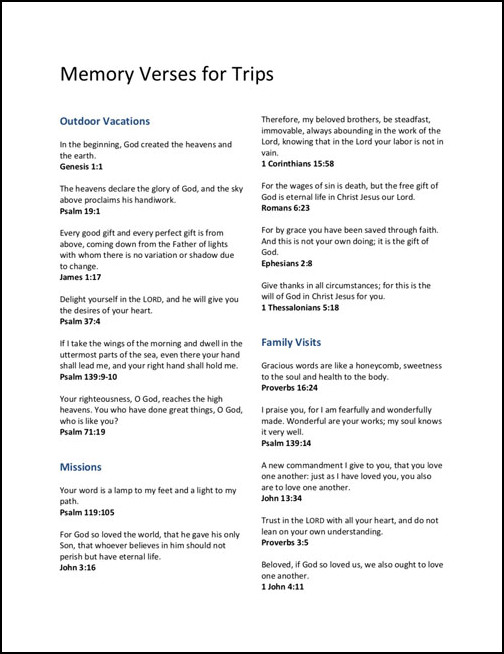
Memory-Verses-for-Trips_donotdepart

FREE PRINTABLES:

  • Memory verses for trips
  • Classic scriptures to memorize this summer
  • “The Word for the Road” for 7 days of family devotions

Have you ever memorized on the road?
What theme scripture might describe your summer?
Is there a verse you’re learning right now?

Please share in the comments.

Bible Study Tools for Truth While You TRAVEL Holy habits || www.donotdepart.com

Let’s Mean It – “God Bless You!”

January 17, 2013 by Lisa Burgess 9 Comments

The LORD bless you and keep you;
the LORD make his face to shine upon you and be gracious to you;
the LORD lift up his countenance upon you and give you peace.
Numbers 6:24-26

My daughter Jenna sneezes in pairs.

Jenna: Achoo!
Me: God bless you.
Jenna: Achoo!
Me: God bless you.

I don’t think twice about my response either time. If you were to sneeze behind me at Kroger, I’d give you a “God bless you,” too. You’d do the same for me, yes?

Are we practicing a spiritual discipline when we say those words? Probably not, if we’re only offering “God bless you” out of cultural habit.

But can offering blessings be an exercise in spiritual discipline? Most definitely. Something as simple as a “God bless you” can be redeemed for His glory. If exercised intentionally, blessing others brings you closer to God as you partner with Him to spread the love of Jesus.

Yet let’s not limit our verbal blessings to sneezing fits when we have so much more to offer.

God offered the first blessings (and continues to go first! Ephesians 1:3) on Adam and Eve with, “Be fruitful and multiply” (Genesis 1:22). He promised big blessings to Abraham as well as promised to make Abraham a blessing (Genesis 12:2-3).

Later we see Rebekah’s family blessing her (Genesis 24:60), Isaac blessing Jacob (Genesis 27:28-29), Jonathan blessing David (1 Samuel 20:13), and the psalmists routinely blessing God Himself (Psalm 103:1). From then to now, blessings are routinely offered in orthodox Jewish homes from parent to child.

In the Middle Ages, the simple “God bless you” phrase was to ward off the plague. Or to refill a supposed emptied body with good instead of evil spirits, having just sneezed out its soul.

But why and how should we bless others today?

1. To draw us nearer to the heart of God

When we consciously choose to speak God’s blessings into the lives of our friends, we press in closer to hear His heart so we’ll know what to offer. Listen to His blessings the apostles’ wrote:

“May grace and peace be multiplied to you.”
1 Peter 1:2

“May the God of peace equip you with everything good to do his will.”
Hebrews 13:20-21

We can use theirs as well as create our own blessings based on truths we’ve learned from the Lord:

“May the love of the Father awaken you; may the presence of the Son enliven you; may the breath of the Spirit empower you, to hope in His grace and to follow His will today.”

2. To exercise our priestly duties

But who are we to offer God’s blessings? Most of us aren’t ordained ministers or official church officers. Are we qualified for this? Yes! We are a royal priesthood (1 Peter 2:9), uniquely positioned to remind others of the gifts prepared for them by our good Father (James 1:17).

We’re not called to spectate as others give blessings; we’re called to participate. To bless and be blessed (1 Peter 3:9).

3. To feed a world hungry for God

By deciding to bless others as a spiritual discipline, we become more aware of those around us needing our Savior’s sweet touch.

Who could use a blessing from you this week?

  • A teacher: “May the Lord bless your work as you pour knowledge into the minds of children.”
  • A friend traveling: “May your presence be light and salt in every city you enter.”
  • A troubled sister: “May the Lord grow your peace by leaps and bounds and fill you with strength to endure every trial with hope.”
  • Your child: “May you grow in wisdom and understanding to see God’s love for you through my love for you.”
  • Your parents: “May you be richly replenished throughout your golden years for giving me life and teaching me to love the Lord.”

Say it. Pray it. Write it. Type it.
In person, in a card, in an email, over the phone. Just do it.

Friends don’t let friends live unblessed. Don’t let yours go until you bless them (Genesis 32:26).

May you be blessed by the Lord as you bless others through the Lord, with or without a sneeze for prompting.

When have you received a blessing from someone? Is there someone you can bless this week? Do you have a favorite scripture of blessing? We’d love to hear from you.

For more on how to give blessings, including and beyond the spoken word, I recommend The Blessing by John Trent and Gary Smalley.

Spiritual Disciplines: Soul Training theme

Let’s Celebrate

January 28, 2011 by ScriptureDig 4 Comments

After several minutes of spontaneous clapping, cheering, hugging, and even jumping up and down, a reverential hush fell over those of us packed into the small sanctuary. God had done it! He had provided abundantly more than we could even think or imagine.

God had led our small, but quickly growing congregation to embark on a new building project. We needed a pretty large sum of money to get started. Our church, in a small town outside Calgary, Alberta, included many seminary students and young families. Very few members really had any money, yet we stepped out in obedience.

We set a “loaves and fishes” date. The church would bring their offerings – money and pledges – and lay them on the altar. Then we would share a meal together while the offerings were counted. Children drug sacks of coins down the aisle, others committed their Christmas or vacation money, some gave education savings, but all gave. Even though the church gave sacrificially, logically there was no way we could give enough. But we stepped out in obedience and trusted God to provide.

We gathered after dinner to hear the report. When the pastor shared the amount of the offering the church verbally and physically celebrated over the amazing thing God had done. And when the awe of our incredible God came over us, worship joined our celebration.

To be honest, I never thought of celebration as a spiritual discipline until reading Richard Fosters Celebration of Discipline. Foster says:

“joy is the end result of the Spiritual Disciplines’ functioning in our lives.”

God’s transforming work produces joy in our lives. So, we will experience it as we obediently practice the spiritual disciplines.

However, joy or celebration is also itself a spiritual discipline. God commands us to be joyful. (See Philippians 4:4-9.) Those of us who have been redeemed have much to rejoice about. Celebrating what God has done for us honors Him and acknowledges His mercy towards us. We do not deserve what He has given us but still He lavishly poured out every spiritual blessing in Christ.

The ancient Israelites had regular celebrations to give God thanks for all He had done and provided. These kinds of celebrations not only turned their hearts toward God, it pointed others to Him as well. Today, we don’t always celebrate enough. It’s okay to let loose and celebrate all God has done! Sing, cheer, and clap. Applaud the One who is worthy of our praise.

Our small church in Alberta, Canada had reason to celebrate. God had blessed our obedience. And celebrate we did! We also told others about God’s goodness and many joined in our joy resulting in more glory to God.

Do you have something to celebrate today? How can you celebrate God and what He has done in your church and in your life?

Recognizing and Responding to Who God Really Is

January 26, 2011 by ScriptureDig 7 Comments

The Bible is full of references to worship. Narrative accounts of individuals and groups offering worship to God. Commands to worship. Instructions for how and where to worship. The Psalms brim with references to praising and worshiping God… and yet we often seem to have a very fuzzy, if not distorted, understanding of what worship really is.

The word “Worship” is used 13 times in the Psalms.

  • The Hebrew word “Sachah” is used 12 of the 13 times – it means ‘to prostrate oneself (in homage to royalty or to God), to bow oneself down as an act of respect before a superior being. It meant to honor God with prayers, even without prostration of the body. However, those who used this mode of salutation often fell upon their knees and touched the ground with their foreheads. In short, it was a way of showing submission.’
  • The Hebrew word “Abad” is used once, and carries the idea of serving a master.

From Baker’s Evangelical Dictionary of Biblical Theology, Worship is described as “both an attitude and an act.” Referring to Jesus’ conversation with the woman at the well in John 4, it goes on to say,

All true worshipers must worship God in “spirit and in truth.” That is, true worship takes place on the inside, in the heart or spirit of the worshiper (cf. Psalm 45:1; 103:1-2). Worship pleasing to God must be unfeigned and transparent, offered with a humble and pure heart (Psalm 24:3-4; Isa 66:2).

But this is not enough. Worship “in truth” connects the heart or spirit of worship with the truth about God and his work of redemption as revealed in the person of Jesus Christ and the Scriptures. David understood the importance of worshiping in truth and the necessary linkage between “truth” and the Word of God when he wrote, “Teach me your way, O Lord, and I will walk in your truth; give me an undivided heart, that I may fear [i.e., worship] your name” (Psalm 86:11; cf. Psalm 145:18). Here both the Old and New Covenants agree! The true worship of God is essentially internal, a matter of the heart and spirit rooted in the knowledge of and obedience to the revealed Word of God.

In my words, I like to define worship as recognizing and responding to Who God really is.

We often think of worship as an experience, a feeling, a service we attend. Worship is much, much more than that. Worship begins as I understand truth about my God – as I study His Word, as I walk with Him and learn more of who He is and what He has done. As I learn more of Him, an attitude forms in my heart – an attitude of reverence, of submission, of humility and awe in His presence. True worship then turns this attitude into an act. I bow myself before Him, internally and possibly even externally, I offer Him myself as a sacrifice and obey Him!

What does this look like? In Celebration if Discipline, Foster suggests some steps into worship that are challenging to me. Consider with me how we might:

  • Learn to practice the presence of God daily. Pray continually throughout our days. Make a conscious effort to praise, thank, adore Him in the quietness of our hearts. Foster says, “All this will heighten your expectancy in public worship because the gathered experience of worship just becomes a continuation and an intensification of what you have been trying to do all week long.” Ann Voskamp continually challenges me along these lines – she has so much encouragement on her site if you struggle with this like I do!
  • Prepare ourselves for large-group worship. How often do we drag through the church doors on Sunday morning tired from staying up far too late the night before, distracted by rushing around finding missing kids’ shoes, frustrated by conflict with our spouse on the way? How much more would God move in our midst if we took the time to really prepare ourselves to worship with the Body, to treat that time as a truly sacred hour that must not be rushed through or slapped together haphazardly that day?
  • Get our eyes off of ourselves, our tastes, our preferences in corporate worship. Foster points out, “as an individual I must learn to let go of my agenda, of my concern, of my being blessed, of my hearing the word of God. The language of the gathered fellowship is not ‘I,’ but ‘we.’ There is a submission to the ways of God. There is a submission to one another in the Christian fellowship.” He challenges that we should accept even distractions and interruptions and give them back to God in praise rather than allowing them to cause us to be anxious and put off.
  • Understand that worship is an act of sacrifice. Sometimes we just don’t feel like it. Remember that worship is not about us and how we feel – it is about who God is and how worthy He is of our adoration and submission! No matter how I might feel, God is no less deserving of my attitude and act of worship both individually and corporately.

Are there certain habits or practices that have helped you focus on worship as an attitude rooted in Truth and an act of submission before Him?

Tell Each Other What?

January 25, 2011 by ScriptureDig 13 Comments

Therefore, confess your sins to one another and pray for one another, that you may be healed. James 5:16 ESV

For there is one God, and there is one mediator between God and men, the man Christ Jesus. 1 Timothy 2:5 ESV

The confession of evil works is the first beginning of good works. Augustine of Hippo


Corporate Disciplines … spiritual practices exercised within the Body of believers.   Those habits and methods that grow us together to function in unity.    And we start with Confession.

Confession:  (n) acknowledgment, avowal; admission.  {from Dictionary.com}

Why is it necessary to engage in corporate confession?

I love what Richard Foster says about this in Celebration of Discipline:

But if we know that the people of God are first a fellowship of sinners, we are freed to hear the unconditional call of God’s love and to confess our needs openly before our brothers and sisters.  We know we are not alone in our sin.   The fear and pride that cling to us like barnacles cling to others also.  We are sinners together.  In acts of mutual confession we release the power that heals.  Our humanity is no longer denied, but transformed.  (145-146)

We need to confess to one another … not for redemption or absolution, but for healing! It is in sharing our failures – as well as our successes – that we are bound together in the depth of His grace.   And it is in receiving the sincere confession of others and offering our willing voices of grace and counsel without judgment or condemnation that we experience the fullness of bearing one another’s burdens.

It’s a scary thought, though, to look someone else in the eyes and confess the blackness of our hearts.   Opening ourselves up to that level of vulnerability forces us to assume a great risk.    Equally hazardous to our hearts is the hearing of another’s vulnerabilities and sins.

So how does this Discipline of Confession work?

  1. Discernment is vital! We do not confess to one another randomly or without great prayer beforehand.   Generally speaking, confession as a discipline functions best within the framework of a mentoring, discipling relationship.
  2. When we confess, we are specific … and when we pray over one another, we do not add to nor take away from the confession that has been offered.  Honesty is necessary for a sincere confession.  HOWEVER, this is not a time for unnecessary explanation or gratuitous details.
  3. Like fasting, confession is not commanded. We offer you information about these Disciplines not to add burden to your faith.   Rather, as with fasting, confession to one another is discussed in Scripture and therefore is a topic we must explore and seek the will of God in our own lives.

Exercising the disciplines of fellowship and confession will take us into relationships and situations that will challenge our faith and test our love for God and his people.  It is good to remember that God gave us these disciplines to aid us in our growth toward Christlikeness … they are aids for training us to live free of artiface and bondage to appearances. {Jan Winebrenner, Intimate Faith: A Woman’s Guide to the Spiritual Disciplines}

Perhaps you have experienced the grace found in confessing both to God and to another the burden of sin in your life … maybe you have difficulty believing the fullness of God’s mercy and grace and living in the freedom of His forgiveness … or maybe you struggle with being open with others about the sin in your life … the Discipline of Confession can be a powerful tool in our spiritual formation.

What are your experiences with confession to or from others?

How have you seen it benefit or harm the Body?

Image by:  suds4565


The Corporate Disciplines – Doing Life Together

January 24, 2011 by ScriptureDig 4 Comments

As we enter our last week of study on the Spiritual Disciplines, we look at those that involve the Body.   These last Disciplines are certainly to be practiced privately but they are also to be shared practices.


Why does it matter if we practice these Disciplines in the collective?  What difference does it make? This week we will explore Confession, Worship, Guidance, and Celebration … visible, audible, hands-on, feet-to-the-pavement putting into practice the foundations laid through the Inward Disciplines of Prayer and Study, Fasting and Meditation, and then nurtured and grown through the Outward Disciplines of Simplicity and Solitude, Submission and Service.


These Corporate Disciplines guide us into functioning as the early church … doing life together.   As we learn the richness of Confession and the depth of Worship, the necessity of Guidance and the joy of Celebration, our understanding of the beauty of the Church, the vibrant Body of Christ, will undoubtedly grow and our recognition of our need for fellowship with one another will be increased.

Join us?

Duty or devotion?

January 21, 2011 by ScriptureDig 9 Comments

God began softly tapping at my heart early this past year about His call to follow His example and be a servant. So I’ve been praying and watching for opportunities to serve. I’ve even acted on many of them and thanked God for using me. However, God has used my preparation for this post to correct my thinking even more.

There is a difference between doing acts of service and being a servant. The first is accomplished on a case by case basis out of a sense of duty. The second is a life attitude; a change of nature resulting from devotion to Christ.

True discipleship – a life of following Christ – is not simply a set of actions or behavior. True disciples adopt His mindset, His attitudes, His very nature, and then live it out. Jesus was a servant; He did not merely do acts of service. As disciples, we too should be servants by nature, not simply Christians who serve others.

Acts of service are often motivated by a sense of duty. A true servant is motivated by love for Christ. We become servants because Jesus was a servant and calls us to be like Him. We obediently serve because of our love for our Savior and our desire to be like Him.

Jesus clearly defined His role as a servant. “The Son of Man did not come to be served, but to serve, and to give his life as a ransom for many” Matthew 20:26-28. Reflecting on Matthew 20:28 in his classic devotional, My Utmost for His Highest, Oswald Chambers wrote:

If our devotion is to the cause of humanity, we will be quickly defeated and broken-hearted, since we will often be confronted with a great deal of ingratitude from other people. But if we are motivated by our love for God, no amount of ingratitude will be able to hinder us from serving one another.

The practice of the spiritual discipline of service – literally becoming a servant – positions us to experience tremendous spiritual growth. In her book The Christian’s Secret of a Happy Life, Quaker Hannah Whitall Smith (1832-1911) wrote:  “There is, perhaps, no part of Christian experience where a greater change occurs, upon entering into this life hid with Christ in God, than in the matter of service.”

Why is that? How does becoming a servant promote such great spiritual growth? Dying to ourselves in order to become slaves of Christ requires that we push aside our pride. And our pride is the source of so much of our sin and disobedience. When we slay our pride in order to become a slave of Christ we defeat one of Satan’s most powerful tactics. Now we are free to live for Christ and others, not for ourselves.

Simply doing acts of service out of human effort can even feed our pride. This kind of service seeks external rewards and grateful acknowledgement. Richard Foster elaborates in his book Celebration of Discipline:

Self-righteous service requires external rewards. It needs to know that people see and appreciate the effort. It seeks human applause – with proper religious modesty of course. True service rests contented in hiddenness… the divine nod of approval is completely sufficient.

When we become a slave to Christ then we become a servant to all. We won’t pick and choose who and when to serve. Our devotion to Christ will guide our service. Our emotions and calendars will not dictate our service. Instead our love for Christ will naturally express itself in service to others. And in that there is freedom. Freedom to love. Freedom to serve.

Am I looking for ways to serve or am I seeking to be a servant? Is my service motivated by duty or devotion?

Find your beach

January 20, 2011 by ScriptureDig 11 Comments

I looked past the dunes and saw no one. All alone and amazed by it, I wondered if I was safe.  I expected my family to emerge from the beach grass and ask what was for dinner. It was so strange to be so utterly … alone.  I was tempted to feel empty and lonely.  Instead, God overwhelmed me. I reveled in the chance to pray aloud, to lay in the sand and talk to the Lord, to sing with abandon, and to laugh in enjoyment of His creation and the truths He stirred in my mind. If anyone came to the beach, they must’ve left when they saw what they thought was a crazy woman. It was not loneliness. It was solitude.


Finding a deserted beach and hours to drink in the Lord is not common in our day. We must seek solitude.  Jesus made a habit of going to a “lonely place apart” (Matt. 14:13).  Seeking out a solitary place was essential to Jesus’ ministry to people. It’s easy to forge ahead with the “doing,” but even Jesus took time to recharge.  The more filled our lives are with people, the more necessary it is to step aside to find refreshment.


The Discipline of Solitude allows us to:

Release our FEARS ~ Most of us resist being alone, seeking groups and people, instead. When we get alone, we exchange control for putting our TRUST in God. Kristi discussed the part trust plays in Submission yesterday. Getting alone forces us to trust God is sufficient to care for us.  When faced with problems, our instinct is to answer, defend, explain … but silence is the response of a heart  filled with trust, a heart strengthened in the garden of Solitude.

As we discipline ourselves to stop talking, we let God act for us as our Justifier.  Letting go of our modern mindset, craving company and words, it seems natural to open our hands to display our trust in  God, inviting Him to be our only Companion.  When we risk being still, we discover God in a deeper way than while in motion (Psalm 46:10).

Replace our DISTRACTIONS ~ Instead of being swept away be life, Solitude requires the Spirit fruit of self control to be quiet with the Lord. Silence creates emotional and spiritual space. In following Jesus’ pattern of restructuring habits and priorities of mankind, we still the motion of our days. We exchange uncertainty about this life with confidence from being still and knowing He is God.

Ecclesiastes 5:2  “Do not be quick with your mouth, do not be hasty in your heart to utter anything before God. God is in heaven and you are on earth, so let your words be few.”

Redeem our TIME ~ It’s not easy to find this place of solitude, but Foster encourages us that solitude is “more a state of mind and heart than it is a place.”  Our minds settle on Him and experience peace that replenishes. Valuing the discipline of Solitude means we create opportunity to hear God and be refreshed by Him.

So where is this beach, so you can go there? God may have a different, better place to meet with you. Sometimes solitude must be captured when & where we least expect it. It can happen anywhere or time, when we redirect the focus of our hearts:

  • Instead of filling 10 minutes in the car line with a phone call, enjoy the solitude. Talk to God aloud or just concentrate on a scripture and be quiet with Him, as He works the Word into your mind.
  • Instead of using that corner chair to pile laundry, make it a special place for solitude.
  • Instead of looking at this weekend and filling it only w/cleaning & kids’ sports, carve out space for solitude. It could be the sweetest time of your weekend and the refill you need to approach next week.

Lost moments are reclaimed.  Sacred places are created.  Meaningful times are experienced.


Don’t apologize for being still or silent or embracing sweet solitude. Jesus found refreshing, so He could be a blessing to those around Him.  Sweet things from the Lord await us on the beach!

Unexpected freedom

January 19, 2011 by ScriptureDig 8 Comments

Submission. The word chafes. The first occurrence we have of this word in Scripture is surprising. Challenging.

Genesis 16:9 – Then the angel of the LORD told her [Hagar], “Go back to your mistress and submit to her.”

Hagar, young and afraid, alone in the desert. Her abdomen swollen with Abraham’s baby, a baby she never chose to have. Her mistress, Sarai, chose to use her as a baby factory and then sent her into the desert to fend for herself. An angel of the Lord appears to her and says… go back and submit.

Ephesians 5:22 – Wives, submit to your husbands as to the Lord.

Oh, that one really hurts. No comment is even necessary.

Hebrews 13:17 – Obey your leaders and submit to their authority.

1 Peter 2:13-14– Submit yourselves for the Lord’s sake to every authority instituted among men: whether to the king, as the supreme authority, or to governors, who are sent by him to punish those who do wrong and to commend those who do right.

Obey your leaders. Submit to the king, to the governors, to authorities instituted by men. The original audience who unsealed these words in a handwritten letter were facing vicious persecution. Unwarranted, undeserved, unjust. The divine message to them? Submit.

Why is submission so difficult for us to swallow? To submit to authorities, to submit to leaders, to submit to the government, to submit to our husbands?

In my own personal opinion, one of the root reasons we struggle with this is fear. Fear of having no voice. Fear of decisions being made for us that may not be in what we see as our best interest. We struggle and fight and chafe because our culture’s cry of “this is my right!” beats like a drum in our ears. If we don’t fight for our rights, we will lose them! We need to be independent, defiant, nobody-steps-on-me pillars of strength that no one will mess with. And we are terrified that if we give up this fight we will be in bondage to others forever.

The discipline of submission can be practiced only as we grapple on a deep and very personal level with the sovereignty and authority of our very good and very trustworthy God. I sometimes, often even, do not agree with the government which rules over me. But I am called to submit. I sometimes have not agreed with the authorities over me in my daily life – authorities at church, authorities at work, authorities at school. But I am called to submit. I sometimes do not agree with my husband. But I am called to submit. I sometimes chafe against those around me – but I am called to submit my will out of reverence for Christ.

Submission can be mistaken for bondage. But in this serve-to-become-great, last-is-first economy of God’s kingdom, submission brings us freedom. Freedom from the shouting to have our voice, freedom from kicking against every authority in our lives, freedom from fear.

If I really believe that my God is sovereign, if I really believe that my God is loving, if I really believe that my God is the one who sets up authorities and takes them down, if I really trust Him to be who He says He is, love me like He says He does, plan for my good as He promises to do, I am free. I am free to submit my will to those around me because my value and worth does not come from being heard and being recognized as the one who is right. I am free to voice my opinion respectfully and then obey my authorities because I know that my loving Father is the one who sets kings up and takes them down and holds each day of my life in His hands. I am free to submit to my husband without nagging, without frantically attempting to manipulate him into making the “right” decision; I know that as I rest my hand into the hand of my husband, the hand of our loving Father holds us both.

The discipline of submission – the discipline of choosing to yield my will and stop fighting, stop clamoring to be heard – is a discipline of trust. To the world it looks like bondage, but in the kingdom of God it is freedom.

Trust Him. Yield your will. Stop fighting. And be free.

This post is not intended to deal with abusive situations. TRI-R ministries has a booklet entitled “Submission: Are There Limits?” which you can order here.

They point out that Scriptural submission is voluntary, is ultimately done unto God, has limits, and allows for petition.  Scriptural submission pictures the righteous relationship between Christ and the church.

Victimization is involuntary, is done in the fear of man, has no limits, and pictures Satan’s relationship with his subjects.

Codependency is a response learned as a means to feel needed and self-sacrificing.  It allows women who fear petition and confrontation to avoid it.  Based on fear and insecurity, it is pictured in the relationship of God and the wicked servant with one talent (Matt. 25:24-29)

If you feel that you are being victimized, or that you are in an unhealthy codependent relationship, please seek professional Christian counseling.

Laying Aside Every Weight

January 18, 2011 by ScriptureDig 8 Comments

Therefore then, since we are surrounded by so great a cloud of witnesses, let us also lay aside every weight, and sin which clings so closely,  and let us run with endurance the race that is set before us. Hebrews 12:1 ESV (emphasis added)

As we consider briefly the Discipline of Simplicity, I love using Hebrews 12:1 as a framework.   We are called to lay aside every weight, the unnecessary, that keeps us from pursuing life in Christ unencumbered. And, as with so much of our spiritual life … this will look different for each of us.

The legalist in us wants to make this a list of what we must give up.   No cable tv – check.  No eating out – check.  No big house – check.  No new clothes – check.  But simplicity is less about giving up materially and more about growing up spiritually.

The competitor in us would like to measure against someone else.  I have less “stuff” than she does.   We have family game night instead of going to the movies like “them.”  But simplicity is not a competition with others rather it is a cooperation with God.

The attention-seeker in us is desperate for others to notice how “simple” our lives have become and how little we need to make us happy.  But simplicity that is applauded by others is likely not celebrated by the Audience of One.

For some the call of Simplicity will involve decreasing material possessions.  In fact, the abundance of this American Dream in which most of us live may well be the very thing that keeps us from experiencing the abundance of God.   (For more on this idea I highly recommend reading Radical by David Platt.)

Richard Foster says this of simplicity in his book Celebration of Discipline:

Simplicity is the only thing that sufficiently reorients our lives so that possessions can be genuinely enjoyed without destroying us (84).

My “one word” for this year is simple … I have felt a deep longing for simplicity in my heart and life.   Learning to understand what the Lord wants edited out of my life and being content in what remains … materially and otherwise.  I’ve committed myself to laying aside every weight … allowing the Great Physician to remove the unnecessary from my heart, my mind, my possessions.  And so, I write this post not as one who has by any means mastered this Discipline but from a longing to grow in it and experience the deep contentment that comes through it.

Is the Discipline of Simplicity challenging to you?   This week, commit to memory Hebrews 12:1 and ask the Lord what is weighing you down … then agree with Him about the need to eliminate those weights.

{Tomorrow I’m beginning a study of what Foster terms the “ten controlling principles for the outward expression of simplicity” on my blog.   If you want to dig deeper into this Discipline, please feel free to join me for the next ten Wednesdays as we explore one each week.}

The Outward Disciplines

January 17, 2011 by ScriptureDig 5 Comments

Simplicity.

Solitude.

Submission.

Service.

The outward disciplines.  So termed because they are easily seen by others.

Last week we examined the inward disciplines, those habits and practices that lay a solid foundation for our pursuit of deeper intimacy with the Lord.   As we invest ourselves into those disciplines that are inward the results will often be evident in the disciplines that are outward.

Which of these outward disciplines are you most challenged by?  Why?

The Hunger of the Soul

January 13, 2011 by ScriptureDig 11 Comments

Image from wikipedia.org

What controls your heart? As human beings, we long for our appetites to be filled. We long to fill our stomachs, we long to be loved, we long for physical intimacy, we long for satisfaction and a feeling of peace; the list is long.

Since that fateful day in the Garden of Eden, Satan has worked in the life of every man and woman to tempt us, to call us to fulfill legitimate needs and desires God Himself placed in our hearts in illegitimate ways. For some this might simply be an unhealthy habit, and for others these things show themselves as full blown addictions.

  • Some long for satisfaction; they begin to use food as their drug of choice, numbing their pain or loneliness with so-called “comfort food.”
  • Some long for love and affirmation; they develop unhealthy and inappropriate relationships, or become addicted to the illusion of fame and influence within the world of social media.
  • Some long to be known, to be appreciated, to be valued, to be touched; they begin to use their bodies to try to win the long-sought love of another person.

Addictions of all kinds are powerful. They temporarily mask the deep hunger of our souls but leave us empty and wanting more. Perhaps neither you nor I have been labeled an “addict,” but I believe we’ve all been there on some level. Our hearts were hungry, and we attempted to fill that need with food, with shopping, with relationships, with chocolate or caffeine… when all along that hunger was meant to point us to the arms of the Father.

Fasting is a powerful form of personal worship that can loosen the bonds we have to these false sources of satisfaction. Fasting is not a dictated, regulated aspect within the New Covenant under Christ – it is a personal act of celebration within our walk with Him, an outgrowth of a desire to grow closer, commune deeper, to walk humbly with our God. It is a time when we focus on filling the deepest longings of our hearts from Him alone.

I appreciate that in his book Celebration of Discipline, Richard Foster carefully points out that fasting is never commanded in the Bible. However, Jesus’ words of instruction for “when you fast…” (Matthew 6:16) simply assume that we will! In addition, in Matthew 9:15 Jesus answers criticism against his disciples not fasting by saying, “How can the guests of the bridegroom mourn while he is with them? The time will come when the bridegroom will be taken from them; then they will fast.”

Foster states, “There is no way to escape the force of Jesus’ words in this passage. He made it clear that he expected his disciples to fast after he was gone. Although the words are not couched in the form of a command, that is only a semantic technicality. It is clear from this passage that Christ both upheld the Discipline of fasting and anticipated that his followers would do it.” (54)

There are many different kinds of fasts.  You may have heard of people fasting from everything from media to carbohydrates to fasting from solid foods.  If you are new to fasting and not sure where to start, I’d suggest that you think about where you turn when you’re uncomfortable.

If you’re having a rough day, what do you do?

  • Do you have “comfort foods” that you turn to?
  • Do you turn to facebook or twitter to share your frustrations with others online?
  • Do you pick up the phone to call someone?
  • Do you turn on the TV or radio as a distraction?
  • Do you go shopping?

Rather than turning to the Lord at our weakest, most vulnerable moments, do we stuff down our emotions or conviction with food, entertainment, socialization, noise?  How often do we fail to hear Him, fail to receive all that He offers us, because we have settled for a cheap substitute – an idol?

Fasting quiets the noise, the distraction, the cheap substitutes and allows us to learn how to “find rest, O my soul, in God alone.”

A few warnings:

1. DO NOT MAKE THIS LEGALISTIC. You might feel led to give up TV or perhaps fast from food for a set amount of time – and your spouse or friend may not.  That doesn’t mean they are less spiritual. You seek the Lord.  You prayerfully search your heart.  And you ask the Lord: “how can I grow closer to You, commune deeper with You, walk humbly with You?”

2. Fasting is primarily a form of personal worship. While there are times in Scripture when a group or a nation seeks the Lord together in times of corporate fasting and prayer, Jesus warns us in Matthew 6 against making a public spectacle of our fasting.

“When you fast, do not look somber as the hypocrites do, for they disfigure their faces to show others they are fasting. Truly I tell you, they have received their reward in full.  But when you fast, put oil on your head and wash your face, so that it will not be obvious to others that you are fasting, but only to your Father, who is unseen; and your Father, who sees what is done in secret, will reward you.” (Matthew 6:16-18, NIV)

If we are offering our times of fasting to the Lord as a personal act of worship, we should not feel the need to discuss this with others online, announce it or make it obvious to others when we are gathered together socially, or “recruit” others to join us. Even if we are looking for accountability, this should be done quietly and modestly.

3. Fasting is hard and will bring to light ugly and hidden parts of your heart. When we take away those “bandaids” of temporary relief and comfort, however shallow, we find our emotions and frustrations raw with nothing to stuff them down with. Those times of struggle are good if we allow them to drive us to God’s throne. Immerse yourself in prayer, in Scripture, in times of worship and resist the urge to find a new “bandaid!”

Have you found yourself turning to something other than God to fulfill legitimate needs? Have you fasted from those things in the past? How did the fast benefit your spiritual life?

Of Baking and Blessing ~ Meditation

January 11, 2011 by ScriptureDig 11 Comments

In the first issue of 2011, USA Today reported 90% of the world has access to mobile networks, and 1.8 trillion text messages were sent between June 2009 and June 2010.  Mankind has learned to stay tethered to thoughts and topics at the sound of a ring tone or ping.  We focus on what’s trending, respond on Facebook, Tweet about it, and check back for comments. But meditation as a Biblical, spiritual discipline is nothing like the mindset of our culture. The concentration of our culture is captive to the here and now, instead of the holy.


The Barna Group recently released a study about the faith climate in the US, reporting, “The turbo-charged pace of society leaves people with little time for reflection. The deeper thinking that occurs typically relates to economic concerns or relational pressures. Spiritual practices like contemplation, solitude, silence, and simplicity are rare.”

To know what Biblical meditation IS, it helps to know what it’s NOT:

  • It is NOT empty.  God’s Word is the object.
  • It is NOT extra Biblical. God’s Law produces obedience.
  • IT is NOT an escape. God’s peace and compassion prevail.

Meditation is foreign to the way we do life today. While making bread yesterday, I had to let the yeast work, wait for growth, let the dough rise, and labor for the elasticity of dough ready to bake. Homemade bread is a whole different food than store bought. It can’t be rushed. Meditation takes time to listen, reflect, rehearse, and rework God’s truth in our lives, kneading it into our souls and allowing it to grow and live in our minds and hearts.


Meditation requires:

  • A change of pace – slowing down to allow space and opportunity to consider and reconsider God’s truth and hear His voice.
  • An intentional place – carving out an undisturbed corner, where we push aside the urgent and give attention to the Divine.
  • A humble posture – helping us to get into the mindset of the forgiven and the rescued, to worship the Object of our thoughts.
  • A clear path – instead of wandering or floundering, going to God’s Word that is the lamp to our feet and the light to our path.
  • An attitude of prayer – sweet communication flows out of unbothered moments of absorbing God’s truth and grace, and we can respond to Him in praise and honesty.

The New Age movement gave meditation a bad name among many, but Scripture gives a clear pattern of meditation filled with the One True God, not empty and vulnerable to the Enemy. Jesus went away to be alone and communicate with His Father (Matt. 14:13), and Old Testament saints set a precedent of making time to listen to God.

A pace and place for the posture of meditation is going to be hard to carve out, but our hearts can be that holy place. When we commit to practicing this inner discipline, we can look forward to the protection and peace enjoyed by one who is  “blessed.”

1 Blessed is the one who does not walk in step with the wicked or stand in the way that sinners take or sit in the company of mockers, 2 but whose delight is in the law of the LORD, and who meditates on his law day and night. 3 That person is like a tree planted by streams of water, which yields its fruit in season and whose leaf does not wither— whatever they do prospers. ~ Psalm 1:1-3

One way to meditate today: (I suggest Psalm 1:1-3)

Take one Scripture verse and “tether” yourself to it:  write it on a card, say it aloud every time you wash your hands, look up every word in the dictionary, talk about it out loud in the car, tell someone else about it today, pray it back to the Lord, email someone what it means to you, sing it as you work, and find a quiet place to slow your pace long enough to be alone and rehearse that truth in your mind and heart. Let God work out that one truth in your soul, let it froth with new insight, let is rise with understanding, and let it bring the aroma of something new and fresh and wonderful that only the Blessed Woman who meditates on His truth will enjoy!

What’s Inside?

January 10, 2011 by ScriptureDig 10 Comments

First, may we thank you all for your gracious response to the posts last week? This past week we averaged 200 readers per day {not including the 250+ of who you receive our posts daily in a reader or by email} … a new record for our site.   We have been so encouraged by your comments and interest in the Spiritual Disciplines and hope we can offer you information and insight that will be an encouragement back to you as invest time in growth through these long-honored methods.

As we launch into the specifics of the different disciplines, we begin with what Richard Foster calls “The Inward Disciplines.”   These four practices, while they may also be done publicly, are most effectively used in our own prayer closet and times of private time with the Lord.

And so, as we spend this week exploring meditation, prayer, fasting, and study, our earnest desire is to encourage you to be intentional in each of these areas, equip you with a solid foundation of what Scripture says about each, and empower you with tools and exercises to put each into practice.

Which of these four inward disciplines comes most easily to you?  Which is the biggest challenge?  Why do you think that is the case?

Next Page »

This Month’s Theme

  • Jesus is the Way
  • And He Shall Be Called Series Intro

Enter your email address to have new posts emailed to you:

We’ll come to you

Enter your email address to have new posts emailed to you

Categories

Bible Memory – Lent 2021

Memorizing Isaiah 12

Let the Children Come

Let the Children Come

Want more #HideHisWord resources?

Memorizing Psalm 1

Find Us on Facebook


Search

Recent Posts

  • Series Wrap-Up: The Lord Is My Light
  • His Marvelous Light
  • When the Darkness Deepens
  • Though I Sit in Darkness…
  • Let Your Light Shine
  • Life-Giving Light

Archives

© 2026 · Pretty Creative WordPress Theme by, Pretty Darn Cute Design