• Home
  • About
    • Our Contributors
    • Our Beliefs
  • Blog
  • Bible Studies
    • Scripture Dig
  • Archives
  • Shop
  • Advertise
  • Contact
    • Email
    • Facebook
    • Instagram
    • Pinterest
    • Twitter

Do Not Depart

Encouragement and Tools to Abide in God's Word

You are here: Home / Archives for church

Building One Another Up in Love

September 17, 2020 by Jennifer Hong 1 Comment

Building Up in Love

Cheli began this week in our month-long series on Missional Living by writing about how the Church gathers to worship, serve, and then go out and impact the world with love. Today we look at how life in the Church also builds us up in love as we grow towards spiritual maturity.

Building Up in Love

Almost fifteen years ago, my husband and I composed our wedding vows half an hour before the wedding on a napkin passed between the bride’s room and the groom’s. When our pastor asked for the vows we intended to exchange following the traditional vows, we realized that we’d never written them down!

Thankfully, we had talked about the Scriptural foundation for our marriage, and we knew what we intended to put into those vows. So, I paraphrased Colossians 3:12-17 into a series of (admittedly ambitious, grace-dependent) promises on a napkin, and the wedding was on!

This is God’s model for the Body of Christ:

Put on then, as God’s chosen ones, holy and beloved, compassionate hearts, kindness, humility, meekness, and patience, bearing with one another and, if one has a complaint against another, forgiving each other; as the Lord has forgiven you, so you also must forgive. And above all these put on love, which binds everything together in perfect harmony. And let the peace of Christ rule in your hearts, to which indeed you were called in one body. And be thankful. Let the word of Christ dwell in you richly, teaching and admonishing one another in all wisdom, singing psalms and hymns and spiritual songs, with thankfulness in your hearts to God. And whatever you do, in word or deed, do everything in the name of the Lord Jesus, giving thanks to God the Father through him.
(Colossians 3:12-17)

What a beautiful, descriptive image of Church life! Paul wrote that Believers are to grow together in spiritual maturity into the likeness of Christ, making the Church body “grow so that it builds itself up in love” (Ephesians 4:15-16). This passage in the third chapter of Colossians fleshes out some of the ways in which we build one another up in love.

Building with Patience

Today, some concerning policies at my children’s Christian school were brought to my attention. As I process it all, I am struck by the words that begin this passage, “Put on then….” There is an entire wardrobe of godly attitudes available to me, and they must replace the critical heart that bristled initially.

Have you ever tried talking a toddler into putting on a coat on a cold day, when it didn’t appeal to her? Good luck! Similarly, in Christ the garments of humility, patience, compassion, and meekness are available to me but require that I choose to put them on. As I process the school situation, I am commanded to prepare my soul appropriately before I speak.

 “Put on then, … compassionate hearts, kindness, humility, meekness, and patience, bearing with one another and, if one has a complaint against another, forgiving each other; as the Lord has forgiven you, so you also must forgive.”
(Colossians 3:12-13)

With compassion, humility, and forbearance, we build up the Body of Christ.

Building in Harmony

“And above all these put on love, which binds everything together in perfect harmony.”
(Colossians 3:14)

Love is key to harmony. A speaker at my church recently pointed out that our very diverse congregation spans a wide demographic range, including members who identify with both political parties; we even have members who have run for political office in both parties. What a set-up for division in a politically-charged, divisive season.

Our church, however, is committed to unity and love. Love, which binds everything together in perfect harmony, and hearts ruled by the peace of Christ hold us together as one body.

With love and the peace of Christ, we build up the Body of Christ.

Building with Wisdom

Colossians 3:16 tells us that we are to teach and admonish one another in all wisdom, and it begins by identifying the source of that wisdom: “Let the word of Christ dwell in you richly….” 

The word translated “richly,” plousiōs, is also translated as “abundantly.” When the Word dwells within us, our lives abound in its fruit, including the wisdom to teach and admonish our Church family, spurring one another towards godliness. We must be cautious not to teach or lead primarily from human reason or worldly wisdom but to let everything flow from the wisdom of the Word of Christ.

With wisdom, we build up the Body of Christ.

Reflect

As I think through the ways that the Church was designed to grow corporately in spiritual maturity, these questions come to mind.

“In which relationships or circumstances do I need to put on humility and patience?”
“How does love contribute to harmony in my Church and in my home?”
“Am I letting the Word of Christ dwell in me richly and carrying that wisdom into my conversations?”


Called Out to Gather

April 21, 2016 by Caroline 4 Comments


What do you think of when you hear the word “church?”

Do you think of a building — unmovable and solid?

Or do you think of people or a gathering — fluid and active?

This second idea is likely more the meaning the authors of the New Testament meant when they used the word “church” or “ekklesia.”

Ekklesia – Called Out to Gather

The word “ekklesia” appears in the New Testament about 111 times.

This word is derived from two different Greek words — “ek” (from out of) and “kaleo” (to call).

So ekklesia translates to:

“a gathering of citizens called out from their homes into some public place, an assembly”

Greek government may have used the word as any public gathering, but we know that the New Testament authors used the word to connate gathering of believers for some purpose within the faith – to worship, to serve, to act.

Let’s look at those words closer: worship, serve, act.

All of those are active words on their own.

So ekklesia isn’t and can’t be static. We are called out by God (which is active by origin) to gather together to then actively spread God’s love to others.

What Active Ekklesia Can Look Like

So if ekklesia isn’t just meeting in a building once a week, what can it look like?

Here is just a sampling of what the New Testament says about ekklesia:

  • In Acts 12:5, the church fervently prays.
  • In Acts 14:27, the church reports good done via the faith amongst each other for encouragement.
  • In Acts 20:28, the church shepherds each other to stay on the path.
  • In 1 Corinthians 12, we see that each member of the church has God-given gifts to serve others.
  • In Ephesians 1:20-23, we see Christ as the head of the gathering of believers.
  • In 2 Thessalonians 1:1-4, the members of the church love each other and persevere together for the purpose of spreading God’s love.
  • In James 5:14, the church serves and prays over the sick.

So when we gather, let’s remember that we are called out to gather together to strengthen each other in our walks with God. And we are called out to gather together to serve Him and serve others. We are called out to act and do and love.

*Stay tuned for a post at the end of the month with study cards on all the Greek words discussed this month!

Key Greek Words of the New Testament at DoNotDepart.com

What are some ways the church (ekklesia) has actively served you with God’s love? What ways have you seen fellow believers be an active gathering for God?

Ekklesia isn’t and can’t be static. We are called out by God to gather and actively love and serve:

Click To Tweet

Today’s #NTGreekWords is ‘ekklesia.’ What do you think of when you hear the word ‘church’?

Click To Tweet

Holy habits for everyday life

June 17, 2014 by Julie 6 Comments

Holy habits everyday life

We’re already practicing holiness, to one degree or another. People might say you’re “all in” when it comes to letting God’s holiness drive your habits.  Others might say you’re one of those who keeps God’s holiness and your habits in separate categories.

But what does God say? Does He leave it up to us to decide how holy we want to be, practically speaking? Or does He gives us any kind of a picture to show us how holiness looks in the everyday life of His followers?

The first part of Ephesians spells out our identity in Christ; the second illustrates how that identity matters. As we change who we were, contrast who we are, and imitate who the Father will always be, our new holiness in Jesus changes everything.

Holy habits everyday life

Holy habits due to change

Do you describe your dietary choices with words like “vegan, gluten free, dairy free, vegetarian, or sugar free?” A lifestyle change impacts how we spend, what we talk about, what decisions we make, and how we think. A lifestyle change is no small choice … if it’s authentic.

True followers seek “to put off your old self, which belongs to your former manner of life and is corrupt through deceitful desires, and to be renewed in the spirit of your minds, and to put on the new self, created after the likeness of God in true righteousness and holiness.” (Ephesians 4:22-24)

No one follows Christ without making a genuine change. Ephesians 4:22-32 shows us how a life of loving the Holy One requires putting off our old self and putting on the new. Old habits like lying, sinful anger, stealing, corrupt talk, and unforgiveness have to be put away. Like cleaning out Twinkies when we choose to go sugar free, past routines fall away as we take on holy habits in their place. True followers of Christ Jesus change.

Holy habits due to contrast

Sports seasons inspire fans to bring out team flags, wear jerseys, do cheers, and follow players. Devotees don’t follow every team; just their own. They may be aware of others, but they don’t buy into others. Real followers want their loyalty to be known. It’s the same for real Christ followers, “for at one time you were darkness, but now you are light in the Lord.” (Ephesians 5:8)

Instead of continuing to let darkness reign in our practical life, new life in Christ means the light of the Lord shines into every area of our personal everyday. The fruit of the Spirit within us comes out in how we talk to customers, discipline of our children, respond to hardships, solve financial problems, react to our mate, view our computer screen, deal with family relationships, see our culture, choose reading material, conduct our sexual life, participate in our local church, and get dressed daily. God’s light where darkness once reigned shines into every crack of our lifestyles.

The contrast brought by Christ can’t help but create holy habits where darkness once reigned.

Holy habits due to imitation

Reflection reveals the authenticity of our admiration. After all, isn’t imitation the highest form of flattery? A child’s mimicry on Fathers Day shows how much they watch, idolize, and strive to follow dad … or not. God’s unchanging holiness only requires a change in those who call Him “Abba,” Father. Our imitation brings Him praise.

For the children of God, holiness in practical living is the only believable response to the Father. “Therefore be imitators of God, as beloved children. And walk in love, as Christ loved us and gave himself up for us, a fragrant offering and sacrifice to God,” (Ephesians 5:1-2).  Our growth in practicing holy living reveals the genuine nature of our adoption as sons of God.

Before we joined God’s family through Christ’s holy sacrifice, we were “sons of disobedience.“  When our father was the Devil, we imitated him. Once we’re adopted into God’s holy family, covered in a righteousness not our own, our Father is God, and we imitate Him through obedience. Like a child who grows older, revealing more and more of their father’s nature in the way they look, talk, walk, smile, laugh, and do life, so a child of God imitates the heavenly Father in holiness more and more.

A child of God has changed, lives in contrast to the world, and imitates the Father through holy habits in practical ways in everyday life.

Would you be willing to pray this prayer?

Father, You are my Father. I want to imitate You, like a genuine child who reflects Your nature. Would you make me alert to practical areas of my life where I need to mimic You more? Help me see where I’m acting more like the old me than the new me. Show me how to apply holiness in all of my life habits.

A call to all & the gift of hospitality

May 27, 2014 by Julie 6 Comments

Hospitality Do Not Depart

When she opened the door to her humble home, warmth flooded into the night. A quick scan revealed simple furnishings and few decorations. Aromas wafted out of a small collection of dishes, exposing the time she spent preparing for our arrival. The only richness was the joy at our arrival, though we were strangers just days before. The scene would never be on glossy magazine pages or a network home show, but I’d never felt more cherished and comfortable in the home of a host. Her life said, “Welcome” as she graciously displayed the gift of hospitality.

What is hospitality?

If spiritual gifts are for the common good of the body of Christ, hospitality is the tray upon which they are served. Like other qualities of Christ followers, an hospitable spirit is not only expected of those so uniquely gifted. All followers of Christ are called on to, “Contribute to the needs of the saints and seek to show hospitality,” (Romans 12:13). While the expression of welcome impacts those in the Church, the word for “hospitality” is “philozenia,” a combination of two words that mean:  affection + strangers. If only offered to our church, family, and friends, hospitality is incomplete.

Hospitality Do Not Depart

How does hospitality look?

Hospitality overflows from a heart of genuine love. We love others because we were first loved by God (1 John 4:19). The Romans 12 passage explains that sincere love results in an enthusiastic desire to serve the Lord, motivation to work hard, and inspiration to practice a lifestyle of hospitality. “Show hospitality to one another without grumbling. As each has received a gift, use it to serve one another, as good stewards of God’s varied grace,” (1 Peter 4:9-10). All believers should practice being open to receive others into their lives and homes, but some are uniquely gifted with a divine measure and ability to host and serve others.

You might have the spiritual gift of hospitality if:

  1. You want to bring people into your home for fellowship and food.
  2. You create an atmosphere where people feel valued and welcomed.
  3. Your home/environment feels comfortable and safe to guests.
  4. You put people at ease when meeting them or hosting them.
  5. You enjoy sharing your home, relationships, food, and resources.
  6. You take initiative to plan events to bring people together.
  7. You extend yourself to others and find they are drawn to you.
  8. You overcome challenges of cleaning, budget limits, or cooking to host.
  9. You use appropriate etiquette and planning as tools to care for people.
  10. You delight in having people in your space, especially your home.

Why we’re starved for hospitality

Sadly, as cultures become more affluent, people tend to raise expectations, retreat in privacy, and to put up invisible barriers around their homes. Images of perfectly coiffed living rooms and camera-ready meals have us believing we need to be professionals before we open our lives and homes to church members, family, friends, or strangers.  Let’s not hold back. We are stewards of our homes, to be used for welcome.  Hospitality does not pause or cease because we have little or because aren’t winning cooking awards. A life of welcome has nothing to do with riches or comfort. People today are starved for the ministry of hospitality.

  • I remember the night I discovered pure hospitality.
  • I don’t remember the food; maybe we ate pizza.
  • I don’t remember the dishes; maybe we used paper plates.
  • I don’t remember a centerpiece; maybe there was none.
  • I don’t remember a seasonal wreath; I only know it was an open door.
  • I remember the beautiful fragrance of a life that says, “Welcome.”

If you want to cultivate hospitality in your life, do a quick clean up, get some simple food (cheese & crackers & fruit?), and ask the Lord to show you who needs a welcome.

If you’re an introvert and find hospitality challenging, you might like to read this.

If you’d like to read an example of a woman with the spiritual gift of hospitality, and read applications for using it in the workplace, church, and family, you would enjoy this short overview.

Click to TWEET This >>  Hospitality is the tray upon which spiritual gifts are served http://wp.me/p1Su7F-2Xy #Hospitality #SpiritualGifts via @DoNotDepart

It’s our pleasure to serve & follow Jesus

April 16, 2013 by Julie 4 Comments

SurrenderWhere I live, the temperature crept up into the flip flop zone today, and the sky was the color blue that makes you want to stand on top of a hill and spin around. You know what I mean, don’t you? Apparently, this clear, sunny, warm day also made everyone crave Chick-fil-a. Our double drive-thru lines stretched out to the street as cars full of people dangled their hands out of their windows. The employees were not rattled by the masses or the lunchtime challenge. No, if you’re going to work at Chick-fil-a, you have to be ready to answer every customer with a genuine “My pleasure.”  Becoming an employee comes with certain expectations.

If anyone serves Jesus, you have to follow him. Becoming a disciple comes with certain expectations.

The Ultimate Servant

Just after announcing that the time had finally come for the Son of Man to be glorified, Jesus explained that when “a grain of wheat falls into the earth and dies,” it is able to bear a harvest. Knowing that he was about to sacrifice his life on the cross in order to offer the gift of eternal life, Jesus directed his words to those who would serve him and follow him. Instead of recruiting disciples with promises of an easy journey with guaranteed low pain and high prosperity, Jesus told the truth. He was going to be the ultimate servant by surrendering his life for others, and those who want to serve him will be called to do the same.

The Following Servant

To serve Christ the Lord is to be ready to answer every lost person with a genuine desire to sacrifice self as a follower of Christ. It may mean you forego a pleasure in order to make room for someone else. It may mean you give up your own recognition to defer to another person. It may mean you risk your reputation by claiming to know Christ Jesus. It may mean you surrender your life to a government that demands you renounce your faith. It may mean you run into a smoke filled Boston sidewalk just moments after a bombing to carry a victim to safety, because that’s what Jesus did for us in the conflict of eternity.

The Servant’s Truth

It’s unthinkable that we would serve Jesus and not follow him in a daily life of surrender. To be his servant is to be his follower. Modern church culture often sells a watered down version to entice would-be recruits to an easy grace, but Jesus tells it like it really is.  Grace came with a high price, and to follow in the steps of the One who paid it, we must also live a life of surrender. For the genuine servant of Christ, it is possible to do the hard work, even the sacrificial work, of following because, “I have been crucified with Christ. It is no longer I who live, but Christ who lives in me. And the life I now live in the flesh I live by faith in the Son of God, who loved me and gave himself for me” (Galatians 2:20).

The Servant’s Promise

The Chick-fil-a job application promises a positive work environment, competitive pay, training, flexible hours, and even fun employee outings. They’re looking for “friendly, enthusiastic people who enjoy serving customers.”  That’s awesome if you’re Chick-fil-a, but Jesus asks for more and promises more.

  • If you serve him, you have to follow him daily, everywhere, even to the hard places.
  • You have to surrender everything, but you gain everything.
  • He promised, “If anyone serves me, the Father will honor him,” (John 12:26b).

Jesus glorified his Father by surrendering his life, and he invites us to do the same. “Whoever loves his life loses it, and whoever hates his life in this world will keep it for eternal life” (John 12:25).

To serve Jesus is to surrender your own agenda and follow him, and as you do, it will be his divine pleasure to welcome you to a present peace with him now and a perfect future with him for eternity.

  •  Has God ever asked you to make a sacrifice as His servant/follower?
  • What scripture gives you confidence that God will enable you to do the hard things?

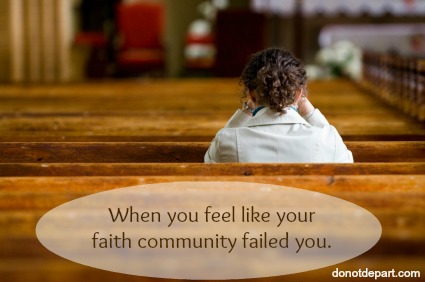
When Your Faith Community Fails You

February 28, 2013 by Sandra Peoples 9 Comments

Months after our son was diagnosed with autism, I sat at lunch with two friends and cried about all we were going through. They listened, they prayed for me, and they asked loving questions like, “How is this affecting your marriage? Are you and Lee pulling together or being pushed apart?” My friends were exactly what I needed exactly when I needed it. But, this was only the second time we had been together face-to-face. One lived in Tennessee and one lived in Ohio, far away from our house in Pennsylvania. They had never even met my husband Lee or our sons. Most of the time, they were just avatars on Facebook and Twitter. As thankful as I was for them, I wondered why no one else was praying over me, asking me questions, or just spending time with me as I adjusted to my new life as a special needs mom. These two friends ministered more to me in the hour before I caught my plane to fly back home than I felt our church family was doing. The more I thought about it, the more bitter I became, finally feeling like our church failed us.

A couple years have passed since that day. Now, I can look back with objectivity. But that doesn’t diminish the pain I felt at that time. Nancy Guthrie writes,

“We all know what it’s like to have a burn or a physical injury and discover for the first time how much we use that part of our body. The affected area might have been bumped or brushed up against countless times before it became inflamed, but we never really noticed. Now we’re much more sensitive. We notice every time someone carelessly makes contact with us. We have a heightened sensitivity, and it doesn’t take much to hurt us.

That’s how it is when our hearts have been broken, when our insides have been rubbed raw by difficulty or disappointment or the death of someone we love. We’re far more sensitive to the thoughtless comments and dismissive slights of others. We expect more from everyone around us, and we’re easily annoyed and offended when we don’t get it.”

I was raw. Everything hurt—words people said, words people didn’t say, their reactions, and their inactions. How should we act when we feel like our faith communities have failed us? Here are a few lessons I learned during that time I’m still trying to apply today:

  • Give your faith community grace. No one in our church was intentionally hurting us. Most didn’t know what to say. They didn’t know what might set off my tears. Our church family learned about autism with us. Now, we couldn’t ask for more supportive and encouraging friends. They not only love us, but they have started a special needs ministry to reach out to other families like ours. But it took time. For us and for them.
  • Give yourself grace. Realize how raw you are. Understand you may be hyper-sensitive and will process events differently when you get to a new normal. Find books and blogs by people who have been through what you are experiencing so you know you aren’t alone, even if you feel alone.
  • Give grace to others. Reach out so you don’t fail them. Before our experience, I never knew what to say to a woman who had experienced a miscarriage, so I said nothing. But now, I say something. I say I’m sorry. Then I follow-up a week later and again say I’m sorry and I’m praying. I work hard to get over myself and join with someone else in whatever they are going through. It isn’t comfortable for me, but it’s worth it, so no one else feels like I have failed them.

Life in community isn’t always easy. But grace makes it easier. Give grace to your family community, yourself, and to others who may need it today.

Singles in community

February 19, 2013 by Julie 10 Comments

Is there a place in the faith community for singles? More than half of homes with children in my city are headed by a single parent. The number of adults who are unmarried, divorced, or widowed continues to rise in the United States, but much of church community life focuses on married people. Recently, a godly single friend of mine admitted that she often feels “invisible.” If God sees the life of each individual, married or single, why doesn’t the Church?

With industrialization came assembly line concepts that grouped like pieces for the purpose of efficiency. God didn’t intend for the community life of believers to be so segregated. Instead, His word describes a Body life where a variety of ages and marital statuses blend for greater strength, understanding, and impact. Singles want and need to be in community with married friends, and the whole Church is better when our single friends are part of it.

“For the body does not consist of one member but of many… But as it is, God arranged the members in the body, each one of them, as he chose… If all were a single member, where would the body be? As it is, there are many parts, yet one body… If one member suffers, all suffer together; if one member is honored, all rejoice together. Now you are the body of Christ and individually members of it” (from 1 Corinthians 12:4-27).

A “single” member here doesn’t refer to marital status, but to one individual. As each one experiences God’s grace individually, we each have reason to look around us and help every other member be seen, included, valued, and loved. “By this all people will know that you are my disciples, if you have love for one another” (John 13:35).

Many unmarried community members are suffering today, because they long to be in a mixed status, loving community, but they feel invisible. The Body needs the value they bring, and we miss out when they’re absent … or just invisible. If one suffers, the whole Body suffers.

A godly single friend of mine is a treasure in our community, and I asked her to share: What can a married woman do to be a good friend to a single woman?

How to love single women in your community

  1. Respect the single woman and treat her as an equal.
  2. Be interested in your single friend’s life.
  3. Be sensitive to her desire for marriage and accept her for who she is.
  4. Encourage her to serve the Lord with her whole heart in the situation God has placed her in.
  5. Be sensitive to the single woman’s comfort level around children.
  6. Offer to help (don’t wait to be asked). Let her have the joy of helping you.
  7. Pray for and with the single woman.

Created for Community
A “single” (marital status) person doesn’t want or need to be a “single” (only one/alone) person in the community of believers. Let’s see those who are unmarried and help them feel like part of the “one body” of God’s bigger family.


Read more about Married Friends for Singles and Why some married people make good single friends.

The Picture of Health

February 12, 2013 by Kathy Howard 4 Comments

Healthy church body


My first grandchild is almost 11 months old.  Watching him grow and change and learn has been amazing and fun.

When Micah and his parents (our daughter and son-in-law) were here for Christmas, he was pulling up on everything and walking around by holding on to the furniture.  But that won’t be the end of the growing. Soon, Micah will be standing without assistance and then walking on his own.

Healthy church body

Micah’s success with standing and walking would be severely diminished if he was missing a limb. While, the human body is miraculous and can rise to all kinds of physical challenges, we need every single part to optimally function like God intended.

The same is true for the body of Christ. The church needs every part, every member of the body, to function as God intends.

When God saved you, He saved you into His family, into the body of Christ. You are one member joined together with all the other members. God designed us for community. His plan for His children is for us to live out our faith in community and to grow together in unity (Eph 2:19-22).

The church cannot be all God purposes without you and you cannot be all God purposes without the local church. Here are a few quick truths from Scripture:

  • Every Christian is a member of God’s family.
  • A believer cannot choose to separate herself from the body. She is a part (1 Cor 12 15).
  • Each member of the body “belongs” to the other members. Christians have a mutual responsibility to and for each other (Romans 5:4-6).
  • God gives every Christian spiritual gifts intended to be used for the good of the family (1 Cor 12:7).
  • Every Christian has a specific place of service in the body (1 Cor 12:27).
  • It takes every member serving where God placed her for the body to grow properly and become mature in Christ (Ephesians 4:11-13).

In Ephesians 4, Paul beautifully describes God’s intent for the church – locally and globally:

 11 So Christ himself gave the apostles, the prophets, the evangelists, the pastors and teachers, 12 to equip his people for works of service, so that the body of Christ may be built up 13 until we all reach unity in the faith and in the knowledge of the Son of God and become mature, attaining to the whole measure of the fullness of Christ.14 Then we will no longer be infants, tossed back and forth by the waves, and blown here and there by every wind of teaching and by the cunning and craftiness of people in their deceitful scheming. 15 Instead, speaking the truth in love, we will grow to become in every respect the mature body of him who is the head, that is, Christ. 16 From him the whole body, joined and held together by every supporting ligament, grows and builds itself up in love, as each part does its work. Ephesians 4:11-16, NIV

Created for CommunityAs individual members each carry out their “God assignment” in the local church, the body grows together in health and unity. As we all continue to serve together, love each other, and encourage and challenge each other, the church will become spiritually mature. Then the church will be steady and strong, resistant to false teaching and battle-ready to defeat Satan’s scheming. And the best part is that the church will reflect Christ to a lost world.

This is God’s design for a healthy, mature church body. Are you doing your part? Have you obeyed God’s call?

What body “part” are you? Where has God placed you in His body?


Faithful in community

February 7, 2013 by Julie 5 Comments

Created for Community

The believers were scattered and facing persecution when James wrote to them to encourage them in their trials. They struggled to have joy, well aware of their need for wisdom in the difficult things of life. Have you ever been alone in the midst of trying times? Trials are hard enough, but facing them without community is harder.

Accept His community challenge

Created for Community
The message of the book of Hebrew resonates with the echo of encouragement to be full off faith in trials. Tucked inside the tenth chapter of the book, God reveals a key choice that may determine how steadfast we are as individuals. Choose to regularly assemble in one place with others who follow Him.  He challenges us to practice this habit in order to be faithful in hard times.

“Let us hold unswervingly to the hope we profess, for he who promised is faithful. And let us consider how we may spur one another on toward love and good deeds, not giving up meeting together, as some are in the habit of doing, but encouraging one another—and all the more as you see the Day approaching” (Hebrews 10:23-25).

Accept the community urgency

As followers of God recognize the Day of His return coming closer, they will face hardships that tempt them to move from hope to hopeless. Just identifying themselves as a member of His Body may come with a price tag, and they may give us coming together. Some Christ followers will drift away from a culture of love and doing kingdom things. More than ever, God wants the community of faith to gather together to encourage each other to be firm in their faith.  By gathering together as His people, we remember who we are in Christ, who God is, why we have power instead of fear, and how light overcomes darkness.

Accept no community substitute

In this day, a scattered community of believers has more ways than ever to overcome isolation. It’s never been easier to network globally, but it’s never been easier to give up “meeting together,” which has the idea of assembling together in one physical place. Technology complements and creates community networks, but it doesn’t take the place of “meeting together.” There’s power in physical presence. We can not experience in reality what we only envision virtually.

Just as God became “God with us,” He urges us to be with each other. He set the precedent of relationship in community. Let’s keep on:

  • gathering together regularly
  • in local communities of believers
  • to spur each other on
  • to living out our faith
  • right up until the Day is here!

We will be faithful to the faithful One when we meet together faithfully.

Following the knee-worn path

January 22, 2013 by Julie 11 Comments

“There’s one more thing,” the plumber said, “Do you know where your main water cut off is?” Indicted by his simple question, I wondered how I could have ignored something so basic, especially when we’ve had a major “water episode.”

“What would you do if you needed to turn off your water?” He asked.

“Call you? Call my husband? Call my neighbor?” I smiled. He wasn’t charmed.

“I’m going to show you where your water source is. You don’t want to wait until you need it to find out where it is.”


If you haven’t cultivated prayer’s knee-worn path before a flood rushes in, now is a good time to begin. We don’t want to wait until we need it to find out where it is. Theologian Armin Gesswein said, “God’s throne is the busiest place in all the universe because everything centers there. Yet, the lack of prayer on earth keeps it from operating at full capacity.” Most of us say we’re too busy to pray. I was once too busy to find the water source in our house, and I paid a high price.

Jesus Prayed

Jesus himself was a man of prayer, expressing dependence on his Father and determination to do His will. Even now, “he always lives to make intercession for them,” (Hebrews 7:25b) pleading our case. The Father Himself is the source of prayer, a gift to mankind as an invitation for two-way communication. With all of our technology, it’s better than any man-made version. Scripture teaches us the language of prayer, teaching our independent mouths to speak heart words of dependence. Though seated beside His Father, Jesus prays on.

Followers Prayed

Simple men who followed Jesus up close and personal, and knew the work of prayer, still asked to be taught how to pray (Luke 11:1). Jesus’ prayer pattern hinged on desiring His Father’s will. Since God’s word reveals His will, prayer needs the fodder of truth to drive the faith behind it. The Bible is our book of prayer.

The Church Prayed

When believers first gathered as the Church, they began as a praying Church. Vulnerable in a contra-God world, “All these with one accord were devoting themselves to prayer.” (Acts 1:14a). They were sure of their need to cry out in dependence on God. If the people of God are to experience faith, intimacy, and power in an anti-God world, they must be people of prayer. To claim we are too busy to pray is to turn away from our waiting Lord. Prayer is not a piece of Body life; prayer is the foundation of Body life.

When I pray

  • Prayer strengthens faith. We call on God to fulfill promises He has already made.
  • Prayer nurtures intimacy. We expose ourselves to God and He makes Himself personally known.
  • Prayer inspires power. We gain boldness by focusing on the person of God instead of ourselves.

Two-way communication with God isn’t only for moments of helplessness, though Abba Father welcomes us near then. He invites us to call on Him as long as we live, to live in sweet, close communion with Him. To cultivate the discipline of prayer is to work at knowing His will, listening to Him, and opening our lives to Him.

“I love the LORD, because he has heard my voice and my pleas for mercy. Because he inclined his ear to me, therefore I will call on him as long as I live” (Ps. 116:1-2).

If you want to take a step on the knee-worn prayer path, check out our tools like Prayer Calendars or  A Prayer Album for Women on the Go.

Is there a tool or habit you’ve found to help you keep prayer as part of your daily life?

Thankful for Fellow Believers

November 13, 2012 by Kathy Howard Leave a Comment

Thanksgiving in the Word

Thanksgiving in the Word In our 29 years of marriage, we’ve moved seven times with my husband’s job. Probably the hardest thing about each move has been leaving our local church family. However, the greatest thing about each new place is knowing that God already has a church family waiting for us there.

Thankful for God’s Church

This month we are focusing on thanking God for His tremendous blessings in our lives. His church should be near the top of our long list. The apostle Paul constantly thanked God for his fellow believers and left us a good example to follow:

  • Every time I think of you, I give thanks to my God.  Philippians 1:3, NLT
  • Ever since I first heard of your strong faith in the Lord Jesus and your love for God’s people everywhere, I have not stopped thanking God for you. Ephesians 1:15-16, NLT
  • We always pray for you, and we give thanks to God, the Father of our Lord Jesus Christ. Colossians 1:3, NLT

Specific Things to Thank God For

God works through local believers to love us in concrete ways. They are His hands ministering to us. Here’s a sampling:

  • To teach us God’s Word (Romans 15:14)
  • To comfort us (2 Corinthians 13:11)
  • To serve us (Galatians 5:13, 1 Peter 4:10)
  • To restore us (Galatians 6:1)
  • To bear our burdens (Galatians 6:2)
  • To build us up (1 Thessalonians 5:11)
  • To do us good (1 Thessalonians 5:15)
  • To exhort us (Hebrews 3:13)
  • To encourage us to do good deeds (1 Thessalonians 4:18, Hebrews 10:24)
  • To meet our physical needs (James 2:15-17, 1 John 3:17)
  • To pray for our healing (James 5:16)

I encourage you to use this list as a prayer guide today. As you read through this non-exhaustive list of the way God loves us through His local church, thank God for a specific people and particular ways He has loved you through His church.

I’d love for us to share some specific ways God has blessed you through His people. We can write them as a prayer of thanksgiving to God.


10 Churchy Words We All Need to Know

February 13, 2012 by Kathy Howard 16 Comments

Last fall, I spent two weeks in Moldova. Most of the people speak Russian. Since I don’t, I often wondered what people were talking about. Translators helped, but I longed to understand and speak the language.

Christians have a unique language too. Theological words and “Christianize” pop-up constantly in church services, Bible studies, and conversations. For long-time church-goers, words like “saved,” “lost,” and “repentance” come naturally. But others often wonder what we’re talking about. And sometimes even Christians can’t explain them.

So, should we just toss them out? No, these words – which come straight from Scripture – richly express the truths of our faith. Instead, we must define them and help others to understand them too.

Here’s my list of the top ten “churchy” words you should know, complete with Scripture references and definitions:

  1. Born Again (John 3:3-8) – Jesus coined this phrase Himself referring to being spiritually reborn or born from above; this term is synonymous with “Christian.” The phrase “born again Christian” is redundant.
  2. Lost (Luke 19:10; Matt 10:6) – Jesus used this term to refer to those who are alienated or separated from God. The same Greek word is translated as “perish” in John 3:16! The Greek means “to destroy, kill, or to declare that one must be put to death.” Christians use “lost” to refer to those who are spiritually dead in their sin and separated from God.
  3. Salvation/Saved (Acts 4:12; Ephesians 2:8-9) – Delivery from sin and its consequences; the present and eternal spiritual condition granted by God to those who believe in Jesus and His saving work.
  4. Repent/Repentance (Luke 24:47, Acts 2:38; 2 Cor 7:10) – The Greek noun and verb translated as “repentance” and “repent” means to “change one’s mind or purpose.” The Bible uses this word specifically to refer to changing one’s mind and behavior regarding sin and evil.
  5. Faith (Ephesians 2:8; James 2:14) – having a solid confidence, trust, hope and active reliance in God and His promises. This firm conviction produces full acknowledgment and personal surrender.
  6. Sin (Romans 3:23) – to “miss the mark” as an arrow missing a bull’s-eye; to deviate from the norm. The Bible uses “sin” to refer to anything that deviates from the perfect pattern God established for mankind. “Sin” refers to our wrong thinking actions, and corrupted nature.
  7. Justification (Romans 3:24; 4:25) – to make or declare one to be righteous. Our sin earned the guilty verdict, but Jesus paid our penalty and gave us His righteousness.
  8. Redemption (Romans 3:24) – a releasing or deliverance bought with a ransom. Christ bought our “redemption” from sin, spiritual death, and separation from God with His own life, given on the cross.
  9. Righteousness (Romans 3:25; 2 Cor 5:21) – the quality of being right or just; conformity to God’s perfect moral standard. Righteousness is impossible to accomplish on our own. But Jesus gives His righteousness to those who trust in His death for salvation.
  10. Sanctification/Holiness (Romans 6:19; 1 Thess 4:3; Hebrews 12:14) – separation of the believer from anything sinful. It requires conscious action and submissive obedience to God’s will and way. It is an ongoing process that begins at salvation and continues throughout this life.

Are you still with me or do you feel like you just got thrown into the deep end of the pool? Although these “churchy” words can be confusing, understanding them will deepen our understanding of our great salvation.

I’d love to know what “churchy” words you love and hate! What “churchy” word do you struggle to understand or use? What “churchy” word do you just love because it conveys so much meaning?

Royal Wedding?

April 25, 2011 by ScriptureDig 6 Comments

At the end of this week, much of the world will watch as Prince William of England marries Catherine Middleton at West Minster Abbey.  An app was developed to allow curious people of the world (ahem) to take a virtual tour of the Abbey before the wedding. Barbara Walters released a special about the events, saying “No one does it quite like the British.”  After Princess Diana’s 25 foot long train in 1981, we might be tempted to believe Barbara, but she’s not quite right.  In reality, the world has yet to see a truly royal wedding.


On Friday we looked at the heavenly hope for wives to respect their husbands and husbands to love their wives. The comparison to how Christ loves his church was a key part of understanding how and why, but today let’s take a closer look at what it means to be the Heavenly Bride.

Unlike an earthly husband, Christ is actually able to sanctify his bride (set her apart) and cleanse her by paying for her impurities with his own righteous sacrifice. In comparison, even the earthly wealth of England doesn’t look quite so grand.   The gift of the Bridegroom Christ on the cross makes it possible for the Bride Church to be totally clean and holy, so nothing separates her from his love. He longs to “present the church to himself in splendor, without spot or wrinkle or any such thing, that she might be hold and without blemish,” (Eph. 5:27) and husbands are to love their wives “in the same way” (v.28).

Photo by Shine4Him8Himself.

We glimpse the gift in our “engagement,” but we’ll fully realize the joy when we are united at the royal Marriage Supper of the Lamb. It will rival the celebration just held at Buckingham Palace by Her Majesty the Queen. The Marriage Supper of the Lamb and his love will be hosted by the Heavenly Father

Revelation 19 offers us a glimpse of what awaits the Bride of Christ, the Church, in heaven.

“Hallelujah!For the Lord our God the Almighty reigns.
Let us rejoice and exult and give him the glory,
for the marriage of the Lamb has come, and his Bride has made herself ready; it was granted her to clothe herself with fine linen, bright and pure”— for the fine linen is the righteous deeds of the saints. And the angel said to me, “Write this: Blessed are those who are invited to the marriage supper of the Lamb.”

(vv. 6b-9a)

For West Minister’s “royal wedding,” Catherine prepared for months; the world watched with curious anticipation.  When the Bridegroom Christ receives his Bride the Church, will he see that, “his Bride has made herself ready?”  Will we be covered in the fine linen of righteousness?

I’m sad to say I didn’t receive an invitation to royal wedding of William and Kate, and I venture to guess you didn’t either, but we ALL got an invitation to the Marriage Supper of the Lamb.  And even more thrilling, the Father has chosen us to be the Bride!  We don’t know when we’ll be wed to our Love, but we know the wedding is coming, and it’s going to be more than royal; it’s going to be divine.


Are you ready to meet the Bridegroom? 

If we are the body…

October 29, 2010 by ScriptureDig 5 Comments

I hope that you have been blessed and challenged by our look at the beautiful and sometimes difficult thing we know as the local church. As believers in Christ, we are part of the body… and if we are the body, what does that mean?

It’s difficult. It’s messy. It’s painful. It’s beautiful. – We opened our series considering how close the church is to God’s heart, and therefore how close it should be to our own.

The birth of the church – Sandra looked at the very beginning of the Church at Pentecost and reminded us that we can’t take a time-out. The church has a job to do!

From one church to many – We buckled our seatbelts and took a fast-paced overview of the development of the Church through Acts and the epistles.

What is “church?” – Kathy reminded us that the church is not a building and used Ephesians 2 to define for us what the church is really all about.

Why all these denominations? – Teri Lynne distinguished between religion and denomination and gave a broad overview of the differences between the denominations.

Can’t we all just get along? – Julie reminded us what really matters.

You need a local church – Sandra explained how God has provided the perfect environment for spiritual growth within the local church.

Connection is key to service – Stephanie taught us that we are saved to serve, and that we need one another to function as the body.

Sock shopping – Julie looked at how consumerism in the church is like sock shopping.

Sin causes pain in the body – Kathy tackled the tough topic of church discipline and why it is so essential for healthy body life.

Give grace – Teri Lynne challenged us to give grace to one another, whether we know each other’s life circumstances or not.

When is it ok to leave? – Kathy looked at Biblical principles to guide us through this tough question.

Welcome forgiveness – Julie shared her own personal story of welcoming forgiveness when rifts occur in the body.

It’s not what you think it is – Teri Lynne gave us a great picture of what worship really entails.

Service in the church – Sandra reminded us that the the body of Christ needs all of us and all of our gifts to function effectively.

Truth, justice, and the congregation’s way? – Teri Lynne challenged us to stand for the truth of the Gospel, recognize God’s justice in all things, and submit to God’s ways in all areas.

Loving lavishly – Stephanie asked us to examine whether or not we really love one another in the body.

Loving Lavishly

October 28, 2010 by ScriptureDig 8 Comments

Love. Its presence validates us. Its absence makes our faith questionable. The Bible tells us love is to be a defining characteristic in the life of every believer.

If we say we love God, yet we don’t love our brothers and sisters in Christ, then how real is our love? If anyone says, “I love God,” yet hates his brother, he is a liar. For anyone who does not love his brother, whom he has seen, cannot love God, whom he has not seen. 1 John 4:20 (NIV)

But love doesn’t always come easily. Personalities clash. Conflicts occur. People let us down and sometimes even knock us down when what we really need is a hand up. Then there are those who are contentious. Always stirring the pot. Gossips. Busybodies. Critical complainers who are seldom satisfied. The proud who arrogantly promote themselves and their “service for the Lord.” The lazy who murmur about what needs to be done, yet won’t lift a finger to help. The self-seeking; the whiny; the wimpy and the wayward. The argumentative; the audacious and the angry.

Definitely not an easy bunch to love.

But we aren’t called to love because someone is worthy. We are called to love because we have been loved in the midst of our own unworthiness. We are God’s children – and as His children we are to love others with the love of Christ. Unmerited, sacrificial, continuous and abundant love. It’s not a suggestion. It’s a command. Love one another.

“A new command I give you: Love one another. As I have loved you, so you must love one another. By this all men will know that you are my disciples, if you love one another.” John 13:35

Dear friends, since God so loved us, we also ought to love one another. 1 John 4:11

“But I tell you who hear me: Love your enemies, do good to those who hate you, bless those who curse you, pray for those who mistreat you.” Luke 6:27-28

Unfortunately, the church is filled with contentious converts who cause the world to wonder what in the world to believe. While unbelievers stand in need of the love of Christ, congregations are splitting over the color of the carpet, the choice of songs or a simple difference of opinion. May it not be so, Lord. May it not be so!

Have you ever heard of a hand choosing to separated from the arm? Or an eye being separated from the head? We are the church. The called out ones. The bride of Christ. The body of Christ. Family. And God calls us to love each other lavishly. To be conduits of grace, especially to one another. That’s one of the primary ways we show the world that Jesus lives in us – by our love for one another.

I think that sometimes we talk about love, yet we really aren’t sure what it is. God gives us His definition of love in 1 Corinthians 13. Many years ago, I began to use it as a “Love Test” for myself. To measure my love in light of His Word.

1 Corinthians 13:4-8 tells us what love is and what love isn’t:

Love is patient. (Am I patient?)

Love is kind. (Am I kind?)

Love isn’t jealous. (Am I jealous?)

It doesn’t sing its own praises. (Am I being boastful?)

It isn’t arrogant. (Am I arrogant?)

It isn’t rude. (Am I rude?)

It doesn’t think about itself. (Am I self-centered?)

It isn’t irritable. (Am I irritable?)

It doesn’t keep track of wrongs. (Do I keep track of wrongs?)

It isn’t happy when injustice is done, but it is happy with the truth. (Am I happy when others suffer? Do I rejoice in honesty)

Love never stops being patient. (Am I weary with being patient?)

Never stops believing. (Have I stopped believing the best about someone?)

Never stops hoping. (Have I stopped hoping?)

Never gives up. (Have I given up on someone?)

Love never comes to an end. (Has my love ceased to exist for someone?)

The way you answer these questions will reveal whether or not you are truly loving someone or not.

We are called to love each other in spite of ourselves. In spite of our failures and flaws. We need to remember that we are all a work in progress.

The next time you are finding it difficult to love your neighbor as yourself, give yourself the 1 Corinthians 13 “Love Test” and remember to…

1. Give each other room to fail

2. Give each other room to grow

3. Give each other room to be human

4. Love beyond their failures and flaws, just as God has loved you beyond your failures and flaws.

Do you struggles with loving others? Have you been hurt by someone in the church who hasn’t loved well? Have you hurt others by your own lack of love? Do you need to reconcile with someone you failed to love regardless of whether they deserved it or not? Is your faith confirmed by your love for others?

May we love each other with the love with which we have been loved. Undeservedly, sacrificially, abundantly and consistently!


Truth, Justice, and the Congregation’s Way?

October 27, 2010 by ScriptureDig 8 Comments

Superman With two younger brothers, much of my childhood was filled with superhero role-playing.  In fact, when we were all under five, my brothers’ room was decorated in the various heroes of the day – Superman, Batman, and good ol’ Spidey.  I, of course, was always Wonder Woman.  (Hey, it was the 70s, y’all, we all thought Lynda Carter was IT!)

Whenever we played, we always knew our hero’s catch phrase … and the favorite of both boys was Superman.  If I close my eyes tight enough, I can still see two tow-headed little boys running about in towel-capes with one arm forward and one back yelling, “Truth, Justice, and the American Way.”

Now, as a pastor’s wife, I’ve learned the new rallying call in many Christian circles … Tradition, Judgment, and MY way. There are moments in ministry when I feel as though my heart will break.  We have lost sight of important principles and replaced them with personal agenda.   In doing so, we have also forsaken the priority of God’s Word and His standards regarding our behavior as individual believers and as the Church collective.

We have replaced Truth with Tradition.

Far too many churches have gone far too long without asking the question, “Is this activity, ministry, or function grounded in the TRUTH of God’s Word or in the comfort of our TRADITION?” Paul spoke clearly to the church at Colosse,

“See to it that no one takes you captive through hollow and deceptive philosophy, which depends on human tradition and the basic principles of this world rather than Christ” (Colossians 2:8 NIV, emphasis added).

While traditions of themselves are neither good nor bad, when we allow traditions to take priority over proclaiming the truth of God’s Word, we have elevated them to an ungodly and sinful place.  In all things, we must be willing to ask if the tradition is rooted in and bringing forth truth … or if it has become hollow and focused on celebrating the past rather than crying out the grace of the Gospel.

We have replaced Justice with Judgment.

Oh that we could trust in the justice of God without feeling the need to exact judgment on one another! Again, we find that Paul speaks to this idea,

“Everything is permissible – but not everything is beneficial.  Everything is permissible – but not everything is constructive.  Nobody should seek his own good, but the good of others … So whether you eat or drink or whatever you do, do it all for the glory of God” (Romans 10:23-24, 31 NIV).

We look around our sanctuaries and worship centers finding reasons that we are better than others – from choices regarding the education of our children to holiday traditions, from socioeconomic factors to generational prejudice, from our own insecurities to others’ previous lifestyles – we can be a judgmental lot!  And in being so quick to judge, we lose sight of this simple yet eternal truth:  We serve a just God.  The reality is while we focus on judging one another the world around us is dying without hope and salvation. We prefer to focus on the loving, forgiving part of God’s nature – but we must never, ever forget that we are called to “Go ye therefore and make disciples” … for the God who has offered us salvation is just and the “wages of sin is death.” (References to Matthew 28:19 and Romans 3:23)

We have replaced God’s Way with My Way.

Churches are filled with people who have been conditioned to “Have it Your Way!”  We are consistently guilty of giving corporate worship and fellowship far less devotion that the Lord intended.   We come when we feel like it, serve when it’s convenient, and give what we feel we can. Again, we find that Paul has a word for us,

“Be imitators of God, therefore, as dearly loved children and live a life of love, just as Christ loved us and gave himself up for us as a fragrant offering and sacrifice to God (Ephesians 5:1-2 NIV).

Paul reminds us that we are called to live in the manner of Christ … not of the world.  And Christ’s life was marked by humility (Philippians 2:5-8), service (John 13:2-17), and sacrifice (Hebrews 10:8-10).  And so, if we are to live in God’s way, our lives must bear witness to those same qualities. We must lay aside preference and personal taste and focus instead on serving, on forgiving, on giving grace, and on true worship.

Fellow believers, will we be the generation that lays down tradition and self-righteousness, judgment and self-fulfillment, and  pride and selfishness?  Will we stand up for the TRUTH of the Gospel of Jesus Christ?  Will we recognize the JUSTICE of the God we serve?  And will we submit to GOD’S WAY in all things big and small?  Will we?

Next Page »

This Month’s Theme

  • Jesus is the Way
  • And He Shall Be Called Series Intro

Enter your email address to have new posts emailed to you:

We’ll come to you

Enter your email address to have new posts emailed to you

Categories

Bible Memory – Lent 2021

Memorizing Isaiah 12

Let the Children Come

Let the Children Come

Want more #HideHisWord resources?

Memorizing Psalm 1

Find Us on Facebook


Search

Recent Posts

  • Series Wrap-Up: The Lord Is My Light
  • His Marvelous Light
  • When the Darkness Deepens
  • Though I Sit in Darkness…
  • Let Your Light Shine
  • Life-Giving Light

Archives

© 2026 · Pretty Creative WordPress Theme by, Pretty Darn Cute Design