• Home
  • About
    • Our Contributors
    • Our Beliefs
  • Blog
  • Bible Studies
    • Scripture Dig
  • Archives
  • Shop
  • Advertise
  • Contact
    • Email
    • Facebook
    • Instagram
    • Pinterest
    • Twitter

Do Not Depart

Encouragement and Tools to Abide in God's Word

You are here: Home / Archives for John

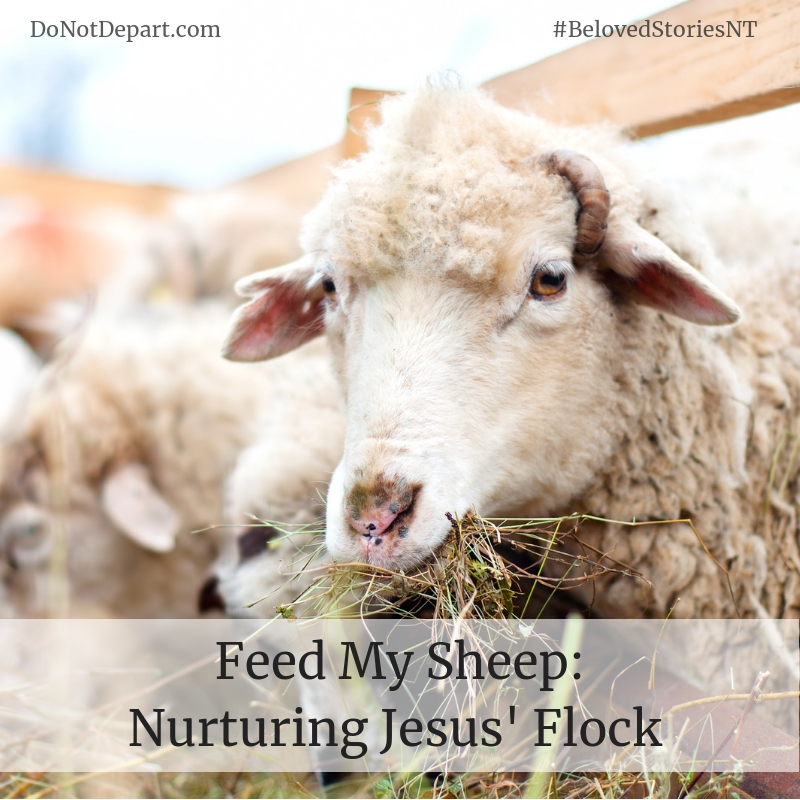
Feed My Sheep: Nurturing Jesus’ Flock

September 30, 2018 by Patti Brown Leave a Comment

Feed My Sheep: Nurturing Jesus' Flock

Feed My Sheep: Nurturing Jesus' Flock
I stuck the cassette tape in the machine and pressed play. It was 1993—I was newly married, jobless in a state drowning in a recession, and deeply depressed. I had no idea what to do with my life.

My mother had mailed me the tape from across the country because of a strange request – “Mom, I was praying, and I just felt like I needed to listen to that old album by Dallas Holm again. Can you send it to me?”

I sat in the dark listening to the songs, wondering why it had seemed so important when I was praying. I knew as soon as I heard these words:

“Feed my sheep, feed my sheep, if you really love me, just feed my sheep.”

That was it. That was what I was supposed to hear. Even though I was sure the phrase had a specific application to me, it would be years before I fully understood that quiet word from God. Indeed, what it looks like in my life is still unfolding today.

Feed My Sheep – John 21:15-17

It is a well-known story. Jesus had been crucified and had risen from the dead. Peter’s betrayal was still fresh. Early one morning, Peter and six other disciples were in a boat after an unsuccessful night of fishing.

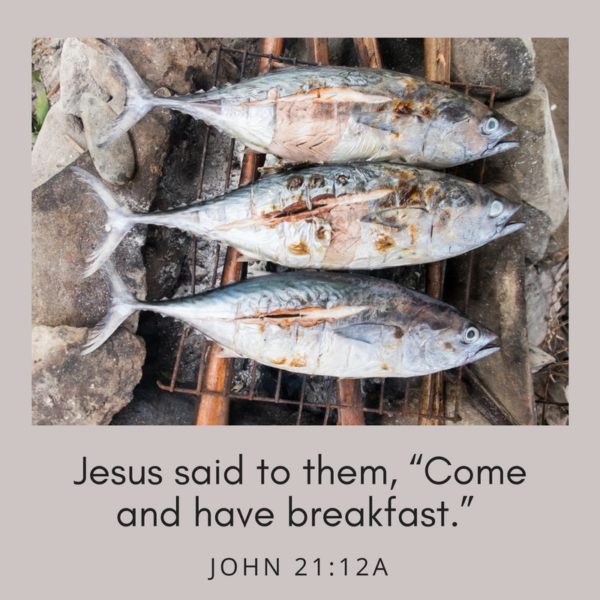
Then there He was. Standing on the beach tending a fire, Jesus called them to breakfast.

When they had finished breakfast, Jesus said to Simon Peter, “Simon, son of John, do you love me more than these?” He said to him, “Yes, Lord; you know that I love you.” He said to him, “Feed my lambs.” He said to him a second time, “Simon, son of John, do you love me?” He said to him, “Yes, Lord; you know that I love you.” He said to him, “Tend my sheep.” He said to him the third time, “Simon, son of John, do you love me?” Peter was grieved because he said to him the third time, “Do you love me?” and he said to him, “Lord, you know everything; you know that I love you.” Jesus said to him, “Feed my sheep.” – John 21:15-17

More often than not, the focus of sermons about this passage stays on the question part: “Do you love me?” There is such depth in that aspect of the story and well worth the time to study.

But for me the command “Feed my sheep” has been a guide for my life. You’ll notice in the English that the three phases are not exactly the same. They are also different in the original Greek.

A straightforward way to understand these three verses is:

  • Verse 15 – Feed my lambs
  • Verse 16 – Shepherd my sheep
  • Verse 17 – Feed my sheep

Physical Care

Feeding (Βόσκε or Boske) here can be understood as quite literal. Physical provision for God’s people is necessary – those with hungry bellies do not have ears that hear well!

In Luke 3:11, Jesus said “Whoever has two tunics is to share with him who has none, and whoever has food is to do likewise.” James 1:27 tells us that pure religion in God’s eyes is to care for widows and orphans. The early church recognized the importance of physically caring for its people and appointed seven deacons just for that purpose (Acts 6:1-6).

Even more compelling, Jesus told the disciples that feeding the hungry was the same as giving Him food (Matthew 25:35)!

As people of Christ we are called to be caregivers of others, and aware of their physical needs. This certainly means food, but it can also include finances, shelter, and any other practical need someone might have.

Spiritual Care

Shepherding (Ποίμαινε or Poimaine) has implications more along the lines of spiritual care. Guiding and tending to non-physical needs is equally as important as a caregiver.

While 1 Peter 5:1-3 is addressed to elders, it gives valuable insight into what godly spiritual care looks like:

“shepherd the flock of God that is among you, exercising oversight, not under compulsion, but willingly, as God would have you; not for shameful gain, but eagerly; not domineering over those in your charge, but being examples to the flock.” 

Words like teacher, pastor, counselor, come to mind. But you and I do not have to have these titles to care for others spiritually. A willing ear, godly counsel that is steeped in Scripture, commitment to prayer… all of these are ways to spiritually care for those in your life.

As parents we tend to the spiritual care of our children by teaching them truth (Deuteronomy 6:6-7) and modeling it. Titus 2:3-5 instructs older women to teach the younger women what is good.

It is essential that all the spiritual care we undertake is grounded in Scripture for “all Scripture is breathed out by God and profitable for teaching, for reproof, for correction, and for training in righteousness” (2 Timothy 3:16)

My Sheep Feeding Story

“Feed my sheep” was such a personal message for me – I have spent huge amounts of time literally preparing food for others, not only my family, but in ministry. The “feeding” message even had an unexpected twist when I spent time as a volunteer lactation counselor. And several years after that dark night when His words whispered their way into my heart, I found myself in a class being trained to lead Bible studies. This opened a door into decades of in-person and written Bible study ministry.

As I look back over 25 years since that moment in my living room, I can see so many ways that God has fulfilled that word in my life! The fact that I am writing here is one of them!

Jesus is the Shepherd

Jesus is the Good Shepherd, and He asks us to be His assistants in tending to His flock. All good assistants understand that they implement the instructions of their superior, and maintain his vision in their work, but know that they are not ultimately in charge.

You and I also, as those who desire to love Jesus by serving His people, must always remember that it is He who is our gentle leader—it is for Him and because of Him that we serve. May He be glorified in all that we do!


Feed My Sheep: Caring for Physical and Spiritual Needs. #BelovedStoriesNT

Click To Tweet

The Good Shepherd asks us to be His assistants in tending to His flock. #BelovedStoriesNT

Click To Tweet

Our Risen Savior: Mark 16 and John 19-21

March 30, 2018 by Patti Brown Leave a Comment

Our Risen Savior: Mark 16 and John 19-20 #40DaysWithJesus

Our Risen Savior: Mark 16 and John 19-20 #40DaysWithJesus

John 19: Prophecies Fulfilled

John gives us a heart wrenching and detailed description of Jesus’ “trial,” crucifixion, and burial in chapter 19. Scattered throughout this chapter are reminders that every detail fulfills prophecy—proof that Jesus Christ is the Messiah.

This was to fulfill the Scripture which says, “They divided my garments among them, and for my clothing they cast lots.” John 19:24

After this, Jesus, knowing that all was now finished, said (to fulfill the Scripture), “I thirst.” John 19:28

For these things took place that the Scripture might be fulfilled: “Not one of his bones will be broken.” And again another Scripture says, “They will look on him whom they have pierced.” John 19:36-37
Jesus fulfilled hundreds of Old Testament prophecies. Every detail of his life, death, and resurrection was important, and pointed to the Truth of who He was.

Mark 16: Resurrection Overview

Mark’s consolidated overview of the Resurrection is his final chapter. Verses 9-20 are not found in the earliest manuscripts, and based on style, most scholars believe they were later additions.

Mark writes in verses 1-8 of the women who went to the tomb with spices after the Sabbath had ended. This would have been a costly decision — financially, emotionally, and timewise. But love can drives us to do things that require personal sacrifice. I can only imagine their emotions heading to the tomb: their grief, their worry over the weight of the stone in front of the tomb. And then their horror and fear to find the stone moved, and an angel sitting in the tomb!

The additional verses in Mark describe the people Jesus appeared to after He was raised from the dead, as well as His ascension into heaven.

John 20 – Peace Be With You

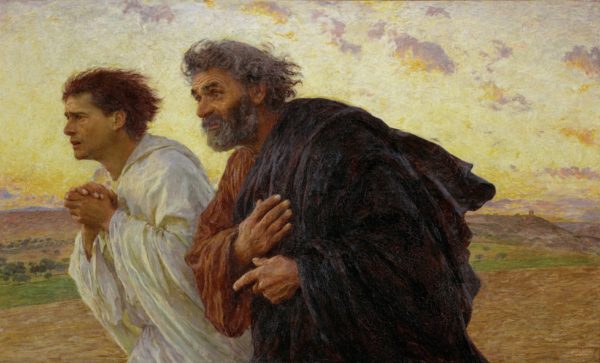
I have always loved this chapter of John. I almost feel as if I am there… I can feel the anxiety of Mary Magdalene as she ran to tell Peter and John that the stone was moved… the thumping heart of young John as he ran faster than Peter to see what had happened… the grief and fear of Peter as he was freshly dealing with not only the loss of Jesus, but his recent betrayal of Him.

Apostles Peter and John hurry to the tomb. Eugène Burnand, 1898.

But I think what touches my heart most is this verse:

Jesus said to her, “Mary.” She turned and said to him in Aramaic, “Rabboni!” (which means Teacher). (John 20:16)

Mary recognized the voice of her dear Lord, and we know that she flung herself on him, because in the next verse He tells her “Do not cling to me.” The deep love relationship between Jesus and Mary, and the fact that He honored this once despised woman with the very first glimpse of His resurrected self, is so moving to me.

Jesus then miraculously appeared to all the disciples in the locked room in which most of them were tucked away. Thomas was not there; John chronicles Thomas’ doubt that Jesus had really appeared, and his subsequent reaction when he finally did see Jesus.

I am struck by the fact that Jesus’ first greeting to the group of disciples, as well as Thomas, was “Peace be with you.” (verses 19, 21, and 26). How well the Lord knew that His disciples needed His peace which passes all understanding!

John 21 – Going Forward in Love

We now come to the final chapter of John, and the final chapter in our #40DaysWithJesus journey.

This chapter revolves heavily around Peter, and these are the first personal interactions we read about between Peter and Jesus after Peter’s betrayal.

Jesus tells Peter and crew where to find fish after a rough night, and the amazing abundance they pull in helps John recognize Jesus (v.7). Peter in his endearingly over-the-top way flings himself out of the boat and swims to shore to Jesus. Jesus cooks some fish for them, always aware of their every need.


Jesus and Peter then have a difficult conversation, which in English might appear confusing, but when you dig into the Greek you realize that the words translated “love” are not the same throughout the passage.

“Simon, son of John, do you love [agapas] me more than these? “Yes, Lord; you know that I love [philō] you.” He said to him, “Feed my lambs.” He said to him a second time, “Simon, son of John, do you love [agapas] me?” He said to him, “Yes, Lord; you know that I love [philō] you.” He said to him, “Tend my sheep.” He said to him the third time, “Simon, son of John, do you love [phileis] me?” Peter was grieved because he said to him the third time, “Do you love me?” and he said to him, “Lord, you know everything; you know that I love [philō] you.” Jesus said to him, “Feed my sheep.” (John 21:15-17)

Peter knew he was not yet capable of agape love, but Jesus knew that some day he would be.

John concludes his Gospel with these stirring words: “Now there are also many other things that Jesus did. Were every one of them to be written, I suppose that the world itself could not contain the books that would be written.” (John 21:25) 

What a fitting way for us to end our study together!

40 Days With Jesus

As we come to the end of our Lenten Reading Plan, let’s look back over what we have studied:

  • 40 Days With Jesus: A Reading Plan for Lent — Thoughts on Lent and a printable reading plan.
  • Why Read from Mark and John for Lent? — Some background on the books of Mark and John.
  • Lent is About Love (John 1:1-18) — In the first half of John 1, John tells us that Jesus is the Word… “lofty, intangible, the very essence of all thought and wisdom.”
  • What Have You Seen (John 1:19-51, Mark 1) — John the Baptist is introduced, Jesus is tempted in the desert, and His healing ministry begins.
  • Healing and Controversy (Mark 2-3, John 2) — Jesus begins to heal people, and turns water into wine.
  • The Son Gives Living Water Welling up to Eternal Life (John 3-5) — Jesus teaches Nicodemus about spiritual rebirth, offers the Samaritan woman living water, and continues to perform miraculous healings.
  • Parables and Prerogatives (Mark 4-6) — Jesus teaches His followers using parables, and demonstrates that He has authority over the weather, demons, illness, and even death!
  • Jesus, Astonishing Bread of Life (Mark 7, John 6) — Jesus continues to amaze people with His teachings and miracles.
  • When in Doubt Focus on Jesus (Mark 8-9, John 7) — Jesus wants us to see, hear and remember Him, take our doubts to Him, and align our thinking with Him.
  • The Truth Will Set You Free (John 8-10) — We can choose to follow Jesus and enter through the door that lads to life. Or we can be blind to the truth, which ultimately leads to death.
  • The Path to the Cross (John 11, Mark 10-11) — In these chapters, Jesus raises Lazarus from the dead, teaches the disciples and tells them what is to come, and returns to Jerusalem triumphantly.
  • Jesus: The Great Teacher (John 12, Mark 12-13) — These chapters are filled with Jesus’ teachings.
  • Jesus: Preparing Us for Change (Mark 14:1-42, John 13-14) — As Jesus’ death grows closer, He begins to prepare His disciples for what is coming.
  • 12 Ways to Let Jesus Love You (John 15-17) — These chapters are collections of Jesus’s words as He talked to His disciples, and later to God, on the night He would be arrested.
  • Jesus, King of Kings (Mark 14:42-72, John 18, Mark 15) — Jesus was not the King the Jewish people had envisioned would come to save them, but He was the King they needed!
  • Our Risen Savior (Mark 16, John 19-21) — Jesus’ death, resurrection and ascension into heaven are the topics of these final four chapters.

We hope you have been blessed by your time in God’s Word during our #40DaysWithJesus. I know I speak for the entire DoNotDepart team when I say we are grateful for you, and have especially enjoyed the discussions and sharing in our Facebook community group during this Lenten season. We hope you plan to spend every day with Jesus!

Our Risen Savior: Mark 16 and John 19-21. The final days of #40DaysWithJesus. #biblestudy

Click To Tweet

Recap of all the posts in our #40DaysWithJesus Lenten #biblestudy.

Click To Tweet

12 Ways to Let Jesus Love You – John 15-17

March 23, 2018 by Lisa Burgess 9 Comments

12 Ways Let Jesus Love You

How does Jesus love you? Find lots of answers in John 15-17.

12 Ways Let Jesus Love You

It’s one thing to believe a fact. It’s another thing to experience it.

  • We think we know someone…until we live with them.
  • We think we know how to parent…until we have a child.
  • We think we know the love of Jesus…until we experience it for ourselves.

But what if we haven’t yet experienced His love?

“Jesus loves me this I know
For the Bible tells me so”

Maybe we know in theory that Jesus loves us. But do we understand HOW to receive His love?

We can’t fully take it in. His love is so big.

But here’s what we can do. We can adjust our attitudes and reframe our thoughts about the ways Jesus is loving us. By being more open to it, we can better experience it.

Don’t overlook these important three readings in our Lenten plan, John 15-17.

These chapters are collections of Jesus’s words as He talked to His disciples, and later to God, on the night He would be arrested. They’re important. They’re full of answers about how Jesus loves.

12 Ways to Let Jesus Love You

JOHN 15

Jesus continues to comfort His disciples with these words after Judas left the table. We can take heart in them as well.

  1. Take a bath

Already you are clean because of the word that I have spoken to you.
John 15:3

You don’t have to live covered in guilt, in shame, in regrets. If you live in the vine, Jesus wants you to realize you’ve been cleaned up. Take a bath in the grace that Jesus offers you. Drench yourself in His mercy and forgiveness. It’s yours. Receive it.

  1. Use your gifts

By this my Father is glorified, that you bear much fruit and so prove to be my disciples.
John 15:8

You have interests. You have skills. You have gifts that God gave you to give to the world. Drop the hesitation and exercise your talents. Just as Eric Liddel said, “God made me fast. And when I run, I feel His pleasure,” so you, too, can feel the love of Jesus pouring out of you when you use YOUR gifts.

  1. Love others

This is my commandment, that you love one another as I have loved you.
John 15:12

Another way to feel Jesus’s love is by letting it flow straight you to others. God is love. He is the source and the root of all love. When you love another person, you are doing so by the power of the root source of all love, God. Use that.

  1. Be loved by others

Greater love has no one than this, that someone lay down his life for his friends.
John 15:13

A fourth way Jesus loves you is through other people loving you. It’s a crucial way to know the love of Jesus. If He told another person to lay down his life for you, don’t block the blessing. Accept their love, and thus His love.

JOHN 16

But Jesus’s words didn’t stop there. He continued speaking to the apostles, saying these things.

  1. Don’t surrender to confusion

I have said all these things to you to keep you from falling away.
John 16:1

You will be confused at times in life. You will have doubts. That’s not sinful. But don’t give up your faith in Jesus because of it. Jesus says you don’t have to. Let His gift of words strengthen you.

  1. Let the Spirit guide you

When the Spirit of truth comes, he will guide you into all the truth, for he will not speak on his own authority, but whatever he hears he will speak, and he will declare to you the things that are to come.
John 16:13

Not only did Jesus give you His words, He also gives you His Spirit to stick with you. When you are touched—whether through the wisdom of a friend or the teachings of a pastor or the words of a child—know the Spirit of Jesus is behind it.

  1. Ask God directly

Truly, truly, I say to you, whatever you ask of the Father in my name, he will give it to you. Until now you have asked nothing in my name. Ask, and you will receive, that your joy may be full.
John 16:23-24

Another way Jesus loves you is by giving you direct access to the Father. Don’t miss out on a fuller experience of the love of Jesus because you fail to ask directly for what you need.

  1. God loves you, too

For the Father himself loves you, because you have loved me and have believed that I came from God.
John 16:27

Can it get any plainer? Jesus said that loving Him makes God happy, too. God loves you as much as Jesus does.

JOHN 17

The words transition here. Jesus switches away from talking to His followers and now talks directly to His Father. We can glean much here, not only about how Jesus loves God, but also how Jesus loves us.

  1. Update your spiritual birth certificate

All mine are yours, and yours are mine, and I am glorified in them.
John 17:10

When a child is adopted, they get a new birth certificate. They get a new name. Being loved by Jesus gives you a new name. You no longer live under a curse of condemnation from your humanity. Royal blood now runs through your spirit.

  1. Experience joy

But now I am coming to you, and these things I speak in the world, that they may have my joy fulfilled in themselves.
John 17:13

Because you live in this world, you will naturally feel grief and experience heartaches. But underneath it all—even when you’ve lost touch with it for a season—joy remains your foundation. It’s part of your birthright.

  1. Take the heart protection

I do not ask that you take them out of the world, but that you keep them from the evil one.
John 17:15

Another evidence of Jesus’s love is your safety. You are protected. Not from physical or emotional hurts, but you are safe from ultimate destruction. Despite the hard things that come, God holds your heart in His hands.

  1. Live as one

I in them and you in me, that they may become perfectly one, so that the world may know that you sent me and loved them even as you loved me.
John 17:23

Love isn’t blind. You know love when you see it. So does the world. When believers love as God loves, people notice. An evidence of being loved is your capacity to love. When you live in harmony with others, you are living proof of God’s love

The Fruit of Being Loved

These three rich chapters of John 15-17 show us the fruit of being loved by Jesus. We experience this fruit as:

  • Joy
  • Unity
  • Fulfillment
  • Adoption
  • Protection
  • and more

We may still have times when we don’t feel loved by Jesus. But by reminding ourselves of the variety of ways that He does indeed love us, feeling it or not, we can rest assured that we ARE loved.

May Jesus’s love nourish your heart.

I love each of you with the same love that the Father loves me. You must continually let my love nourish your hearts.
John 15:9

How do you experience the love of Jesus? 12 Ways to Let Jesus Love You #40DaysWithJesus

Click To Tweet

Which of these twelve ways do you experience most fully? What would you add about how you know the love of Jesus? Please share in the comments.

When in Doubt, Focus on Jesus – Mark 8-9, John 7

March 6, 2018 by Lisa Burgess 28 Comments

When in doubt focus on Jesus

What do you do with the holes in your faith (and we all have them)? Read these passages with us during Lent: Mark 8, Mark 9, John 7. See what Jesus says about doubts.

When in doubt focus on Jesus

When You Doubt

Nobody has perfect faith. We all have doubts sometimes.

Our doubts can come when:

  • We’re faced with a difficult decision and we’re not getting a clear answer from God.
  • Or when we are in a season of suffering and we don’t feel God’s “comfort that only He can give.”
  • Or when the doctrine we used to believe just doesn’t make sense anymore.

When Jesus walked among men in the flesh, they had doubts, too. He was turning their world upside down. Everything they once knew was being flipped inside out.

How did Jesus handle their doubts? How does He handle our doubts?

Mark 8 – See, Hear, Remember Jesus

Jesus multiplied food again. He was concerned about those who had come a long way to hear Him. He didn’t want them to go home hungry. So He blessed what they had, turning it into more than enough for everyone to be satisfied.

But the miracle wasn’t enough for some. It didn’t satisfy their hunger for signs.

The Pharisees wanted more (Mark 8:11). Another sign. Another sign.

It was enough to make Jesus “sigh deeply in His spirit” (Mark 8:12). He didn’t give them a sign.

Later, the disciples were arguing among themselves about their own lack of bread.

Jesus overheard and was discouraged by their lack of understanding. He said, “Don’t you see the point of all this? Don’t you get it at all?” (Mark 8:17)

He then reminded them they had eyes to see. They had ears to hear. Why weren’t they remembering?

He wanted them to see Him. To hear Him. To remember what He had done.

Mark 9 – Take Doubts to Jesus

This chapter reveals Jesus in a new form, transfigured in a burst of light right before the eyes of Peter, James, and John (Mark 9:2).

They didn’t know what to say. And as we are prone to do when we’re left speechless, Peter blurted out something anyway. Anything. The wrong thing.

“Why don’t we build three shelters? One for you, one for Moses, and one for Elijah?” (Mark 9:5)

God redirected him directly to Jesus.

Then a cloud overshadowed them, and a voice from the cloud said, “This is my dearly loved Son. Listen to him.” (Mark 9:7)

Look only to Jesus.

Later, a man from the crowd brought his writhing son to Jesus. “Your disciples can’t heal him. If you can, help us.”

Jesus noted the doubt. “If I can?” (Mark 9:23)

The man acknowledged his own doubts. “I believe; help my unbelief!”

Jesus had mercy. He healed the boy. Surely the father’s unbelief shrunk measurably.

Later the disciples went with Jesus through Galilee. He told them He was be killed and would rise again in three days.

But they couldn’t grasp it (Mark 9:32). Instead of asking Jesus their questions, they kept their doubts underground.

John 7 – Reboot Your Thoughts

When Jesus went privately to Judea for the Feast of Tabernacles, the Jews couldn’t find Him. Their pride and fear kept them from speaking publicly about Him. Yet around the middle of the Feast when Jesus did choose to appear and teach, the Jews were even more confused.

“How does he know so much when he has never studied?” (John 7:15)

Jesus answered that His teachings were from God. He told them to use their heads to believe correctly, to make “right judgments.” (John 7:24)

Later when Jesus taught more—“If anyone thirsts, let him come to me and drink” (John 7:37—they became divided on who He really was.

Some believed He had to be the Messiah. But others kept doubting, believing their own interpretations of scripture instead of the one right in front of their eyes.

Their old beliefs wouldn’t budge, despite new evidence mounting in front of them: “No prophet comes from Galilee.” (John 7:52)

And with that, they went home, missing out on the amazing Son of God in their midst.

Do This When Doubting

We can doubt, too. Can Jesus really live up to the hype? Is it okay to admit doubt and ask questions? Is there ever a time to change our minds about what we believe?

What can we do when we doubt? 

  • See. Hear. Remember Jesus. Yes, Jesus has and does live up to the hype.
  • Ask questions. Jesus already knows our doubts anyway. Keep searching.
  • Upgrade our beliefs. When we’re wrong, let’s not be afraid to admit it. Believe better thoughts.

Nobody starts out with mature faith. It’s a growing process for all of us. And when we doubt, we need to look directly at Jesus again and again. Watch Him. Talk to Him. Believe Him.

Doubts aren’t always signaling weakness. Sometimes they’re forecasting growth.

When in doubt, focus on Jesus.

Doubts don’t mean you’re weak. They may signal you’re about to grow. ‘When in Doubt, Focus on Jesus’

Click To Tweet

Are you reading along with us for Lent? Do you ever struggle with doubts? Are you slow or quick to change your mind? Please share in the comments.

John, the Disciple Whom Jesus Loved

May 16, 2017 by Kelli LaFram Leave a Comment

The Disciple Whom Jesus Loved

Today in our series on the New Testament writers we focus on the Apostle John, the man who referred to himself as the “disciple whom Jesus loved.” The truth is that anyone of the disciples could have said this about themselves. Jesus did (and does) love all of them, but I think this statement tells a little bit about John’s relationship with Jesus. John knew He was loved. And when we know we are loved by someone, doesn’t that make us want to love that person back?

We love Him because He first loved us. 1 John 4:19

John’s keen awareness of Christ’s love may have been the reason John stood by Him at the Cross. John was the only apostle, by the way, who did not run when Jesus was arrested. He was the only one standing at the foot of the cross when Jesus died. It really is no wonder that John wrote so extensively about the love of God in his epistles.

Not every detail we believe to be fact about John comes from the Bible. Yes, we do get clues from the writings of Matthew, Mark, and Luke, but much of our general knowledge about John comes from church tradition. Here are some things worth remembering when you read books written by John’s.

He wrote:

  • The Gospel According to John
  • 1st, 2nd, and 3rd Epistles of John
  • The Book of Revelation

Details & Events of John’s Life:

  • Not the same person as John the Baptist
  • Son of Zebedee, a Galilean fisherman, and Salome
    • Salome may have been Mary’s sister, which would make John a cousin of Jesus
  • Only apostle who did not forsake or deny Jesus before He was crucified.
  • At the cross Jesus charged John with the care of His mother Mary (John 19:26-27).
  • John referred to himself as the “disciple whom Jesus loved” (John 13:23, 19:26)
  • Pastored the church at Ephesus and had influence on other churches in the area
  • Was banished by the Romans to the Greek Island Patmos, where he wrote the Book of Revelation (Revelation 1:9)
  • Believed to have been boiled in oil by Roman authorities, yet remained unharmed
  • Oldest living apostle and only one to die of old age (the rest died violent deaths)

Themes in His Writing

  • The Deity of Jesus – the “I Am” statements (John 6:35, 48; 8:12; 9:5; 10:7-14; 11:25; 14:6, 15:1)
  • Jesus is the Word who became flesh (John 1:1-5; 1 John 1:1-2)
  • Jesus is the Light (John 1:5-13, 12:42-50 1 John 1:1-2)
  • Abiding in Christ (John 8:31, 15:1-11)
  • Fellowship with the Father, the Son, and Other Believers (1 John 1:5-2:2)
  • Light and darkness cannot mix (1John 1:5-10)
  • Beware of false teachers (1 John 2:18-23, 3:24-4:6; 2 John 1:7-11)
  • God is Love (John 13:34-35, 15:12-17; 1 John 3)

Join us for a series on the men whom God inspired to write the words of the New Testament

John, the disciple whom Jesus loved. Read about this #NewTestamentWriters

Click To Tweet

John knew He was loved. And when we know we are loved by someone… #NewTestamentWriters

Click To Tweet

New Testament Writers {Intro}

May 2, 2017 by Patti Brown Leave a Comment

Join us for a series on the men whom God inspired to write the words of the New Testament

The Word of God is inspired by the Holy Spirit. And, as with so much of what He does on earth, God used mere men to record the precious words that give us hope and guidance.

Join us for a series on the men whom God inspired to write the words of the New Testament
For students of the Word, history and context give deeper insight into the heart behind the words we examine. This month we will be discussing the men whom God used as His scribes to write the letters which now comprise the New Testament.

From a poor fisherman to a highly educated Roman citizen, the writers of the New Testament varied greatly in background, personality, and writing style. But all were chosen of God for the express purpose of recording the holy Scriptures. Understanding more about each of them can help us dig even deeper into what God has for us in His Word.

Do you have questions about the writers of the New Testament? Share in the comments, or in the Do Not Depart Facebook community, and we will help you find answers.

Join us for this month’s series on the #NewTestamentWriters

Click To Tweet

From a poor fisherman to a highly educated Roman citizen, the #NewTestamentWriters varied greatly.

Click To Tweet

Painting of Luke by Andrea Mantegna (1430-1506)

Save

On Celebrating Instead of Striving This Christmas

December 19, 2015 by Caroline 3 Comments

Jesus Storybook Bible page 54

You know how you can read a Bible story over and over again, and sometimes you need to read it in a different translation or version to see something new?

One of my favorite ways to do that? Children’s bibles.

Yep. Children’s bibles. Good ones.

One of my family’s very favorites is [amazon_link id=”0310708257″ target=”_blank” ]The Jesus Storybook Bible[/amazon_link] by Sally Lloyd-Jones, illustrated by Jago (Zonderkidz, 2007).

Sometimes (actually, often, for this one), reading a story in this Bible brings an aspect to light or emphasizes something I need to hear just at that moment. This particular storybook Bible also beautifully links every Old Testament story to the Christ of the New Testament.

For example, take the story of The Tower of Babel (Genesis 11:1-9).

On Striving, and for the Wrong Reasons

In Genesis 11:4, we learn that the people wanted to build a tower that “reaches to the heavens.” So reaching the heavens was part of their goal. But we also learn the secondary reason: “… so that we may make a name for ourselves.”

God sees what they are doing and decides they must be stopped, so He “confuses their language” and creates new languages amongst a people who had once all spoken the same language.

The Jesus Storybook Bible offers this about their reasoning for the tower:

“We’ll be like God. We’ll be famous and safe and happy and everything will be all right.” – p. 50

Yes, as a storybook Bible, this is inferred, but it’s also grounded in what we know about us as humans and what the Bible has taught us about ourselves over our history.

Sometimes we forget. Sometimes we think we need to strive, to work, to scramble for safety, happiness, and some sort of goal that will bring us closer to God.

We think we must do it. That it’s all up to us.

The Jesus Storybook Bible continues:

“But God wasn’t pleased with them. God could see what they were doing. They were trying to live without him, but God knew that wouldn’t make them happy or safe or anything. If they kept on like this, they would only destroy themselves, and God loved them too much to let that happen. So he stopped their plans.” – pp. 50-51 (emphasis added)

This. This is something I think I miss when I quickly reread the story of the Tower of Babel when I’ve read it over so many times.

The people became arrogant, yes (don’t we?), and wanted more for themselves, yes (don’t we?).

But the main point to remember (and that this children’s storybook bible shows me)? It’s about God’s love.

What We Really Need

At Christmas, it’s so easy to fall into the trap of “we must to do this, we must make that, it must look like this.”

Or, in some cases, when Christmas can be a stressful time if certain family relationships are strained or toxic, it can feel like we have to fight just so hard for even a little peace and focus on Christ in the season.

We get tired over trying so hard.

One solution? Celebrate, instead of strive.

(Easier said than done, I know.)

Here’s where The Jesus Storybook Bible reminds us to celebrate:

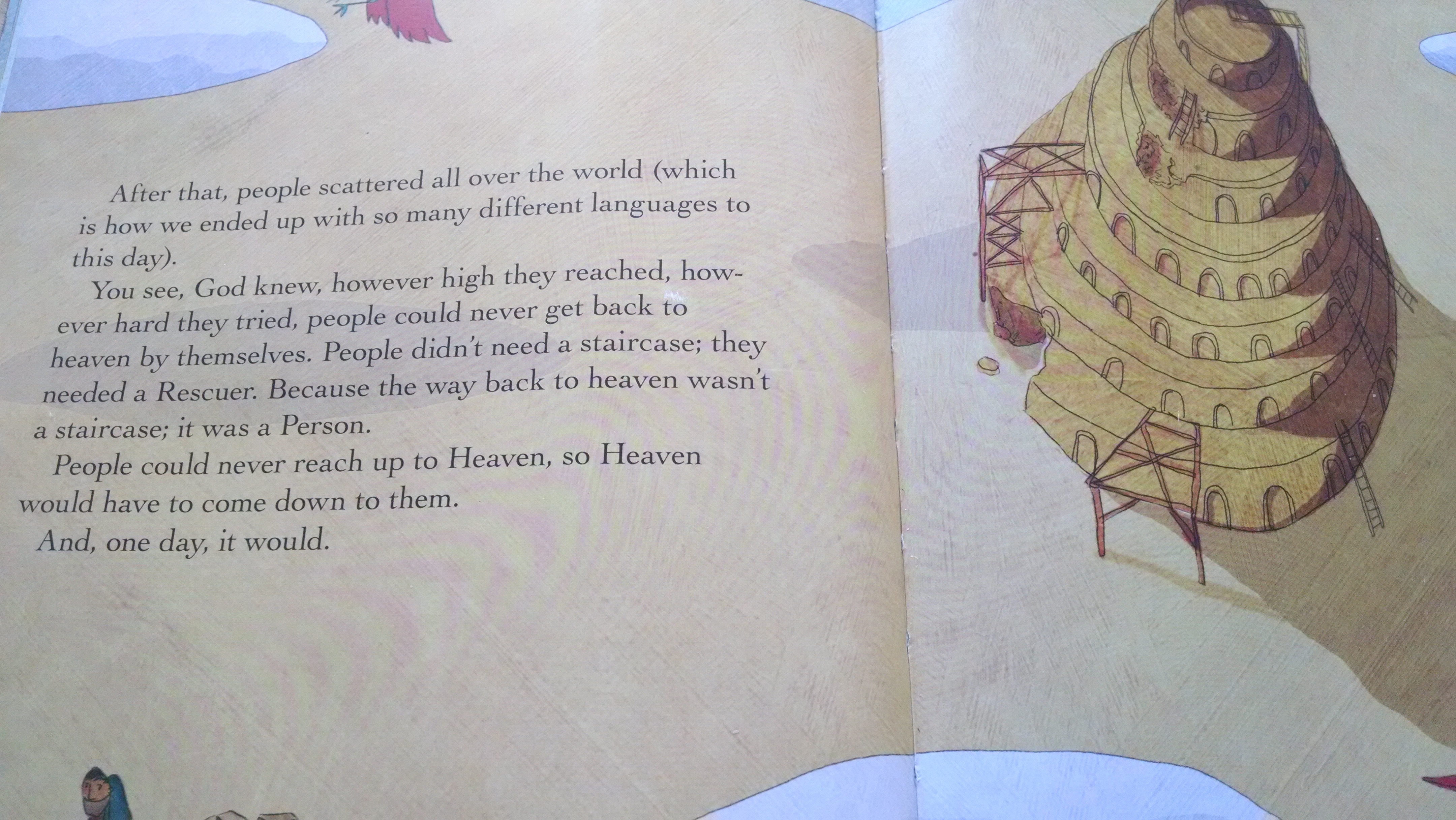
“You see, God knew, however high they reached, however hard they tried, people could never get back to heaven by themselves. People didn’t need a staircase; they needed a Rescuer. Because the way back to heaven wasn’t a staircase; it was a Person.

People could never reach up to Heaven, so Heaven would have to come down to them.

And, one day, it would.” – p. 54 (emphasis added)

Jesus Storybook Bible page 54

Heaven came down at Christ’s birth.

That’s what Christmas is for. To celebrate “heaven come down” and know that we are already loved.

Once we know that, feel that, remember that, we can share that celebration and love with others.

“For I have come down from heaven not to do my will but to do the will of him who sent me.” – John 6:38 (emphasis added)

For one small way to celebrate, please enjoy this free printable coloring page to do with your family! Click on the image below to open the file and choose “save as” to save to your computer and then print. Thanks to our friend, Ashley Taylor, for creating this printable! 

John 6:38 printable

(Please do not sell, edit, or host this printable elsewhere. It is a free gift for readers of Do Not Depart. Please do share a link to this post so others can find it, too!)


How do you celebrate at Christmas and share that celebration with others? What helps you remember if Christmastime becomes a strained time for you or your family? Please share and encourage each other in the comments!


Sometimes it can be easy to forget Christmastime is for celebrating over striving:

Click To Tweet

How a children’s storybook Bible reminds us about #JesusintheOT and celebrating at Christmas:

Click To Tweet

Take Heart {John 16:33 printable for Spread the Word}

April 4, 2015 by Caroline 2 Comments

John 16:33


John 16:33

“A time is coming and in fact has come when you will be scattered, each to your own home. You will leave me all alone. Yet I am not alone, for my Father is with me.

I have told you these things, so that in me you may have peace. In this world you will have trouble. But take heart! I have overcome the world.”  – John 16:32-33 (NIV)

It’s a silent weekend for the disciples and those of us who pray to remember. But Sunday is coming. And we have faith that He has overcome the world. There is beauty here because He created it and He is in it.

Every day this month, the Do Not Depart team will be posting a scripture graphic that you can use to spread the Word of God. Share it on social media, print it out and write someone a letter, email it to someone who needs encouragement.

You are free to share our image with John 16:33 above. If you have questions about how to download images, just ask in the comments. (Be sure to tell us what type of computer/device you are using.)

(Please do not sell or host these images elsewhere. But share freely.)

Visit DoNotDepart.com for more shareable scripture graphics! #SpreadTheWord


It’s Easter weekend, but we can take heart for He has overcome the world. Free verse printable to #SpreadtheWord:

Click To Tweet

Today’s #SpreadtheWord image features John 16:33, a good verse to remember before Easter Sunday:

Click To Tweet

What Happens When Jesus Gets Ahold of Your Heart

January 23, 2014 by Lindsey 7 Comments

What Happens When Jesus Gets Ahold of Your Heart {DoNotDepart.com}
Photo Courtesy: freedigitalphotos.net/Grant Cochrane

Admin note: We’d like to welcome Lindsey Bell to our writing team! Lindsey is a wife, awesome mom of two, and great writer with her first book coming out in less than two weeks! Meet Lindsey and her writing below. 

Something happens when Jesus gets ahold of your heart.

We’ve been talking all month about how God changes us…how he makes us into new creations…how he molds our lives through his Word and His Son.

This could not be more evident than in the life of John.

John, whom Jesus called a Son of Thunder, became the disciple of love.

John, the disciple who asked Jesus for permission to call down fire on a Samaritan village (Luke 9), transformed into the man who later said these words: “Dear friends, let us love one another, for love comes from God” (1 John 4:7).

Anger to forgiveness.
Judgment to love.
Son of Thunder to Disciple of Love. 

So what happened that caused John to change?

As I look at the New Testament, I think the thing that happened was this: Jesus got ahold of John’s heart.

John watched as Jesus gave his life for the sins of the world (John 3:16-17).

He listened as Jesus taught the sermon on the mount (Matthew 5).

He saw Jesus forgive the woman caught in adultery (John 8:1-11).

John witnessed the sinful woman pour perfume on Jesus’ feet…and then saw Jesus love this woman-this woman that everyone else refused to even look at.

When others would have avoided a person, Jesus reached out his hands and touched them. When others would have thrown stones, Jesus forgave. When others would have judged, Jesus loved.

And that’s what made all the difference for John.

I’ve learned it’s also what makes the difference for us. When Jesus gets ahold of our hearts, He changes us too.

Where once there was a heart of anger, He gives us forgiveness.

Where once there was a tendency to judge, He gives understanding and grace.

Where once there was brokenness, He gives healing.

I don’t know where you’re at today…if there’s anger eating away at your heart or pain that never seems to go away or unforgiveness threatening to destroy you…but I do know this:

If you’re willing to give these things to Jesus..and let Him get ahold of this area of your heart…something amazing is bound to happen.

Something always happens when Jesus gets ahold of your heart.

What’s a story of what changed when Jesus got a hold of your heart?

A Big, Big Life

December 9, 2011 by Teri Lynne Underwood 2 Comments

When we moved to Alabama this summer, I was given a new set of dishes.  I love them!   They are part of the LIFE  collection from Day Spring.   One of my favorite verses is inscribed on them …

I have come that they may have life, and have it to the full.  John 10:10

Life … zoe.  One of my lexical aids described this life as “the very life of God, of which believers are made partakers.”

We are partakers of the very life of God!  

And not only that, He offers us this life to the full.

Abundantly … over and above, more than enough.

Friends, Jesus came so that we would be able to live the fullest, most abundant, crazy over and above, more than enough lives!

What does this big life involve?

Relationship with Him … We are invited into the very life of God, intimacy with the Creator and Sustainer of everything.   That’s big!

Relationships with others … We are offered community, fellowship, and interaction with fellow believers in order to strengthen and support one another.   We are given the opportunity to sow into the lives of unbelievers in order to point them to the Giver of all life.

Receiving blessing now … Isn’t God good?  He gives us gifts innumerable and blessings unimaginable – every. single. day.

But the best part is,

Redemption for eternity … In all of life, there is no greater gift than THE Gift – the gift of salvation and the promise of eternal life.

Jesus came to give us abundant life – now and forever!

How have you experienced life to the full?

{image from Dayspring}

He Will Go before Christ…

December 27, 2010 by ScriptureDig 2 Comments

We all dream big for our children. My husband Lee and I pray for our sons, and future children, every day. When will they come to know the Lord? What will their gifts and talents be? Will my sweet boys go to China to be missionaries or live near momma? Will they like my meatloaf or only ask for chocolate chip cookies when they come home to visit?

Elizabeth and Zacharias knew God’s purpose for their son even before he was born. Zacharias was told John would be the forerunner of Christ and that he would be filled with the Holy Spirit in his mother’s womb (Luke 1:15).

When Mary visited her relative Elizabeth who was six months pregnant, the babe leaped in Elizabeth’s womb! (Luke 1:44). Even before he was born, John was unique. He would play a special role in God’s redemptive story.

John would turn many of the children of Israel back to the Lord their God. John’s ministry was closely intertwined with Jesus’. John baptized Jesus (Matthew 3). Andrew, one of Jesus’ disciples, had previously been part of John’s ministry. And when there was a dispute among John’s disciples, he told them, “[Christ] must increase, but I must decrease” (John 3:30).

What can we learn from the life of John?

Primarily, if we follow the Lord, we will also be different from the world. James 4:4 pointedly says, “Do you not know that friendship with the world is enmity with God? Therefore whoever wishes to be a friend of the world makes himself and enemy of God.”

We should strive to lead lives that imitate Christ in every action, decision, and relationship. Author Sally Clarkson writes, “Jesus’ work in a person’s life has always begun with a call to leave behind the goals, purposes, and distractions of this world and say yes to a whole new life, a new way of thinking. ”

John’s life and even the events that caused his death are evidence of a life lived with one purpose in mind–to point people to Christ. May we all live with that purpose in mind!

image: Fra Angelico: The Annunciation (via ArtBible)

Truth, Justice, and the Congregation’s Way?

October 27, 2010 by ScriptureDig 8 Comments

Superman With two younger brothers, much of my childhood was filled with superhero role-playing.  In fact, when we were all under five, my brothers’ room was decorated in the various heroes of the day – Superman, Batman, and good ol’ Spidey.  I, of course, was always Wonder Woman.  (Hey, it was the 70s, y’all, we all thought Lynda Carter was IT!)

Whenever we played, we always knew our hero’s catch phrase … and the favorite of both boys was Superman.  If I close my eyes tight enough, I can still see two tow-headed little boys running about in towel-capes with one arm forward and one back yelling, “Truth, Justice, and the American Way.”

Now, as a pastor’s wife, I’ve learned the new rallying call in many Christian circles … Tradition, Judgment, and MY way. There are moments in ministry when I feel as though my heart will break.  We have lost sight of important principles and replaced them with personal agenda.   In doing so, we have also forsaken the priority of God’s Word and His standards regarding our behavior as individual believers and as the Church collective.

We have replaced Truth with Tradition.

Far too many churches have gone far too long without asking the question, “Is this activity, ministry, or function grounded in the TRUTH of God’s Word or in the comfort of our TRADITION?” Paul spoke clearly to the church at Colosse,

“See to it that no one takes you captive through hollow and deceptive philosophy, which depends on human tradition and the basic principles of this world rather than Christ” (Colossians 2:8 NIV, emphasis added).

While traditions of themselves are neither good nor bad, when we allow traditions to take priority over proclaiming the truth of God’s Word, we have elevated them to an ungodly and sinful place.  In all things, we must be willing to ask if the tradition is rooted in and bringing forth truth … or if it has become hollow and focused on celebrating the past rather than crying out the grace of the Gospel.

We have replaced Justice with Judgment.

Oh that we could trust in the justice of God without feeling the need to exact judgment on one another! Again, we find that Paul speaks to this idea,

“Everything is permissible – but not everything is beneficial.  Everything is permissible – but not everything is constructive.  Nobody should seek his own good, but the good of others … So whether you eat or drink or whatever you do, do it all for the glory of God” (Romans 10:23-24, 31 NIV).

We look around our sanctuaries and worship centers finding reasons that we are better than others – from choices regarding the education of our children to holiday traditions, from socioeconomic factors to generational prejudice, from our own insecurities to others’ previous lifestyles – we can be a judgmental lot!  And in being so quick to judge, we lose sight of this simple yet eternal truth:  We serve a just God.  The reality is while we focus on judging one another the world around us is dying without hope and salvation. We prefer to focus on the loving, forgiving part of God’s nature – but we must never, ever forget that we are called to “Go ye therefore and make disciples” … for the God who has offered us salvation is just and the “wages of sin is death.” (References to Matthew 28:19 and Romans 3:23)

We have replaced God’s Way with My Way.

Churches are filled with people who have been conditioned to “Have it Your Way!”  We are consistently guilty of giving corporate worship and fellowship far less devotion that the Lord intended.   We come when we feel like it, serve when it’s convenient, and give what we feel we can. Again, we find that Paul has a word for us,

“Be imitators of God, therefore, as dearly loved children and live a life of love, just as Christ loved us and gave himself up for us as a fragrant offering and sacrifice to God (Ephesians 5:1-2 NIV).

Paul reminds us that we are called to live in the manner of Christ … not of the world.  And Christ’s life was marked by humility (Philippians 2:5-8), service (John 13:2-17), and sacrifice (Hebrews 10:8-10).  And so, if we are to live in God’s way, our lives must bear witness to those same qualities. We must lay aside preference and personal taste and focus instead on serving, on forgiving, on giving grace, and on true worship.

Fellow believers, will we be the generation that lays down tradition and self-righteousness, judgment and self-fulfillment, and  pride and selfishness?  Will we stand up for the TRUTH of the Gospel of Jesus Christ?  Will we recognize the JUSTICE of the God we serve?  And will we submit to GOD’S WAY in all things big and small?  Will we?

Give Grace

October 20, 2010 by ScriptureDig 11 Comments

Grace … receiving what we do not deserve.

We cling to this verse:

For it is by grace you have been saved, through faith–and this not from yourselves, it is the gift of God – not by works, so that no one can boast.   Ephesians 2:8-9, NIV

Not from ourselves.  Not of ourselves.  Not through ourselves.

We can’t earn grace.  We don’t deserve grace.  It is the gift of God.

But somehow, though we have been given such great grace so freely, we are stingy with it. We demand grace be given according to our need and yet we resist offering that same grace to others.

It happens in churches.  A lot.

The pastor’s sermon isn’t as well delivered as I’d like.

The worship leader doesn’t sing the same words as are on the screen.

The Sunday School teacher is distracted and the lesson isn’t very good.

The nursery worker failed to change the baby’s diaper before I picked her up  so she was wet.  Very wet.

No one spoke to me during the welcome time.

But what if you knew that the pastor had been at the hospital all night comforting parents whose child had been in a car accident and was in a coma.

Or what if you knew the worship leader had received a call early Sunday morning that his best friend’s wife had left him.

What if the Sunday School teacher hadn’t studied because he was laid off last week and was just having a hard time figuring out how to trust God in the midst of his fears about providing for his family.

And what if that nursery worker hadn’t changed your sweet baby’s diaper because she had spent time comforting the child of a visitor who had never been to church before.

What if the people who normally speak to you didn’t because they were checking on a young widow who was back at church for the first time since her husband’s tragic death.

Does that make a difference?

Should it?

Truthfully, not a bit.

Our extension of grace should never be based on our feelings or understanding of a situation.  Instead, we are called to give grace because we have received grace.

And, this is never more true than in our local faith families.  Jesus spoke to this truth plainly:

“A new command I give you:  Love one another.  As I have loved you, so you must love one another.  By this all men will know that you are my disciples if you love one another.”  John 13:34-35, NIV

Love gives grace … willingly.

We must give grace in our words.

Let your conversation be always full of grace, seasoned with salt, so that you may know how to answer everyone.  Colossians 4:6 NIV

We must give grace to prevent conflict.

See to it that no one misses the grace of God and that no bitter root grows up to cause trouble and defile many.  Hebrews 12:15 NIV

We must give grace as we serve.

Each one should use whatever gift he has received to serve others, faithfully administering God’s grace in its various forms.   1 Peter 4:10 NIV

Am I saying this will be easy?  Nope!  It won’t.  In fact, giving grace is hard.  Giving grace requires laying down self and giving priority to others.  Giving grace necessitates that we let go of our expectations and focus instead on encouraging others.

But time and again, I have seen this truth:  Grace multiplies!

And so my challenge to you is to give grace in your church.  To the pastors, the leaders, the teachers, the nursery workers, the technical crew, and to the people in the pews.

Time and again, give grace!   Not because “they” deserve it but because you didn’t deserve it either.

Have you seen grace multiplied in your church?  How can you give grace this week?

{I’ve also written on this idea of giving grace relating to online relationships for Gather Inspirit.}


This Month’s Theme

  • Jesus is the Way
  • And He Shall Be Called Series Intro

Enter your email address to have new posts emailed to you:

We’ll come to you

Enter your email address to have new posts emailed to you

Categories

Bible Memory – Lent 2021

Memorizing Isaiah 12

Let the Children Come

Let the Children Come

Want more #HideHisWord resources?

Memorizing Psalm 1

Find Us on Facebook


Search

Recent Posts

  • Series Wrap-Up: The Lord Is My Light
  • His Marvelous Light
  • When the Darkness Deepens
  • Though I Sit in Darkness…
  • Let Your Light Shine
  • Life-Giving Light

Archives

© 2026 · Pretty Creative WordPress Theme by, Pretty Darn Cute Design