• Home
  • About
    • Our Contributors
    • Our Beliefs
  • Blog
  • Bible Studies
    • Scripture Dig
  • Archives
  • Shop
  • Advertise
  • Contact
    • Email
    • Facebook
    • Instagram
    • Pinterest
    • Twitter

Do Not Depart

Encouragement and Tools to Abide in God's Word

You are here: Home / Archives for Bible

Love Like Him: 1 Corinthians 13:1-3

May 28, 2012 by Guest Post 10 Comments

“Love is not affectionate feeling, but a steady wish for the loved person’s ultimate good as far as it can be obtained” C.S. Lewis

The breeze blows in as the sun sags low on the horizon. Dinner’s still unmade and words twist tangled in a mess in my head and my heart. I’m dying for some peace and quiet to try to undo the knots that have accumulated throughout this day. They’re all hanging on me this this late hour and emotionally I love them but my actions speak another emotion.

Annoyance. Frustration. Irritation.

When it comes down to it it matters little to them if I make their favorite pumpkin-chocolate-chip muffins, or those stuffed peppers he’s been begging for. That’s nice of me. It makes them smile and their smiles make me feel good, but those are just actions.

Anyone can make them muffins. A restaurant could deliver the craved stuffed peppers.

Who cares?

If I just move through the motions of loving my family but don’t actually love them with the selfless love of Christ, it’s all meaningless.

In 1 Corinthians 13:1-3 Paul says,

If I speak in the tongues of men and of angels, but have not love, I am a noisy gong or a clanging cymbal. And if I have prophetic powers, and understand all mysteries and all knowledge, and if I have all faith, so as to remove mountains, but have not love, I am nothing. If I give away all I have, and if I deliver up my body to be burned, but have not love, I gain nothing.

I’ve read and re-read this scripture repeatedly–with each reading I stand convicted.

Our motives matter. Obedience out of obligation is worthless.

Obedience on the outside is easy compared to obedience of the heart. 1 Samuel 16:7 reminds us that God looks at our hearts. Christ commands us to love one another, not just for their benefit, but for our own as well (John 15:11). Paul says when we crash through life, gongs banging, we are nothing and we gain nothing. We make ourselves irrelevant by acting apart from love.

The Greek word Paul uses here for love is agape. This is not an emotional love. Agape is the love that went to the cross for us. Agape love says “I love you no matter what you do, whether you love me back or crucify me, I will love you”.

When I love selfishly, with my hand out waiting for my reward and acknowledgement, it’s worthless.

Galatians 5:22 names love as the first fruit of the spirit. 2nd Peter chapter 1, he says to add to our faith, (among other attributes) unselfish love. Peter goes on to say in verse 8, “for if these things are really yours and continually increasing, they will keep you from becoming ineffective and unproductive in your pursuit of knowing our Lord Jesus Christ more intimately.” To Paul’s point, when our motivation for our actions and behaviors is love, we are no longer clanging cymbals–ineffective, noisy nothings. Offering nothing, gaining nothing.

This term Paul uses for love is used roughly 228 times in the New Testament.

Love matters.

1 Corinthians 13:13 names love as the greatest gift. Christ demonstrated what that love looks like, as He made His way to the cross and bore our sins.

We are called to love like Christ–to love unselfishly. In John 13:34 Christ says,

“A new command I give you: Love one another. As I have loved you, so you must love one another. By this everyone will know that you are my disciples, if you love one another”.

Christians are to make Christ known to the world not by flaunting their spiritual gifts, but rather by demonstrating the sacrificial love of Christ that places others before self and willingly bends low to raise another up.

Apart from this we’re just noisy–just hollow clanging, banging emptiness with no purpose, with no effectiveness.

We make our way from yard to kitchen, kicking off shoes and lumbering a dusty-sweaty trail of half-pints upstairs to the tub, these words press hard at my heart and I catch myself before I open my mouth. I must love them, even when I am tired and aching for quiet. I must love them because that’s Christ in me. Learning to love as He loves is no simple task. A thousand opportunities present daily and love becomes a choice to be made.


If you aren’t yet, consider joining us for the Love Like Him bible study? You are welcome to jump in any time!

What did you learn from the passage this week? What is God showing you about the way you love?


Kris is just a girl who loves Jesus with her whole heart. She is a stay at home mom, MOPS Coordinator and an Advocate for Compassion International. Kris winds through her days, homeschooling 4 kids, and playing wife to her amazing husband.The floors are covered in crumbs and the washing machine never stops running (never!) but she counts each day as a gift! In her spare time (ha!) she writes, reads and plays with her camera.
I Praise Because He is Worthy (Run to Him – Psalm 148)

April 14, 2012 by Katie Orr 2 Comments

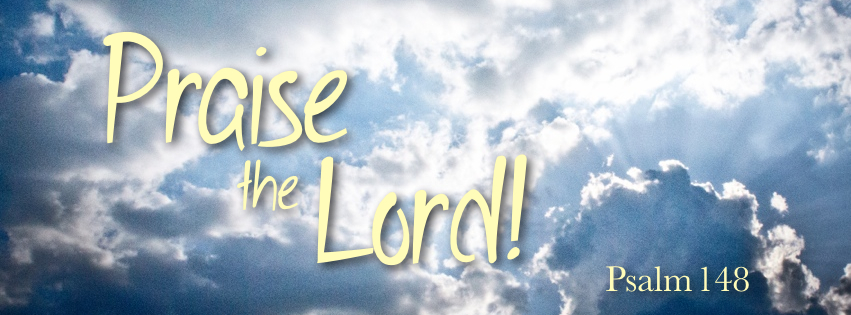
Praise the Lord

We’ve been in Psalm 148 this week. Everytime I read it, I get this Seeds Family Worship song stuck in my head. (Click here if you can’t see the video.) It’s my daughter’s favorite Seed’s song, and she asks for it almost every time we get in the car. So I’ve listened to it…a lot.

Praise the Lord!

There is no mistaking the main command in Psalm 148!  We are to praise the Lord.

Praise the Lord

I looked at the Hebrew word for praise this week; it is halal. I love the insight looking at the original language gives:

…to shine…to make a show, to boast; and thus to be (clamorously) foolish; to rave…celebrate, commend…glory, give (light)…(sing, be worthy of) praise…renowned, shine. (Strong’s Concordance via eBible)

How to Praise the Lord

One fun Bible study tool is to insert these synonyms into the verses, to get a fuller meaning of the text. Let’s try it together!

Shine the Lord!
Make a show about the Lord!
Boast about the Lord!
Be clamorously foolish about the Lord!
Rave about the Lord!
Celebrate the Lord!
Commend the Lord!
Give glory to the Lord!

Doesn’t this give a better idea of what it means to praise the Lord?

Let them praise the name of the Lord!

What can you praise God for today? Share it in the comments below!

Oh sing to the Lord a new song;
sing to the Lord, all the earth!
Sing to the Lord, bless his name;
tell of his salvation from day to day.
Declare his glory among the nations,
his marvelous works among all the peoples!
For great is the Lord, and greatly to be praised!
(Psalm 96:1-4 ESV)

(And by the way, the picture above is the perfect dimensions for a free Facebook cover. To download it for free, just right click the picture to download!)

I Obey Because He Instructs Righteousness (Run to Him – Psalm 119)

March 31, 2012 by Katie Orr 2 Comments

Picky

Obedience.

It’s hard for my four year old. (It’s also hard for that four-year-old’s momma.)

Though I long to live a life of obedience to His commands, I struggle daily to keep my feet on the narrow path.

Obedience is not simply a choice of the will, as our efforts will only bring us so far. Our beliefs come in to play as well.

When I disobey I am ultimately saying that I know better—just like my four year old. Now, I might never say so with my mouth—that I know better than God—but I say it daily when I choose my own way.

You do too.

Disobedience, even in the smallest of choices, is at its core rebellion against the God of those commands.

When I choose selfishness instead of sacrifice, I sin. When I “vent” my frustrations about a difficult person instead of holding my tongue, I disobey. When my thoughts drift to discontentment and dwell in an attitude of ungratefulness, I rebel.

In each of these situations, I say “Katie knows best.”

Obedience is saying “God knows best.”

Holiness is not a series of do’s and don’ts, but conformity to the character of God and obedience to the will of God. – Jerry Bridges, The Pursuit of Holiness

The Beliefs of the Psalmist

Your testimonies are wonderful; therefore my soul keeps them. (Psalm 119:129)

The psalmist was not some super-Christian, who had more ability to obey than you or me. We have all been given everything we need for godliness (2 Peter 1). We just need to figure out what hinders us. Oftentimes it is because we don’t believe that God and His commands are good. The psalmist saw God’s commands as wonderful, and I fully believe that had all to do with his commitment to obedience.

Here is more of what the psalmist believed:

  • God’s words gives light and understanding. (Psalm 119:130)
  • His rules are forever right and faithful. (Psalm 119:138, 144)
  • God righteousness is everlasting. (Psalm 119:137,142)
  • His Word is very pure.  (Psalm 119:140)
  • His law is truth and well tried. (Psalm 119:142)

Because of these beliefs, the writer of this Psalm had a resolved commitment to the Word of God, and the God of those words. This commitment flows naturally into obedience.

The Actions of the Psalmist

Here are just a few actions I saw of the psalmist:

  • He longed for God’s commandments. (Psalm 119:131)
  • He prayed for God to teach him His statues, and direct his steps by the Word (Psalm 119:133, 135)
  • He loved the Word. (Psalm 119:140)
  • He delighted in God’s commands. DELIGHTED. (Psalm 119:35, 143)
  • He was determined to walk in obedience to God’s Word. (Psalm 119:33,34,57)

The psalmist understood the relationship between God and His commandments. They could not be separated. If He wanted to be near to God, He must walk in His commands. He saw God and His commandments as good, right, and trustworthy. That made all the difference in his obedience.

When we walk with the Lord

in the light of his word,

what a glory he sheds on our way!

While we do his good will,

he abides with us still,

and with all who will trust and obey.

Then in fellowship sweet we will sit at his feet,

or we’ll walk by his side in the way;

what he says we will do,

where he sends we will go;

never fear, only trust and obey.

Trust and obey, for there’s no other way to be happy in Jesus, but to trust and obey.

–John H. Sammis

What did you see in the verses you studied this week? Come and share with us what you learned!


Photo Credit

The Life-Changing Power of God’s Word {Guest Post}

March 29, 2012 by Do Not Depart 9 Comments

By Brooke Espinoza

I would rather lay my soul asoak in half a dozen verses all day than rinse my hand in several chapters. -Charles Spurgeon

Though even a quick rinse in God’s Word will not return void, God gives us several motivating reasons to abide in His Word.

Photo credit

God’s Word is powerful!

I am just in awe of how great our God is that He literally spoke the entire universe into existence! The psalmist proclaimed in Psalm 33:6, “By the word of the Lord the heavens were made, and all the host of them by the breath of His mouth.”

Likewise, when a Roman centurion came to Jesus and asked Him to heal his dying servant, Jesus was happy to go with him to his home, but the centurion answered, “Lord, I am not worthy that You should come under my roof. But only speak a word, and my servant will be healed.” (Matthew 8:8) This man knew the incredible power of God’s Word! As a result of his great faith in God’s Word, the Roman centurion’s beloved servant was healed that very hour.

God’s Word is life-changing!

Psalm 1 shows the incredible transformation that is promised to anyone whose love for God’s Word drives them to abide in His Word day and night.

“He shall be like a tree
Planted by the rivers of water,
That brings forth its fruit in its season,
Whose leaf also shall not wither;
And whatever he does shall prosper.” Psalm 1:3

Just from this one verse we see the life changing power of God’s Word. This person is characterized:

  • Like a tree—a symbol of strength and uprightness
  • Planted by the rivers of water—fixed and abiding in the refreshing rivers of water
  • That brings forth its fruit in its season—a fruitful life
  • Whose leaf also shall not wither—with roots so deep into the Living Water, even the heat of trials shall not cause this tree’s leaves to wither
  • And whatever he does shall prosper—a prosperous life

God’s Word is mighty!

Just looking solely at Psalm 119, look at what it proclaims are just some of the awesome ways God uses His Word in our life when we take the time to be in it.

  • To bless us (v2)
  • To cleanse us (v9)
  • To give us counsel (v24)
  • To revive us (v25)
  • To strengthen us (v28)
  • To give us a ready answer (v42)
  • To give us hope (v49)
  • To comfort us in our afflictions (v50)
  • To give us life (v93)
  • To make us wiser than our enemies (v98)
  • To give us more understanding than all our teachers (v99)
  • To give us a lamp for our feet and a light to our path (v105)
  • To give us great peace (165)
  • To keep us from stumbling (v165)
  • To deliver us (v170)

Knowing the amazing life-changing power of God’s Word, I know what is at stake if I feel pressure from the day’s schedule to rush through my devotions or skip them all together. So on the days that I’m pressed for time, but still want to spend quality time in God’s Word, I will listen to my favorite audio Bible, The Word of Promise (NKJV) and take my memory verse for the day with me on a 3 x 5 card and meditate on it throughout my day when “my hands are busy, but my mind is free” as Janet Pope says in her book, His Word in My Heart.

Whether we spend time in God’s Word by reading it, studying it, listening to it, mediating on it, or memorizing it, what’s important is that we spent time in it. And when we do, oh will we be blessed!

What Bible verses have had the greatest impact on your life? Let us know in the comments


Brooke blogs at Rivers of Water, a site dedicated to encourage and equip Christian women to fully trust in God and His Word so when their faith is tested, through trials, they will not be shaken. She has a Bachelors degree in Biblical Studies from Calvary Chapel Bible College, and is passionate about studying and memorizing Scripture.

Intentional Bible Study in Fifteen Minutes a Day

March 22, 2012 by Katie Orr Leave a Comment

The Bible is so much more than just another book. It is living. Active. Life-changing.

That’s why you are here, at Do Not Depart. You love the Word. You know it’s value. You crave time with your Savior.

Announcing a New Study Series

I’ve created a new Bible study series to help you in your time with God in His Word.

Many of you have been enjoying the Run to Him study.

I am thrilled!

Lara and I appreciate the positive feedback about the study, and we JUST LOVE hearing about how God is using the selected Psalms to speak truth to your soul.

Focused 15: Intentional Bible Study in Fifteen Minutes a Day uses a method of study similar to the studies of the past, but I’ve taken it up a notch.

Through the use of different “lenses,” Focused15 will teach you how to dig even deeper.

  • Day 1 – Portrait Lens – Seeing the big-picture through cross-referencing.
  • Day 2 – Immersion Lens – Discovering the original language.
  • Day 3 – Zoom Lens – Finding truths, promises, and commands.
  • Day 4 – Wide-angle Lens – Looking at the sentence structure.
  • Day 5 – Personal Lens –  Looking for God’s plan for us in these verses.

Focused15: 1 Corinthians 13 The first study—a four week study of 1 Corinthians 13—has “officially” launched today, and I would love to know what you think!

You can read all about it at the Focused15 site.

This Focused15 Bible study is available for immediate PDF download for only $3.99!

Add to Cart

It is also available for Kindle and Nook, and every Kindle and Nook ebook contains a free download link to the PDF, for easy printing!

My prayer for this book is to equip you to study the Bible on your own—to take one more step toward becoming a self-feeder—so you can enjoy Him more and more every day!

The Most Powerful List You Can Make :: Run to Him :: Psalm 77

March 9, 2012 by Do Not Depart 8 Comments

We make lists. To do lists. To read lists. To buy lists.

We live in a fast paced society that is all about getting things done. Go. Go. Go. Our culture sees the power in movement. But in all that getting ahead, we miss the power of remembering.

Sometimes? At the end of a day, I make a list of the things I accomplished simply so I can check them off. Yes, I’m one of those people. But there is a certain power and momentum in remembering what we’ve done.

the list

Photo credit

Apparently, the Psalmist was a list maker too. But he didn’t make a list of all the things he has or hasn’t done. Instead, he made a list of all the things God has done.  And wow what a difference it made!

In Psalm 77, the writer was having a terrible, horrible, no good, very bad day.

…I would not be comforted… (v. 2)

I was too troubled to speak. (v. 4)

Ever had one of those days? Ever wonder how to change the course of one of those days? Here’s how he did it:

Starting in verse 13, he began to simply list the wonders God has done.

Your ways, God, are holy. What god is as great as our God? You are the God who performs miracles; you display your power among the peoples. (v. 13)

The change in tone, attitude and hopefulness of the passage is simply remarkable from verse 13 onward.

With your mighty arm you redeemed your people, the descendants of Jacob and Joseph…You led your people like a flock by the hand of Moses and Aaron. (vv. 15, 20)

He may not have immediately felt different, but he immediately spoke different and that changed everything.

He took his eyes off of himself and what he could or couldn’t do. Instead put his eyes on God and what He has already done and will do again.

You see, God doesn’t change. He has been faithful to do wonders and He will be faithful to do wonders. Our greatest times of struggle are simply when we forget to remember.

Make a list

Keep a journal of the things God has done in your life. When troubles come your way, fight them with remembrance of the wonders He’s done.

Psalms Bible Study, How to run to God, Psalms study


What is one thing He’s done that you can remember today?

What did you learn from your study of the Psalms this week?


________________________________

Kat blogs at Inspired To Action, a site dedicated to helping moms develop the habits and skills they need to effectively manage their homes and raise children who are prepared to change the world. Kat and her husband live in the great state of Texas and have 3 children ages 7, 5 and 2.


Ten Verses for Trying Times

February 6, 2012 by Caroline 9 Comments

What do you do when you start feeling anxious, troubled, scared? Do you pray? Do you run to a spouse, a friend, a family member?

I wish I could say I always cry out to Him first. But I don’t.

I feel like it’s up to me to fix something, deal with trouble, solve a problem.

But it’s not.

God is always there.

How can I focus every bit of my heart – in every moment of life – on Him first, rather than on worry or “self-sufficiency.” How do I train my heart to seek His shelter rather than scrounge for my own?

A few ways helping me so far (and maybe able to help you?): Store up His Word in our hearts! Seek out verses to memorize, leading to quick recall when those trying times occur. Place His Word first in our hearts over and over and over again so we form a habit of going to Him first.

How can we find these guiding verses?

  • Pray first for God to open your heart to His leading and heighten your awareness of applicable verses for your situation.
  • Use a concordance (found in most study bibles) to find a topic (I searched for grief, trouble, fear, worry…) and read verses listed.
  • Use online bible study resourcesto search a specific topic.

    Image from Microsoft Clip Art
  • Study one passage (a chapter, a book) for several days in a row, asking God to lead you to needed truths at the right times.

Ten Verses for Trying Times

Here are ten verses I’ve found helpful in getting through hard times:

  1. Hebrews 12:7 – Hardships train us.
  2. Psalm 27:13-14 – Wait for and trust in Him in all things.
  3. Psalm 16:7-8 – God counsels.
  4. Psalm 34:2-5 – God hears.
  5. Psalm 34:18 – Brokenhearted? He remains near. (Our Run To Him reading for this week speaks on His redeeming us from troubles!)
  6. 1 Thessalonians 5:8-11 – We need not hold on to grief for we have His hope and joy in the midst of grief.
  7. Psalm 10:14 – God sees our troubles and helps.
  8. John 16:19-24, 33 – Grief caused by this age will be wiped away in the age to come. (John 16:33 is one of my personal favorites.)
  9. 2 Corinthians 1:3-7 – God comforts our troubles, and then we can share His comfort with others going through similar troubles.
  10. 2 Corinthians 4:16-18 – These troubles, no matter how severe they are, are nothing compared to the eternal glory coming. I have to remind myself of this perspective sometimes.

How does God share what you need through His Word?

The Word is Our Weapon

April 28, 2011 by ScriptureDig 5 Comments

“And take the helmet of salvation, and the sword of the Spirit, which is the word of God” Ephesians 6:17
Photo from Photobucket

Yesterday, Kristi explained the armor of God and challenged us to be Battle Ready because the stakes are so high and our families are at risk.

Today, we’re going to examine the Sword of the Spirit.

An unseen battle rages on around us. It’s a battle for the souls of those who do not know Christ. It’s a war against the faith of those who do. But the battle is not only going on around us – Romans 7:21-24 tells us that it wars within us, as well.

In 2 Timothy 2:3-4, Paul compares the Christian life to that of a soldier in a war as he calls us to endure hardships as a good soldier. And the best way to become skilled in our line of duty is to learn from the Master.

In Matthew 4:1-11, Jesus shows us how to wield the Word of God as weapon when the enemy comes against us. When you read through these verses you find that the enemy waited until Jesus was at His weakest point physically before he tried to tempt Him.

He didn’t try to tempt Jesus with food when He had only been without food for a day or two. He lurked behind the scenes until he thought He could catch Jesus in a moment of weakness and then he pounced. That’s how he operates…attacking us when we’re weak.

Jesus met each fiery dart with the Word of God.

He was tested in the same three areas we are: (1 John 2:16)

The lust of the flesh, the lust of the eyes and the pride of life.

For Christians, the invisible battle that rages on around and in us is designed for our destruction. The destruction of our faith, our testimonies, our influence and ultimately our effectiveness. Winning each battle requires diligence. It’s not an easy win when the enemy, the world and our own flesh fight so hard to raise their banner of victory over different areas of our lives.

Let’s take a look at some of the packages our attacks come wrapped in:

  • Wrapped in what we think are our biggest needs (After 40 days without food, Jesus’ need for food was real – but He knew that real sustenance comes from the Word of God)
  • Wrapped in religion (When the enemy tempted Jesus, he misrepresented the Word of God. He tried to attack Him at the core of His belief system. But Jesus rebuked him with what the Word of God really said)
  • Wrapped in a shiny “You Deserve This” package (The enemy tried to tempt Jesus with power and possessions, yet he was foolishly offering Jesus something He already owned)
Sisters, we are in a war, but the battle is the Lord’s. Our role is to stand as we wield the Word of God in order to slice and dice every wayward thought – every circumstantial attack – every deceptive lie – every hurtful word or deed – every fleshly desire and every doubt and fear.

The battle is hard. We get weary in the fight. But God’s Word not only protects us, it refreshes and strengthens us as well.

Today, I want to encourage you to arm yourself well. Yes…God has given us His Word, but it is our responsibility to read it, to study it, to memorize it, to meditate on it and to really know it.

Good soldiers keep their blades sharp and are always ready for battle. Are you? Do you have some sharpening to do? Which tool do you need to use to sharpen your blade…studying, memorizing, meditating or all three?

God Said It … Do I Believe That’s Enough?

February 1, 2011 by ScriptureDig 12 Comments

May I just begin by saying I am not a biblical scholar nor a theologian?  I confess that when Sandra sent out the list of topics for this month my first response was, “I am not qualified to write about a single one of these!”   I finally asked for the simplest ones … and even with these “easy” doctrinal issues, I still feel in way over my head.

So, if you were tempted to skip this month on Scripture Dig, I can totally understand why!   It seems overwhelming to contemplate “doctrine.”   But, please don’t miss these posts!  We want to give you (me!) some basic understanding of what can be complex ideas and, as Sandra explained so well yesterday – our doctrine affects everything else we do.

Our doctrine for today is … inerrancy.

You might have heard this word in sermons.   I grew up hearing a pithy sound bite concerning the accuracy of God’s Word, “God said it.  I believe it.  That settles it.”     However, that overused statement is actually two sentences too long.   Inerrancy is rooted in one simple truth:  God said it.

Inerrancy:  Free from error; infallible.  {dictionary.com}

Regarding Scriptural inerrancy I found this definition most understandable:

By this word we mean that the Scriptures possess the quality of freedom from error. They are exempt from the liability to mistake, incapable of error. In all their teachings they are in perfect accord with the truth. {E. J. Young, Thy Word is Truth, 113}

The apostle Paul explains this idea to Timothy this way:

All Scripture is breathed out by God and profitable for teaching, for reproof, for correction, and for training in righteousness.  {2 Timothy 3:16, ESV emphasis added}

Quite simply, the inerrancy of the Bible is the solid foundation for all our other doctrines. That God’s Word is breathed out by Him, entirely inspired by Him, is absolutely necessary!  If the accuracy of the Bible is in question, then beliefs such as redemption, salvation, holiness of God, the Trinity … all of the other doctrines we espouse are rooted in error.

Our first doctrine must be that God’s Word, our Bible, is entirely true, free from error … breathed out and inspired by Him and brought to us through His power.

What is your understanding of biblical inerrancy and why do you think it does or doesn’t matter?

Recommended Reading:

What Does It Mean that the Bible is Inerrant, or without Error?

Does God Really Say to Stone our Kids?

Scripture Dig posts on Bible Basics


Created By God & For God

September 3, 2010 by ScriptureDig 20 Comments

“For by Him all things were created, both in the heavens and on earth, visible and invisible, whether thrones or dominions or rulers or authorities– all things have been created through Him and for Him.” Colossians 1:16 (NASB)

OK Scripture Diggers, I’m so excited! I wish I could sit down with you all – coffee in hand, Bible and study books spread across the table – because I really want you to see this with me! We all know that it is foundational to our faith that we were created by God. But the Lord structured His Word in such a way that we could never attribute our existence to anyone or anything but Him.

In Genesis 1:1, we find these words, “In the beginning God created the heaven and the earth.” And in Genesis 1:27, the Bible says, “God created man in His own image, in the image of God He created him; male and female He created them.”

The very first verb we come across in the Word of the Living God is the word , “created.” But, because the English language does not convey the complete essence of this word, we can’t really fathom its magnitude. Go with me for a minute, because I think this will blow your mind! I know it did mine. :-)

The original word for created (Gen 1:1) is the Hebrew word bara’. It means exactly what you think it does…to create, to form, shape or fashion. But the beautiful surprise is that in the 40+ times this specific form of the word create is found in scripture, it is not combined with any other subject but God. If grammar isn’t your thing, let me clarify it. God (subject) created (verb) man (direct object). Whenever you find bara’ (created) – God is the One doing it.

Think about that! God’s choice of words leaves no room to doubt the nature of our existence. Only God can bara’  (create). Don’t you just love how God makes Himself known to us in ways we have yet to discover! There is no mistake about it – He is our Creator! He is THE Creator! (Oh, please tell me that rocks your world like it does mine!)

As the world tries desperately to deny the creation of you and I, the Living God made sure we knew it could have happened no other way.

We did not just ooze from a jillion year old slime pit, nor did we morph from a monkey into a man. We were created by God – and we were created for God.

Knowing we were created by God reminds us that we are so much more than some random cosmic collision of molecules. We were the intentional, well-thought-out masterpiece of the Creator of the universe. He personally fashioned each one of us and placed us on planet earth the exact time and the exact way He wanted to – and that defines our lives as significant while also holding us accountable to the One who created us.

There’s comfort and confidence in knowing we were created by and for the Living God. But there is also the sobering realization that we will one day stand before our Creator and give an account for our time here on planet earth.

You see, if He created us for Himself – for His good pleasure, then He is also our Judge and He makes the rules. We can’t just pass our time on earth and acknowledge Him as our Creator if we never submit our lives to His plan. So, what are His rules? What’s His plan?

RULES: Absolute Perfection – Pure & Holy “but like the Holy One who called you, be holy yourselves also in all your behavior; because it is written, “YOU SHALL BE HOLY, FOR I AM HOLY.” 1 Peter 1:15-16

PROBLEM: Sin – We’re all sinners by nature and by choice – “for all have sinned and fall short of the glory of God” Romans 3:23 – “For the wages of sin is death…” Romans 6:23a

PLAN: The Cross of Christ – The Perfect Sacrifice of His Son on the Cross to Pay for Our Sins  – “But God demonstrates His own love toward us, in that while we were still sinners, Christ died for us.” Romans 5:8 – “For Christ also suffered once for sins, the just for the unjust, that He might bring us to God” 1 Peter 3:18

PERSONAL APPLICATION: Trusting Christ as Our Savior, Surrendering to Him as Our Lord – “For whoever calls on the name of the LORD shall be saved.” Romans 10:13 – “He was in the world, and the world was made through Him, and the world did not know Him. He came to His own, and His own did not receive Him. But as many as received Him, to them He gave the right to become children of God, to those who believe in His name” John 1:10-12

I really am so excited by the way God reveals Himself to us in His Word! I love how He loves us and longs for us to know Him personally.

He is our Creator. He is our Savior. He is our Lord.

We were created by Him. We were created for Him.

Do you know Him? Have you ever called upon your Creator to save you, forgive you of your sins and help you live your life to please Him? Have you surrendered to Him as Lord of your life? If not, will you do that today? If you have, will you share a word of testimony in the comment section?

Thou art worthy, O Lord, to receive glory and honour and power: for thou hast created all things, and for thy pleasure they are and were created. Revelation 4:11 (KJV)


Confidence: Finding Rest in the Sovereignty of God

August 24, 2010 by Kristi Stephens 11 Comments

US Supreme Court building, front elevation, st...
Image via Wikipedia

I frequently talk with other believers who seem to be struggling with a deep fear of the future. Their confidence in the government has been rocked, the security of their 401K has been shaken, they watch the news fretfully for updates about the latest Supreme Court decision or word from Iran.

Are these things serious? Of course- but they need not shake our confidence. If we truly believe that our God is sovereign, that absolutely nothing has escaped His notice or is out of His control, then there is a deep sense of calm in our hearts even as we write letters to our senators, seek financial counsel, cast our ballots, and urge those around us to know and obey the Truth.

In 1 Samuel chapter 2, we find Hannah praying a prayer we would do well to emulate.

Recount and Rejoice!

Then Hannah prayed and said: “My heart rejoices in the LORD; in the LORD my horn is lifted high. My mouth boasts over my enemies, for I delight in your deliverance.There is no one holy like the LORD; there is no one besides you; there is no Rock like our God.” (v.1-2)

There is no Rock like our God! Oh, the hope and promise of those words. One of the best ways to battle fear and worry is to praise Him – to recount truths about His character, His ways, His promises. Have you noticed how many times throughout the Bible God’s faithfulness to His people is recounted in prayer and public praise? If you find yourself fretting over the news or the “what ifs” in your head, you must make a choice to replace those thoughts with truth. Rehearse truths of God’s character and ways to yourself, fill your mind and mouth with Scripture and praise – choose to rejoice in who our God truly is.

Remind Yourself of His Omniscience

“Do not keep talking so proudly or let your mouth speak such arrogance, for the LORD is a God who knows, and by him deeds are weighed.” (v. 3)

As I shared last week in our discussion about praying for our churches, I find great comfort in two simple words: “He knows!” He knows your heart, He knows your thoughts, He knows what is around the corner of your life. While we might find ourselves shocked and taken aback by current events, nothing ever comes as a surprise to Him – for the LORD is a God who knows.

Not only does He know, but He is the only one able and worthy to weigh our deeds and the deeds of others. He knows the motivation behind each act, each word; He knows every thought. I find myself often praying, “O Lord, you know!” What a comfort it is that His ways are higher than mine, His understanding is deeper, His thoughts are purer- it gives me great confidence as I offer my trust and the words, “Thy will be done.”

Remember He is the One Who Raises Up and Puts Down

“The bows of the warriors are broken, but those who stumbled are armed with strength.

Those who were full hire themselves out for food, but those who were hungry hunger no more.
She who was barren has borne seven children, but she who has had many sons pines away.

The LORD brings death and makes alive; he brings down to the grave and raises up.

The LORD sends poverty and wealth; he humbles and he exalts.

He raises the poor from the dust and lifts the needy from the ash heap;
he seats them with princes and has them inherit a throne of honor.
For the foundations of the earth are the LORD’s; upon them he has set the world.” (v. 4-8)

No one is alive who has not been created by the hand of our God. Both wealth and poverty are in His hands. No world ruler sits in his office by his own power and doing – we serve a God who raises up and who puts down.

Do I understand everything He does and allows? Absolutely not! But I trust that His plans are much grander than I can comprehend. I can pray for God’s direction for those in authority over me – be that my husband, my church leadership, my government, my employer – and I can pray with confidence, knowing that there is no one who is out of the sphere of God’s control.

Rest in His Ultimate Victory

“He will guard the feet of his saints, but the wicked will be silenced in darkness.

It is not by strength that one prevails; those who oppose the LORD will be shattered.
He will thunder against them from heaven; the LORD will judge the ends of the earth.
He will give strength to his king and exalt the horn of his anointed.” (v. 9-10)

When everything seems to be spinning out of control, we rest in this: we know the end of the story, and our God wins! One day there will be full and final justice. One day every knee will bow to Him. One day Satan and all those who rebel against God’s name will be completely defeated.

Feeling fearful today? Perhaps it is time to prayerfully recount and rejoice, remind yourself, remember, and rest. Our God is firmly on His throne – and He has invited you to approach that throne with confidence.

Supplemental Reading:

The God Who Raises Up and Puts Down – a look at how Hannah’s prayer ties the books of 1st and 2nd Samuel together

Fear God, Honor the King – a gentle challenge to my fellow believers who disagree with Obama’s administration: when belief in God’s sovereignty gets real

Worthy is the Lamb – an ongoing series on the book of Revelation to fix our eyes on the end of the story!

Time to mull, ponder, meditate

June 28, 2010 by Kathy Howard 22 Comments

According to Psalm 1:1-3, God will bless the woman who does not embrace the world and its ways, but instead finds her delight in God’s Word and “meditates” on it “day and night.” Sounds like we should all practice a little biblical meditation.

Unfortunately, while we are often encouraged to foster many of the spiritual disciplines, we don’t hear much about meditation. Why is that? I think many of us have misunderstood what it means to meditate on God’s Word because other forms of meditation carry a negative connotation. We don’t know what it is, why we should do it, or how we should do it. Well, let’s dig in and try to gain a little understanding of this overlooked spiritual discipline.

What is meditation?

Because of many New Age religions and practices like transcendental meditation, many of us picture “meditation” as emptying our minds of all thoughts. This is not biblical meditation. In fact, God’s Word makes it clear we are to meditate by filling our thoughts. A few things God tells us to meditate on include His law, love, mighty deeds, statutes, and promises. He also encourages us to “think on” whatever is noble, right, pure, lovely, admirable, and praiseworthy (Phil 4:8).

In his book “Spiritual Disciplines for the Christian Life,” Donald Whitney helps us understand biblical mediation. He uses the analogy of a tea bag. While reading and hearing Scripture may represent a dunk or two, meditation is like letting the bag steep. It’s the idea of “mulling” something over or “pondering” a subject.

Whitney defines biblical meditation as “deep thinking on the truths and spiritual realities revealed in Scripture for the purposes of understanding, application, and prayer.”

Why should we meditate?

Charles Spurgeon said that anyone who wanted to possess the treasure of God’s Word “must dig into Scripture as one who seeketh for choice pearls.” Meditation takes dedication, time, and hard work. So why would we want to practice this spiritual discipline?

First, as we’ve already seen, the Bible establishes meditation on God’s Word as the example for His people. Second, our meditation on God and His truth pleases God (Ps 104:33-34). And third, meditation benefits us spiritually. Meditation helps us better understand and apply the truths of God’s Word. Someone who regularly meditates on God’s Word will not simply survive in this life, she will flourish.

He is like a tree planted by streams of water, which yields its fruit in season and whose leaf does not wither. Whatever he does prospers. Psalm 1:3

Simply reading through or hearing a biblical passage will not affect our hearts, minds, and lives like steeping in its richness. We must immerse ourselves in God’s Word, holding onto it in our thoughts until its truth becomes a part of who we are. Then we will be like a tree whose roots reach down to an endless supply of living water. We will be sustained in drought and difficulty. And in God’s timing our lives will produce an abundance of fruit for His glory.

How do we meditate?

Let’s get hands on and practical so we can get a feel for how to meditate on God’s Word.

  1. Choose a passage. It may be one that God impressed on your heart during Bible reading or one that jumped out at you during a sermon. It should be small enough to work through thoroughly.
  2. Reread with different emphasis on different words and phrases.
  3. Rewrite the passage in your own words.
  4. Ask questions about what it teaches. For instance, does this passage reveal something I should:
  • Believe about God?
  • Praise or thank or trust God for?
  • Have a new attitude about?
  • Do for the sake of Christ, others, or myself?

5. Look for personal application then obey.

6. Pray through the Scripture.

7. Think on it throughout the day.

I want to be like that tree planted by streams of water. I long to please God and flourish through the truth of His Word. I think I’ll go ponder for a while.

Recommended Reading:

Spiritual Disciplines for the Christian Life, by Donald S. Whitney

Meditating on the Scriptures, by Charles Spurgeon

Why should we read the Bible anyway?

June 23, 2010 by Kathy Howard 8 Comments

Would you agree or disagree with the following statement? “The Bible answers all or most of the basic questions of life.” Well, according to a Gallup Poll, 65% of Americans agree with the statement. However, according to that same poll, only 37% of those polled read the Bible at least once a week. (Twenty-one percent read it once a week and 16% read it daily.)

What we do more accurately reveals what we believe than what we say. I can tell you I believe the Bible is vitally important, but what I do will reveal what I really believe about the Bible.

The Bible is God’s revelation of Himself and His ways to mankind – the very words of God “breathed” through divinely inspired humans (2 Timothy 3:16). Think about that truth for just a second. The one true God, the Creator of everything that exists, makes Himself known to us lowly humans. Wow!

Here are just a few of the characteristics the Bible gives us about itself:

  • Sustaining (Deut 8:3; Matt 4:4)
  • Flawless (Ps 18:30)
  • Unfailing (1 Kings 8:56)
  • Right and true (Ps 33:4; John 17:17)
  • Eternal (Ps 119:89; Is 40:8)
  • Message of life (John 5:24; Rom 10:17)
  • It also preserves, strengthens, and guides. (Ps 119:25, 28, 105).

God intercepts our lives through the Bible. We encounter His presence in His Word. Through it we are encouraged, comforted, strengthened, and refreshed. But more importantly, the Bible reveals how we can have a saving relationship with God through His Son, Jesus Christ and then helps us live lives that please Him.

God’s ultimate purpose for each of us who have entered into a saving relationship with Jesus is for us to be transformed into the likeness of Christ (Rom 8:29). God uses the Bible to shape, refine, and mold our character, thoughts, attitudes, and behaviors. God uses the Bible to carry out His purpose in our lives.

For the word of God is living and active. Sharper than any double-edged sword, it penetrates even to dividing soul and spirit, joints and marrow; it judges the thoughts and attitudes of the heart. Hebrews 4:12

The Bible is not static or time-bound. God’s Word is applicable to our lives now and tomorrow. It breaks through our pretenses, prejudices, and pride and exposes what’s underneath. Painful? Sometimes. Beneficial? Always.

All Scripture is God-breathed and is useful for teaching, rebuking, correcting and training in righteousness, so that the man of God may be thoroughly equipped for every good work. 2 Timothy 3:16-17

God applies His Word to our lives personally and specifically. He rebukes us when we sin. He teaches us what we lack. He trains and equips us to do the work He has planned for us to do. All for His glory.

But we must immerse ourselves in His Word, submitting to and cooperating with God’s transforming power. Read it. Study it. Meditate on its truths.
What do you believe about the Bible? How often do you read it?

More resources & reading:

Why should we read/study the Bible? Got Questions.org

How to Read the Bible for all It’s Worth by Gordon Fee & Douglas Stuart

Free Bible reading plans for download at kathyhoward.org

Unbroken Link From God to Us!

June 17, 2010 by Julie 6 Comments

Acid covered strings allow plastic balloons full of verses to release slowly, so empty and eager hearts can receive them across restricted borders, and it’s been happening since the 1970s.  Prison cells around the world hold those who risked their lives to hold, know, and share the Bible’s words.  How has God’s Word been preserved despite attempts to eliminate it?

Many books have been hated or censored, but no other book has been the subject of such determination to annihilate it, proving its power and influence.  Even the Enemy knows it is God’s revelation to man. Attempts to destroy it began before Christ became flesh and continue today at the hands of governments in places across Asia, the Middle East, Africa, Europe, and the Americas.

Isaiah 40:8 testifies that, “The grass withers, the flower fades, but the Word of our God stands forever,” and it has, indeed, survived the onslaught of the ages.

Before invention of the printing press by Gutenberg in 1450, copies were painstakingly made, but largely illegal, so most existed in pieces, often hidden and protected.  Old Testament books were written on stone, clay, and leather, while New Testament books were written on papyrus, then copies were made on vellum and parchments of animal skins. When translations made God’s Word available for common men to read for themselves, it resulted in rulers ordering the burning of copies produced by men like William Tyndale and Martin Luther.

Translated now into over 2,000 languages, work continues to get the Gospel out to all nations. In the last decade Bibles have been burned in Jerusalem itself, confiscated during the Chinese Olympic Games, and pronounced illegal in countries like Morocco and North Korea.  The Voice of the Martyrs reports that believers walk for days to obtain and distribute Bibles for those longing to know the one true God and His truth.  Some copy passages repeatedly, so they can keep God’s Word in the “safest place of all – their heart,” able to quote it at meetings “without the danger of having a Bible at the meeting.” (VOM, March 2010) Hatred for the Book of Truth extends through history and across cultural and language barriers, but God has preserved His Word.

While men accept classical Greek and Roman literature such as the Iliad of Homer, there are fewer than 1,000 original sources.  Today there are more than 5,000 manuscript sources for the Greek New Testament. God has insured that enough ancient copies of His Word exist, so it leaves us confident in its preservation.  Many fragments and copies and quotes provide what Geisler and Nix call “an unbroken link of testimony.”

Few things will endure beyond today or beyond a thousand years, but God’s Word has been preserved as His truth revealed to mankind, and it will stand forever. Since it’s obvious God has guarded and protected His Word to us, there’s no mistaking He wants us to know Him and understand His truth.  Awesome motivation to dig in!

Sources for further reading or reference:

A General Introduction to the Bible by N. Geisler & W. Nix

How We Got the Bible by Rose Publishing

Voice of the Martyrs, www.persection.com

Wycliffe Bible Translators, www.wycliffe.org

Finding What I’m Looking For

June 14, 2010 by Stephanie Shott 20 Comments

I love digging into the Word and unearthing priceless treasures from the troves of Scripture. But when I first became a Christian, I didn’t have a clue where to start – I was just hungry for the Word of the Living God and anxious to know Him more. I wish someone would have mapped out my journey through the Word and given me a helping hand as I started my dig.

So, I’m excited about the opportunity to write this post and share with you what I wish someone would have shared with me about 23 years ago. I’d like offer a map of sorts that will help us find what we’re looking for in the Word of God. To make it cohesive, I’m going to begin with the basics and chart it out in topical chunks.

CHARTING OUT THE BIBLE

Old Testament:

Law – Genesis, Exodus, Leviticus, Numbers, Deuteronomy

Historical – Joshua, Judges, Ruth, 1 & 2 Samuel, 1 & 2 Kings, 1 & 2 Chronicles, Ezra, Nehemiah, Esther

Poetic – Job, Psalms, Proverbs, Ecclesiastes, Song of Solomon (Song of Songs)

Major Prophets – Isaiah, Jeremiah, Lamentations, Ezekiel, Daniel

Minor Prophets – Hosea, Joel, Amos, Obadiah, Jonah, Micah, Nahum, Habakkuk, Zephaniah, Haggai, Zechariah, Malachi

New Testament:

Historical – Matthew, Mark, Luke, John (a/k/a The Gospels), Acts

Pauline Epistles – Romans, 1 & 2 Corinthians, Galatians, Ephesians, Philippians, Colossians, 1 & 2 Thessalonians, 1 & 2 Timothy, Titus, Philemon

Other Letters – Hebrews, James, 1 & 2 Peter, 1,2 & 3 John, Jude

Prophecy – Revelation

Knowing the basic structure of the Bible helps point you in the right direction when you begin your own treasure hunt in the Word. If you’re not familiar with where they are, you can find them in the table of contents.

FINDING WHAT I’M LOOKING FOR

The Word of God is exciting, rich and inexhaustible. Every word on every page is a deliberate choice by the Creator of the universe to speak to us from His heart to ours. That’s why it’s so important that we not just casually read it, but thoroughly study it.

As you flip through the Bible, you’ll find that it’s broken down into easily distinguishable portions of scripture known as chapters and verses. But it wasn’t always that way. In the 13th century Stephen Langton gave us the chapter system we use today and in the 1400’s, Robert Stephanus devised the verse system that makes finding what we’re looking for much easier. Could you imagine if someone told you to find where the Bible says, “for the grace of God that brings salvation has appeared to all men.” without having it divided by chapters and verses? I’m so thankful we live on this side of the chapter and verse implementation!

There’s nothing like the thrill of turning the pages of scripture in our quest to know God more. When you’re looking for a specific word, you can turn in the back of your Bible to the concordance and find it along with several scripture references that contain that word. It’s a great tool, but the concordance in the back of your Bible is limited.

However, in the 1800’s, James Strong developed what we know today as, Strong’s Concordance. With this wonderful tool, we can now find any word in the Bible along with every chapter and verse where it is found. It’s important to note that the Strong’s Concordance is divided by the Old Testament (Hebrew) and New Testament (Greek). Each word has a coordinating number. After finding the assigned number, you turn to either the Old or New Testament section and find the basic meaning of that particular word.

Today, we have the luxury of cyberspace  where we can find just about anything with the click of a button. We can go to blueletterbible.org, biblegateway.com, crosswalk.com and a host of other sites to find what you’re looking for. If you’re not sure what chapter or verse to go to in order to find something, most website tools allow you to input a keyword or phrase.

It’s vital to  study the Bible beyond the surface. The same word that has been translated into our English Bible may have several meanings in it’s original Hebrew or Greek. That’s why the Strong’s Concordance is such a valuable tool. But I’d also like to share with you a few of my favorite study books that give us more depth to our word studies.

Here’s a sample of what’s on my bookshelf:

Spiros Zodhiates ~ “Complete Word Study Dictionary-Old Testament” ~ AMG Publishers

Spiros Zodhiates ~ “Complete Word Study Dictionary-New Testament” ~ AMG Publishers

W.E. Vines ~ “Expository Dictionary of the Old and New Testament” ~ Zondervan

Holman Illustrated Bible Dictionary ~ Holman

Interlinear Hebrew Greek English Bible

An array of commentaries on various books of the Bible

When I became a Christian in 1987, I didn’t know about all the resources that were available then. I certainly would have been stoked to have access to the tools that are now at our fingertips through the internet. We are so blessed because what we have now makes the excavation of the Word of God much easier and much less time consuming. But I also believe to whom much is given, much is required.

So, let’s all study to show ourselves approved…workers who need not be ashamed…rightly dividing the Word of Truth.

How did we get 66? Part Two

June 9, 2010 by Kathy Howard 5 Comments

Yesterday, we began our two-part discussion on how we got the 66 books that comprise the biblical canon. If you missed it, feel free to take a look back before moving on to the New Testament discussion.

New Testament

First century Christians did not have the New Testament Canon. They relied on the Old Testament Canon and the teachings of the Apostles to guide their faith. However, they began recognizing additional writings as divinely inspired very early, even while the human authors were still alive.

In fact, NT Scripture acknowledges other NT Scripture. For example, in 1 Timothy 5:18 Paul quotes Luke 10:7 and refers to it as “Scripture.” And another example, in 2 Peter 3:16, Peter calls the writings of the Apostle Paul “Scripture.” Church leaders from the late first and early second centuries AD often quote the words of Jesus and the writings of the Apostles and refer to them as “Scripture.”

To protect from heresy and false teaching, it became necessary by the middle of the second century to compile an official list of books that the Church recognized as Christian Scriptures. Although a few discussions arose over a handful of books, it appears that there was general consensus by early in the third century AD.

As with the Old Testament Canon, the twenty-seven books of the New Testament were not chosen by men. They were merely recognized to be those God had already inspired as Scripture. Three primary criteria guided the early Church as they recognized the New Testament Canon.

  1. Apostolic connection – the author had to be one of the original apostles or closely associated with Jesus or one of them.
  2. No contradiction – the early Church leaders recognized that God would not contradict Himself in theology or ethics, so any divinely-inspired writings would not do so either.
  3. Widely applicable – from the time they were written it was clearly obvious which writings had widespread application for the Church. These were the letters and books that were greatly circulated and read again and again.

The Third Council of Carthage in 397 AD, which was attended by Augustine, officially recognized the list of 27 New Testament books we accept as canonical today. There had already been widespread, general consensus from east to west. The Council merely confirmed the writings that God had made clearly known to His church.

The following quote from “An Introduction to the New Testament,” by Carson, Moo, and Morris, emphasizes God’s selection of the canon.

Indeed, it is important to observe that although there was no ecclesiastical machinery like the medieval papacy to enforce decisions, nevertheless the worldwide church almost universally came to accept the same twenty-seven books. It was not so much that the church selected the canon as that the canon selected itself. (page 494)

God’s creation and protection of the Canon is miraculous! He has revealed Himself to His children through His written, Spirit-filled Word.

All Scripture is God-breathed and is useful for teaching, rebuking, correcting and training in righteousness, so that the man of God may be thoroughly equipped for every good work. 2 Timothy 3:16-17, NIV

Kathy Howard

For further reading:

“How and When was the Canon of the Bible put together.”

“How did we get our Bible?” (Focus on the Family)

“Is the Bible Reliable?” (Article adapted from Kathy’s book “God’s Truth Revealed.”)

Sources for this article:

An Introduction to the New Testament, D.A. Carson, Douglas J. Moo, and Leon Morris (Zondervan: Grand Rapids, 1992)

Encountering the Old Testament, Bill T. Arnold and Bryan E. Beyer (Baker Books: Grand Rapids, 1999)

Introduction to Biblical Interpretation, William W. Klein, Craig L. Blomberg, and Robert L. Hubbard, Jr. (Word Publishing: Dallas, 1993)

« Previous Page
Next Page »

This Month’s Theme

  • Jesus is the Way
  • And He Shall Be Called Series Intro

Enter your email address to have new posts emailed to you:

We’ll come to you

Enter your email address to have new posts emailed to you

Categories

Bible Memory – Lent 2021

Memorizing Isaiah 12

Let the Children Come

Let the Children Come

Want more #HideHisWord resources?

Memorizing Psalm 1

Find Us on Facebook


Search

Recent Posts

  • Series Wrap-Up: The Lord Is My Light
  • His Marvelous Light
  • When the Darkness Deepens
  • Though I Sit in Darkness…
  • Let Your Light Shine
  • Life-Giving Light

Archives

© 2026 · Pretty Creative WordPress Theme by, Pretty Darn Cute Design