• Home
  • About
    • Our Contributors
    • Our Beliefs
  • Blog
  • Bible Studies
    • Scripture Dig
  • Archives
  • Shop
  • Advertise
  • Contact
    • Email
    • Facebook
    • Instagram
    • Pinterest
    • Twitter

Do Not Depart

Encouragement and Tools to Abide in God's Word

You are here: Home / Blog

What Bible Study Is Best for My Small Group?

June 28, 2012 by Sandra Peoples 2 Comments

Welcome to Do Not Depart! Be sure to subscribe to the Do Not Depart RSS feed or email updates to receive regular encouragement and tools to abide in God's Word.

Welcome back to Do Not Depart! If you haven't already, subscribe to the Do Not Depart RSS feed or email updates to receive regular encouragement and tools to abide in God's Word. This post may include affiliate links. To read our full disclosure policy, click here. Thank you for supporting this site!

Every few months the ladies of my Sunday school class have to pick what we’re going to study next. Sometimes it’s hard to choose! Walking into a book store or browsing online can be overwhelming.

How do we choose books and Bible study tools that will encourage our women to grow in godliness? We must evaluate the curriculum based not on the popularity of the author or attractiveness of the cover, but we must evaluate it in light of Scripture.

Photobucket

When you are looking for Bible or book studies, ask yourself these questions:

1. Is the book biblically based?

There are many books out there that may be helpful to our lives, marriages, families, and ministries. But only Scripture has the power to change lives and encourage growth in godliness. If you are using this book to bring about spiritual growth and true change, it must be biblically based. Scripture must be more important than experience, emotion, and opinion.

2. Is the book consistent with the theology and practices of our church?

It is important that the books you choose reflect and teach the same ideas your church believes.

3. Who is the author and what are his/her sources?

What is his/her education and experience in ministry? Why is he/she qualified to write on this topic? Who endorses the book? What sources are cited? Are they reliable?

4. Will the format of this book work for us?

What tools come with the book? (workbook, leader guides, videos) What are the strengths and weaknesses of the facilitator? Will the tools help or hinder her teaching ability?

5. What are the needs of our group?

Who is the target audience of the book? What are the personalities and dynamics of the group that will be studying the book? While it’s often a good idea to have women in different stages of life to be in a small group together, you want to choose a book that will teach all of them. If the book you have chosen is biblically based, it will help women in all stages.

What have been some of your small group’s favorite Bible studies?

10 Simple Ways Weary Mothers Can Abide in the Word

June 26, 2012 by Patti Brown 9 Comments

In depth study of the Word of God is priceless, and something most of our readers at Do Not Depart aspire to. But let’s face it, exhausted mamas are not always in a season when extended study is possible.

Have you been trying to have an early morning quiet time, only to be wakened by the baby? Does your life seem like an exercise in crisis management? If the mere thought of planning a regular bible study leaves you feeling defeated, take heart!

You too can abide in the Word every single day. You just have to be creative!

10 simple ways to stay in the Word

1) Be flexible

“Quiet” time doesn’t have to be in the morning, doesn’t have to be a set amount of time, and doesn’t have to be quiet!  You may find that you can get 5 minutes of bible reading done at 3:12 in the afternoon while the baby is banging a spoon on the floor and practicing her vowels. Change your expectations.

2) Music

Play scripture-based music you love. From old hymns to contemporary Christian tunes, a large portion of Christian music is based on the Word of God. Dance to it with your kids!

3) Scripture calendar

For years I have kept a page-a-day calendar of scripture on the windowsill in front of my kitchen sink. Every day I have a new scripture to ponder during the hours I spend standing there.

4) Simple scripture-based devotionals

Buy a scripture based devotional, with an entry for each day of the year. Keep it somewhere you will see it (that might even be the bathroom!) Or subscribe to an email devotional.

5) Make bible reading part of your family’s day

Read your bible aloud to your children (yes, an adult version) while they draw or do other quiet activities that keep their hands busy. This is best done after they have had an active play time and are able to settle down to something quiet for a while.

6) Decorate with scripture

Pick a scripture that addresses something you are struggling with, or something you find especially encouraging (a concordance is helpful for this). Print it out and post it around the house, or even in your car!

7) Take a bible when you lie down or nurse

Many mothers spend hours nursing every day. Others lie down with their children at nap time. I read through the whole bible while nursing one of my babies. It’s pretty reliable quiet time – babies won’t let you forget! And don’t worry if you fall asleep. It will happen!

8) Use your smartphone

One mom told me that using a bible app helps her be flexible: “I can sit down and read it when I nurse the baby or at night in the dark. It doesn’t require me turning on a light and disturbing my hubby or my cosleeping baby.” There are many great apps for the iPhone and Android.

9) Listen to an audio bible

Audio bibles are wonderful tools for busy mamas! Play them in your car. Play them while washing the dishes. Play them while taking a walk.

10) Have a place or a signal when it all gets too much

Some days it just gets too much. Some days you might look at those precious little sinners living in your house and wonder how you are going to survive training them up in the way they should go. When you find yourself deeply overwhelmed, this is a moment to retreat to a hidden spot… maybe a closet, maybe your bathroom… and take 5 minutes to pray and read your bible. Or take a page from Susannah Wesley and pull an apron over your head right there in the midst of the chaos!

No matter how you do it, remember this: any time in God’s Word is better than none at all!

How do you abide in the Word when life gets busy and exhausting? Add to the list in the comments below!

photo credit

Love like Him: Love Isn’t Resentful

June 25, 2012 by Lisa Burgess 10 Comments

Inductive Bible Study

“All this is from God, who through Christ reconciled us to himself and gave us the ministry of reconciliation.”
2 Corinthians 5:18

Ouch. What a week to be studying 2 Corinthians 5:14-21. (Do you ever wonder how God pinpoints our tender spots with each study?)

God knows I needed this one. I’ve recently signed off a chapter of my life. But remaining behind are many mixed emotions. Including some leftover resentment.

The more I think about it, the more I think I’m due payment on some outstanding debts. I deserve some apologies. Definitely more respect. And quite a few opportunities, not just for me but for many.

Oh, it sounds so ugly, yes? Yes. And rightly so. Can you imagine Christ saying those things? Nope, me neither.

On the contrary, not only did He not call in the debts owed Him (and we know He could have!), He paid off everybody else’s. Including mine.

And including the few I think are owed me. They’re no longer mine to cash in. When I became a new creature (2 Corinthians 5:17), I handed them over—the few dollars’ debt owed me in exchange for the release of trillions I owed Him. And I paid no broker’s fee.

That means I’m free to travel light. I can liquidate my inventory. No resentment to hold on to. No bitterness to fester. No grudges to grow interest.

And I’m to spread that message to others.

God invites my participation in publicizing this debt-elimination plan (2 Corinthians 5:19). To let others know they, too, can live debt-free. They, too, can trade in balancing the books each month for a journey of grace and peace instead.

It’s the great exchange.

So what will I do with the supposed debts owed me? With grace from God, I’ll rip them up, then fall on my knees in praise to Him for doing the same with mine.

Easy? No. But possible? Yes. Not because I have great character or willpower, but because the love of Christ is to control me (2 Corinthians 5:14). The more amazed I am at His grace given me, the more grace I can show others.

That’s an investment I can’t resist. And the dividends will grow into eternity.Inductive Bible Study

Is there a debt someone owes you? What are you waiting for before you forgive it?

Is there a verse in 2 Corinthians 5:14-21 that hits a tender spot with you?

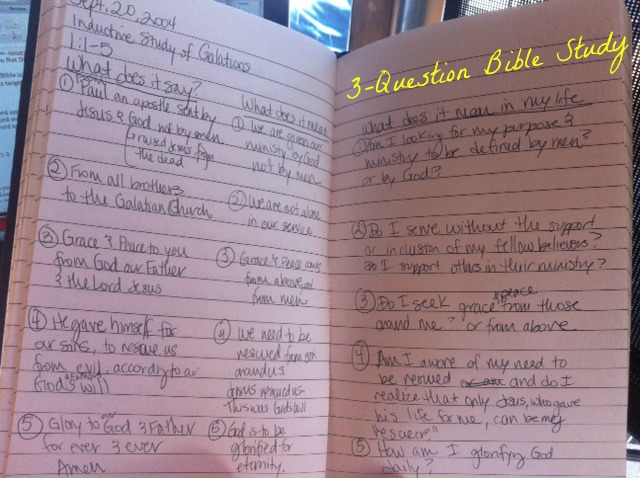
Simple 3-Question Bible Study Method

June 21, 2012 by Heather 9 Comments

Engaging His Word

When I read a portion of Scripture, unless I actively engage myself in the reading, I walk away unchanged.  Mindlessly reading His Word without seeking truth to apply to my life and to encourage others is foolish. Like studying myself in the mirror and forgetting what I look like…

 But be doers of the word, and not hearers only, deceiving yourselves.  For if anyone is a hearer of the word and not a doer, he is like a man who looks intently at his natural face in a mirror. For he looks at himself and goes away and at once forgets what he was like. – James 1:22-24

In order to study and apply Scripture to my life, I need a systematic approach. A Bible Study method with enough freedom to allow the Holy Spirit to speak to me through His Word.

Many years ago I attended an AnGeL conference by Anne Graham Lotz (Billy Graham’s daughter). She introduced a simple but engaging way to study Scripture, the 3-Question Study Method.

I contacted the wonderful staff at AnGeL ministries to get permission to share her approach with the readers of Do Not Depart. They welcomed the opportunity.

The 3-Question Method

Each week one chapter of the Bible is studied. The chapter is divided into five sections with about 5-7 verses targeted each day. For each verse do the following:

  1. Read God’s Word
  2. List the facts (What does God’s Word say?)
  3. Learn the lessons (What does God’s Word mean?)
  4. Listen to His voice (What does God’s Word mean to me?)

Let’s do try this method together:

1. Read Galatians 1:3-4:

 3 Grace to you and peace from God our Father and the Lord Jesus Christ, 4 who gave himself for our sins to deliver us from the present evil age, according to the will of our God and Father,

2. What does God’s Word say? (facts):

  • Verse 3- Grace & peace to you from God our Father;
  • Verse 4- Jesus gave himself for our sins, to keep us from evil, according to God’s will

 3. What does it mean? (lessons):

  • Verse 3- True grace and peace comes from above, not from men
  • Verse 4- We need to be rescued from sin. Jesus rescued us according to God’s will.

 4. What does it mean for me? (listen):

  • Verse 3- Do I seek grace and peace from people or from God?
  • Verse 4- Am I aware of my need to be rescued? Do I realize that only Jesus, who gave His life for me, can be my Rescuer?

Typically I would read the entire passage (usually 5 to 7 verses). Then answer all 3 questions for the first verse. I would continue answering the 3 questions with each subsequent verse.

My favorite aspect of this method is its use with any portion of Scripture, anywhere I am (home, work, vacation, etc.). All you need is a Bible, paper, pen and the Holy Spirit.

On the AnGeL Ministries website you can find wonderful free resources, including an overview of the Bible Study method (Learning to Hear His Voice: A Journey to Jesus) with a video introduction. You can download a 10-week study (Journey to Jesus) to learn the 3-Question method.  She offers several other free Bible studies using this method (Acts, Ephesians, 1 & 2 Peter, John).

Have you used an inductive study method like the 3-Question approach? 

Solitude: Letting Bible study soak in

June 19, 2012 by Julie 4 Comments

Is your Bible study just accumulating knowledge or changing your life? Do you feel like you keep learning without absorbing?

Past the dunes, I saw no one and expected my family to emerge and ask what was for dinner. It was strange to be so utterly alone.  I reveled in the chance to pray aloud, sing with abandon, laugh at God’s creatures, and marvel at truths He unveiled from His Word. It was not loneliness. It was solitude.


Finding a deserted beach and hours to drink in the Lord is not common. Without some quiet, Bible study risks being just the accumulation of knowledge, unrooted in our souls.

Solitude releases our FEARS

~ Most of us resist being alone; it forces us to go beyond book knowledge to trusting God.  To be alone with Him is to rest in His sufficiency, as life’s challenges come to mind and His truth answers. Silence is the response of a heart filled with trust, strengthened on the beach of Solitude (Psalm 46:10). God wants us to “Be still and know” He is sufficient, powerful, and in control.  He wants us to let His truth soak in and overshadow our fears. Bible study is the fodder God uses to work out confidence in the circumstances of life.

Solitude replaces our DISTRACTIONS

 ~ Solitude requires self-control to create space. Instead of being swept away by life’s noise, we decide to remove distractions and restructure our priorities, to have the opportunity to meditate on God’s truth. We give Him access to our thoughts, so He can show us how His truth applies to our life. As our motion and words slow, we hear His authority over our own voice and that of the world.

Ecclesiastes 5:2  “Do not be quick with your mouth, do not be hasty in your heart to utter anything before God. God is in heaven and you are on earth, so let your words be few.”

Solitude redeems our TIME

~ When our minds settle on God’s truth, we experience His replenishing peace through the opportunity to hear and be refreshed by Him. In times of solitude, we can “Be still” and absorb the reality of His truth. We make a greater difference in our world when His truth has saturated our thoughts and taken root in our lives.

Finding your beach

Where is that beach, so you can go there? Fill your heart and mind with some Biblical fodder, and then carve out an opportunity for solitude, so God can speak to you above life’s noise. He will strengthen your faith and refresh your spirit there. Solitude may be captured when you least expect it:

  • Instead of filling a 10 minute wait with a phone call, enjoy the solitude.
  • Instead of using that corner chair for laundry, make it a special place for solitude.
  • Instead of only filling your planner with work, block out space for solitude.

It’s possible for Bible study to become simply motion adding knowledge. Bible study soaks in when we practice solitude.

Have you found a creative way to carve out some solitude in your life?


Love Like Him – Love is Patient Because Jesus Suffered Long for Me

June 18, 2012 by Caroline 10 Comments

Jesus suffered long for us. Hebrews 12:1-3 shows us such.

“…let us run with endurance the race that is set before us, looking to Jesus, the founder and perfecter of our faith, who for the joy that was set before him endured the cross, despising the shame, and is seated at the right hand of the throne of God. Consider him who endured from sinners such hostility against himself, so that you may not grow weary or fainthearted.” – Hebrews 12:1b-3 (emphasis added)

He endured during His life, with trials and temptations of every kind (Hebrews 4:15). He endured during His death – for us. For our salvation, for our hearts, for our inclusion as God’s children.

Photo credit

He asks us to suffer long for others.

What does Suffering Long Look Like?

First Thessalonians 5:14 says:

“And we urge you, brothers, admonish the idle, encourage the fainthearted, help the weak, be patient with them all.”

That additional use of “brothers” (or “brothers and sisters,” if you read the NIV translation) indicates Paul was including all believers within the Thessalonian church, not just the leaders he referenced in the previous two verses.

We are all called to be patient and long-suffering, as Christ was and is.

What does patience look like towards others?

  • “Admonish the idle” – Patience includes redirection. Sometimes we need direction. And we need patience during that time of redirection. Or patience and long-suffering includes faithfully readdressing an issue to help someone’s heart.
  • “Encourage the fainthearted” – When someone experiences sadness for an extended period of time, reacting patiently can be difficult, but we are called to encourage and love.
  • “Help the weak” – Suffer along side someone who has endured trials and affliction.
  • “Be patient with [everyone]” – Christ showed patience with all types of people. As can we, through His strength.

In all of this patient living, we seek to serve. Serving, by nature, calls for patience, endurance, and selfless action. Christ served regardless of if He was served in return.

“See that no one repays anyone evil for evil, but always seek to do good to one another and to everyone.” – 1 Thessalonians 5:15

Remembering the Goal

We do grow weary. But, when we do, we can remember His life, His heart, His strength, His patience, and endure longer. Let us run this race together with patience and love for each other – all for and because of Him.

“Rejoice always, pray without ceasing, give thanks in all circumstances; for this is the will of God in Christ Jesus for you.” – 1 Thessalonians 5:16-18


What truths, promises, and commands did you discover during this week’s #LoveLikeHim reading? What patient love captured your heart this week?

Memory Verses: 3-Step Review to Remember

June 14, 2012 by Lisa Burgess 25 Comments

scripture memory review

Don’t lose what you fought to gain.

Embedding words from a page to words in a brain isn’t quick or easy. If you’ve memorized one scripture or one thousand, you understand. After putting in time, energy, and prayers, you don’t want those words to fade away.

Keep god's word in your heart

But with a little planning, you can keep them in your heart with much less work than it took to put them there in the first place.


Here are 3 steps so you can review to remember:

1. Gather verses in one place.

You may prefer a computer program like ScriptureTyper or MemVerse or a phone app. As long as you capture all your verses in one location, that’s great.

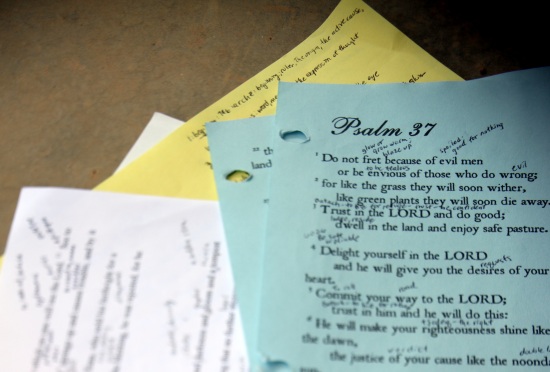
I prefer a binder as home base for all my verses. I print out the chapter I’m learning with margins wide enough to write notes on the side or in between lines. There I jot down meanings of Greek words or alternate translations or special insights as I memorize. I also add a starting and ending date (when I remember, ironically).

Then I file all the chapters together in the binder in the books-of-the-Bible order.

For individual verses, I print out a running list on continuous pages, also in Bible order. I reprint the whole document periodically to include the newest verses I’ve learned.

Once you’ve gathered your verses all in one location, you’re ready to move on to scheduling.

2. Make a review schedule.

This step is crucial. Without a plan, you may find your verses disappearing from your brain.

There are many approaches to scheduling review, and if you use an online system, they’ll likely have a review plan for previous verses. But the simplest approach for me (and thus the one I’m most likely to use), is to work through the pages in my binder in the order I’ve filed them.

I review one chapter and one sheet of individual verses per day, four days a week (give or take), for about 5-15 minutes.

Sometimes my review is nothing more than a quick read-over. That’s not ideal, but it’s better than nothing, and I’ll come back around to each page soon enough.

What works better is reviewing each verse of the chapter or page a minimum of five times. What you don’t remember the first time or two, you’ll likely remember by the fifth.

3. Use the heart.

The most important place to keep your verses active is your heart. Without sinking them deeply here, they’ll remain only words.

The heart is where Spirit-work takes place. On you. Through you. Here you realize word-for-word accuracy isn’t as important as the meaning behind those words. Here is where you let the heart of God change your heart for God.

This is the review-on-demand, as needed, anytime, anywhere. Middle of the night awakenings are a common time for me to mentally recite a chapter. Also in waiting rooms. In conversations with friends. In hard times. And in happy times. Let your heart use these words to express itself.

But remember…

Don’t be discouraged when you do forget some. Because you will. While we all desire word-for-word retention of everything we’ve learned, heart transformation is what God is after.

Consider your review time as an invitation for the Lord to change your thoughts through His thoughts. That’s the goal.

In reviewing His words, you’re valuing what He values. And with that, He is honored.

I will meditate on your precepts and fix my eyes on your ways.
I will delight in your statutes; I will not forget your word.
Psalm 119:15-16

How do you retain verses you’ve memorized?
Please share what works (and even what doesn’t) for you
.

Meditate on God’s Word – Time to mull, ponder, and steep

June 12, 2012 by Kathy Howard 7 Comments

Meditate on God's Word

According to Psalm 1:1-3, God will bless the woman who does not embrace the world and its ways, but instead finds her delight in God’s Word and “meditates” on it “day and night.” Sounds like we should all practice a little biblical meditation.

Unfortunately, while we are often encouraged to foster many of the spiritual disciplines, we don’t hear much about meditation. Why is that? I think many of us have misunderstood what it means to meditate on God’s Word because other forms of meditation carry a negative connotation. We don’t know what it is, why we should do it, or how we should do it. Well, let’s dig in and try to gain a little understanding of this overlooked spiritual discipline.

What is Christian meditation?

Meditate on God's WordBecause of many New Age religions and practices like transcendental meditation, many of us picture “meditation” as emptying our minds of all thoughts. This is not biblical meditation. In fact, God’s Word makes it clear we are to meditate by filling our thoughts. A few things God tells us to meditate on include His law, love, mighty deeds, statutes, and promises. He also encourages us to “think on” whatever is noble, right, pure, lovely, admirable, and praiseworthy (Phil 4:8).

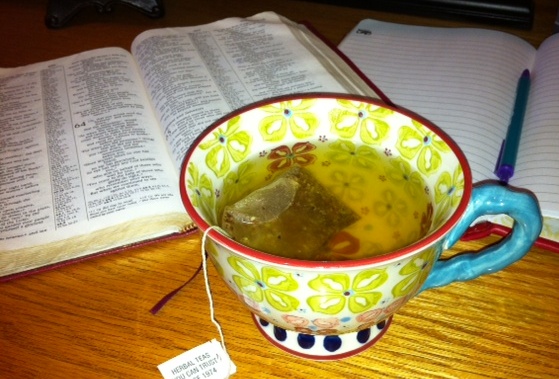
In his book “Spiritual Disciplines for the Christian Life,” Donald Whitney helps us understand biblical mediation. He uses the analogy of a tea bag. While reading and hearing Scripture may represent a dunk or two, meditation is like letting the bag steep. It’s the idea of “mulling” something over or “pondering” a subject.

Whitney defines biblical meditation as “deep thinking on the truths and spiritual realities revealed in Scripture for the purposes of understanding, application, and prayer.”

Why should we meditate?

Charles Spurgeon said that anyone who wanted to possess the treasure of God’s Word “must dig into Scripture as one who seeketh for choice pearls.” Meditation takes dedication, time, and hard work. So why would we want to practice this spiritual discipline?

First, as we’ve already seen, the Bible establishes meditation on God’s Word as the example for His people. Second, our meditation on God and His truth pleases God (Ps 104:33-34). And third, meditation benefits us spiritually. Meditation helps us better understand and apply the truths of God’s Word. Someone who regularly meditates on God’s Word will not simply survive in this life, she will flourish.

He is like a tree planted by streams of water, which yields its fruit in season and whose leaf does not wither. Whatever he does prospers. Psalm 1:3

Simply reading through or hearing a biblical passage will not affect our hearts, minds, and lives like steeping in its richness. We must immerse ourselves in God’s Word, holding onto it in our thoughts until its truth becomes a part of who we are. Then we will be like a tree whose roots reach down to an endless supply of living water. We will be sustained in drought and difficulty. And in God’s timing our lives will produce an abundance of fruit for His glory.

How do we meditate?

Let’s get hands on and practical so we can get a feel for how to meditate on God’s Word.

  1. Choose a passage. It may be one that God impressed on your heart during Bible reading or one that jumped out at you during a sermon. It should be small enough to work through thoroughly.
  2. Reread with different emphasis on different words and phrases.
  3. Rewrite the passage in your own words.
  4. Ask questions about what it teaches. For instance, does this passage reveal something I should:
    • Believe about God?
    • Praise or thank or trust God for?
    • Have a new attitude about?
    • Do for the sake of Christ, others, or myself?
  5. Look for personal application then obey.
  6. Pray through the Scripture.
  7. Think on it throughout the day.

I want to be like that tree planted by streams of water. I long to please God and flourish through the truth of His Word. How about you?

Let’s give mediation a try right now.

Read Psalm 1:1-3. Follow the steps above. What did you learn?

Share with us something God taught you about Himself or a way He personally applied the Scripture.

Recommended Reading:

Spiritual Disciplines for the Christian Life, by Donald S. Whitney

Meditating on the Scriptures, by Charles Spurgeon

Love Like Him: 1 Corinthians 13:8-13

June 11, 2012 by Sandra Peoples 3 Comments

Have you ever said, or heard someone say, “When I get to heaven, I’m going to ask God _____”? Or, “I’m going to get in line to ask Mary _____”? I have thought those many times! As clear and direct as Scripture is, it is also mysterious. It requires faith to believe when you can’t have the answers to every question you ask.

Today we are looking at 1 Corinthians 13:8-13. It is about what we can know and what we can’t know. It’s about what’s truly important in our quest for knowledge.

Paul says in this passage,  “For we know in part and we prophesy in part, but when the perfect comes, the partial will pass away.”

We are currently living in a world of “in part knowledge.” We know what Scripture reveals, but Scripture doesn’t reveal everything. God’s inspired, infallible, inerrant Word includes exactly what He wanted us to know, but it doesn’t include everything we want to know.

Have you been around a four-year-old recently? How many questions did you have to answer during your conversation with him/her? It’s a constant stream of who, when, where, why, and how! Like four-year-olds, we have lots of questions.

I think Paul was there at one point in his life. He writes, “When I was a child, I spoke like a child, I thought like a child, I reasoned like a child. When I became a man, I gave up childish ways.” I believe he’s saying something like this, “When I was young in my faith, I tried to figure everything out. I questioned everything. I wanted answers. But now that I’m a man, I rely on my faith instead of my knowledge. I rest in hope instead of strive to figure it all out. And above all, I love.” 

I’m not suggesting you stop asking questions. God gave us His Word so we could study, learn, and grow in knowledge of Him. But don’t focus so much on your questions that you forget what is truly important. Paul says what we know in part, we will eventually know in full. Until that time, he reminds us,  “So now faith, hope, and love abide, these three; but the greatest of these is love.”

What did you learn from your study of 1 Corinthians 13:8-13? How are you finding that balance between asking questions and resting in faith, hope, and love?

5 Ways to Dig into God’s Word

June 7, 2012 by Teri Lynne Underwood 3 Comments

Bible Study Tools www.donotdepart.com

{This is one of my “go to” posts for encouraging others about spending time in Scripture.  I love sharing the many ways we can interact with God’s Word.  As we consider tools for Bible study this month on Do Not Depart, I wanted to offer you a post I wrote in June 2010 for Scripture Dig about encountering God through His Word.}

The Bible is to us what the star was to the wise men; but if we spend all our time in gazing upon it, observing its motions, and admiring its splendor, without being led to Christ by it, the use of it will be lost on us. Thomas Adams (1583–1652), English clergyman and religious writer

Bible Study Tools www.donotdepart.com


We are called to use our Bibles … our time spent in Scripture must alter us if it has truly been an encounter with God. Just as Moses’ countenance glowed upon his interaction with The I AM, so to must our light shine brighter upon our meeting with the Living God revealed through the Word.

The good news is … we are all wired differently!  In our unique personality and makeup, God has created us to interact and respond to His Word in multiple ways.  Each is valuable and we should all endeavor to engage in every way; but, rest assured, it is absolutely normal and appropriate that one or two of these will be more comfortable and natural to you!!

STUDY

For Ezra had set his heart to study the law of the Lord, and to practice it, and to teach His statutes and ordinances in Israel. ~ Ezra 7:10, NASB

When we study God’s Word we are investing focused time in a passage, word, character or theme.     Study is analytical.   Study requires concentration and focus.     Richard Foster explains, “In the study of Scripture a high priority is placed upon interpretation:  what it means” (Celebration of Discipline, 69).   This reflects back to the important truth Kristi explained, “The Bible is not about us.  The Bible is about God.”    Spending time studying God’s Word is our intentional determination to grow in our understanding of Him.   Simply put, the primary goal of study is UNDERSTANDING.

DEVOTIONAL

The second method we use to engage in the Bible is devotional.  This is perhaps the most common method.   Foster contrasts devotional reading from study in this manner, “In the devotional reading of Scripture a high priority is placed upon application:  what it means to me” (69).    In no way is there an implication that devotional reading is not important, but we must make certain this is not the ONLY way we interact with Scripture; for in doing so, we risk losing the truth that ALL Scripture is useful (2 Timothy 3:16).  The goal of devotional reading is APPLICATION.

MEDITATION

But his delight is in the law of the Lord, and in His law he meditates day and night.  ~ Psalm 1:2, NASB

Again from Foster, “Christian meditation, very simply, is the ability to hear God’s voice and obey His Word” (17).   We have a tendency to make meditation a complex thing or something only the “super spiritual” can accomplish.  Or on the flip side, we shy away from this discipline because of it’s association with eastern religions.  I have heard it said that eastern meditation is the goal of emptying the mind while Christian meditation’s purpose is to fill the mind with Christ.   Honestly, I believe the goal of mediation is simple:  REFLECTION.

MEMORIZATION

Thy Word have I treasured in my heart, that I may not sin against Thee.  Psalm 119:11, NASB

Familiar verse to most of us … but a powerful, powerful promise!  It is important to understand that Scripture clearly teaches and Christ clearly models the value and necessity of embedding Scripture into our hearts and minds.   Memorizing Scripture helps us achieve the goal of DISCIPLINE. Within this goal, we find that we are more self-controlled in our actions and protected from temptation to sin.

ACTION

But prove yourselves doers of the Word, and not merely hearers who delude themselves.  James 1:22, NASB

Clearly, we must be focused on DOING what Scripture teaches. For if we spend hours in study, delight in meditation, engage in devotional reading, and memorize countless passages but never DO anything in response, we have not truly encountered the Living Word of God.   We must be changed and compelled into action – whether in our thoughts and motives or our actions and mannerisms – spending time in the Word must lead us to OBEDIENCE!

Which of these five comes most easily to you?  Which is most difficult?

Sources for Further Reading or Reference:

  • Celebration of Discipline by Richard Foster
  • Sacred Pathways by Gary Thomas (a great resource for understanding how you are wired to interact with God)
  • Seeking the Face of God by Gary Thomas
  • Intimate Faith:  A Woman’s Guide to the Spiritual Disciplines by Jan Winebrenner

You might also find 7 Ways to Interact with Scripture and 10 Tips for a Great Quiet Time useful.

« Previous Page
Next Page »

This Month’s Theme

  • Jesus is the Way
  • And He Shall Be Called Series Intro

Enter your email address to have new posts emailed to you:

We’ll come to you

Enter your email address to have new posts emailed to you

Categories

Bible Memory – Lent 2021

Memorizing Isaiah 12

Let the Children Come

Let the Children Come

Want more #HideHisWord resources?

Memorizing Psalm 1

Find Us on Facebook


Search

Recent Posts

  • Series Wrap-Up: The Lord Is My Light
  • His Marvelous Light
  • When the Darkness Deepens
  • Though I Sit in Darkness…
  • Let Your Light Shine
  • Life-Giving Light

Archives

© 2026 · Pretty Creative WordPress Theme by, Pretty Darn Cute Design