
• Home
  • About
    • Our Contributors
    • Our Beliefs
  • Blog
  • Bible Studies
    • Scripture Dig
  • Archives
  • Shop
  • Advertise
  • Contact
    • Email
    • Facebook
    • Instagram
    • Pinterest
    • Twitter

Do Not Depart

Encouragement and Tools to Abide in God's Word

You are here: Home / Blog

Resources – Hiding John 1 in My Heart

March 27, 2012 by Lisa Burgess 17 Comments

Welcome to Do Not Depart! Be sure to subscribe to the Do Not Depart RSS feed or email updates to receive regular encouragement and tools to abide in God's Word.

Welcome back to Do Not Depart! If you haven't already, subscribe to the Do Not Depart RSS feed or email updates to receive regular encouragement and tools to abide in God's Word. This post may include affiliate links. To read our full disclosure policy, click here. Thank you for supporting this site!

Are you ready to grow more of God’s Word in your heart?

One way to ensure a better harvest is to prepare before you plant. Download any or all of these free resources and get ready to memorize.

But whether you’ll be memorizing with us or not, would you consider leaving a short prayer or message of encouragement in the comments for all who will be memorizing John 1:1-14 during the 50 days between Easter and Pentecost Sunday? Thanks!

Schedule

Week 1   April 8-14 John 1:1-2
Week 2   April 15-21 John 1:3-4
Week 3   April 22-28 John 1:5-6
Week 4   April 29-May5 John 1:7-8
Week 5   May 6-May 12 John 1:9-10
Week 6   May 13-May 19 John 1:11-12
Week 7   May 20-May 27 John 1:13-14

Memory Cards

The entire text on one sheet. Use as is, or cut into 3×5 cards and place them anywhere your eyes frequent.

John 1 Cards

First Letter Cards

Some studies suggest recalling data from a minimal amount of cues can boost retention. Use this sheet (or cut into cards) as an additional way to practice the verses from the first letter of each word.

John 1 Letter Cards

Audio

In your car or iPod or headphones, listen to this mp3 clip of verses 1-14 from Bible Gateway, read by Max McLean. (If you’d like, you can receive free audio of the entire gospel of John.)

John 1:1-14.mp3

Note: This recording does not include the verse numbers. If you make or find a recording that does, please tell us about it in the comments. It’s helpful to learn the numbers with the words.

Groups

  • Join our Facebook page for more memorization tips and accountability.
  • Use #HideHisWord on Twitter.
  • Link up on April 3 with posts and comments about memorizing Romans 8 or any other scriptures.

Wallpaper

Click on the small picture that best matches your screen size. In the new window, right click on the enlarged image to either “Save Image As…” or “Set as Desktop Background.”

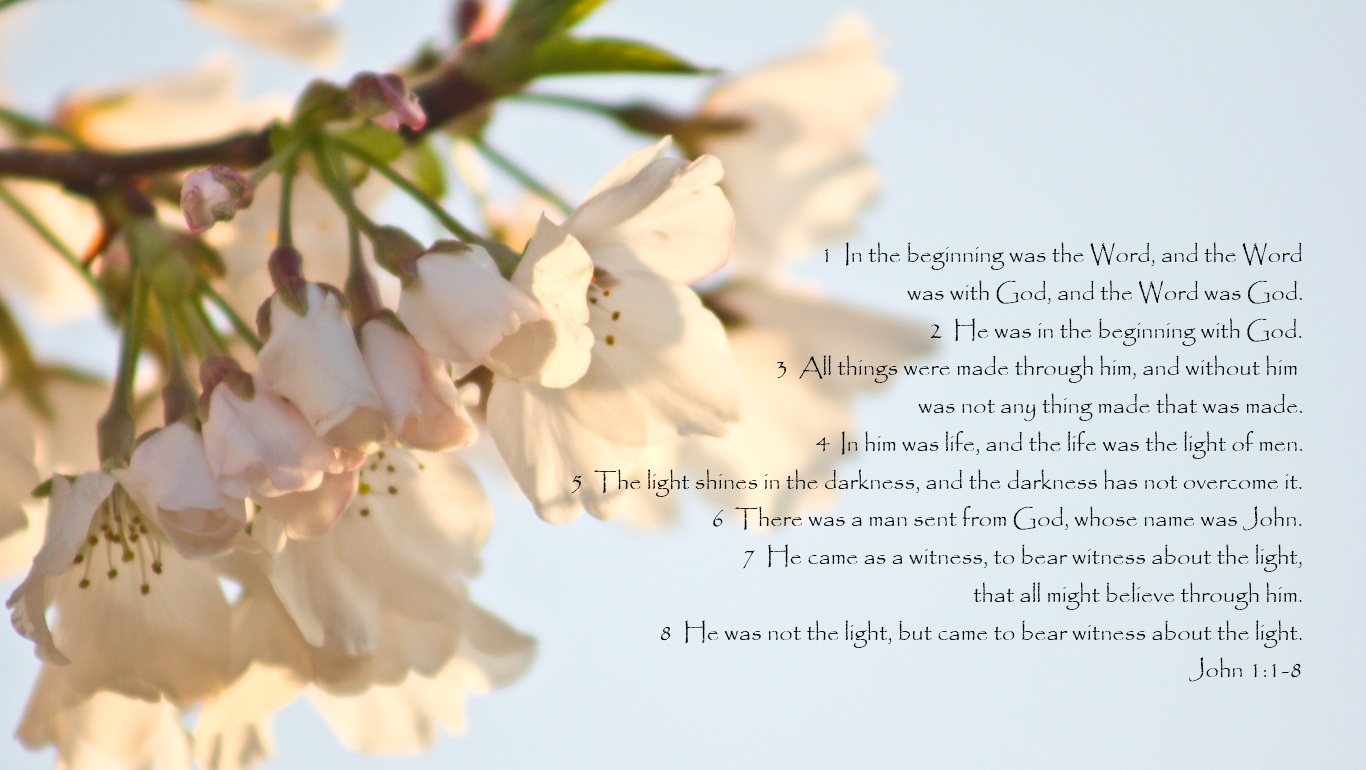
1280 x 960 John 1:1-8
1024 x 685 John 1:1-8
1366 x 768 John 1:1-8
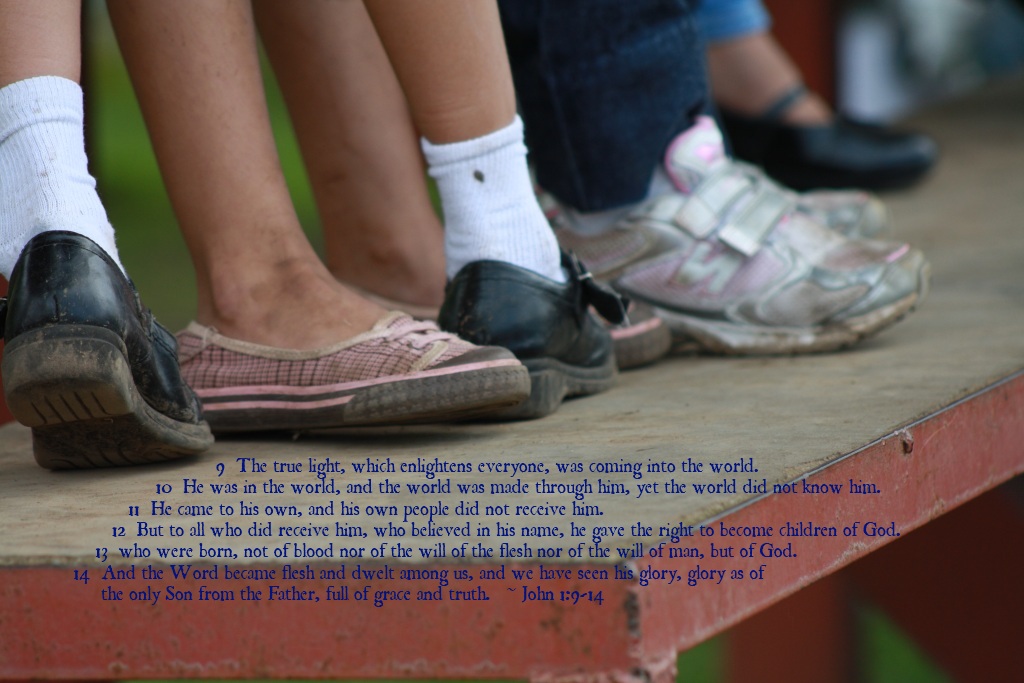
1280 x 960 John 1:9-14
1024 x 685 John 1:9-14
1366 x 768 John 1:9-14


Commentaries: Building Your Own Bible Study Library

March 26, 2012 by Sandra Peoples 6 Comments

Ten years ago when I started seminary, if I wanted to research a Bible passage, I went to the library. There was an entire section on the first floor with row after row of commentaries. I would grab as many as I could carry, find a quiet corner, and get to work on a passage.

But now I live a few hundred miles away from my beloved seminary library. So I’ve started building my own Bible study library. An important part of my personal library is commentaries, which are detailed books about a specific book or section of Scripture. They help you understand the context of the passage, look at the historical events at that time, understand the genre of literature the passage represents, and cross-reference parallel and/or complementary passages.

If you want to start a collection of commentaries, I would start with larger commentaries, like the Women’s Evangelical Commentary for NT and OT. Then, buy specific volumes on books of the Bible you like, often teach from, or want more help understanding. The first two commentaries I bought were Hebrews (from the MacArthur commentary series) and Leviticus (from the New American Commentary set).

There are also free commentary resources:

  • Commentaries on BibleStudyTools.com
  • Commentaries on BibleGateway.com

Do you find Bible commentaries useful? Which books of the Bible would you start with, if building your own Bible study library? 

I Bless Him Because He Lavishes Love (Run to Him-Psalm 103)

March 23, 2012 by Julie 3 Comments

freedigitalphotos.net credit to Kongsky

A Story of Blessing

The texted words on my phone burst out in blessing:  “God is so awesome! Words can’t express the thankfulness I have. I pray that God blessed you as much as you’ve blessed me and my girls!”

I had just left a small one bedroom apartment after dropping off a brand new set of pots and pans, bags of food, a mixer and can opener, new sets of towels, and much, much more. They weren’t from me, but I delivered them from the open hands and hearts of the team of ladies who serve with me at the women’s shelter. One of “our girls” was moving out on her own, preparing for permanent reunion and restoration with her daughters. God allowed us to join Him in the work of piecing a life back together, and the heart of our loved one was full of blessing for the love her Heavenly Father showed her.

A Psalm of Blessing

Psalm 103 begins with the call for each soul in the community of the beloved to remember the benefits of God’s love and to cry out in praise. The audience included those who knew well the journey of the broken, how it feels to rise out of exile and survive at the mercy of a generous, divine hand. A list of the benefits (vv. 3-19) fed the amazement of those whose lives were pieced together with provision from the true God. He forgives, heals, redeems, crowns, satisfies, and cares for oppressed; He who knows and loves the helpless is slow to anger, full of grace and mercy. He lavishes love on those who have nothing to offer Him but praise.

A Love for the Broken

While we are weak and frail like the grass or flower (vv. 14-16), so undependable that we are compared to dust. But the Lord loves with steadfast love that remains committed and true (vv. 17-18). To the once exiled and presently broken, He extends love everlasting, calling us to keep his covenant and remember His ways. When we feel alone, His love can only be compared to the distance of the east to the west, the distance from earth to heaven, and the scope of a father’s love for his childrevv. 11-14). He doesn’t only love us; He lavishes us with awesome love with full awareness of who we are. Yes, God is so awesome!

Every journey includes failures and fresh starts, and we all survive at the mercy of a generous, divine hand. You may not need a toaster or a can opener or gently used coffee table. But how have YOU experienced the benefits of the east to west, earth to heaven, fatherly love of God? 

When standing amidst the broken pieces, fear Him, remember His promises, keep His commands, and enjoy His steadfast love. The God who knows and loves us in our weakness must be blessed!

Hiding John 1 in My Heart

March 22, 2012 by Lisa Burgess 23 Comments

Congratulations if you memorized all or even part of Romans 8 with us! I pray you were blessed by your time in the Word. Link up here on April 3 with a post on your blog or comments about your experience.

And now…

New Bible Memory Challenge

Want to connect more with Jesus during the 50 days between Easter and Pentecost Sunday?

Join us for a short, low-pressure memory challenge. For seven weeks, we’ll learn two new verses a week, getting to the heart of who Jesus is and what He came to do.

We’ll provide resources, starting next week, from the English Standard Version–printable sheets for the schedule, text, first letters, and more. But of course you’re free to memorize in your own favorite version. Check out these general memory resources available now.

Quick Details

  • Text: John 1:1-14
  • Start date: Easter Sunday, April 8, 2012
  • Finish date: Pentecost Sunday, May 27, 2012
  • Suggested pace: 2 verses a week

If you’re on Facebook, join our NEW Hide His Word group. It’s open to anyone memorizing ANY scripture at any time. We’ll provide tools and ongoing support for all who are on a lifelong journey of hiding God’s Word in their hearts.

Spread the Word

Invite your friends to join us, too. If you tweet, use the hashtag #HideHisWord. I’ll be tweeting this:

I’m memorizing 14 verses in John 1 with @DoNotDepart. Join me? http://bit.ly/GItFXK #HideHisWord

May God be glorified through His Word in us!

In the beginning was the Word, and the Word was with God, and the Word was God. John 1:1

Next Week

Full schedule and resources…coming soon!

Intentional Bible Study in Fifteen Minutes a Day

March 22, 2012 by Katie Orr Leave a Comment

The Bible is so much more than just another book. It is living. Active. Life-changing.

That’s why you are here, at Do Not Depart. You love the Word. You know it’s value. You crave time with your Savior.

Announcing a New Study Series

I’ve created a new Bible study series to help you in your time with God in His Word.

Many of you have been enjoying the Run to Him study.

I am thrilled!

Lara and I appreciate the positive feedback about the study, and we JUST LOVE hearing about how God is using the selected Psalms to speak truth to your soul.

Focused 15: Intentional Bible Study in Fifteen Minutes a Day uses a method of study similar to the studies of the past, but I’ve taken it up a notch.

Through the use of different “lenses,” Focused15 will teach you how to dig even deeper.

  • Day 1 – Portrait Lens – Seeing the big-picture through cross-referencing.
  • Day 2 – Immersion Lens – Discovering the original language.
  • Day 3 – Zoom Lens – Finding truths, promises, and commands.
  • Day 4 – Wide-angle Lens – Looking at the sentence structure.
  • Day 5 – Personal Lens –  Looking for God’s plan for us in these verses.

Focused15: 1 Corinthians 13The first study—a four week study of 1 Corinthians 13—has “officially” launched today, and I would love to know what you think!

You can read all about it at the Focused15 site.

This Focused15 Bible study is available for immediate PDF download for only $3.99!

Add to Cart

It is also available for Kindle and Nook, and every Kindle and Nook ebook contains a free download link to the PDF, for easy printing!

My prayer for this book is to equip you to study the Bible on your own—to take one more step toward becoming a self-feeder—so you can enjoy Him more and more every day!

How to Read the Bible “Christianly”

March 21, 2012 by Heather 6 Comments

It’s not all about me?

Most mornings I sit down in my big leather chair, spend some time in prayer & then read the Bible looking for inspiration & encouragement. Not a bad way to start the day. It’s the “Christian” thing to do. Right?

Isn’t the New Testament the easiest source of encouragement, like “I can do all things through Christ who strengthens me” (Philippians 4:13)?

Outside of Psalms & Proverbs, the Old Testament is sometimes viewed as not applicable to modern day life. Reading about sacrifice & land wars doesn’t help us deal with our work situations or our children’s misbehavior. Sometimes we wrongly assume that the Bible was written for our personal interests or just to make us feel good.

Early church kept Christ central

After Christ’s death, resurrection, and ascension, the early church formed & began to spread the gospel. Their primary Scriptures were the Old Testament, gospel writings & some letters.

This first “Christians” or “Christ followers” viewed the Scripture differently than we tend to today. Christ was central. Willing to be persecuted for the belief that Jesus was the Messiah, they clung to the Word that He was the Son of God.

Reading the Old Testament gave them encouragement of the legitimacy of their faith…Christ was the fulfillment of prophecy.  They read the Bible Christologically.

“The New Testament apostles interpreted the Old Testament scriptures Christologically; that is, they understood and made sense of the Old Testament through the lens of Christ, specifically through the person, work, and mission of Christ. They used Christ to explain the Old Testament and they used the Old Testament to explain Christ. We must learn to do the same if we intend to rightly understand the Bible.” -Hexon Maldonado

When Philip (an apostle) was traveling and came across an Ethiopian eunuch reading Isaiah 53, he helped the Ethiopian see Christ in the Old Testament:

“And the eunuch said to Philip, ‘About whom, I ask you, does the prophet say this, about himself or about someone else?’ Then Philip opened his mouth, and beginning with this Scripture he told him the good news about Jesus.” Acts 8:34-35

A greater context

One of the best classes I attended at our church was an overview of the entire Bible, God’s plan from Genesis to Revelation. It gave me a fresh perspective for when I read the Bible.

The Old Testament came alive, as I understood the connection of the sacrificial system to Christ’s death on the cross. When I understood that the battles over land correlated to the covenant God made with Abraham, a covenant including a land and a people.

Kathy in her post “Context is King” gave us great tips on looking at the context of Scripture. In addition to looking at the immediate context, we need to consider the greater story. To see the entire bible as one book, not 66 separate books.

“The Bible is a collection of differing voices that may be heard in concert insofar as they are heard to be witnesses of God’s singular and saving act in Jesus Christ. “-Christian Smith

Even Jesus encourages leaders to read the Law of Moses Christologically:

“You search the Scriptures because you think that in them you have eternal life; and it is they that bear witness about me, yet you refuse to come to me that you may have life… For if you believed Moses, you would believe me; for he wrote of me. But if you do not believe his writings, how will you believe my words?” John 5:39-40; 46-47

Next time you read a portion of the Bible ask yourself, “What does this teach me about Christ?” and  “How does this fit into God’s redemptive plan?”

If you are looking for a resource to help your children read the Bible Christologically, consider “The Jesus Storybook Bible”   or  “The Big Picture Story Bible”.

*Thank you Eldy Eldhose from Dallas Theological Seminary for consulting with me regarding the content of this post.

Is it wrong to read the Bible for encouragement and personal insight? Have you ever read the Bible Christologically?


Keys to understanding

March 19, 2012 by Julie 4 Comments

It’s time to plan a summer vacation, but I dread the question of “What to do with the dog?”  When we camp, he comes, but when we travel far, he stays. And when he stays, I worry that his in-bred habit will be his fatal flaw.  Given the opportunity, he’ll bolt. Finding someone to watch Trace is a delicate business.

When his caretaker reads the following directions, they CAN NOT miss the vital meaning.

Our dog runs away. If you leave the door open, then he’ll run out. His breed has the urge to hunt, so they bolt. The front door has to stay closed so he doesn’t escape. So, above all, don’t leave the door open. He’ll slip through and run away!

To be a faithful steward of our house and dog, a house sitter must catch the key words of our message:  “run” (bolt/escape) and “door.”

When words are vital, they’re repeated for emphasis. In a Biblical book or passage, key words point to the text’s important meaning. To miss out on the repetition would be to let the most significant message escape.  Dependable caretakers notice the “If … then”  words in our directions that spell out a potential cause and effect.  “So” introduces an application we want to underscore, in light of the facts. Take a look at these examples of how God repeated key words in the text of scripture for our understanding:

  • The Gospel of John helps us understand who Jesus is by repeating “I am” throughout the book.
  • Revelation 1-3 includes the repeated phrases: “And to the angel of the church in ____ write … I know your …”  Repeatedly, John wrote the Lords words: “I know your works…”  Each letter to the 7 churches ends with, “He who has an ear, let him hear what the Spirit says to the churches,” and he specifies promises “To the one who conquers.”  These are personal letters, from the heart of an all-knowing God, longing for His followers to be “conquerors” in the face of their challenges.

Look at how the meaning of a passage stands out when we focus our attention on the repeated language, the KEY WORDS.  Key words are the keys to understanding.

7 So Jesus again said to them, “Truly, truly, I say to you, I am the door of the sheep. 8 All who came before me are thieves and robbers, but the sheep did not listen to them. 9 I am the door. If anyone enters by me, he will be saved and will go in and out and find pasture. 10 The thief comes only to steal and kill and destroy. I came that they may have life and have it abundantly. 11  I am the good shepherd. The good shepherd lays down his life for the sheep. 12 He who is a hired hand and not a shepherd, who does not own the sheep, sees the wolf coming and leaves the sheep and flees, and the wolf snatches them and scatters them. 13 He flees because he is a hired hand and cares nothing for the sheep. 14  I am the good shepherd. I know my own and my own know me, 15  just as the Father knows me and I know the Father; and I lay down my life for the sheep. 16 And I have other sheep that are not of this fold. I must bring them also, and they will listen to my voice. So there will be one flock, one shepherd. (John 10:7-16)

John 10:1-16 uses key words like sheep, sheepfold, flock, and shepherd to explain how Jesus is the good shepherd. The key words paint a picture of the relationship the shepherd has with the sheep.

It really helps me to “see” the key words in a passage when I highlight them in the same color OR draw a simple symbol over them. The most significant ideas jump off the page at me. When I see “shepherd,” I draw a simple shepherd’s staff.  “Sheep” gets a fluffy shape around it. Choose what symbol resonates in your mind to mark a key word. If you’ve been in Precept studies, you’ve done a lot of this, but you can keep it simple and make it work for you. By marking those important, repeated key words, the meaning jumps off the page and into our heart and mind.

The treasures of God’s word are too important to let them slip past us and escape our understanding. Key words are the keys to understanding. Ask God to help you discover the key words, and be a faithful steward of what He’s left in your care.

Practice looking for a key words in John 10:7-16 and uncovering the exciting truths they hold:

  • Go back to verse 9 and discover the “If/then” statement.
  • There are 4 verbs that “anyone” can do.  What is the first verb that produces the other 3? List them.
  • Look for every mention of the Shepherd. What is said about the Shepherd?
  • Go back and circle the pronouns that refer to the sheep; what do they reveal about the sheep?


I Dwell, He Strengthens (Run to Him – Psalm 84)

March 16, 2012 by Kathy Howard 12 Comments

image from 303magazine.com

Do you ever have a deep, intense craving? I often find myself drooling over the cartons of Blue Bell Ice Cream at my local grocery store. (If you aren’t familiar with Blue Bell, it may be because this creamy, decadent indulgence is only available in 20 states. But it’s worth moving to Texas for!)

No other kind of frozen treat will do. No other brand of ice cream will suffice. It must be Blue Bell and it must be a lot of Blue Bell.

In Psalm 84, the psalmist expresses a yearning that can only be satisfied by the presence of God. Nothing and no one else will satiate the deep longing of his soul. He is so desperate to be with God, he would trade 1,000 days of being anywhere else for just one day of being with the LORD.

In his book “Reflections on the Psalms,” C.S. Lewis calls this an “appetite for God.” Do we have an appetite for God that can only be satisfied in His presence?

According to biblical scholars, this psalm may have been sung by pilgrims on their way to the temple. Any Jews that lived outside Jerusalem made pilgrimages to the temple three times a year – for Passover, Feast of Tabernacles, and Pentecost. The temple symbolized God’s presence. These pilgrimages into the presence of God were considered rare and special. During the journey they anticipated the blessing and joy of once again being close to Yahweh.

You and I don’t have to travel long distances or wait for months to enter His presence. As believers we can enjoy constant communion with our holy God. His presence is a place of safety and security. Like the sparrow who built a nest near the altar, the LORD Almighty welcomes and protects the lowly and weak.

As I studied this psalm, I was impacted by the transforming power of God’s presence. Just this one chapter alone shows us at least three ways His nearness satisfies our longings.

  1. When we are vulnerable, He makes us safe and secure.
  2. When we are weak, He fills us with His strength.
  3. When we have need, He provides in abundance.

I particularly love verse 7:

They go from strength to strength, till each appears before God in Zion.

Our lives are a pilgrimage to heaven where we will finally see our Savior face-to-face. Meanwhile, He brings us “from strength to strength,” giving us what we need to take that next step of obedience, whetting our appetites for the full and glorious revelation of His presence.

What does your soul yearn for? Have you tasted the sweet presence of God? Do you long for more?

Why Use a Bible Dictionary?

March 14, 2012 by Lisa Burgess 8 Comments

Little time, Big results

You barely have time to just read your Bible. Why would you add reference books on top of that?

Would you if the rewards outweighed your effort?

While there’s no guarantee that acquiring more knowledge will translate to greater insights or to spiritual transformation (it takes a work of the Spirit to do that), you can position yourself to be more open to growth.

That’s one reason I love Bible dictionaries. For a small investment of time, you can reap big benefits.

What is a Bible dictionary?

Bible dictionaries are concise reference tools that, at a minimum, provide a short definition of an English word. But they can also give definitions of the original Hebrew or Greek words. Some add scripture references, pronunciation guides, parts of speech, word derivations, synonyms, and brief contexts. There are also dictionaries for Bible names, subjects, places, backgrounds, and themes.

While a few are written specifically for scholars, the most popular ones are easily understood by those of us with no formal theological training.

Some well-established dictionaries include Strong’s Bible Dictionary, Smith’s Bible Dictionary, The Complete Word Study Dictionary, Vine’s Expository Dictionary, and Thayer’s Greek-English Lexicon.

Many dictionaries are free online from a direct site (ex: Easton’s Bible Dictionary) or embedded in broader Bible study sites (such as Bible Gateway or Bible Study Tools). [See resource list below]

My favorite source is the free Bible software from e-Sword.net. They offer fourteen free dictionaries and three paid ones, plus multiple other resources.

How to use

Here’s a simple example. I saw an interesting post here on “came” (translated “rushed” in ESV) in Judges 14:19. I wanted to know more.

So I looked up the verse in e-Sword and clicked on the Hebrew word tsalach, which is Strong’s number 6743 (each Hebrew and Greek word is assigned a number). Strong’s Hebrew Dictionary showed me the Hebrew spelling (okay, useless to me but maybe helpful to you?) and several definitions.

I then typed in 6743 in my favorite online Hebrew dictionary to hear the pronunciation, learn more definitions, see other words translated from this one, and get a quick glance at other verses where it’s used.

Faith-building

So what? Well, understanding more fully how the Spirit didn’t just “come” upon Samson in a passive way, but “pushed forward; rushed; advanced; broke out” teaches me I can be more confident in how He’s capable of working in me, too—all from a small piece of information easily accessed in a Bible dictionary.

While a dictionary won’t provide an all-encompassing study and won’t give you much context (other resources are available for that), it is a great starting point and is often all the extra information you need.

Understanding God’s message more clearly can help you see God Himself more clearly. The more you see, the more you’ll love and want to share His love with others.

So the next time you see an interesting word in your Bible reading (maybe one of these?), I encourage you to go look it up. See what new treasures you will find to build your faith to ultimately honor the Father!

Quick Links for Bible Dictionaries

  • Bible Gateway – Easton’s Bible Dictionary, Hitchcock’s Bible Names Dictionary, Smith’s Bible Names Dictionary
  • Bible Study Tools—Baker’s Evangelical Dictionary of Biblical Theology, King James Dictionary, more
  • Blue Letter Bible—multiple search tools
  • E-Sword – free downloadable software with 14 dictionaries
  • Katie’s Top 10 Online Bible Study Tools
  • Study Light—Hebrew and Greek lexicons based on Thayer’s Bible Dictionary and others

Do you have a favorite Bible dictionary? How do you use it? Please share comments and questions below.

Top 10 Scripture Memorization Tips for Kids

March 13, 2012 by Patti Brown 15 Comments

A lovely community has grown up around scripture memorization here at Do Not Depart.  As you are hiding His words in your heart, help your children to develop the habit as well!

Bible
photo by Marcelino Rapayla Jr.

Even very young children can learn simple scriptures. Older children often surpass adults in speed and accuracy when memorizing verses.  Knowing your child’s dominant learning style can help you focus on methods that are uniquely effective.

Top Ten Bible Memory Tips for Kids

(Grownups can use them too!)

For Visual Learners

  • Journal – Have your child keep a special journal just for memory work. She can use it to record the verse, as well as her thoughts about the scripture.
  • Colored pencils and small drawings – Color coding special words in the verse or drawing little pictures by the words will trigger your child’s memory and engage his imagination. And it’s just more fun to learn when the page looks cheerful!

For Auditory Learners

  • Listen – Read the verse out loud to your child or listen to an audio version together. Free audio versions of the bible can be found at LibriVox and Bible Gateway. You can also record yourself reading the verse – this is an easy choice for smartphone users, and fun for your kids to hear.
  • Talk about it – Discuss what the verse means. Don’t just give a sermon, ask your child what he thinks God is showing him through the verse. Listen patiently and correct theological errors with gentle questions. Ultimately the goal in memorizing scripture is not to know a lot of words but to grow in relationship with God.
  • Say it out loud – Over and over and over! We say the verse 10 times together out loud, then each person tries to say it alone. Don’t be surprised if you need to repeat more often.
  • Sing – There are a number of great scripture albums geared for kids, including Songs for Saplings, Seeds Family Worship, and Hide ’em in Your Heart. If you can’t find a song with your verse, make one up! We like to keep scripture music CD’s in the car.

For Kinesthetic Learners

  • Use your body – Make up motions to go along with the words, or use American Sign Language. Here is Sami Cone showing Psalm 23 with hand motions. It’s especially fun to combine motions with scripture songs… dance His Word with your kids!

Keep It Fun!

  • Learn scripture with friends – Find a local chapter of a scripture memorization organization, or start your own. Awana clubs provide structure and incentive for memorizing verses.  If your child enjoys a good competition check out Junior Bible Quiz or Bible Bee.
  • Use a book designed for kids – Use a story book like My ABC Bible Verses to engage your child’s imagination as he memorizes. I have also heard good things about the Truth and Grace Memory Book series.
  • Use technology – Older children will enjoy websites like ScriptureTyper and MemVerse, as well as smartphone apps such as FighterVerses.

Tips For Parents

  • Choosing scriptures –  Use scripture lists to help you choose the verses you want your child to memorize. You may want to highlight basic theological concepts, well-known verses, or even scriptures that address areas in which your child is struggling. You will find topical lists in books such For Instruction in Righteousness and Parenting with Scripture: A Topical Guide for Teachable Moments. The FighterVerses app has a “Foundation Verse for Kids” section.
  • Keep it hidden in their hearts – to retain verses over time, try using the Scripture Memory System from Simply Charlotte Mason.

Whichever methods you use to help your children learn scripture, be sure to keep the goal in mind – growing your child’s love for the Lord. Stay cheerful and have fun alongside your children!

Do you have any great tips to help kids memorize scripture? Share with us in the comments…

Disclosure: Some affiliate links present.

« Previous Page
Next Page »

This Month’s Theme

  • Jesus is the Way
  • And He Shall Be Called Series Intro

Enter your email address to have new posts emailed to you:

We’ll come to you

Enter your email address to have new posts emailed to you

Categories

Bible Memory – Lent 2021

Memorizing Isaiah 12

Let the Children Come

Let the Children Come

Want more #HideHisWord resources?

Memorizing Psalm 1

Find Us on Facebook


Search

Recent Posts

  • Series Wrap-Up: The Lord Is My Light
  • His Marvelous Light
  • When the Darkness Deepens
  • Though I Sit in Darkness…
  • Let Your Light Shine
  • Life-Giving Light

Archives

© 2026 · Pretty Creative WordPress Theme by, Pretty Darn Cute Design