• Home
  • About
    • Our Contributors
    • Our Beliefs
  • Blog
  • Bible Studies
    • Scripture Dig
  • Archives
  • Shop
  • Advertise
  • Contact
    • Email
    • Facebook
    • Instagram
    • Pinterest
    • Twitter

Do Not Depart

Encouragement and Tools to Abide in God's Word

You are here: Home / Archives for bible study

You’re Invited to Join Us in “Unshakeable Faith”

August 22, 2012 by Kathy Howard

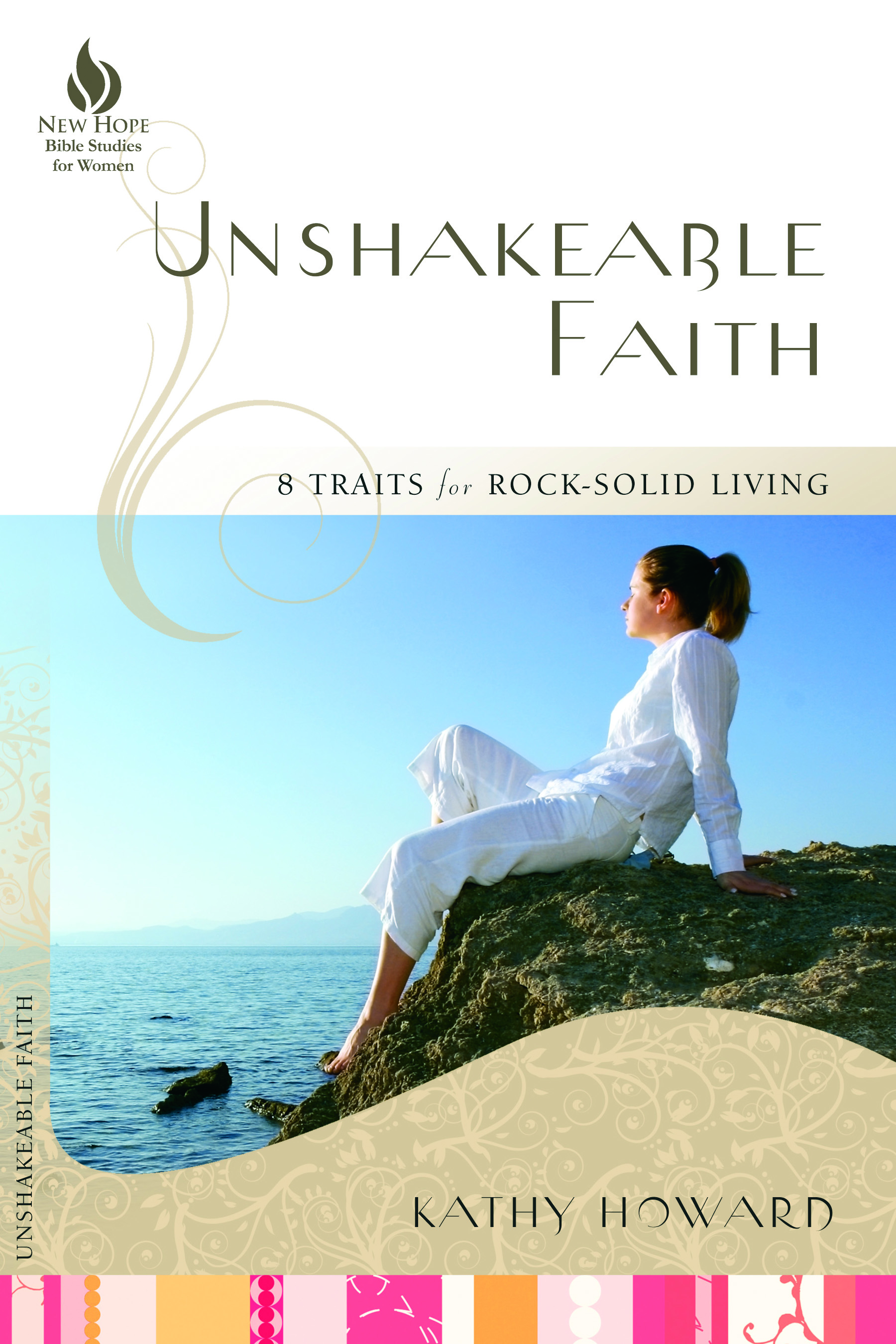
Unshakeable Faith, online Bible study

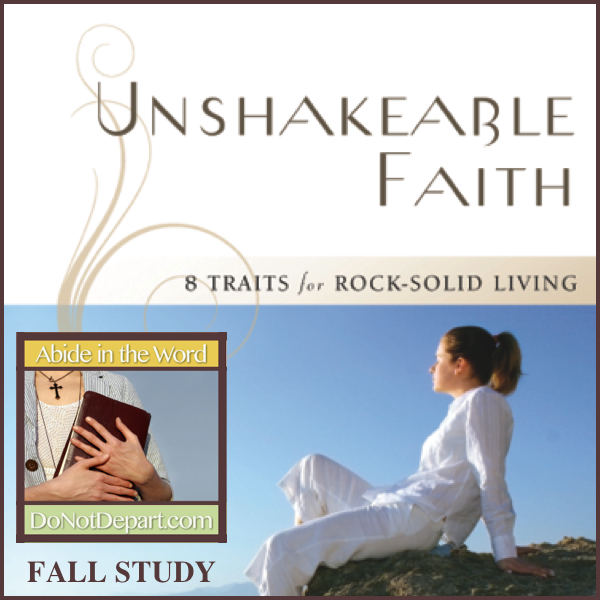
Unshakeable Faith, online Bible study We women are usually prepared for anything. We carry snacks for hunger pangs and tiny sewing kits for loose buttons. We have dozens of hamburger recipes to carry us through the end of the month when money is tight. But is our faith prepared for hard times? Will it stand firm when the trials of life inevitably come or will it be shaken? We can have an unshakeable faith that will weather any storm!

Online study starting September 10

Please join us as we study “Unshakeable Faith: 8 Traits for Rock-Solid Living” right here at Do Not Depart beginning Monday, September 10.th I am honored to share this 8-week Bible study with you! “Unshakeable Faith” explores 8 key “faith traits” found in the life of Peter. We will see how God used Peter’s relationship with Jesus to transform his weak, fragile faith – that once denied Jesus – into a faith that stood firm even in the face of death.

Three options/One Community

Doing this study online allows for some great flexibility. You will have the option of participating at three different levels designed to meet the time constraints of busy women.

  1. Devotional – The Monday posts will share some brief insight about that week’s faith trait, give a Scripture to read, and ask a couple of questions for reflection. You will be able to read this in a few minutes.
  2. Quick Study – For those women who have a bit more time, the Monday posts will include a link to a 2-page lesson to download and complete. The quick study covers that week’s topic a bit more thoroughly and gives more Scripture to read and questions to answer.
  3. Full Study – For those who would like to do the full study, you can purchase the book and work through it as we cover the traits here online.
  • Purchase “Unshakeable Faith” from Amazon
  • Purchase “Unshakeable Faith” from ChristianBook.com

Of course we want all of you to interact with us here at Do Not Depart. We will begin discussion with Monday’s post and continue it through the week. On Fridays, one of the DND team members will post a story or vlog corresponding with that week’s faith trait.

Enter to Win!

We will kick-off the study Monday, September 10th with an introductory lesson on what the Bible says about trials in Christians’ lives. But before then, we want to give away several copies of “Unshakeable Faith!” Entries will close Monday, August 27 and winners will be announced Wednesday, August 29. You can enter up to three times: GIVEAWAY IS CLOSED

  1. Leave a comment below saying you plan to participate in the study.
  2. Share this post on FB or Twitter, then leave a comment letting us know you did.
  3. Blog about this study! Then leave a comment with the link.
Unshakeable Faith

So tell us, is your faith ready for anything? Will you join us as we work towards an “Unshakeable Faith?”

What Bible Study Is Best for My Small Group?

June 28, 2012 by Sandra Peoples 2 Comments

Every few months the ladies of my Sunday school class have to pick what we’re going to study next. Sometimes it’s hard to choose! Walking into a book store or browsing online can be overwhelming.

How do we choose books and Bible study tools that will encourage our women to grow in godliness? We must evaluate the curriculum based not on the popularity of the author or attractiveness of the cover, but we must evaluate it in light of Scripture.

Photobucket

When you are looking for Bible or book studies, ask yourself these questions:

1. Is the book biblically based?

There are many books out there that may be helpful to our lives, marriages, families, and ministries. But only Scripture has the power to change lives and encourage growth in godliness. If you are using this book to bring about spiritual growth and true change, it must be biblically based. Scripture must be more important than experience, emotion, and opinion.

2. Is the book consistent with the theology and practices of our church?

It is important that the books you choose reflect and teach the same ideas your church believes.

3. Who is the author and what are his/her sources?

What is his/her education and experience in ministry? Why is he/she qualified to write on this topic? Who endorses the book? What sources are cited? Are they reliable?

4. Will the format of this book work for us?

What tools come with the book? (workbook, leader guides, videos) What are the strengths and weaknesses of the facilitator? Will the tools help or hinder her teaching ability?

5. What are the needs of our group?

Who is the target audience of the book? What are the personalities and dynamics of the group that will be studying the book? While it’s often a good idea to have women in different stages of life to be in a small group together, you want to choose a book that will teach all of them. If the book you have chosen is biblically based, it will help women in all stages.

What have been some of your small group’s favorite Bible studies?

Love like Him: Love Isn’t Resentful

June 25, 2012 by Lisa Burgess 10 Comments

Inductive Bible Study

“All this is from God, who through Christ reconciled us to himself and gave us the ministry of reconciliation.”
2 Corinthians 5:18

Ouch. What a week to be studying 2 Corinthians 5:14-21. (Do you ever wonder how God pinpoints our tender spots with each study?)

God knows I needed this one. I’ve recently signed off a chapter of my life. But remaining behind are many mixed emotions. Including some leftover resentment.

The more I think about it, the more I think I’m due payment on some outstanding debts. I deserve some apologies. Definitely more respect. And quite a few opportunities, not just for me but for many.

Oh, it sounds so ugly, yes? Yes. And rightly so. Can you imagine Christ saying those things? Nope, me neither.

On the contrary, not only did He not call in the debts owed Him (and we know He could have!), He paid off everybody else’s. Including mine.

And including the few I think are owed me. They’re no longer mine to cash in. When I became a new creature (2 Corinthians 5:17), I handed them over—the few dollars’ debt owed me in exchange for the release of trillions I owed Him. And I paid no broker’s fee.

That means I’m free to travel light. I can liquidate my inventory. No resentment to hold on to. No bitterness to fester. No grudges to grow interest.

And I’m to spread that message to others.

God invites my participation in publicizing this debt-elimination plan (2 Corinthians 5:19). To let others know they, too, can live debt-free. They, too, can trade in balancing the books each month for a journey of grace and peace instead.

It’s the great exchange.

So what will I do with the supposed debts owed me? With grace from God, I’ll rip them up, then fall on my knees in praise to Him for doing the same with mine.

Easy? No. But possible? Yes. Not because I have great character or willpower, but because the love of Christ is to control me (2 Corinthians 5:14). The more amazed I am at His grace given me, the more grace I can show others.

That’s an investment I can’t resist. And the dividends will grow into eternity. Inductive Bible Study

Is there a debt someone owes you? What are you waiting for before you forgive it?

Is there a verse in 2 Corinthians 5:14-21 that hits a tender spot with you?

Solitude: Letting Bible study soak in

June 19, 2012 by Julie 4 Comments

Is your Bible study just accumulating knowledge or changing your life? Do you feel like you keep learning without absorbing?

Past the dunes, I saw no one and expected my family to emerge and ask what was for dinner. It was strange to be so utterly alone.  I reveled in the chance to pray aloud, sing with abandon, laugh at God’s creatures, and marvel at truths He unveiled from His Word. It was not loneliness. It was solitude.


Finding a deserted beach and hours to drink in the Lord is not common. Without some quiet, Bible study risks being just the accumulation of knowledge, unrooted in our souls.

Solitude releases our FEARS

~ Most of us resist being alone; it forces us to go beyond book knowledge to trusting God.  To be alone with Him is to rest in His sufficiency, as life’s challenges come to mind and His truth answers. Silence is the response of a heart filled with trust, strengthened on the beach of Solitude (Psalm 46:10). God wants us to “Be still and know” He is sufficient, powerful, and in control.  He wants us to let His truth soak in and overshadow our fears. Bible study is the fodder God uses to work out confidence in the circumstances of life.

Solitude replaces our DISTRACTIONS

 ~ Solitude requires self-control to create space. Instead of being swept away by life’s noise, we decide to remove distractions and restructure our priorities, to have the opportunity to meditate on God’s truth. We give Him access to our thoughts, so He can show us how His truth applies to our life. As our motion and words slow, we hear His authority over our own voice and that of the world.

Ecclesiastes 5:2  “Do not be quick with your mouth, do not be hasty in your heart to utter anything before God. God is in heaven and you are on earth, so let your words be few.”

Solitude redeems our TIME

~ When our minds settle on God’s truth, we experience His replenishing peace through the opportunity to hear and be refreshed by Him. In times of solitude, we can “Be still” and absorb the reality of His truth. We make a greater difference in our world when His truth has saturated our thoughts and taken root in our lives.

Finding your beach

Where is that beach, so you can go there? Fill your heart and mind with some Biblical fodder, and then carve out an opportunity for solitude, so God can speak to you above life’s noise. He will strengthen your faith and refresh your spirit there. Solitude may be captured when you least expect it:

  • Instead of filling a 10 minute wait with a phone call, enjoy the solitude.
  • Instead of using that corner chair for laundry, make it a special place for solitude.
  • Instead of only filling your planner with work, block out space for solitude.

It’s possible for Bible study to become simply motion adding knowledge. Bible study soaks in when we practice solitude.

Have you found a creative way to carve out some solitude in your life?


Love Like Him – Love is Patient Because Jesus Suffered Long for Me

June 18, 2012 by Caroline 10 Comments

Jesus suffered long for us. Hebrews 12:1-3 shows us such.

“…let us run with endurance the race that is set before us, looking to Jesus, the founder and perfecter of our faith, who for the joy that was set before him endured the cross, despising the shame, and is seated at the right hand of the throne of God. Consider him who endured from sinners such hostility against himself, so that you may not grow weary or fainthearted.” – Hebrews 12:1b-3 (emphasis added)

He endured during His life, with trials and temptations of every kind (Hebrews 4:15). He endured during His death – for us. For our salvation, for our hearts, for our inclusion as God’s children.

Photo credit

He asks us to suffer long for others.

What does Suffering Long Look Like?

First Thessalonians 5:14 says:

“And we urge you, brothers, admonish the idle, encourage the fainthearted, help the weak, be patient with them all.”

That additional use of “brothers” (or “brothers and sisters,” if you read the NIV translation) indicates Paul was including all believers within the Thessalonian church, not just the leaders he referenced in the previous two verses.

We are all called to be patient and long-suffering, as Christ was and is.

What does patience look like towards others?

  • “Admonish the idle” – Patience includes redirection. Sometimes we need direction. And we need patience during that time of redirection. Or patience and long-suffering includes faithfully readdressing an issue to help someone’s heart.
  • “Encourage the fainthearted” – When someone experiences sadness for an extended period of time, reacting patiently can be difficult, but we are called to encourage and love.
  • “Help the weak” – Suffer along side someone who has endured trials and affliction.
  • “Be patient with [everyone]” – Christ showed patience with all types of people. As can we, through His strength.

In all of this patient living, we seek to serve. Serving, by nature, calls for patience, endurance, and selfless action. Christ served regardless of if He was served in return.

“See that no one repays anyone evil for evil, but always seek to do good to one another and to everyone.” – 1 Thessalonians 5:15

Remembering the Goal

We do grow weary. But, when we do, we can remember His life, His heart, His strength, His patience, and endure longer. Let us run this race together with patience and love for each other – all for and because of Him.

“Rejoice always, pray without ceasing, give thanks in all circumstances; for this is the will of God in Christ Jesus for you.” – 1 Thessalonians 5:16-18


What truths, promises, and commands did you discover during this week’s #LoveLikeHim reading? What patient love captured your heart this week?

5 Ways to Dig into God’s Word

June 7, 2012 by Teri Lynne Underwood 3 Comments

Bible Study Tools www.donotdepart.com

{This is one of my “go to” posts for encouraging others about spending time in Scripture.  I love sharing the many ways we can interact with God’s Word.  As we consider tools for Bible study this month on Do Not Depart, I wanted to offer you a post I wrote in June 2010 for Scripture Dig about encountering God through His Word.}

The Bible is to us what the star was to the wise men; but if we spend all our time in gazing upon it, observing its motions, and admiring its splendor, without being led to Christ by it, the use of it will be lost on us. Thomas Adams (1583–1652), English clergyman and religious writer

Bible Study Tools www.donotdepart.com


We are called to use our Bibles … our time spent in Scripture must alter us if it has truly been an encounter with God. Just as Moses’ countenance glowed upon his interaction with The I AM, so to must our light shine brighter upon our meeting with the Living God revealed through the Word.

The good news is … we are all wired differently!  In our unique personality and makeup, God has created us to interact and respond to His Word in multiple ways.  Each is valuable and we should all endeavor to engage in every way; but, rest assured, it is absolutely normal and appropriate that one or two of these will be more comfortable and natural to you!!

STUDY

For Ezra had set his heart to study the law of the Lord, and to practice it, and to teach His statutes and ordinances in Israel. ~ Ezra 7:10, NASB

When we study God’s Word we are investing focused time in a passage, word, character or theme.     Study is analytical.   Study requires concentration and focus.     Richard Foster explains, “In the study of Scripture a high priority is placed upon interpretation:  what it means” (Celebration of Discipline, 69).   This reflects back to the important truth Kristi explained, “The Bible is not about us.  The Bible is about God.”    Spending time studying God’s Word is our intentional determination to grow in our understanding of Him.   Simply put, the primary goal of study is UNDERSTANDING.

DEVOTIONAL

The second method we use to engage in the Bible is devotional.  This is perhaps the most common method.   Foster contrasts devotional reading from study in this manner, “In the devotional reading of Scripture a high priority is placed upon application:  what it means to me” (69).    In no way is there an implication that devotional reading is not important, but we must make certain this is not the ONLY way we interact with Scripture; for in doing so, we risk losing the truth that ALL Scripture is useful (2 Timothy 3:16).  The goal of devotional reading is APPLICATION.

MEDITATION

But his delight is in the law of the Lord, and in His law he meditates day and night.  ~ Psalm 1:2, NASB

Again from Foster, “Christian meditation, very simply, is the ability to hear God’s voice and obey His Word” (17).   We have a tendency to make meditation a complex thing or something only the “super spiritual” can accomplish.  Or on the flip side, we shy away from this discipline because of it’s association with eastern religions.  I have heard it said that eastern meditation is the goal of emptying the mind while Christian meditation’s purpose is to fill the mind with Christ.   Honestly, I believe the goal of mediation is simple:  REFLECTION.

MEMORIZATION

Thy Word have I treasured in my heart, that I may not sin against Thee.  Psalm 119:11, NASB

Familiar verse to most of us … but a powerful, powerful promise!  It is important to understand that Scripture clearly teaches and Christ clearly models the value and necessity of embedding Scripture into our hearts and minds.   Memorizing Scripture helps us achieve the goal of DISCIPLINE. Within this goal, we find that we are more self-controlled in our actions and protected from temptation to sin.

ACTION

But prove yourselves doers of the Word, and not merely hearers who delude themselves.  James 1:22, NASB

Clearly, we must be focused on DOING what Scripture teaches. For if we spend hours in study, delight in meditation, engage in devotional reading, and memorize countless passages but never DO anything in response, we have not truly encountered the Living Word of God.   We must be changed and compelled into action – whether in our thoughts and motives or our actions and mannerisms – spending time in the Word must lead us to OBEDIENCE!

Which of these five comes most easily to you?  Which is most difficult?

Sources for Further Reading or Reference:

  • Celebration of Discipline by Richard Foster
  • Sacred Pathways by Gary Thomas (a great resource for understanding how you are wired to interact with God)
  • Seeking the Face of God by Gary Thomas
  • Intimate Faith:  A Woman’s Guide to the Spiritual Disciplines by Jan Winebrenner

You might also find 7 Ways to Interact with Scripture and 10 Tips for a Great Quiet Time useful.

Love Like Him: 1 Corinthians 13:4-7

June 4, 2012 by Katie Orr 2 Comments

I’ve shared this before over on my personal blog, but I saw so many of these great, personal versions of 1 Corinthians 13:4-7 this week shared in the #LoveLikeHim stream on Twitter, I thought I would share mine again.

IF I AM FULL OF LOVE…

I will persevere the offenses of others.

I will show kindness to those who have offended me.

I will not boil with envy.

I will not put myself on display.

I will not put my desires above the needs of others.

I will not demand my own way.

I will not be irritable towards those that I love.

I will not resent those that I love.

I will not enjoy sin, but take joy in what is right.

I will be a protective covering over those around me, as we weather together the storms that come our way.

I will choose to believe the best of those I love.

I will keep a confident expectation for good things to come

I will remain and not run away, even when the unthinkable happens.

1 Corinthians 13:4-7 — as how I want this passage to be made true in my life


I would LOVE for  you to share yours as well! Just leave a link to your post, or copy out your “re-write” of these verses in the comments.


What is God teaching you about LOVE through your studies?

Love Like Him: 1 Corinthians 13:1-3

May 28, 2012 by Guest Post 10 Comments

“Love is not affectionate feeling, but a steady wish for the loved person’s ultimate good as far as it can be obtained” C.S. Lewis

The breeze blows in as the sun sags low on the horizon. Dinner’s still unmade and words twist tangled in a mess in my head and my heart. I’m dying for some peace and quiet to try to undo the knots that have accumulated throughout this day. They’re all hanging on me this this late hour and emotionally I love them but my actions speak another emotion.

Annoyance. Frustration. Irritation.

When it comes down to it it matters little to them if I make their favorite pumpkin-chocolate-chip muffins, or those stuffed peppers he’s been begging for. That’s nice of me. It makes them smile and their smiles make me feel good, but those are just actions.

Anyone can make them muffins. A restaurant could deliver the craved stuffed peppers.

Who cares?

If I just move through the motions of loving my family but don’t actually love them with the selfless love of Christ, it’s all meaningless.

In 1 Corinthians 13:1-3 Paul says,

If I speak in the tongues of men and of angels, but have not love, I am a noisy gong or a clanging cymbal. And if I have prophetic powers, and understand all mysteries and all knowledge, and if I have all faith, so as to remove mountains, but have not love, I am nothing. If I give away all I have, and if I deliver up my body to be burned, but have not love, I gain nothing.

I’ve read and re-read this scripture repeatedly–with each reading I stand convicted.

Our motives matter. Obedience out of obligation is worthless.

Obedience on the outside is easy compared to obedience of the heart. 1 Samuel 16:7 reminds us that God looks at our hearts. Christ commands us to love one another, not just for their benefit, but for our own as well (John 15:11). Paul says when we crash through life, gongs banging, we are nothing and we gain nothing. We make ourselves irrelevant by acting apart from love.

The Greek word Paul uses here for love is agape. This is not an emotional love. Agape is the love that went to the cross for us. Agape love says “I love you no matter what you do, whether you love me back or crucify me, I will love you”.

When I love selfishly, with my hand out waiting for my reward and acknowledgement, it’s worthless.

Galatians 5:22 names love as the first fruit of the spirit. 2nd Peter chapter 1, he says to add to our faith, (among other attributes) unselfish love. Peter goes on to say in verse 8, “for if these things are really yours and continually increasing, they will keep you from becoming ineffective and unproductive in your pursuit of knowing our Lord Jesus Christ more intimately.” To Paul’s point, when our motivation for our actions and behaviors is love, we are no longer clanging cymbals–ineffective, noisy nothings. Offering nothing, gaining nothing.

This term Paul uses for love is used roughly 228 times in the New Testament.

Love matters.

1 Corinthians 13:13 names love as the greatest gift. Christ demonstrated what that love looks like, as He made His way to the cross and bore our sins.

We are called to love like Christ–to love unselfishly. In John 13:34 Christ says,

“A new command I give you: Love one another. As I have loved you, so you must love one another. By this everyone will know that you are my disciples, if you love one another”.

Christians are to make Christ known to the world not by flaunting their spiritual gifts, but rather by demonstrating the sacrificial love of Christ that places others before self and willingly bends low to raise another up.

Apart from this we’re just noisy–just hollow clanging, banging emptiness with no purpose, with no effectiveness.

We make our way from yard to kitchen, kicking off shoes and lumbering a dusty-sweaty trail of half-pints upstairs to the tub, these words press hard at my heart and I catch myself before I open my mouth. I must love them, even when I am tired and aching for quiet. I must love them because that’s Christ in me. Learning to love as He loves is no simple task. A thousand opportunities present daily and love becomes a choice to be made.
 

If you aren’t yet, consider joining us for the Love Like Him bible study? You are welcome to jump in any time!

What did you learn from the passage this week? What is God showing you about the way you love?


Kris is just a girl who loves Jesus with her whole heart. She is a stay at home mom, MOPS Coordinator and an Advocate for Compassion International. Kris winds through her days, homeschooling 4 kids, and playing wife to her amazing husband.The floors are covered in crumbs and the washing machine never stops running (never!) but she counts each day as a gift! In her spare time (ha!) she writes, reads and plays with her camera.

I Praise Because He is Worthy (Run to Him – Psalm 148)

April 14, 2012 by Katie Orr 2 Comments

Praise the Lord

We’ve been in Psalm 148 this week. Everytime I read it, I get this Seeds Family Worship song stuck in my head. (Click here if you can’t see the video.) It’s my daughter’s favorite Seed’s song, and she asks for it almost every time we get in the car. So I’ve listened to it…a lot.

Praise the Lord!

There is no mistaking the main command in Psalm 148!  We are to praise the Lord.

Praise the Lord

I looked at the Hebrew word for praise this week; it is halal. I love the insight looking at the original language gives:

…to shine…to make a show, to boast; and thus to be (clamorously) foolish; to rave…celebrate, commend…glory, give (light)…(sing, be worthy of) praise…renowned, shine. (Strong’s Concordance via eBible)

How to Praise the Lord

One fun Bible study tool is to insert these synonyms into the verses, to get a fuller meaning of the text. Let’s try it together!

Shine the Lord!
Make a show about the Lord!
Boast about the Lord!
Be clamorously foolish about the Lord!
Rave about the Lord!
Celebrate the Lord!
Commend the Lord!
Give glory to the Lord!

Doesn’t this give a better idea of what it means to praise the Lord?

Let them praise the name of the Lord!

What can you praise God for today? Share it in the comments below!

Oh sing to the Lord a new song;
sing to the Lord, all the earth!
Sing to the Lord, bless his name;
tell of his salvation from day to day.
Declare his glory among the nations,
his marvelous works among all the peoples!
For great is the Lord, and greatly to be praised!
(Psalm 96:1-4 ESV)

(And by the way, the picture above is the perfect dimensions for a free Facebook cover. To download it for free, just right click the picture to download!)

I Obey Because He Instructs Righteousness (Run to Him – Psalm 119)

March 31, 2012 by Katie Orr 2 Comments

Picky

Obedience.

It’s hard for my four year old. (It’s also hard for that four-year-old’s momma.)

Though I long to live a life of obedience to His commands, I struggle daily to keep my feet on the narrow path.

Obedience is not simply a choice of the will, as our efforts will only bring us so far. Our beliefs come in to play as well.

When I disobey I am ultimately saying that I know better—just like my four year old. Now, I might never say so with my mouth—that I know better than God—but I say it daily when I choose my own way.

You do too.

Disobedience, even in the smallest of choices, is at its core rebellion against the God of those commands.

When I choose selfishness instead of sacrifice, I sin. When I “vent” my frustrations about a difficult person instead of holding my tongue, I disobey. When my thoughts drift to discontentment and dwell in an attitude of ungratefulness, I rebel.

In each of these situations, I say “Katie knows best.”

Obedience is saying “God knows best.”

Holiness is not a series of do’s and don’ts, but conformity to the character of God and obedience to the will of God. – Jerry Bridges, The Pursuit of Holiness

The Beliefs of the Psalmist

Your testimonies are wonderful; therefore my soul keeps them. (Psalm 119:129)

The psalmist was not some super-Christian, who had more ability to obey than you or me. We have all been given everything we need for godliness (2 Peter 1). We just need to figure out what hinders us. Oftentimes it is because we don’t believe that God and His commands are good. The psalmist saw God’s commands as wonderful, and I fully believe that had all to do with his commitment to obedience.

Here is more of what the psalmist believed:

  • God’s words gives light and understanding. (Psalm 119:130)
  • His rules are forever right and faithful. (Psalm 119:138, 144)
  • God righteousness is everlasting. (Psalm 119:137,142)
  • His Word is very pure.  (Psalm 119:140)
  • His law is truth and well tried. (Psalm 119:142)

Because of these beliefs, the writer of this Psalm had a resolved commitment to the Word of God, and the God of those words. This commitment flows naturally into obedience.

The Actions of the Psalmist

Here are just a few actions I saw of the psalmist:

  • He longed for God’s commandments. (Psalm 119:131)
  • He prayed for God to teach him His statues, and direct his steps by the Word (Psalm 119:133, 135)
  • He loved the Word. (Psalm 119:140)
  • He delighted in God’s commands. DELIGHTED. (Psalm 119:35, 143)
  • He was determined to walk in obedience to God’s Word. (Psalm 119:33,34,57)

The psalmist understood the relationship between God and His commandments. They could not be separated. If He wanted to be near to God, He must walk in His commands. He saw God and His commandments as good, right, and trustworthy. That made all the difference in his obedience.

When we walk with the Lord

in the light of his word,

what a glory he sheds on our way!

While we do his good will,

he abides with us still,

and with all who will trust and obey.

Then in fellowship sweet we will sit at his feet,

or we’ll walk by his side in the way;

what he says we will do,

where he sends we will go;

never fear, only trust and obey.

Trust and obey, for there’s no other way to be happy in Jesus, but to trust and obey.

–John H. Sammis

What did you see in the verses you studied this week? Come and share with us what you learned!


Photo Credit

Intentional Bible Study in Fifteen Minutes a Day

March 22, 2012 by Katie Orr Leave a Comment

The Bible is so much more than just another book. It is living. Active. Life-changing.

That’s why you are here, at Do Not Depart. You love the Word. You know it’s value. You crave time with your Savior.

Announcing a New Study Series

I’ve created a new Bible study series to help you in your time with God in His Word.

Many of you have been enjoying the Run to Him study.

I am thrilled!

Lara and I appreciate the positive feedback about the study, and we JUST LOVE hearing about how God is using the selected Psalms to speak truth to your soul.

Focused 15: Intentional Bible Study in Fifteen Minutes a Day uses a method of study similar to the studies of the past, but I’ve taken it up a notch.

Through the use of different “lenses,” Focused15 will teach you how to dig even deeper.

  • Day 1 – Portrait Lens – Seeing the big-picture through cross-referencing.
  • Day 2 – Immersion Lens – Discovering the original language.
  • Day 3 – Zoom Lens – Finding truths, promises, and commands.
  • Day 4 – Wide-angle Lens – Looking at the sentence structure.
  • Day 5 – Personal Lens –  Looking for God’s plan for us in these verses.

Focused15: 1 Corinthians 13 The first study—a four week study of 1 Corinthians 13—has “officially” launched today, and I would love to know what you think!

You can read all about it at the Focused15 site.

This Focused15 Bible study is available for immediate PDF download for only $3.99!

Add to Cart

It is also available for Kindle and Nook, and every Kindle and Nook ebook contains a free download link to the PDF, for easy printing!

My prayer for this book is to equip you to study the Bible on your own—to take one more step toward becoming a self-feeder—so you can enjoy Him more and more every day!

How to Read the Bible “Christianly”

March 21, 2012 by Heather 6 Comments

It’s not all about me?

Most mornings I sit down in my big leather chair, spend some time in prayer & then read the Bible looking for inspiration & encouragement. Not a bad way to start the day. It’s the “Christian” thing to do. Right?

Isn’t the New Testament the easiest source of encouragement, like “I can do all things through Christ who strengthens me” (Philippians 4:13)?

Outside of Psalms & Proverbs, the Old Testament is sometimes viewed as not applicable to modern day life. Reading about sacrifice & land wars doesn’t help us deal with our work situations or our children’s misbehavior. Sometimes we wrongly assume that the Bible was written for our personal interests or just to make us feel good.

Early church kept Christ central

After Christ’s death, resurrection, and ascension, the early church formed & began to spread the gospel. Their primary Scriptures were the Old Testament, gospel writings & some letters.

This first “Christians” or “Christ followers” viewed the Scripture differently than we tend to today. Christ was central. Willing to be persecuted for the belief that Jesus was the Messiah, they clung to the Word that He was the Son of God.

Reading the Old Testament gave them encouragement of the legitimacy of their faith…Christ was the fulfillment of prophecy.  They read the Bible Christologically.

“The New Testament apostles interpreted the Old Testament scriptures Christologically; that is, they understood and made sense of the Old Testament through the lens of Christ, specifically through the person, work, and mission of Christ. They used Christ to explain the Old Testament and they used the Old Testament to explain Christ. We must learn to do the same if we intend to rightly understand the Bible.” -Hexon Maldonado

When Philip (an apostle) was traveling and came across an Ethiopian eunuch reading Isaiah 53, he helped the Ethiopian see Christ in the Old Testament:

“And the eunuch said to Philip, ‘About whom, I ask you, does the prophet say this, about himself or about someone else?’ Then Philip opened his mouth, and beginning with this Scripture he told him the good news about Jesus.” Acts 8:34-35

A greater context

One of the best classes I attended at our church was an overview of the entire Bible, God’s plan from Genesis to Revelation. It gave me a fresh perspective for when I read the Bible.

The Old Testament came alive, as I understood the connection of the sacrificial system to Christ’s death on the cross. When I understood that the battles over land correlated to the covenant God made with Abraham, a covenant including a land and a people.

Kathy in her post “Context is King” gave us great tips on looking at the context of Scripture. In addition to looking at the immediate context, we need to consider the greater story. To see the entire bible as one book, not 66 separate books.

“The Bible is a collection of differing voices that may be heard in concert insofar as they are heard to be witnesses of God’s singular and saving act in Jesus Christ. “-Christian Smith

Even Jesus encourages leaders to read the Law of Moses Christologically:

“You search the Scriptures because you think that in them you have eternal life; and it is they that bear witness about me, yet you refuse to come to me that you may have life… For if you believed Moses, you would believe me; for he wrote of me. But if you do not believe his writings, how will you believe my words?” John 5:39-40; 46-47

Next time you read a portion of the Bible ask yourself, “What does this teach me about Christ?” and  “How does this fit into God’s redemptive plan?”

If you are looking for a resource to help your children read the Bible Christologically, consider “The Jesus Storybook Bible”   or  “The Big Picture Story Bible”.

*Thank you Eldy Eldhose from Dallas Theological Seminary for consulting with me regarding the content of this post.

Is it wrong to read the Bible for encouragement and personal insight? Have you ever read the Bible Christologically?


Keys to understanding

March 19, 2012 by Julie 4 Comments

It’s time to plan a summer vacation, but I dread the question of “What to do with the dog?”  When we camp, he comes, but when we travel far, he stays. And when he stays, I worry that his in-bred habit will be his fatal flaw.  Given the opportunity, he’ll bolt. Finding someone to watch Trace is a delicate business.

When his caretaker reads the following directions, they CAN NOT miss the vital meaning.

Our dog runs away. If you leave the door open, then he’ll run out. His breed has the urge to hunt, so they bolt. The front door has to stay closed so he doesn’t escape. So, above all, don’t leave the door open. He’ll slip through and run away!

To be a faithful steward of our house and dog, a house sitter must catch the key words of our message:  “run” (bolt/escape) and “door.”

When words are vital, they’re repeated for emphasis. In a Biblical book or passage, key words point to the text’s important meaning. To miss out on the repetition would be to let the most significant message escape.  Dependable caretakers notice the “If … then”  words in our directions that spell out a potential cause and effect.  “So” introduces an application we want to underscore, in light of the facts. Take a look at these examples of how God repeated key words in the text of scripture for our understanding:

  • The Gospel of John helps us understand who Jesus is by repeating “I am” throughout the book.
  • Revelation 1-3 includes the repeated phrases: “And to the angel of the church in ____ write … I know your …”  Repeatedly, John wrote the Lords words: “I know your works…”  Each letter to the 7 churches ends with, “He who has an ear, let him hear what the Spirit says to the churches,” and he specifies promises “To the one who conquers.”  These are personal letters, from the heart of an all-knowing God, longing for His followers to be “conquerors” in the face of their challenges.

Look at how the meaning of a passage stands out when we focus our attention on the repeated language, the KEY WORDS.  Key words are the keys to understanding.

7 So Jesus again said to them, “Truly, truly, I say to you, I am the door of the sheep. 8 All who came before me are thieves and robbers, but the sheep did not listen to them. 9 I am the door. If anyone enters by me, he will be saved and will go in and out and find pasture. 10 The thief comes only to steal and kill and destroy. I came that they may have life and have it abundantly. 11  I am the good shepherd. The good shepherd lays down his life for the sheep. 12 He who is a hired hand and not a shepherd, who does not own the sheep, sees the wolf coming and leaves the sheep and flees, and the wolf snatches them and scatters them. 13 He flees because he is a hired hand and cares nothing for the sheep. 14  I am the good shepherd. I know my own and my own know me, 15  just as the Father knows me and I know the Father; and I lay down my life for the sheep. 16 And I have other sheep that are not of this fold. I must bring them also, and they will listen to my voice. So there will be one flock, one shepherd. (John 10:7-16)

John 10:1-16 uses key words like sheep, sheepfold, flock, and shepherd to explain how Jesus is the good shepherd. The key words paint a picture of the relationship the shepherd has with the sheep.

It really helps me to “see” the key words in a passage when I highlight them in the same color OR draw a simple symbol over them. The most significant ideas jump off the page at me. When I see “shepherd,” I draw a simple shepherd’s staff.  “Sheep” gets a fluffy shape around it. Choose what symbol resonates in your mind to mark a key word. If you’ve been in Precept studies, you’ve done a lot of this, but you can keep it simple and make it work for you. By marking those important, repeated key words, the meaning jumps off the page and into our heart and mind.

The treasures of God’s word are too important to let them slip past us and escape our understanding. Key words are the keys to understanding. Ask God to help you discover the key words, and be a faithful steward of what He’s left in your care.

Practice looking for a key words in John 10:7-16 and uncovering the exciting truths they hold:

  • Go back to verse 9 and discover the “If/then” statement.
  • There are 4 verbs that “anyone” can do.  What is the first verb that produces the other 3? List them.
  • Look for every mention of the Shepherd. What is said about the Shepherd?
  • Go back and circle the pronouns that refer to the sheep; what do they reveal about the sheep?


The Most Powerful List You Can Make :: Run to Him :: Psalm 77

March 9, 2012 by Do Not Depart 8 Comments

We make lists. To do lists. To read lists. To buy lists.

We live in a fast paced society that is all about getting things done. Go. Go. Go. Our culture sees the power in movement. But in all that getting ahead, we miss the power of remembering.

Sometimes? At the end of a day, I make a list of the things I accomplished simply so I can check them off. Yes, I’m one of those people. But there is a certain power and momentum in remembering what we’ve done.

the list

Photo credit

Apparently, the Psalmist was a list maker too. But he didn’t make a list of all the things he has or hasn’t done. Instead, he made a list of all the things God has done.  And wow what a difference it made!

In Psalm 77, the writer was having a terrible, horrible, no good, very bad day.

…I would not be comforted… (v. 2)

I was too troubled to speak. (v. 4)

Ever had one of those days? Ever wonder how to change the course of one of those days? Here’s how he did it:

Starting in verse 13, he began to simply list the wonders God has done.

Your ways, God, are holy. What god is as great as our God? You are the God who performs miracles; you display your power among the peoples. (v. 13)

The change in tone, attitude and hopefulness of the passage is simply remarkable from verse 13 onward.

With your mighty arm you redeemed your people, the descendants of Jacob and Joseph…You led your people like a flock by the hand of Moses and Aaron. (vv. 15, 20)

He may not have immediately felt different, but he immediately spoke different and that changed everything.

He took his eyes off of himself and what he could or couldn’t do. Instead put his eyes on God and what He has already done and will do again.

You see, God doesn’t change. He has been faithful to do wonders and He will be faithful to do wonders. Our greatest times of struggle are simply when we forget to remember.

Make a list

Keep a journal of the things God has done in your life. When troubles come your way, fight them with remembrance of the wonders He’s done.

Psalms Bible Study, How to run to God, Psalms study


What is one thing He’s done that you can remember today?

What did you learn from your study of the Psalms this week?


________________________________

Kat blogs at Inspired To Action, a site dedicated to helping moms develop the habits and skills they need to effectively manage their homes and raise children who are prepared to change the world. Kat and her husband live in the great state of Texas and have 3 children ages 7, 5 and 2.


Top Ten Android Apps for Spiritual Growth

February 29, 2012 by Do Not Depart 33 Comments

Heather’s “Top 10 iPhone Apps for Spiritual Growth” post was great, but I am an Android user. (I did send it to all my iPhone-owning family members and friends who found the post useful though.)

So, below you will find some Droid apps that I have found to be helpful for my spiritual growth. (Some are the same as on iPhone, but links are to Android apps.)

Best Bible Study Apps

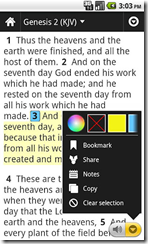
Christian Droid Apps Christian Droid Apps 1. YouVersion Bible (FREE)
*Read/listen to the Bible with over 150 Bible versions and almost 200 Bible reading plans to help you read the Bible and track your progress.
*Easily search the Bible for either a reference or a keyword.
*Connect Twitter and Facebook accounts to easily share Bible verses.
*Bookmark your favorite Bible verses and sync them with YouVersion.com.
*Make public or private notes on your bible reading.


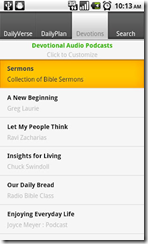
Christian Droid Apps daily 2. Daily Bible (FREE)
*Daily Bible Verse with daily notification
*Daily Bible Reading Plan
*Easy & Fast Search any Bible verse or topic: Easily search any verse of any topic.
*Daily Bible devotionals: Choose from a huge list of podcasts. Read or listen from devotions. Save a podcast and listen to it offline.
*Save or share Bible verse or plan or devotions easily on Facebook, Twitter, email, text etc.


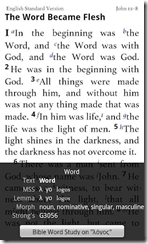
Christian Droid Apps Christian Android Apps 3. Logos Bible Software (FREE)
*Thousands of books and tools for Bible study
*Easy to read, verse preview, footnotes, and easy navigation.
*Includes powerful study tools: Passage Guide, Text Comparison, and Bible Word Study.
*When you download the app you get access to all features and more than 30 resources. When you sign up for a free Logos account, you get access to an additional 30 resources as well as access to over 16,000 resources for sale from the Logos and Vyrso libraries.


Christian Droid Apps Christian Android Apps 4. MySword Bible (FREE)
*Multiple off-line Bibles, Commentaries and Dictionaries
*Bible version verse comparison
*Highlighting
*Bookmarks
*Type your personal notes and insights
*Search (concordance) for Bible, Commentaries and Personal notes
*Dictionary, Commentary and Journal/Book picture support
*Paragraph or Verse mode for the Bible view


Scripture Memory Apps

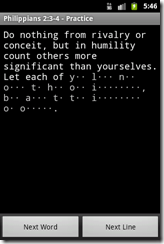
Christian Droid Apps Christian Android Apps 5. RememberMe Bible Verses Memory (FREE)
*Listen to verses
*Study flashcards and play word puzzles
*Obfuscate a passage and fills in the gaps
*First letter and placeholder methods
*Line by line practice
*Daily reminders
*Flashcard widget for your home screen
*Numerous Bible translations
*More than 100 verses preloaded


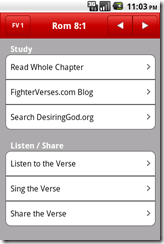
Christian Droid Apps Christian Android Apps 6. Fighter Verses ($2.99)
*Over 520 verses included
*Add ANY VERSE using “My Verses” and optionally define topics for topical memory.
*SIX Bible translations – ESV, NIV, NASB, HCSB, KJV, LBLA
*Fill in the blank QUIZ
*SONGS to help you learn verses (ESV only)
*TOPICAL index for topical memory
*Configurable SCHEDULE for weekly memorization
*REMINDERS to memorize daily or weekly


Best Prayer Apps

Christian Droid Apps Christian Android Apps 7. Prayer Journal ($0.99)
*Keep a running list of topics that you are praying about
*Share entries or the entire journal with friends (email/text messaging)
*Set notifications to remind you to pray for the topic.
*Upload journal to Google Docs.
*When you feel you have reached an answer to your prayer topic(s), mark them as answered and keep them available for later viewing, to remind yourself of God’s goodness to you in those requests.


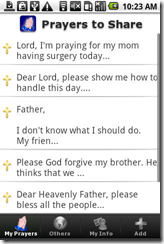
Christian Droid Apps Christian Android Apps 8. Prayers to Share (FREE)
*Share your prayers with people around the world
*Pray along with others
*Write out your prayers
*Keep track of those you pray for
*Share your prayers anonymously with others who can pray along on our Social Prayer Network
*…or just keep them private
*Receive inspiration from reading everyone’s prayers


Best Worship Apps

Christian Android Apps

Christian Droid Apps

9. Pandora (FREE)
*Personalized radio streams music to your phone.
*Type in the name of a favorite artist, song, or composer and a station will be created to play their music and music like it.
*Here are some of the stations on my Pandora app:
Casting Crowns, Addison Road, Nichole Nordeman,
Chris Tomlin, Hillsong, and Brooke Fraser.
If you use Pandora, what stations do you have for your worship times?


Christian Droid Apps Christian Android Apps 10. 1000 Gifts (FREE)
*Quotes on awaking to the joy-filled power of grace and gratitude at your fingertips … to get you started
*Photo and video stream, texts, and voice recordings of your gifts … to keep you going
*A one-tap option to instantly share captured gifts to Twitter, Facebook, and Flickr … to keep friends and family inspired on their way to their one thousand gifts

Thanks Heather, for reminding me about this one!


11. And I have to sneak one more in here: KLOVE Positive & Encouraging (FREE). Commercial-free contemporary Christian music.

Which apps for spiritual growth would you add to the list?

 _______________________________________________


Joyce is a business major turned PreK teacher turned stay-at-home mommy to 2 little girls (ages 5 and 2.5.) She likes to dabble in a little bit of everything, from writing newsletters (for our family and for MOPS) to crafting to trying out new recipes…basically just trying new things.

She loves God, family and friends, date nights, board games, books, and blogging. You can visit her over at Keeping Up with the Moys.


I Trust Because He Delivers {Run to Him Psalm 40}

February 17, 2012 by Caroline 10 Comments

Sitting in a hospital works wonders for one’s trust in God.

My husband and I have seen with our own eyes how God delivers people from pain, troubles, and sadness. It’s not that we won’t experience these hard things. We will see suffering in this life (Romans 5:1-5), but God always remains present for us to trust through the good and the rough. His answer may not always be what we expect, but we can rely on Him to give us what we need (Psalm 34:8-9).

Waiting While Crying Out

In Psalm 40, David waited and received answers from God on his previous troubles (Psalm 40:1). He witnessed God’s good deeds, deepening his knowledge of Him (Psalm 40:3) and set about praising Him.

“Such wonders of God demand a response (Psalm 40:5). No ritual will suffice (Psalm 40:6), only serious commitment to God’s will (Psalm 40:7-8).” (Source: New Bible Commentary, p. 512)

Image from Microsoft Clip Art

Yet, David still needed God’s help and deliverance (Psalm 40:11-13). Continuing to need God’s help did not cause David’s trust to suffer. Instead, he trusted all the more because he had witnessed God’s saving redemption. And because of that trust, he waited patiently while still crying out to God for His saving help. Trust breeds patience and that patience signifies deep trust. Oh, to have that trust!

The New Bible Commentary looks at David’s example of patient trust and summarizes: “How we react to life constitutes a potent testimony and nothing is more powerful than to maintain a simple attitude of waiting trust” (p. 512).

He Delivers

God’s love and faithfulness protects (Psalm 40:11). He gives not only His salvation and His physical protection, but His love and faithfulness protect our hearts, too.

Psalm 40:17 declares that God helps and delivers. We can trust even these words because we know His Word to be true (Psalm 33:4).

We always need God’s gracious help. And He is always willing to give it His children, who love Him, revere Him, and seek Him wholeheartedly. We can do all of this in trust because we see how He delivers. We have known from the beginning (Psalm 22:9-10) and in spite of those who mock the faith (Psalm 22:8) – God is trustworthy. I may want answers fast or a different path than what may be placed in front of me, but in and throughout it all, I have a God who opens my ears to hear His blessings (Psalm 40:6) and opens my heart to receive His love.

My prayer today is to trust like David shows us because God’s love and deliverance produces this praise-filled reliance:

“Be still before the LORD and wait patiently for him…” – Psalm 37:7


How have you personally seen God deliver? What else did you learn from this week’s Run To Him reading in Psalm 40?

« Previous Page
Next Page »

This Month’s Theme

  • Jesus is the Way
  • And He Shall Be Called Series Intro

Enter your email address to have new posts emailed to you:

We’ll come to you

Enter your email address to have new posts emailed to you

Categories

Bible Memory – Lent 2021

Memorizing Isaiah 12

Let the Children Come

Let the Children Come

Want more #HideHisWord resources?

Memorizing Psalm 1

Find Us on Facebook


Search

Recent Posts

  • Series Wrap-Up: The Lord Is My Light
  • His Marvelous Light
  • When the Darkness Deepens
  • Though I Sit in Darkness…
  • Let Your Light Shine
  • Life-Giving Light

Archives

© 2026 · Pretty Creative WordPress Theme by, Pretty Darn Cute Design