• Home
  • About
    • Our Contributors
    • Our Beliefs
  • Blog
  • Bible Studies
    • Scripture Dig
  • Archives
  • Shop
  • Advertise
  • Contact
    • Email
    • Facebook
    • Instagram
    • Pinterest
    • Twitter

Do Not Depart

Encouragement and Tools to Abide in God's Word

You are here: Home / Blog

SLOW: Preparing Your Heart for Easter

March 7, 2013 by Teri Lynne Underwood 6 Comments

Welcome to Do Not Depart! Be sure to subscribe to the Do Not Depart RSS feed or email updates to receive regular encouragement and tools to abide in God's Word.

Welcome back to Do Not Depart! If you haven't already, subscribe to the Do Not Depart RSS feed or email updates to receive regular encouragement and tools to abide in God's Word. This post may include affiliate links. To read our full disclosure policy, click here. Thank you for supporting this site!

We live in a frantic and chaotic world.  Our “to do” lists never end and the demands on our time never cease.  We fight an inner battle between our need for stillness and our desire to accomplish.  We know, in our hearts, how much we need to slow down, need sabbath.  But the voices inside and out remind us of our obligations, our commitments, the tasks at hand.
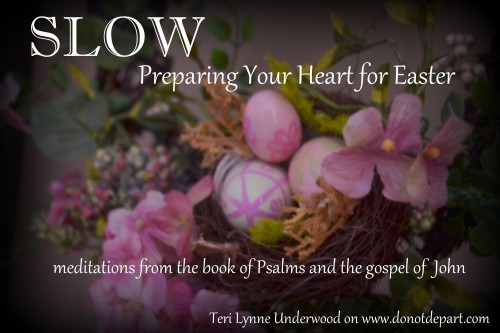
preparing your heart for Easter by Teri Lynne Underwood www.donotdepart.com

Maybe, though, you find yourself this Lenten season in that awkward place of recognizing the need to slow but uncertain how to do it.  Slowing is hard.  Sabbath isn’t easy in a 24/7 world. It’s hard to be the girl in the Bible study who loses the “I’m busiest!” race.  I know, I’ve been there.  Over the past few weeks, I find myself learning a very important lesson:  He slows me because He wants to show me.   When the Lord beckons my heart to be still, to rest in His presence, to slow the pace of my life, it is because He always has something He longs to show me—something I need to know about His nature, His character, His plan for me, His love.  Slowing allows us to be intentional and to learn.

I’d venture to guess that if you are reading a post with “preparing your heart for Easter,” you have an interest in doing just that.  May I offer you a series of Scripture readings to be used for just that purpose?

Let’s SLOW together: Sacrifice, Linger, Own, and Wonder.  Each of these four readings is designed for a time of personal meditation and prayer.  I’ll be using them on Sunday mornings as I prepare for church and then reading the passages again throughout the week, keeping the words and ideas fresh on my heart.

S—SACRIFICE

As we consider the sacrifice of Christ on the cross, we must also consider the sacrifice He’s called us to make in our own lives.  The laying down of all we care about and trusting He cares more.  My friend Kris speaks of Lent this way, “It occurred to me that perhaps what God calls us to give up, really, is ourselves” ([amazon_link id=”1481909681″ target=”_blank” ]Holey, Wholly, Holy: A Lenten Journey of Refinement[/amazon_link]).  I’ve found that Lent presses in on me in ways I’d never expected.

Meditate on these passages about sacrifice:  Psalm 116 (especially verse 17) and John 12:1-8.

L—LINGER

When was the last time you lingered in the Lord’s presence?  Just stayed to enjoy being wrapped up in Him?  Jesus called us to “abide in Him” and even said without doing so we could accomplish nothing (John  15:5).   In the Psalms we find the simple but challenging truth that we best know God when we are still in His presence (Psalm 46:10).  Carve out time to linger in the Lord’s presence.

Meditate on these passages about lingering:  Psalm 46 and John 15:1-9

O—OWN

Do you realize your own need for the Lord, your own part in His death?  Sometimes we fail to accept ownership of the reality of our sin.  We like those words like “mistake” and “messed up” over the harsher “sin” and “sinner.”  But the reality is:  We have to reach the point of owning our sin in order to fully recognize the price Christ paid for it.  Spend time contemplating the reality of your own sin and the depth of Christ’s sacrifice paid for it.

Meditate on these passages as you consider your own sin:  Psalm 22 and John 18:15-18, 25-27; 21:15-19

W—WONDER

I often think about Mary Magdalene’s experience that first resurrection morning.  She probably wondered about how the stone would be moved from the tomb, then wondered how she would tell the disciples what she had seen.  As she returned to the garden, I bet she wondered about all she’d learned from Jesus and then, when He spoke her name, I just can’t imagine the wonder at hearing His voice once again.  May I invite you into the wonder of WHO Jesus is and how much He loves you?  Take time to embrace the wonder of God-made-flesh, sent to die, now sitting at God’s right hand, someday to return, and eternally to reign.

Meditate on these passages as you wonder:  Psalm 89 and John 20:11-18

{Please feel free to print the SLOW pdf and use it as you prepare your heart for Easter.}

How has slowing helped you see the Lord more clearly?

Resurrection Series on www.donotdepart.com

Resurrection: Preparing our hearts to celebrate Easter

March 5, 2013 by Julie Leave a Comment

Resurrection Series on www.donotdepart.com

We’re born wanting something we can’t have. Have you ever lost a loved one? Have you ever battled for your own life? Since death was announced in Genesis 3:19, people have searched for ways to prolong life, live forever, and outwit death. After all, Adam’s judgment echoes through the ages to all of us: “Therefore, just as sin came into the world through one man, and death through sin, and so death spread to all men because all sinned.”   (Romans 5:12)

From tombs full of riches for the afterlife to quests for the fountain of youth to modern medical technology, the hope of life and fear of death spurs men on to find the key to eternal life. Losses, disappointments, and decay tasted in earthly life point to our shared ultimate end: “And just as it is appointed for man to die once, and after that comes judgment” (Hebrews 9:27).

Only One has power over death. There have always been skeptics; even the Sadducees of Jesus’ day scoffed at the thought of immortality. Scripture records the stories of a few who were powerless over death, but they saw God intervene and do the unimaginable: restore life.

Brought to Life In the Old Testament

  • The Widow of Zeraphath’s Son (1 Kings 17:17-24)
  • The Shunnamite Woman’s Son (11 Kings 4:20-37)
  • The Man thrown into Elisha’s Tomb (II Kings 13:21)

Brought to Life In the New Testament

  • The Widow of Nain’s Son (Luke 7:11-16)
  • Jairus’ 12 year old daughter (Mark 5:35-43)
  • Lazarus (John 11:1-44)
  • Tabitha (Acts 9:36-41)
  • Eutychus (Acts 20:7-12)
  • Saints buried near Jerusalem (Matt. 27:51-53)

These people did not raise themselves, but they were raised by God. His power worked independently, and occasionally through His servants, to defeat death itself. As foretold in Genesis 3:15, the Enemy’s plan suffered a fatal blow when the gospel triumphed in the risen Savior. The resurrected life of Jesus makes our abundant life possible. What man could never do, God did.

Resurrection is the conquering of death, the overcoming of the Enemy’s plan to thwart God’s gift of life. Jesus said, “The thief comes only to steal and kill and destroy. I came that they may have life and have it abundantly.“ (John 10:10)

This month we celebrate the Resurrection victory over loss and pain and death. With “Easter” at the end of this month, we want to prepare our hearts with fresh appreciation for the Resurrection. All month long, we will share Bible Study tools to help you focus on this greatest of all mysteries that makes abundant life possible.

Behold! I tell you a mystery. We shall not all sleep, but we shall all be changed … the dead will be raised imperishable, and we shall be changed. For this perishable body must put on the imperishable, and this mortal body must put on immortality…“Death is swallowed up in victory. O death, where is your victory? O death, where is your sting?”… thanks be to God, who gives us the victory through our Lord Jesus Christ.
(Excerpts from 1 Corinthians 15:51-57)

Join us this month on Do Not Depart as we share Bible Study Tools to prepare our hearts for a celebration of the Resurrection.

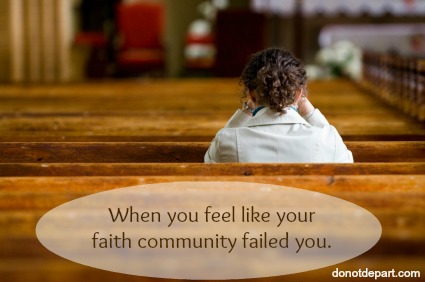
When Your Faith Community Fails You

February 28, 2013 by Sandra Peoples 9 Comments

Months after our son was diagnosed with autism, I sat at lunch with two friends and cried about all we were going through. They listened, they prayed for me, and they asked loving questions like, “How is this affecting your marriage? Are you and Lee pulling together or being pushed apart?” My friends were exactly what I needed exactly when I needed it. But, this was only the second time we had been together face-to-face. One lived in Tennessee and one lived in Ohio, far away from our house in Pennsylvania. They had never even met my husband Lee or our sons. Most of the time, they were just avatars on Facebook and Twitter. As thankful as I was for them, I wondered why no one else was praying over me, asking me questions, or just spending time with me as I adjusted to my new life as a special needs mom. These two friends ministered more to me in the hour before I caught my plane to fly back home than I felt our church family was doing. The more I thought about it, the more bitter I became, finally feeling like our church failed us.

A couple years have passed since that day. Now, I can look back with objectivity. But that doesn’t diminish the pain I felt at that time. Nancy Guthrie writes,

“We all know what it’s like to have a burn or a physical injury and discover for the first time how much we use that part of our body. The affected area might have been bumped or brushed up against countless times before it became inflamed, but we never really noticed. Now we’re much more sensitive. We notice every time someone carelessly makes contact with us. We have a heightened sensitivity, and it doesn’t take much to hurt us.

That’s how it is when our hearts have been broken, when our insides have been rubbed raw by difficulty or disappointment or the death of someone we love. We’re far more sensitive to the thoughtless comments and dismissive slights of others. We expect more from everyone around us, and we’re easily annoyed and offended when we don’t get it.”

I was raw. Everything hurt—words people said, words people didn’t say, their reactions, and their inactions. How should we act when we feel like our faith communities have failed us? Here are a few lessons I learned during that time I’m still trying to apply today:

  • Give your faith community grace. No one in our church was intentionally hurting us. Most didn’t know what to say. They didn’t know what might set off my tears. Our church family learned about autism with us. Now, we couldn’t ask for more supportive and encouraging friends. They not only love us, but they have started a special needs ministry to reach out to other families like ours. But it took time. For us and for them.
  • Give yourself grace. Realize how raw you are. Understand you may be hyper-sensitive and will process events differently when you get to a new normal. Find books and blogs by people who have been through what you are experiencing so you know you aren’t alone, even if you feel alone.
  • Give grace to others. Reach out so you don’t fail them. Before our experience, I never knew what to say to a woman who had experienced a miscarriage, so I said nothing. But now, I say something. I say I’m sorry. Then I follow-up a week later and again say I’m sorry and I’m praying. I work hard to get over myself and join with someone else in whatever they are going through. It isn’t comfortable for me, but it’s worth it, so no one else feels like I have failed them.

Life in community isn’t always easy. But grace makes it easier. Give grace to your family community, yourself, and to others who may need it today.

Two Are Better Than One – The Importance of Developing Godly Friendships {created for community}

February 26, 2013 by Patti Brown 7 Comments

The Importance of Developing Godly Friendhsips - DoNotDepart.com

The Importance of Developing Godly Friendhsips - DoNotDepart.com

We’ve been talking this month about community. There is evidence in scripture of many levels of community in which we can participate and serve:

  • the world (John 3:16)
  • a local fellowship of believers (Luke 10:1-2)
  • a smaller group (Matthew 20:17)

But what about that very personal level? What about intimate friend relationships with two or three other believers?

Close Friendship in Scripture

There are a number of examples of close relationships in the bible:

  • Moses and Aaron – Exodus 4:13-15
  • David and Jonathan – 1 Samuel 23:16-17
  • Jesus spent extra time with Peter, James and John – Mark 5:47 (healing Jairus’ daughter), Matthew 17:1 (the transfiguration), Mathew 26:37 (Garden of Gethsemane)

Ecclesiastes 4:9-12 says: 

Two are better than one, because they have a good reward for their toil. For if they fall, one will lift up his fellow. But woe to him who is alone when he falls and has not another to lift him up! Again, if two lie together, they keep warm, but how can one keep warm alone? And though a man might prevail against one who is alone, two will withstand him—a threefold cord is not quickly broken.

Two friends make a threefold cord? I believe it is because God is the third part of that strong relationship.

Why is Close Friendship Important for Believers?

Time spent one on one allows us to go deeper as we grow toward Christ. There is freedom for a higher level of vulnerability than that which is usually comfortable in a group, even in a small group such as a bible study.

Close friends can help hold you accountable and encourage you. They will also be more aware of and able to help when practical needs arise in your life. They will pray for you.

Ways to Grow in Godly Friendship

  1. meet together – make time just to be together. Encourage one another in the journey of life. (Romans 1:12, Hebrews 3:13)
  2. eat together – I just love it that Jesus cooked up breakfast for a few of the disciples! Share a meal with a friend. (John 21:12)
  3. serve together – encourage one another to live a life of service; serve each other; even go out and serve together! (Hebrews 10:24)
  4. study together – a precious way for God-given friends to grow together is by studying His Word together. Each of us has a unique perspective to share (2 Timothy 3:16-17, Proverbs 27:17)
  5. pray together – spend time in regular prayer with your close friend. In this age of technology distance is no obstacle. I meet weekly over skype to pray with a dear friend who lives 3000 miles away! (Matthew 18:19-20)

Do you have this kind of relationship? Nurture it. Set time aside. Make time.

What if I Don’t Have a Close Friend?

But what if you don’t have any close friends right now? Just as God seeks us out, it is okay for you to seek out friends. You can initiate a friendship!

Think for a moment…. whom have you met that you just “click” with? Pray and ask the Lord to show you one or more people to make a point of growing in relationship with. Seek out believers who can nurture you on your faith journey. This sort of relationship should be with someone of the same sex; a close relationship with someone of the opposite sex should be limited to your spouse.

It is worth the effort to develop godly friendships for mutual encouragement and blessing as you grow in Christ!

How have you found and nurtured close friendships within the body of Christ?
Please share your thoughts in the comments.

photo credit

Created for Community

When You Can’t Find Community

February 21, 2013 by Caroline 7 Comments

When You Can't Find Community via Do Not Depart

You’ve just moved to a new town, and you’re encountering obstacles to finding a new church community for your family.

Or perhaps you have a child with special needs, and you need a church equipped with resources or communities specifically organized to provide support.

Or medical issues are preventing you from attending group events.

Maybe you’ve even endured troublesome circumstances in the past with communities gone wrong, and you desperately need to find a healthy community.

Whatever might have happened, you’re having trouble finding community. What do you do now?When You Can't Find Community via Do Not Depart

What To Do When Finding Community is Tough

  • Stay faithful. Finding a solid community is hard. Keep searching, keep believing. “But encourage one another daily, as long as it is called “Today,” so that none of you may be hardened by sin’s deceitfulness.” – Hebrews 3:13 (NIV)
  • Search for online communities. While online community cannot completely take the place of face-to-face fellowship, online groups are amazing when they boost, encourage, and teach.
    -Online communities we recommend: HelloMornings, (in)courage, SheReadsTruth, the Hide His Word Facebook group, and any of your favorite blogs!
  • Seek community organically. Community in general has surprised me with its growing importance and reliability. But, I have found myself attempting to create bonds where there isn’t a realistic opportunity, especially in mentoring. I’m still learning best options here, but sometimes I find I need to release strict expectations and take some risks in joining or contributing to new communities. A small step keeps me moving forward into deeper community.
  • Read. Read His Word, and read godly books and articles. Reading broadens my perspectives and knowledge base, like community can. Even better after you read: find someone to discuss what you’ve read together.
  • Pray. When I’m struggling to connect, I remind myself to pray. Pray for the right space for me and for me to offer the right contributions. Pray for the members of my community and for us to love and uplift one another (2 Thessalonians 1:3). Prayer causes internal reflection and I feel myself centering focus back on God when I’m lonely or feel excluded.
  • Hold on to hope. If you’ve searched for weeks, months, years for a welcoming community, you might feel discouraged. Grab that hope God gives and cling to it. Community is worth it (Hebrews 10:23-25).
  • Seek Him. Even when community isn’t readily available, we can always commune with God (1 Thessalonians 5:16-18).

“For where two or three are gathered in my name, there am I among them.” – Matthew 18:20


Have you ever been through a time when you weren’t part of a community or couldn’t be part of one? What did you do to find community? Your stories can help encourage others here.

Singles in community

February 19, 2013 by Julie 10 Comments

Is there a place in the faith community for singles? More than half of homes with children in my city are headed by a single parent. The number of adults who are unmarried, divorced, or widowed continues to rise in the United States, but much of church community life focuses on married people. Recently, a godly single friend of mine admitted that she often feels “invisible.” If God sees the life of each individual, married or single, why doesn’t the Church?

With industrialization came assembly line concepts that grouped like pieces for the purpose of efficiency. God didn’t intend for the community life of believers to be so segregated. Instead, His word describes a Body life where a variety of ages and marital statuses blend for greater strength, understanding, and impact. Singles want and need to be in community with married friends, and the whole Church is better when our single friends are part of it.

“For the body does not consist of one member but of many… But as it is, God arranged the members in the body, each one of them, as he chose… If all were a single member, where would the body be? As it is, there are many parts, yet one body… If one member suffers, all suffer together; if one member is honored, all rejoice together. Now you are the body of Christ and individually members of it” (from 1 Corinthians 12:4-27).

A “single” member here doesn’t refer to marital status, but to one individual. As each one experiences God’s grace individually, we each have reason to look around us and help every other member be seen, included, valued, and loved. “By this all people will know that you are my disciples, if you have love for one another” (John 13:35).

Many unmarried community members are suffering today, because they long to be in a mixed status, loving community, but they feel invisible. The Body needs the value they bring, and we miss out when they’re absent … or just invisible. If one suffers, the whole Body suffers.

A godly single friend of mine is a treasure in our community, and I asked her to share: What can a married woman do to be a good friend to a single woman?

How to love single women in your community

  1. Respect the single woman and treat her as an equal.
  2. Be interested in your single friend’s life.
  3. Be sensitive to her desire for marriage and accept her for who she is.
  4. Encourage her to serve the Lord with her whole heart in the situation God has placed her in.
  5. Be sensitive to the single woman’s comfort level around children.
  6. Offer to help (don’t wait to be asked). Let her have the joy of helping you.
  7. Pray for and with the single woman.

Created for Community
A “single” (marital status) person doesn’t want or need to be a “single” (only one/alone) person in the community of believers. Let’s see those who are unmarried and help them feel like part of the “one body” of God’s bigger family.


Read more about Married Friends for Singles and Why some married people make good single friends.

10 Tips for Making the Most of Online Community

February 14, 2013 by Lisa Burgess 29 Comments

Let no corrupting talk come out of your mouths, but only such as is good for building up, as fits the occasion, that it may give grace to those who hear.
Ephesians 4:29

Maybe we’re in our pajamas. Maybe it’s 3 a.m. Maybe we’re not even in town.

But in our new world, these are no longer limitations.

For example, in this little corner we gather any time, from many different countries, to memorize scripture together.  We come to encourage or share a photo or ask a question (what does “portent” mean in Psalm 71:7?).

It’s online community. It’s relatively new to us all. And it’s quite an opportunity.

With only a keyboard and screen, we can type out love for God and others from wherever we are to any person with internet connectivity. While online encounters should never replace in-person ones, they are legitimately useful in our modern lives, a positive addition to our global neighborhood.

Here are ten tips to make the most of your online community:

1. Be you
Whether you’re an introvert or extrovert, have lots to say or little, you now have a turn to talk. Your voice—be it quiet or loud—has never had greater opportunity to be heard as widely as now. So be authentic and give what only you can—you and how you are seeing the Lord in our world. Stay within boundaries of comfort, safety, and appropriateness when you share, but do be real.

2. Genuinely listen
Turn up the volume to hear what others have to say. It’s tempting to quickly scan what others write, but tune in to their stories. Listen to their comments. Hear their hearts. Just because they can’t see whether or not you’re paying attention, read thoughtfully anyway.

3. Talk back
One-way communication doesn’t create community. If you want to establish relationships, leave a grateful comment after reading an encouraging post. Answer a question on Twitter. Message a Bible verse that would be helpful. Skype for back and forth conversation.

4. Pray
And don’t just say you will; do it. If an online friend shares a prayer request on a forum, pray as you read so you won’t forget. Or type out your prayer and email it out to them as well as up to God.

5. Go deep
Invest in a handful of online friends that you truly connect with by giving them extra attention. Nurture a smaller community within a larger one, such as the small groups of six in the Soli Deo Gloria community.  Stick with the same blogger’s link-up for several weeks until you recognize who’s who.

6. Spread wide
Just as with face-to-face friends, you can only go deep with a few, but you can say a kind word to many—a quick “like” or “Happy Birthday” on a Facebook page keeps connections alive. I communicate with just a few words to many Spanish-speaking friends in El Salvador (thanks to Google Translate).

7. Accept limits
Monitor your time online; don’t sacrifice in-the-flesh companions because you’re tied to your iPhone. Don’t publish what you might regret; online words are documented and permanent. Slow down to respond; just because you can reply immediately doesn’t mean you have to. Honor confidences shared privately. Create appropriate boundaries with opposite-sex relationships.

8. Take it offline
Surprise an online friend with a card in your handwriting or a small gift via snail mail. If you’ve established a trusted relationship, and an opportunity arises, meet in person at a conference or restaurant or church.  Talking online is good, but worshiping side by side—hearing each other sing praises or praying together—brings you even closer.

9. Be a resource
Recommend relevant sites, software tools, Pinterest boards to others who can benefit from them. Retweet helpful links. Welcome newbies to an online group you’re already in. Post helpful book reviews on sites like Amazon or reading groups like Goodreads.

10. Above all, love
The greatest command applies online as well as off—love God, love others (Matthew 22:36-39). Let this question be the final one you ask before you hit send or publish: “Am I loving God and loving others with these words?”

Our advancing technologies continue to provide new mediums to nurture friendships and build faith. Now that we’re online, let’s stay connected . . . for God’s glory and each others’ good.

Created for Community

Share your experience with online community. What social media do you use for community? Have you met online friends in person? Please leave a comment below.

The Picture of Health

February 12, 2013 by Kathy Howard 4 Comments

Healthy church body


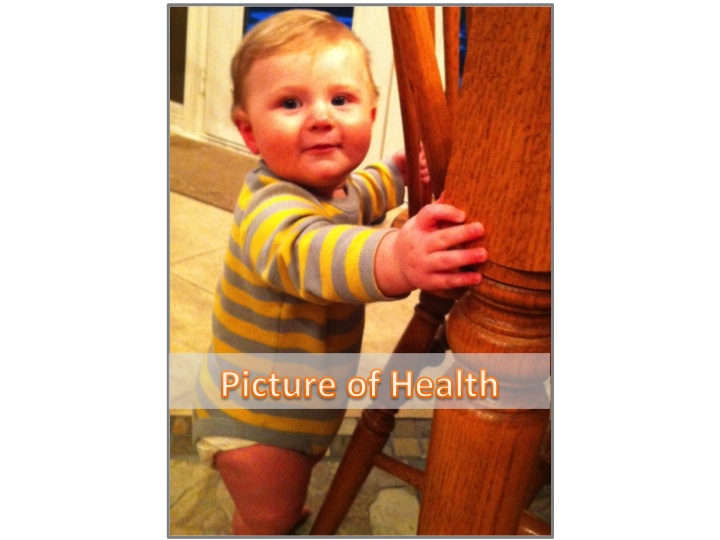
My first grandchild is almost 11 months old.  Watching him grow and change and learn has been amazing and fun.

When Micah and his parents (our daughter and son-in-law) were here for Christmas, he was pulling up on everything and walking around by holding on to the furniture.  But that won’t be the end of the growing. Soon, Micah will be standing without assistance and then walking on his own.

Healthy church body

Micah’s success with standing and walking would be severely diminished if he was missing a limb. While, the human body is miraculous and can rise to all kinds of physical challenges, we need every single part to optimally function like God intended.

The same is true for the body of Christ. The church needs every part, every member of the body, to function as God intends.

When God saved you, He saved you into His family, into the body of Christ. You are one member joined together with all the other members. God designed us for community. His plan for His children is for us to live out our faith in community and to grow together in unity (Eph 2:19-22).

The church cannot be all God purposes without you and you cannot be all God purposes without the local church. Here are a few quick truths from Scripture:

  • Every Christian is a member of God’s family.
  • A believer cannot choose to separate herself from the body. She is a part (1 Cor 12 15).
  • Each member of the body “belongs” to the other members. Christians have a mutual responsibility to and for each other (Romans 5:4-6).
  • God gives every Christian spiritual gifts intended to be used for the good of the family (1 Cor 12:7).
  • Every Christian has a specific place of service in the body (1 Cor 12:27).
  • It takes every member serving where God placed her for the body to grow properly and become mature in Christ (Ephesians 4:11-13).

In Ephesians 4, Paul beautifully describes God’s intent for the church – locally and globally:

 11 So Christ himself gave the apostles, the prophets, the evangelists, the pastors and teachers, 12 to equip his people for works of service, so that the body of Christ may be built up 13 until we all reach unity in the faith and in the knowledge of the Son of God and become mature, attaining to the whole measure of the fullness of Christ.14 Then we will no longer be infants, tossed back and forth by the waves, and blown here and there by every wind of teaching and by the cunning and craftiness of people in their deceitful scheming. 15 Instead, speaking the truth in love, we will grow to become in every respect the mature body of him who is the head, that is, Christ. 16 From him the whole body, joined and held together by every supporting ligament, grows and builds itself up in love, as each part does its work. Ephesians 4:11-16, NIV

Created for CommunityAs individual members each carry out their “God assignment” in the local church, the body grows together in health and unity. As we all continue to serve together, love each other, and encourage and challenge each other, the church will become spiritually mature. Then the church will be steady and strong, resistant to false teaching and battle-ready to defeat Satan’s scheming. And the best part is that the church will reflect Christ to a lost world.

This is God’s design for a healthy, mature church body. Are you doing your part? Have you obeyed God’s call?

What body “part” are you? Where has God placed you in His body?


Faithful in community

February 7, 2013 by Julie 5 Comments

Created for Community

The believers were scattered and facing persecution when James wrote to them to encourage them in their trials. They struggled to have joy, well aware of their need for wisdom in the difficult things of life. Have you ever been alone in the midst of trying times? Trials are hard enough, but facing them without community is harder.

Accept His community challenge

Created for Community
The message of the book of Hebrew resonates with the echo of encouragement to be full off faith in trials. Tucked inside the tenth chapter of the book, God reveals a key choice that may determine how steadfast we are as individuals. Choose to regularly assemble in one place with others who follow Him.  He challenges us to practice this habit in order to be faithful in hard times.

“Let us hold unswervingly to the hope we profess, for he who promised is faithful. And let us consider how we may spur one another on toward love and good deeds, not giving up meeting together, as some are in the habit of doing, but encouraging one another—and all the more as you see the Day approaching” (Hebrews 10:23-25).

Accept the community urgency

As followers of God recognize the Day of His return coming closer, they will face hardships that tempt them to move from hope to hopeless. Just identifying themselves as a member of His Body may come with a price tag, and they may give us coming together. Some Christ followers will drift away from a culture of love and doing kingdom things. More than ever, God wants the community of faith to gather together to encourage each other to be firm in their faith.  By gathering together as His people, we remember who we are in Christ, who God is, why we have power instead of fear, and how light overcomes darkness.

Accept no community substitute

In this day, a scattered community of believers has more ways than ever to overcome isolation. It’s never been easier to network globally, but it’s never been easier to give up “meeting together,” which has the idea of assembling together in one physical place. Technology complements and creates community networks, but it doesn’t take the place of “meeting together.” There’s power in physical presence. We can not experience in reality what we only envision virtually.

Just as God became “God with us,” He urges us to be with each other. He set the precedent of relationship in community. Let’s keep on:

  • gathering together regularly
  • in local communities of believers
  • to spur each other on
  • to living out our faith
  • right up until the Day is here!

We will be faithful to the faithful One when we meet together faithfully.

Hiding His Word in My Heart {February Link-Up}

February 6, 2013 by Lisa Burgess 3 Comments

Bible memory resources

Have you been memorizing scripture in 2013? We’d love to hear what verses you are hiding in your heart!

Many of us are learning Psalm 71 together. It’s never too late to join in if you’re interested.

Suggested blog topics:

  • The verses I’m learning
  • What helps me stay on track
  • Why memorizing verses helps me

Please link a post from your own blog and/or share in the comments about your memory verses.


« Previous Page
Next Page »

This Month’s Theme

  • Jesus is the Way
  • And He Shall Be Called Series Intro

Enter your email address to have new posts emailed to you:

We’ll come to you

Enter your email address to have new posts emailed to you

Categories

Bible Memory – Lent 2021

Memorizing Isaiah 12

Let the Children Come

Let the Children Come

Want more #HideHisWord resources?

Memorizing Psalm 1

Find Us on Facebook


Search

Recent Posts

  • Series Wrap-Up: The Lord Is My Light
  • His Marvelous Light
  • When the Darkness Deepens
  • Though I Sit in Darkness…
  • Let Your Light Shine
  • Life-Giving Light

Archives

© 2026 · Pretty Creative WordPress Theme by, Pretty Darn Cute Design