• Home
  • About
    • Our Contributors
    • Our Beliefs
  • Blog
  • Bible Studies
    • Scripture Dig
  • Archives
  • Shop
  • Advertise
  • Contact
    • Email
    • Facebook
    • Instagram
    • Pinterest
    • Twitter

Do Not Depart

Encouragement and Tools to Abide in God's Word

You are here: Home / Blog

Created for Community

February 5, 2013 by Patti Brown 8 Comments

Created for Community

Welcome to Do Not Depart! Be sure to subscribe to the Do Not Depart RSS feed or email updates to receive regular encouragement and tools to abide in God's Word.

Welcome back to Do Not Depart! If you haven't already, subscribe to the Do Not Depart RSS feed or email updates to receive regular encouragement and tools to abide in God's Word. This post may include affiliate links. To read our full disclosure policy, click here. Thank you for supporting this site!

God did not intend for us to live in isolation.

From the dawn of creation, from the moment He said, “It is not good for man to be alone” (Genesis 2:18), humans have lived in community. Yet despite the clamor of modern life, many believers do experience isolation, bereft of true community.

Scripture is full of references to godly community. Among other things, we are to

  • meet together (Hebrews 10:24-25)
  • eat together  (Acts 2:42-47)
  • help one another  (Galatians 6:2, Proverbs 17:17, Romans 12:13)
  • be unified  (Psalm 133:1, Ephesians 4:1-6)
  • find Christ in the midst of community  (Matthew 18:20)

This month at Do Not Depart we will explore the ins and outs of Christian community. Why does God call us into community? How can we find Christian communities? What should those communities look like? What do we do when challenges arise within communities?

We want to encourage you to be a vibrant part of a community of believers, because you were created for it!
 Do you belong to a community of believers? What blessings have you found as a result of committing to community? Please comment to join the discussion!

Mentoring: Are You Ready?

January 31, 2013 by Sandra Peoples 6 Comments

Women investing in younger women—it’s not just a program, it’s a command in Scripture. But why isn’t it happening in so many churches today?

  • First, we are primarily around people our own age and life stage. What Sunday school class or small group do you attend? I would guess most of you are in an age/stage specific class, like a young married class (or a variation like married with children or newlyweds).
  • Second, the “older” women lack confidence. When talking to the “older” women of our church I hear over and over again, “I don’t know enough to mentor!”
  • Third, most women don’t have time for something new added to their to-do lists.

Titus 2:3-5 gives instructions to women in the church. The older women are to “be sober-minded, dignified, self-controlled, sound in faith, in love, and in steadfastness.” They are to teach the younger women, “what is good and so train the young women to love their husbands and children, to be self-controlled, pure, working at home, kind, and submissive to their own husbands.”

As we’ve talked this month about spiritual disciplines, I would like to make the case for mentoring as a spiritual discipline. It’s clearly commanded in Scripture, and we’re even given the curriculum! If you aren’t currently investing in younger women, let’s look at how you can get started.

In [amazon_link id=”1433503131″ target=”_blank” ]Spiritual Mothering[/amazon_link], Susan Hunt writes, “If you are a Christian woman who is seeking to grow in the faith and to live obediently, then you are qualified for spiritual motherhood.”

You don’t have to be perfect. You don’t have to have all the answers. You just have to be willing.

Mentoring isn’t another thing on your to-do list. It is very natural. In fact, the primary objective is to be natural. You become friends. The “younger” woman begins to ask questions. The “older” woman finds more and more to share. Naturally, they find themselves covering all the topics Paul lists in Titus 2:3-5.

For example, one Sunday after church, I was talking to a couple who are getting married this summer. I mentioned I had started shopping once every two weeks for groceries instead of every week in an effort to save money. She said, “Oh, I hope I can do that too! I want to plan menus and cook ahead and try new recipes!” From that very natural conversation, I now have the opportunity to mentor her. Next time I’m menu planning, coupon cutting, and grocery shopping, I’ll see if she wants to come over and see what works for me!

Mentoring is just that easy. So, how do you start? Seek out younger women. Pray about opportunities to meet and connect with younger women and God will provide. He wants you to obey the command to “teach younger women …” Is there a newlywed who teaches your son’s Sunday School class and you always have fun talking when you pick him up? Do you know a girl in the college ministry who has the same major you had? Talk to her! Chances are, she wants to get to know you too. Let the relationship develop naturally!

1 Thessalonians 5:11 says, “Therefore encourage one another and build one another up, just as you are doing.” Mentoring is an important part of life as a Christian, and it is how God designed women’s ministry! Are you ready to be a mentor?

If you are interested in the topics covered in Titus 2:3-5, I recommend the following resources:
[amazon_link id=”1885904177″ target=”_blank” container=”” container_class=”” ]Becoming a Titus Two Woman[/amazon_link] by Martha Peace
[amazon_link id=”1433503131″ target=”_blank” container=”” container_class=”” ]Spiritual Mothering[/amazon_link] by Susan Hunt
[amazon_link id=”1433534142″ target=”_blank” container=”” container_class=”” ]Feminine Appeal [/amazon_link]by Carolyn Mahaney
[amazon_link id=”0736918833″ target=”_blank” container=”” container_class=”” ]A Woman after God’s Own Heart[/amazon_link] by Elizabeth George

To strengthen yourself in specific areas, I recommend these resources:
Counseling-
[amazon_link id=”1565076176″ target=”_blank” container=”” container_class=”” ]Women Helping Women[/amazon_link] by Fitzpatrick and Cornish
[amazon_link id=”0801064856″ target=”_blank” container=”” container_class=”” ]Peacemaker[/amazon_link] books by Ken Sande
[amazon_link id=”0875526004″ target=”_blank” container=”” container_class=”” ]When People Are Big and God Is Small[/amazon_link] by Edward Welch

Spiritual Disciplines and Growth-
[amazon_link id=”0736926828″ target=”_blank” container=”” container_class=”” ]How to Study Your Bible[/amazon_link] by Kay Arthur
[amazon_link id=”1433537915″ target=”_blank” container=”” container_class=”” ]Disciplines of a Godly Woman[/amazon_link] by Barbara Hughes
[amazon_link id=”0802495389″ target=”_blank” container=”” container_class=”” ]Living by the Book[/amazon_link] by Howard Hendricks

Marriage and Family-
[amazon_link id=”1885904088″ target=”_blank” container=”” container_class=”” ]The Excellent Wife [/amazon_link]by Martha Peace
[amazon_link id=”0310242827″ target=”_blank” container=”” container_class=”” ]Sacred Marriage[/amazon_link] by Gary Thomas
[amazon_link id=”1433520095″ target=”_blank” container=”” container_class=”” ]Give Them Grace[/amazon_link] by Elyse M. Fitzpatrick and Jessica Thompson

Serving Others – A Spiritual Discipline

January 29, 2013 by Patti Brown 10 Comments

Service: A Spiritual Discipline - DoNotDepart.com

Service: A Spiritual Discipline - DoNotDepart.com

It was the middle of a hot summer afternoon. I was a young mama helping out at my first noisy Vacation Bible School. The church was now quiet, except for the occasional sound of my six year old playing near his napping baby sister.

I was sweeping. Sweeping a big mess. Leaning on the broom I looked at the work still be to be done and felt very very tired. And a wee bit grouchy. After all, was I the only person in the universe who could do this? Why had everyone left such a disaster? Why did I have to clean up? I hadn’t volunteered to be the janitor!

As my scowl deepened the Lord whispered to my spirit and I was ashamed. “Sweep for Me,” I felt in my heart. So I took up that broom again and swept as an offering of love to my God. And as I swept the floor, the Lord swept the ugliness out of my heart and mind and replaced it with joy in serving Him.

Jesus’ example of servant leadership

Do nothing from selfishness or empty conceit, but with humility of mind regard one another as more important than yourselves; do not merely look out for your own personal interests, but also for the interests of others. Have this attitude in yourselves which was also in Christ Jesus
Philippians 2:3-5

We serve others because Jesus did. Every single thing Jesus did on earth was in service to the Father and in turn to us.

Jesus commanded us to serve

Jesus said “You shall love your neighbor as yourself”
Mark 12:32

Did you know that the Greek word for love in this verse is in the active tense? Jesus wasn’t talking about feeling warm and fuzzy about your neighbor. Service is love in action.

We were created to serve

For we are his workmanship, created in Christ Jesus for good works, which God prepared beforehand, that we should walk in them.
Ephesians 2:10

God has prepared good works for each of us. There is a plan! The gifts God has given you He desires to use for the kingdom.

Serving others serves Jesus

For I was hungry and you gave me food, I was thirsty and you gave me drink, I was a stranger and you welcomed me, I was naked and you clothed me, I was sick and you visited me, I was in prison and you came to me.’ Then the righteous will answer him, saying, ‘Lord, when did we see you hungry and feed you, or thirsty and give you drink? And when did we see you a stranger and welcome you, or naked and clothe you? And when did we see you sick or in prison and visit you?’ And the King will answer them, ‘Truly, I say to you, as you did it to one of the least of these my brothers, you did it to me.’
Matthew 25:35-40

And he sat down and called the twelve. And he said to them, “If anyone would be first, he must be last of all and servant of all.”
Mark 9:35

We are Jesus’ hands and feet here on earth. When we see need and meet it, we are doing His good work, and serving Him.

Service is a necessary fruit of our faith

Serving does not earn our salvation:

For by grace you have been saved through faith. And this is not your own doing; it is the gift of God
Ephesians 2:8

But serving is a fruit of our new life in Christ. Our love for Him opens our eyes in love to the needs around us. Serving gives life to our faith:

For as the body apart from the spirit is dead, so also faith apart from works is dead.
James 2:26

True service does not seek selfish rewards

“Beware of practicing your righteousness before other people in order to be seen by them, for then you will have no reward from your Father who is in heaven. “Thus, when you give to the needy, sound no trumpet before you, as the hypocrites do in the synagogues and in the streets, that they may be praised by others. Truly, I say to you, they have received their reward. But when you give to the needy, do not let your left hand know what your right hand is doing, so that your giving may be in secret. And your Father who sees in secret will reward you.”
Matthew 6:1-4

It is a fact that serving the Lord brings much joy. But we really do have to ask ourselves – am I serving to gain reward from God or from humans?

Be mindful of your motivation to serve in a given situation. Is it really to glorify God, or is it to glorify yourself? I am throwing no stones in asking this question. On more than one occasion God has shown me that my heart was not right in my reasons for choosing certain areas of serving.

Service is a spiritual discipline

Service is a spiritual discipline because we are all selfish. Humans aren’t born thinking of others before themselves. But as we grow in faith and practice service, more and more it becomes second-nature and a way of life. Our desire to serve grows as we become more molded to Christ’s image.

Have you found service to be an area in which the Lord has grown you? How do you discern if your motivation to serve is godly or selfish? Join the conversation in the comments.

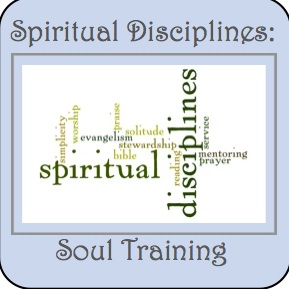
Spiritual Disciplines: Soul Training theme

Title photo source and copyright: 123RF Stock Photos

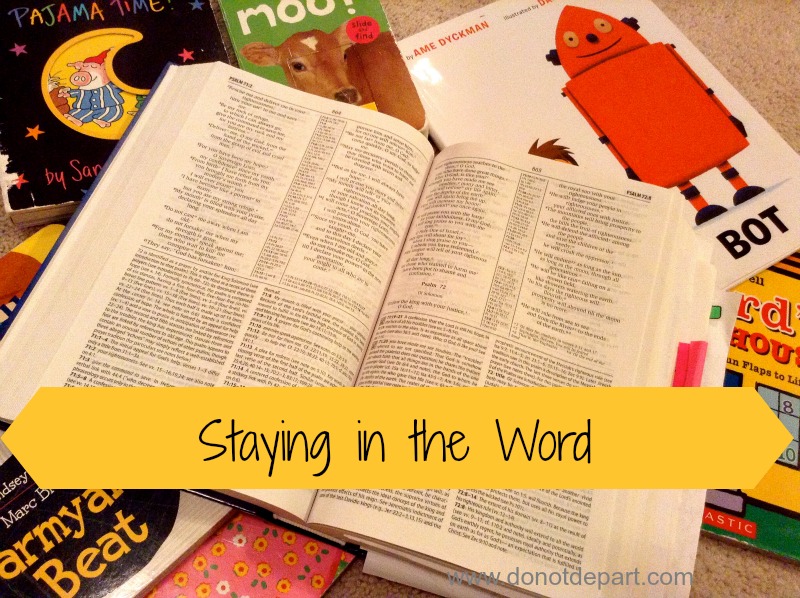
Staying in the Word

January 24, 2013 by Caroline 10 Comments

Staying in the Word - why and how to read bible from Do Not Depart

My children pick up books throughout our days together and bring them to me to read or “read” themselves. Yesterday morning, I even found my older child “reading” to my younger one on the floor for the first time! Melts my momma heart.

It’s pretty easy to motivate them to cuddle and read together. (I pray, pray, pray this easy motivation remains and grows for a long time.) We enjoy quality time when we do so, they learn (hey, I still learn from their books, too), and we’re spending time wisely.

Experts say kids learn to love reading when families read together and when they see their parents reading for fun on their own. Just witnessing me reading encourages my kids to continue reading.

Staying in the Word - why and how to read bible from Do Not Depart

I want them to observe me captivated and changed from reading God’s Word and eager to pick up the Bible like (or more than) I am any other of my favorite reads.

“Keep this Book of the Law always on your lips; meditate on it day and night, so that you may be careful to do everything written in it.” (Joshua 1:8 – NIV)

Do Not Depart is founded upon the above verse. We need to stay in His Word, for doing so brings drastic results on our hearts and perspectives. Why, specifically?

Why We Read the Bible

  • Like Ann Voskamp said, “We read the Bible to really live…” God’s Word is living, and I only continue to see that truth more and more as years progress.
  • He formed us by His words (Genesis 1:26). It seems His words hold mighty power and importance.
  • His Word encourages community (Hebrews 10:24-25), discussion, and growth.
  • Reading the Word spurs action (James 1:22). His Words and the words of those who followed Him inspire us and draw us closer to the heart of God through revealing His active love.
  • His Word offers wisdom (James 3:17-18).
  • God’s Word is trustworthy, alive, and powerful.
  • Christ is the Word become flesh (John 1:14). A pretty good reason to linger in His Word, eh?

How to Stay in His Word

Deuteronomy 6:6-9 is one of my go-to verses on the “how” part of staying in His Word. Talk about the verses, see the verses, read the verses, act on the verses.

As any discipline does, it takes training to making reading the Bible a habit.

Read and think every day. If it’s one book, one chapter, or one verse—just read. And pray for an open heart to His Word for you that day. Whenever I approach Bible reading time with a prayer and willingness, I see so much more of what He wants me to see.

A Few More Resources to Help You Stay in the Word

  • Use an app like Bible Gateway or YouVersion to follow a Bible reading plan. Each of these apps has a variety of topics to choose from and read.
  • Go back and read some our archived studies, like Love Like Him, Run to Him (a study on the Psalms), or Abiding Fruit. These studies focus on spending time in His Word to learn, grow, and deepen faith.
  • Kathy wrote a post several months ago with a free printable meditation worksheet to help you discover more depth in study of His Word.
  • Join a community focusing on reading and discussing the Word. I like She Reads Truth and HelloMornings.
  • For reflective bible study, read Savoring Living Water, filled with useful, in-depth bible study tips, and our series on creating a Bible notebook.

So, go ahead. Cuddle up with your bible. And see what amazing love you find from lingering in His Word.

Why do you read God’s Word? What are your favorite tips for staying in His Word? We love hearing from you.

Following the knee-worn path

January 22, 2013 by Julie 11 Comments

“There’s one more thing,” the plumber said, “Do you know where your main water cut off is?” Indicted by his simple question, I wondered how I could have ignored something so basic, especially when we’ve had a major “water episode.”

“What would you do if you needed to turn off your water?” He asked.

“Call you? Call my husband? Call my neighbor?” I smiled. He wasn’t charmed.

“I’m going to show you where your water source is. You don’t want to wait until you need it to find out where it is.”


If you haven’t cultivated prayer’s knee-worn path before a flood rushes in, now is a good time to begin. We don’t want to wait until we need it to find out where it is. Theologian Armin Gesswein said, “God’s throne is the busiest place in all the universe because everything centers there. Yet, the lack of prayer on earth keeps it from operating at full capacity.” Most of us say we’re too busy to pray. I was once too busy to find the water source in our house, and I paid a high price.

Jesus Prayed

Jesus himself was a man of prayer, expressing dependence on his Father and determination to do His will. Even now, “he always lives to make intercession for them,” (Hebrews 7:25b) pleading our case. The Father Himself is the source of prayer, a gift to mankind as an invitation for two-way communication. With all of our technology, it’s better than any man-made version. Scripture teaches us the language of prayer, teaching our independent mouths to speak heart words of dependence. Though seated beside His Father, Jesus prays on.

Followers Prayed

Simple men who followed Jesus up close and personal, and knew the work of prayer, still asked to be taught how to pray (Luke 11:1). Jesus’ prayer pattern hinged on desiring His Father’s will. Since God’s word reveals His will, prayer needs the fodder of truth to drive the faith behind it. The Bible is our book of prayer.

The Church Prayed

When believers first gathered as the Church, they began as a praying Church. Vulnerable in a contra-God world, “All these with one accord were devoting themselves to prayer.” (Acts 1:14a). They were sure of their need to cry out in dependence on God. If the people of God are to experience faith, intimacy, and power in an anti-God world, they must be people of prayer. To claim we are too busy to pray is to turn away from our waiting Lord. Prayer is not a piece of Body life; prayer is the foundation of Body life.

When I pray

  • Prayer strengthens faith. We call on God to fulfill promises He has already made.
  • Prayer nurtures intimacy. We expose ourselves to God and He makes Himself personally known.
  • Prayer inspires power. We gain boldness by focusing on the person of God instead of ourselves.

Two-way communication with God isn’t only for moments of helplessness, though Abba Father welcomes us near then. He invites us to call on Him as long as we live, to live in sweet, close communion with Him. To cultivate the discipline of prayer is to work at knowing His will, listening to Him, and opening our lives to Him.

“I love the LORD, because he has heard my voice and my pleas for mercy. Because he inclined his ear to me, therefore I will call on him as long as I live” (Ps. 116:1-2).

If you want to take a step on the knee-worn prayer path, check out our tools like Prayer Calendars or  A Prayer Album for Women on the Go.

Is there a tool or habit you’ve found to help you keep prayer as part of your daily life?

Let’s Mean It – “God Bless You!”

January 17, 2013 by Lisa Burgess 9 Comments

The LORD bless you and keep you;
the LORD make his face to shine upon you and be gracious to you;
the LORD lift up his countenance upon you and give you peace.
Numbers 6:24-26

My daughter Jenna sneezes in pairs.

Jenna: Achoo!
Me: God bless you.
Jenna: Achoo!
Me: God bless you.

I don’t think twice about my response either time. If you were to sneeze behind me at Kroger, I’d give you a “God bless you,” too. You’d do the same for me, yes?

Are we practicing a spiritual discipline when we say those words? Probably not, if we’re only offering “God bless you” out of cultural habit.

But can offering blessings be an exercise in spiritual discipline? Most definitely. Something as simple as a “God bless you” can be redeemed for His glory. If exercised intentionally, blessing others brings you closer to God as you partner with Him to spread the love of Jesus.

Yet let’s not limit our verbal blessings to sneezing fits when we have so much more to offer.

God offered the first blessings (and continues to go first! Ephesians 1:3) on Adam and Eve with, “Be fruitful and multiply” (Genesis 1:22). He promised big blessings to Abraham as well as promised to make Abraham a blessing (Genesis 12:2-3).

Later we see Rebekah’s family blessing her (Genesis 24:60), Isaac blessing Jacob (Genesis 27:28-29), Jonathan blessing David (1 Samuel 20:13), and the psalmists routinely blessing God Himself (Psalm 103:1). From then to now, blessings are routinely offered in orthodox Jewish homes from parent to child.

In the Middle Ages, the simple “God bless you” phrase was to ward off the plague. Or to refill a supposed emptied body with good instead of evil spirits, having just sneezed out its soul.

But why and how should we bless others today?

1. To draw us nearer to the heart of God

When we consciously choose to speak God’s blessings into the lives of our friends, we press in closer to hear His heart so we’ll know what to offer. Listen to His blessings the apostles’ wrote:

“May grace and peace be multiplied to you.”
1 Peter 1:2

“May the God of peace equip you with everything good to do his will.”
Hebrews 13:20-21

We can use theirs as well as create our own blessings based on truths we’ve learned from the Lord:

“May the love of the Father awaken you; may the presence of the Son enliven you; may the breath of the Spirit empower you, to hope in His grace and to follow His will today.”

2. To exercise our priestly duties

But who are we to offer God’s blessings? Most of us aren’t ordained ministers or official church officers. Are we qualified for this? Yes! We are a royal priesthood (1 Peter 2:9), uniquely positioned to remind others of the gifts prepared for them by our good Father (James 1:17).

We’re not called to spectate as others give blessings; we’re called to participate. To bless and be blessed (1 Peter 3:9).

3. To feed a world hungry for God

By deciding to bless others as a spiritual discipline, we become more aware of those around us needing our Savior’s sweet touch.

Who could use a blessing from you this week?

  • A teacher: “May the Lord bless your work as you pour knowledge into the minds of children.”
  • A friend traveling: “May your presence be light and salt in every city you enter.”
  • A troubled sister: “May the Lord grow your peace by leaps and bounds and fill you with strength to endure every trial with hope.”
  • Your child: “May you grow in wisdom and understanding to see God’s love for you through my love for you.”
  • Your parents: “May you be richly replenished throughout your golden years for giving me life and teaching me to love the Lord.”

Say it. Pray it. Write it. Type it.
In person, in a card, in an email, over the phone. Just do it.

Friends don’t let friends live unblessed. Don’t let yours go until you bless them (Genesis 32:26).

May you be blessed by the Lord as you bless others through the Lord, with or without a sneeze for prompting.

When have you received a blessing from someone? Is there someone you can bless this week? Do you have a favorite scripture of blessing? We’d love to hear from you.

For more on how to give blessings, including and beyond the spoken word, I recommend The Blessing by John Trent and Gary Smalley.

Spiritual Disciplines: Soul Training theme

Accountability for Growth {A Note about HelloMornings}

January 16, 2013 by Caroline Leave a Comment

Abounding Hope ebook

We’re discussing the spiritual disciplines this month here at Do Not Depart. Since the word “discipline” means “to train,” we know growing in these areas takes work and practice!

Finding Quiet Time with HelloMornings

In your search for quiet time and study time, do you ever wish you had someone to help encourage you to get up a bit earlier in the mornings, stay focused just a few minutes longer, or set that new goal?

Maximize Your Mornings - HelloMornings

HelloMornings might a good resource to help you! The challenge uses accountability groups to check-in and encourage one another via social media. (What is HelloMornings? Read more here!)

Interested in joining other like-minded believers working to begin the day focused on God?

Head over to the HelloMornings website to register for the new challenge (starting today!): http://www.hellomornings.org/register/

This session runs January 28th-April 26th (13 weeks). The HelloMornings group offers a study each session, and this time it’s Abounding Hope (a Quench Bible study on hope amidst any circumstance – written by Lara Williams and our own Katie Orr!).Abounding Hope ebook

Registration for this winter’s challenge is open for one week only: January 16th-23rd. Register today!

What have you found helps you begin your day focused on God? If you’ve participated in previous HelloMornings challenges, we’d love to hear about your experiences in the comments below.

Giving God His Due

January 15, 2013 by Kathy Howard 5 Comments

I know what’s happening in God’s throne room right now.

Forming galaxy captured by NASA’s Hubble Telescope

And no, I haven’t had been granted a vision of heaven, but the Apostle John got a glimpse and he told us all about it.

God is being worshiped. Continually. Day and night. The citizens of heaven never stop saying:

“Holy, holy, holy is the Lord God Almighty, who was and is, and is to come.

You are worthy, our Lord and God, to receive glory and honor and power,

For you created all things, and by your will they were created and have their being.”

Revelation 4:8, 11, NIV

God created us to glorify – or worship – Him (Isaiah 43:7). Worship is our earthly purpose and our eternal destiny. Because we were wired to worship God, we can only find true joy, peace, and contentment when we worship Him. People who “serve and worship created things rather than the Creator” (Romans 1:25) will never be fully content.

“Worship” is considered a spiritual discipline we can practice to pursue a godly life. Do you purposefully practice worship?

What is worship?

“Worship” is recognizing the greatness and majesty of the one, true God and responding to Him in a way He deserves. It begins with an inward attitude of repentance, submission, reverence, and honor and can be seen in an outward response of obedience and service. Worship can also be physically expressed with actions such as kneeling, laying prostrate, or raising your hands to heaven.

Worship is the proper response to our holy God. Worship focuses all of who we are on all of who God is.

In his book [amazon_link id=”1576830276″ target=”_blank” ]Spiritual Disciplines for the Christian Life[/amazon_link], Donald Whitney makes this connection between worship and spiritual discipline:

“But is we would be Godly, we must focus on God. Godliness requires disciplined worship.”

How can we foster worship?

If worship is the proper response to who God is – to His holiness, then one of the best ways to foster worship in our own heart and lives to is study the nature of God. Although we can never fully comprehend our unfathomable God, we can grow in our understanding. And as our understanding grows, so will our worship.

If you are serious about growing your understanding of God, I have some reading recommendations for you:

  • Of course, His own Word, the Bible
  • [amazon_link id=”0060684127″ target=”_blank” ]The Knowledge of the Holy,[/amazon_link] A.W.Tozer
  • [amazon_link id=”084992085X” target=”_blank” ]Holiness,[/amazon_link] Henry Blackaby
  • [amazon_link id=”0842339655″ target=”_blank” ]The Holiness of God,[/amazon_link] R.C. Sproul

How do we practice worship?

God gives us a picture of worship in Isaiah 6. Like John, Isaiah had a vision of God seated on His throne.  When Isaiah saw God in all His holiness, he was impacted with the reality of his own sin. Here’s what Isaiah did to respond to God in appropriate worship:

  • Confession and repentance
  • Submission to God’s will and ways
  • Obedient service

Worship is unique among the spiritual disciplines. To properly practice any of the others we should also be engaging in worship. If worship is “focusing on who God is and responding appropriately,” then we should be worshipping when we’re praying, when we’re serving, when we’re reading our Bible, and so forth.

Let’s focus on God and respond to Him with everything He deserves!

What do your outward expressions of worship look like?


Finding Quiet in an Incredibly Loud World: 5 tips for practicing stillness

January 10, 2013 by Teri Lynne Underwood 13 Comments

Usually, when the distractions of daily life deplete our energy, the first thing we eliminate is the thing we need the most: quiet, reflective time.

[amazon_link id=”0446563595″ target=”_blank” ]Simple Abundance: A Daybook of Comfort and Joy[/amazon_link]

5 tips for practicing stillness

Is your world noisy?  Between the people, the gadgets, and the never-ending cacophony of social media and 24-hour news, the quest for quiet in the modern mom’s life can seem more difficult than solving the national debt crisis.   And while we may recognize our need for other disciplines, like study or fellowship, we often find it difficult to acknowledge our need for silence or solitude.  We feel selfish or believe time for that will come in other seasons of life, but not now.

But maybe, it’s those times when quiet is hardest to find when we really need it the most.

The Psalmist tells us,

Be still and know that I am God.  Psalm 46:10

How do we accomplish this discipline of stillness, of solitude and silence?  And especially how do we make it happen in the midst of our loud and busy lives?

What are solitude and silence in the life of a believer?

In her book, [amazon_link id=”0446679151″ target=”_blank” ]Intimate Faith: A Woman’s Guide to the Spiritual Disciplines[/amazon_link], Jan Winebrenner writes, “[S]olitude, as a spiritual discipline, calls us to keep company with God.” (116)

Isaiah, the prophet, wrote, “In quietness and trust is your strength” (30:15).

These disciplines, this call to stillness, is one of drawing close to God … of eliminating the distractions of daily life and listening, even resting, in His presence.   Winebrenner says, “The discipline of stillness, when exercised in faith and in the power of the Holy Spirit, will always yield fruit” (128)

the disciplines of solitude and silence

How can we incorporate these disciplines into our real, incredibly loud lives?

There is no perfect way to practice silence and solitude … nor is there a perfect amount of time to devote to them.   There are countless ways we can build this practice of stillness into our routines.  Here are few suggestions.

  1. Establish a daily quiet hour (or 10 minutes!) in your home.   While many moms have this time scheduled for their children, they often fail to use this time for their own stillness.
  2. Turn off the devices.  All of them.  You don’t have to be accessible at all times, honest.  Make it a practice to spend meaningful time each day unplugged.
  3. Learn to listen.  Listening is becoming a lost art.  Make a decision to listen more than you speak … both in your relationships with others and with the Lord.
  4. Grab minutes and trust the Lord to multiply them.   We all have days when the only quiet is the two minutes in between crises … but when we give God those short minutes, He—in His incredible economy—is faithful to multiply the fruit in our lives.
  5. Set the alarm 10 minutes earlier.  I know, I hear the groans through the screen. (Oh wait, that was actually me groaning as I typed.)  It’s no fun to think about setting that alarm even earlier.  During those 10 minutes, even if you just lie there in the warmth of your bed, pray, offering those first dark moments of the day ahead to the Lord.  Meet Him in the stillness before the day begins.  It’s worth it, I promise!

It is in the solitary moments, hemmed with silence, that we discover the heart of God … When we make time to be alone with God, we discover that his presence fills us with contentment like no other’s can. (129)  [amazon_link id=”0446679151″ target=”_blank” ]Intimate Faith[/amazon_link]

How do you practice stillness, the disciplines of silence and solitude, in your life?  Please share your ideas and tips for stillness with us.

Spiritual Disciplines: Soul Training theme

affiliate links included in this post.

image sources: (c) Can Stock Photo, Teri Lynne Underwood

Hiding His Word in My Heart {January Link-up}

January 9, 2013 by Lisa Burgess 1 Comment

Bible memory resources

What’s been your experience with memorizing scripture? Did you do it as a child? Have you tried it as an adult? We’d love to hear what you have to say. Please leave a comment below or link a post from your blog. Link-up will stay live all month so visit often.

It’s not too late to join in our new Psalm 71 memory challenge. Register here for more information and print out free resources here.

Other suggested topics:

  • Why I want to memorize now
  • My memory goals for 2013
  • What I learned from memorizing 1 Peter 1 (or whatever verse(s) you’ve learned!)


« Previous Page
Next Page »

This Month’s Theme

  • Jesus is the Way
  • And He Shall Be Called Series Intro

Enter your email address to have new posts emailed to you:

We’ll come to you

Enter your email address to have new posts emailed to you

Categories

Bible Memory – Lent 2021

Memorizing Isaiah 12

Let the Children Come

Let the Children Come

Want more #HideHisWord resources?

Memorizing Psalm 1

Find Us on Facebook


Search

Recent Posts

  • Series Wrap-Up: The Lord Is My Light
  • His Marvelous Light
  • When the Darkness Deepens
  • Though I Sit in Darkness…
  • Let Your Light Shine
  • Life-Giving Light

Archives

© 2026 · Pretty Creative WordPress Theme by, Pretty Darn Cute Design