• Home
  • About
    • Our Contributors
    • Our Beliefs
  • Blog
  • Bible Studies
    • Scripture Dig
  • Archives
  • Shop
  • Advertise
  • Contact
    • Email
    • Facebook
    • Instagram
    • Pinterest
    • Twitter

Do Not Depart

Encouragement and Tools to Abide in God's Word

You are here: Home / Blog

How to talk to God with His words

January 11, 2012 by Lisa Burgess 18 Comments

Welcome to Do Not Depart! Be sure to subscribe to the Do Not Depart RSS feed or email updates to receive regular encouragement and tools to abide in God's Word.

Welcome back to Do Not Depart! If you haven't already, subscribe to the Do Not Depart RSS feed or email updates to receive regular encouragement and tools to abide in God's Word. This post may include affiliate links. To read our full disclosure policy, click here. Thank you for supporting this site!

Whose words?

We know God’s words are powerful. When He speaks, things happen (Psalm 33:9).

So what happens when we speak His words? Are things more likely to change if we pray His exact words?

Well, they’re not meant to be a magical “Abracadabra!” It’s only God’s power behind the words that make them work anyway. But when we reflect His words back to Him through our prayer conversations, we are ensuring we’re in agreement with His will.

Jesus said if we abide in Him, and His words abide in us, we can ask whatever we wish, and it will be done for us (John 15:7). Whose words? His words.

I’m not suggesting we forgo original prayers. God forbid. We need to talk things out using our own words with our heavenly Father just like we do in earthly relationships.

But we can effectively supplement those times by occasionally praying scripture.

How?

1. Pick out a scripture.
Find scriptures that speak to you. (Can you stop reading and go find one right now?)

2. Make it personal.
Personalize it by substituting “I” and by addressing God directly, instead of as “He.” For example, Isaiah 55:6 says, “Seek the LORD while he may be found; call upon him while he is near.” You can pray that back to God by saying, “I will seek You, Lord, while You may be found; I will call upon You while You are near.”

3. Write it down.
Put a few in writing so you can pray more directly instead of converting in your head on the fly. Keep a notebook or a document on your computer with several scripture prayers you can automatically turn to.

4. Say it aloud.
You may find it helpful to say these prayers aloud. There’s something about hearing your own voice repeating God’s truths to Him that makes them even more real.

Where to find texts

1. Psalms
It’s easy to begin with Psalms. Many are already in the form of prayers. As you read them, address them to God. My personal favorites include Psalm 16, Psalm 27, Psalm 139, and Psalm 145.

2. Jesus’ example
Jesus was the master prayer. The example He gave His disciples to pray—including us—is in Matthew 6:9-13.

3. Other Bible prayers
By substituting their specific circumstances with yours, you can adapt the principles in prayers found throughout the Bible (2 Timothy 3:16-17), including King Solomon’s prayer at the temple dedication (1 Kings 8:22-30), King Hezekiah’s prayer of deliverance from enemies (2 Kings 19:15-19), Elijah’s prayer for God to reveal Himself at Mt. Carmel (1 Kings 18:36-37), as well as the apostle Paul’s prayers in the epistles, including Ephesians 1:15-23, Ephesians 3:14-21, and Colossians 1:9-12.

4. Favorite scriptures
But don’t limit yourself to scriptures already clearly articulated as prayers. Do you have a favorite Bible verse that proclaims truths or promises? Be careful not to take it out of context, but if it does apply, let God know you believe His words by exclaiming them back to Him.

5. Prayer books
You may already have a favorite book (please share below!); many are available straight from scripture. My favorites are compiled by Kenneth Boa in his Face to Face books: Vol 1: Praying the Scriptures for Intimate Worship, and Vol. 2: Praying the Scriptures for Spiritual Growth.

Benefits

By grounding your prayers in God’s living and active words (Hebrews 4:12), you will honor the Father, you will pray effectively (James 5:16), and you will strengthen your faith, drawing closer to God through His truths, being transformed into the woman of God you are designed to be.

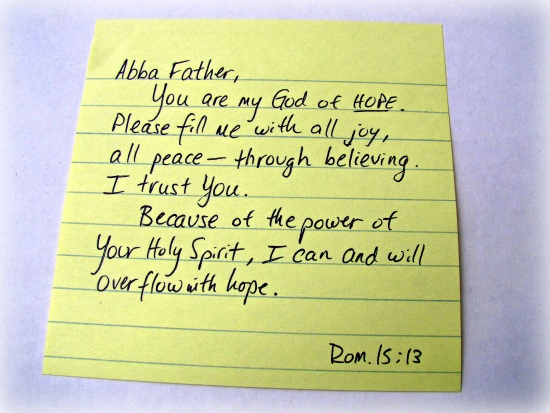
Use Spirit-inspired words for Spirit-filled prayers.

Lord,
Your word that goes out from Your mouth does not return to You empty. May it accomplish that which You purpose, and succeed in the thing for which You sent it.
~ Isaiah 55:11

Do you do pray with scripture? Have a favorite verse? A useful prayer book? Let’s share our experiences.

Five tips for setting goals for spiritual growth in 2012

January 9, 2012 by Kathy Howard 14 Comments

What do the following things have in common?

  • Exercise more
  • Lose weight
  • Improve my relationships
  • Pay off debt
  • Get organized
Image from sheknows.com

Every year these items pop up in lists of the Top Ten New Year’s Resolutions. Did you make any resolutions for 2012? The first of the year is a great time to start fresh, set goals, and begin something new. In fact, it’s the perfect time to evaluate our spiritual health and set some goals for growth.

We can’t cause our spiritual growth. Only the Holy Spirit has the power to transform us into the image of Christ (2 Cor 3:18). But God does expect our obedient and active cooperation (1 Cor 9:24-27). One way we can purposefully “train ourselves to be godly” (1 Tim 4:7-8) is through spiritual evaluation and goal-setting.

Resolutions and goals can be hard to keep. Statistics show that, at best, only 46% of New Year’s resolutions are still kept six months into the year. Often, people lose their resolve so quickly because they set unattainable goals.

  1. Concentrate your efforts. Set just one, two, or three goals at a time. Don’t spread yourself too thin. When you experience success then add another goal.
  2. Be realistic. Set goals that are attainable. If you don’t read your Bible regularly now, don’t set a goal to read the entire Bible in three months. Instead commit to read it 3 to 5 times per week.
  3. Think concretely. Set goals so progress can be measured. For instance, this goal is too ambiguous: I’m going to spend more time with God. Instead be concrete: I will read one Bible chapter and pray for 10 minutes five times a week.
  4. Include strategies. Develop strategies designed to move you toward your goals. If one goal is to memorize Scripture, determine how you will do that. What verses you will memorize? How often you will tackle a new one? What memorization techniques will you use?
  5. Create manageable steps. Break your overall goal into a series of smaller goals that are doable and will foster success.

To get started, first take a serious look at your spiritual health. You may use the free “Discipleship Evaluation” download. This tool covers 17 different key discipleship areas. Your weakest areas can be great growth this year.

Next, set spiritual growth goals using the five tips above. Planning is not unspiritual. Living a life that glorifies God will not happen by accident. The free “Spiritual Goals” worksheet lists specific areas of discipleship such as time with God, ministry, service, and Christian education.

Most importantly, ask God to guide you as you evaluate your spiritual health and set goals for growth. He will bring the spiritual transformation as you strive to live a live that pleases Him.

Let’s talk! What goals for spiritual growth have you set?

Run to Him Study Guide

January 8, 2012 by Katie Orr 34 Comments

Psalms Bible Study

The Study Guide is here!

This study guide includes a 5-day weekly quiet time plan, studying one Psalm a week, with options to add on scripture memory and 2 additional days of study. There is also a printable bookmark for easy access to the study schedule.

Anyone is welcome to join us in this study of the Psalms. We will be posting a supplemental Bible study on each Psalm on Friday afternoons. The study guide plan starts Monday, January 16th.

Click here to download the free Bible study printable.

Psalms Bible Study

Praying He uses this study to help us run to Him.

What’s on Your Heart?

January 4, 2012 by Teri Lynne Underwood 7 Comments

new years resolutions, Deuteronomy 4:4-6

Hear, O Israel: The Lord our God, the Lord is one.  You shall love the Lord your God with all your heart and with all your soul and with all your might.  And these words that I command you shall be on your heart. ~ Deuteronomy 6:4-6


new years resolutions, Deuteronomy 4:4-6
source: Microsoft Clip Art

What are you thinking about, focusing on, as this new year begins?

Resolutions made and plans for seriously following through this year.

Plans for losing weight, exercising more, or finally decluttering the junk drawer in the kitchen.

Maybe you’ve determined to read the Bible through this year or be more consistent in Scripture memorization.

But what’s on your heart? 

Is it fear of failure or worry about finances?  Maybe your heart is heavy with concern for loved ones fighting illness or children who have chosen a wayward path.   Perhaps you are fighting an internal battle with insecurity.

Far too often, I believe we end up letting go of the resolutions and goals and dreams because we’ve allowed the wrong things to settle deep in our hearts.

We live in fear though we have been given a spirit of power. 2 Timothy 1:7

We battle with insecurity though we are created in the image of the One True God. Genesis 1:27

We wrestle with worry though we are promised peace beyond understanding. Philippians 4:6-7

As this year begins, my desire is that the Word of God be settled deep on my heart.   That my first response to life will be to seek His truth.  That my response to others will be rooted in Scripture’s clear example.  That I will speak words of life and hope and truth into the hearts and lives of others.

My earnest prayer is this:

Lord, may my heart be stayed on Thee, daily seeking Thy clear Word

Ever trusting in Thy steady hand.

Lord, may my heart be found in Thee, wrestling not with sinful deed

Rather walking by Thy faithful plan.

Amen

What’s on your heart?

Gigantic Announcement!!

January 3, 2012 by Katie Orr 8 Comments

We are thrilled to announce that Do Not Depart and Scripture Dig are merging!

There are a million details ahead of us, but we are so excited to welcome Teri Lynne, Kathy, Julie and Sandra to the Do Not Depart writing team. Over the next month or so, we will be merging the two sites and all of the amazing Bible study resources at Scripture Dig will be available here at Do Not Depart.

We have also invited Caroline to join the writing team!

Please help me welcome these Word-loving, God-honoring women to the Do Not Depart family.

Announcing…Run to Him

January 2, 2012 by Katie Orr 16 Comments

Psalms Bible Study, How to run to God, Psalms study

Run to Him, our winter Bible study, will start up Friday, January 13. We will be diving into a selection of Psalms; searching for how to relate our emotions, fears and challenges to the God who knows; digging for promises we can cling to when our soul cries out.

Psalms Bible Study, How to run to God, Psalms study

Maximize Your Mornings

Once again, we will be hosting this Bible study in partnership with Inspired To Action’s Maximize Your Mornings challenge. If you are looking for encouragement and accountability toward getting up early to meet with the Lord, this is the challenge for you! Check out the details here, but go quickly, as registration ends January 3rd!

Anyone is welcome to participate in the study, regardless of whether you are a part of the HelloMornings challenge. Be sure to stay tuned for a Run to Him study guide and more details about the study!

Four Tips for Scripture Memory

January 1, 2012 by Katie Orr 22 Comments

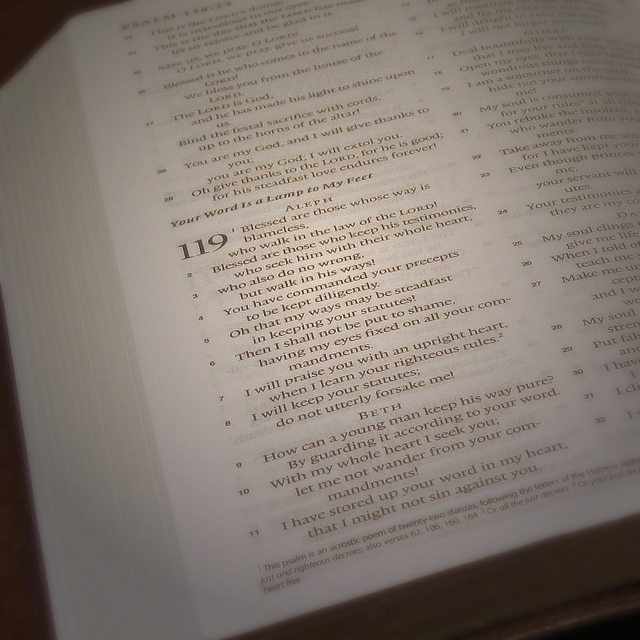
Psalm 119, James 3, Psalm 1—these are not verses I’ve memorized, but just some of the verses I have (unsuccessfully) attempted to memorize!

Bible, Psalm 119

Photo Credit

I’ve tried the whole memorization thing for years. Each attempt I dove head first, setting aside time every day to read, memorize and review my verses. Each time, I didn’t make it past 5 verses.

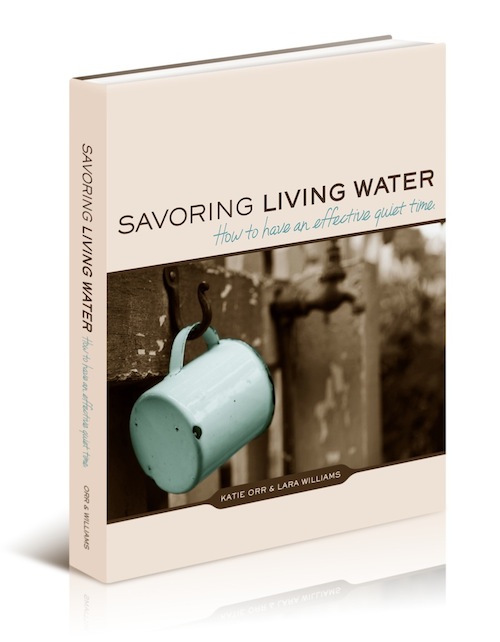
After distancing myself from the sting of what I felt was failure, and then doing a bit of research, I have established a four-pronged attack which I have found (finally!) successful in the area of Scripture memorization. (The following is a shortened excerpt from Savoring Living Water: How to have an effective quiet time by Lara Williams and myself.)

Hear it.

We need to hear His Word. In order to have that passage stick into our minds and bury into our hearts, our ears need to hear it over and over again.

I keep the audio version of my current memorization passage on my computer and on my phone. When my hands are busy but my mind is free to listen, I play the track. I listen while I drive. I listen while I clean toilets. I listen while I fold towels. I hear it.

Write it.

Something happens in my brain when my pen hits the paper. Writing things down helps me remember. It helps me remember what I need from the grocery store, and it helps me remember the Scripture I want to memorize.

Each week I take non-­‐fancy, white 4×6 index cards and write out my verse or passage. I typically write it four times on four different cards so I can keep them in four different places.

I also like to write out the verse or passage in my journal every morning. Beneath my prayers of repentance and my words of thanksgiving, I write His Word.

Repetition causes remembrance.

See it.

I take those index cards and post them on my fridge, computer, shower door, and car dashboard. They serve as constant reminders of the truths for which my soul desperately thirsts. Seeing the verses imprints His Word upon my mind.

Speak it.

There is power in the spoken word. When we speak our verses out-­loud they embed deeper into our hearts. This aspect is absolutely vital to successful memorization.

As I “hear” my verses while I fold the never-ending laundry, I talk with the recording. If it’s a new verse, I say it a half second behind the track. If I know the verse, I say it alongside the audio.

Speaking my verses solidifies the words in my mind and shows where I need to review. Speaking them enables me to remember.

If you find yourself stuck in your scripture memory efforts, try adding a few of these approaches to your routine and see if it helps!

Are you memorizing Scripture? Have you tried hearing it, writing it, and speaking it? What has worked for you? Share your struggles and tips below in the comments!

Written a post this month about scripture memory? Link it up below. We hope you’ll visit some other blogs, be encouraged, and leave some comments along the way!


For more tips and encouragement on how to connect with God through Scripture memory, journalling and personal Bible study, Savoring Living Water is available for immediate download to your computer, Kindle, and Nook. Second edition paperback copies are also available for pre-order, and will be shipped mid-January.


Living Fully Convinced {Believing Better}

December 31, 2011 by Katie Orr 8 Comments

I look back on 2011 and have many regrets. There are words I wish I could take back; choices I would like to change, but I can’t. There are habits I hoped to establish; goals I had planned to achieve, but I didn’t.

It would be a mistake to look at my failures and, through guilt-motivation, set out to try harder this new year.

Trying harder may work for a while but, come February, most of us will find ourselves “two steps back,” discouraged and defeated.

By Grace Through Faith

Though I cannot change the past, I do have hope for change for the future. It is through the same great truths we experienced in our first moment of life with Christ.

It is by God’s grace, through my faith, that I can experience life change. 

The focus in the Bible, over and over again, is not on our works, but on God’s grace and our faith. Yes, our deeds are important, and as we grow in Christ, our actions should and will look differently a year from now; but the change we want to see in our lives—true life-change—comes only through a grace-filled work of the Holy Spirit in us, as we abide in Christ.

We see this beautiful picture of faith in the grace of God bringing forth righteousness in Abraham:

That is why [righteousness] depends on faith, in order that the promise may rest on grace and be guaranteed to all his offspring—not only to the adherent of the law but also to the one who shares the faith of Abraham, who is the father of us all…No unbelief made him waver concerning the promise of God, but he grew strong in his faith as he gave glory to God, fully convinced that God was able to do what he had promised. That is why his faith was “counted to him as righteousness.” (Romans 4:16-22 ESV)

Living Fully Convinced

Friends, will you join me in a new pursuit? To not to let my plans for more quiet times, a better prayer life, or more self-control trump my pursuit of growing strong in my faith. To make my new-year’s goals less oriented toward becoming a better person, and more toward knowing God in bigger ways.

To focus on becoming fully convinced that God is able, instead of trying to prove that I am the one who is able.

Let’s enter into this new year with a new resolution. Not one of trying harder, but one of believing better.

Here is a wrap-up of the Believing Better Series:

  • Success in the Christian life is not about trying harder.
  • As I focus on trusting that God knows, God cares, and God works, the burden of worry is lifted.
  • Moving from knowing to believing takes me from being a hearer to a doer.
  • Belief is choosing to say with conviction that He will provide, even when I’m faced with a season of waiting.
  • Believing God’s promises sets me free from fear and gives me confidence. His truth has power over fear.
  • A big faith will not make me believe better. But faith in my Big God will.
  • Believing better means understanding that it’s not about what I have done. It’s about Him.
  • My belief in God is not proven genuine by my efforts but by intentionally keeping in step with His Spirit.

You’ve got to have a plan

December 30, 2011 by Kathy Howard 7 Comments

Can you hear the countdown yet? A new year arrives in less than 48 hours and 2011 will be history. Are you ready? Have you made plans for 2012?

I’m not talking about vacation plans or career plans or plans to renovate your kitchen, though those all need thought and preparation. No, I’m talking about purposeful plans to spend time with God in 2012.

Many of us start the year with good intentions, but regular time with God in His Word often falls by the wayside because we’ve failed to put a plan in place. Planning is not “unspiritual.” Paul told Timothy to “train yourself to be godly” (1 Timothy 4:7) because real spiritual growth takes discipline and purposeful intent.

A great place to begin is with a Bible reading plan. Haphazard reading will always be just that – haphazard. If you have a plan, then you have direction and structure. You never have to wonder, “What will I read today?”

If you’d like to have both a reading plan and group accountability I invite you to join me as I use the “Chronological Bible Story” Reading plan. I’ve invited all my Facebook friends and I have a nice big group joining in. I’ve established a Facebook group where we can talk about what we’re reading, ask questions, and be encouraged.

Won’t you join us? Here’s the group entitled “Reading the Bible Together in 2012”. You can access the reading plan there, or here.

If this plan does not meet your needs, I have several other Bible reading plans on my website. You are welcome to use any of them. Be sure to check out the other discipleship resources as well like the “Quiet Time Tips” and Prayer Helps.

Have you used a Bible reading plan before? What are your goals for getting into God’s Word in 2012?


Establishing a Rhythm with God {Believing Better}

December 28, 2011 by Heather 7 Comments

At the beginning of the month, Katie introduced our series with a post on “believing better” instead of trying harder; focusing on our faith and letting go of the guilt to do more. The Do Not Depart Team wrote about believing God to forgive, believing God to heal, believing in a big God, believing God in the times of waiting and believing God in difficult circumstances.

These posts prompted me to consider: I know I believe IN God, but do I truly believe God?

Do my actions and choices reflect that I believe God to forgive, heal, & provide? Do I go about my day moved by the moments & influenced by my environment resulting in reactive chaos?

Everything changes when I am intentional. When I set up patterns or establish a rhythm with God in my day, week, month, even year, then I can stay in tune with His Spirit and my faith is secure. My actions reflect a stronger belief…not because of my efforts but because of staying in step with His Spirit through intentionality.

As we begin the new year let us not have a list of activities that we will fail to fulfill after a couple of months. Instead let us think about how we can set up a rhythm with God. What can we put in place in our lives that keep us connected to Him?

“A rule for life is a simple statement of the regular rhythms we chose in order to present our bodies to God as our ‘spiritual act of worship’ (Romans 12:1). Each rule or rhythm, is a way we partner with God for transformation only he can bring…Life-giving rules are brief and realistic scaffold of disciplines that support your heart’s desire to grow in loving God and others.” Adele Calhoun from Spiritual Disciplines Handbook

God desires us to have life and to have it abundantly (John 10:10). He wants us to be in tune with Him so that we are free to rest in Him and not our efforts.

photo credit

How do you realistically establish a rhythm (or rule for life) with God?

Here are some questions to ask yourself (from Adele Calhoun):

  1. When & where do you feel closest to God? Pay attention to the experiences, practices, & relationships that draw you toward God.
  2. What practices best suit your daily, monthly, and yearly rhythms and cycles?
  3. Where do you want to change? Where do you feel powerless to change? Ask the Holy Spirit to help you do through grace what you cannot do through effort alone.
  4. Choose several disciplines that arise from your desire for God’s transforming work and that suit the limits and realities of your life. Begin your practice.

You may feel most “in sync” with God while listening to a worship song. Or perhaps journaling your prayers. Or memorizing scripture. Or taking a walk in nature. Or meeting with a kindred spirit to discuss His truth. Or reading commentaries on His Word.

Here are some sample rules or rhythms:

  • Dedicate every day (in the morning) for the glory of God
  • Confess my sins before I go to bed
  • Pray for others
  • Direct all my wandering thoughts to my Savior
  • Set aside one day a week to “rest in Him” (Sabbath)
  • Meet monthly with a spiritual director or mentor

In your life. With your schedule. Your unique personality. What rules or rhythm will you establish in 2012 to rely on Him?

“The one who calls you is faithful and he will do it.” (1 Thessalonians 5:24)

If you are intentional to make space for God in the busyness of life, He will be faithful to partner with you for personal transformation. Believing Better. Not only believing IN God but believing God. 

« Previous Page
Next Page »

This Month’s Theme

  • Jesus is the Way
  • And He Shall Be Called Series Intro

Enter your email address to have new posts emailed to you:

We’ll come to you

Enter your email address to have new posts emailed to you

Categories

Bible Memory – Lent 2021

Memorizing Isaiah 12

Let the Children Come

Let the Children Come

Want more #HideHisWord resources?

Memorizing Psalm 1

Find Us on Facebook


Search

Recent Posts

  • Series Wrap-Up: The Lord Is My Light
  • His Marvelous Light
  • When the Darkness Deepens
  • Though I Sit in Darkness…
  • Let Your Light Shine
  • Life-Giving Light

Archives

© 2026 · Pretty Creative WordPress Theme by, Pretty Darn Cute Design