• Home
  • About
    • Our Contributors
    • Our Beliefs
  • Blog
  • Bible Studies
    • Scripture Dig
  • Archives
  • Shop
  • Advertise
  • Contact
    • Email
    • Facebook
    • Instagram
    • Pinterest
    • Twitter

Do Not Depart

Encouragement and Tools to Abide in God's Word

You are here: Home / Archives for Salvation

Parenting With Authentic Faith {Guest Post}

March 8, 2016 by Guest Post Leave a Comment

Parenting with authentic faith is not the same as raising a child in a “christian” culture.


We are pleased to welcome Kelli LaFramboise from Quietly Reminded for this month’s installment of Let the Children Come.

Parenting With Authentic Faith

Parenting with authentic faith. That sounds good, right? And chances are that if you are reading this article, you probably want to parent this way. But let’s a be honest, parenting is hard… And parenting with authentic faith, well, what is that? And why would you do it?

To understand what parenting with authentic faith is, let’s begin with what it is not. Parenting with authentic faith is not the same as raising a child in a “christian” culture. It’s not just taking your child to church every Sunday. It’s not just praying before bedtime and meals. It’s not just memorizing Bible verses and reading the Word together as a family. Although these things are good and may even be necessary for our faith, when they are done for the wrong reason, when they are done to put a check in the box, they are simply cultural practices, not acts of authentic faith.
Parenting with authentic faith is not the same as raising a child in a “christian” culture.
Authentic faith happens out of a response to the Holy Spirit, when He says to our hearts “I, the Triune God, love you more than you can fathom. I have created you to live in fellowship with Me, and I desire to serve, protect, and provide for you” (Romans 5:8, Matthew 20:28, Psalm 91:1-16, Philippians 4:19). Authentic faith is trusting Him to do what He says He will do and not attempting to take on His responsibility in any shape or form. Authentic faith is a lot simpler than we like to make it out to be. It starts, stops, and centers around the gospel — the simple truth that Jesus Christ, God Himself, stepped down out of heaven to serve, protect, and provide for each one of us.

Each one of us.

Each one of us… Including each of our children.

There is not a single thing that any of us can do to make our children accept the grace of God. We are not the savior of our children’s souls. Jesus is. Only Jesus is. And when we attempt, whether consciously or subconsciously, to take that responsibility away from Him, we fail to parent with authentic faith.

Here just a few of the many promises God has made to us through His Word. Read them, but instead of reading them just for yourself, remember that Jesus has extended these promises to your children as well.

For I know the thoughts that I think toward you, says the Lord, thoughts of peace and not of evil, to give you a future and a hope. ~Jeremiah 29:11

But God, who is rich in mercy, because of His great love with which He loved us, even when we were dead in trespasses, made us alive together with Christ (by grace you have been saved)… ~Ephesians 2:4,5

But the Lord is faithful, who will establish you and guard you from the evil one. ~2 Thessalonians 3:3

Behold, I stand at the door and knock. If anyone hears My voice and opens the door, I will come in to him and dine with him, and he with Me. ~Revelation 3:20

Now at this point there may be a reader or two out there wondering, well if that’s the case, do I need to worry about my child’s salvation at all? Do I have any responsibility here? The answers may surprise you: no and no. No, you do not need to worry because worry will not add one ounce of anything good to your life or your child’s (Matthew 6:25-34). And no, you have no responsibility for child’s salvation because Jesus has already paid his or her sin debt in full (John 19:30, 1 Peter 2:24).

Don’t get me wrong, you have a job to do. Your child has been placed in your life for discipleship. However, instead of worrying and taking on responsibility that is not yours, simply abide in Jesus. Abide through prayer, abide through time in the Word, abide by hiding God’s word in your heart and meditating on it daily. Abide so that when worry and doubt creep into your parenting moments you know where to turn to for comfort and direction. Abide so that when the Holy Spirit asks you to parent in a specific way, you can simply respond to that direction.

Abide in Me, and I in you. As the branch cannot bear fruit of itself, unless it abides in the vine, neither can you, unless you abide in Me. I am the vine, you are the branches. He who abides in Me, and I in him, bears much fruit; for without Me you can do nothing. ~John 15: 4, 5

Abiding allows us to be an instrument used by the Father to show our children how much He does love them and how He wants to serve, protect, and provide for them. He is the responsible Savior, not anyone else. He is the responsible Teacher, not anyone else. He is the responsible Defender, Deliverer, Comforter, Provider, Sufficiency, and so, so much more. Parenting with authentic faith is trusting Jesus to be your child’s all-in-all and not trying to be it yourself.

Below I’ve listed some practical ways and resources to help you get started abiding in Jesus, but please don’t view these as must-do or checklist items. These are just a few suggestions to help you fall more in love with Jesus and begin to know Him more. But before you look through these suggestions, let’s start our abiding with prayer.

Jesus, thank You for loving my children more than I ever could. Thank You for shedding Your blood to wash away their sins and set them free from the bondage of sin. I also thank You that this is completely and fully Your responsibility and not mine. Please forgive me for the times that I have worried needlessly and attempted to take this responsibility from You. Help me to see and believe that You are good and You have my and my children’s best interest at heart. Help me to remember that every promise You have extended to me through Your word has also been extended to my children. I ask that You show me how to abide in You so that I may parent as an instrument of Your love for my children. I want to be responsive to your Holy Spirit because I trust in You. In Your name I pray, amen.

Abiding in Christ :: A Few Suggestions

  • Prayer is essential to abiding in Christ. If you don’t know how to pray, first and foremost, ask Him to teach you how. You may find these useful as well:
    – And When You Pray: Understanding the Lord’s Prayer
    – The Power of a Praying… Series by Stormie O’Martian (affiliate link)
  • Start a simple Bible reading plan like this one. Here are 3 super simple steps to studying God’s word all on your own.
  • Nothing is or ever will be more more relevant than the Word of God. However, there maybe times when we need a little guidance through our Bibles. I have found HelloMornings’ Bible studies and accountability groups to be very helpful during these times.
  • Memorizing God’s word is the only way to “hide it in your heart” and “meditate on it day and night” (Psalm 19:11, Joshua 1:8). Start by asking God to direct you to the verse(s) that He would like you to memorize. Here are a few resources I have found helpful when choosing to memorize God’s word.
    – Hiding His Word challenge.
    – Seeds Family Worship (affiliate link)
    – Scripture Typer
  • And don’t neglect fellowship, discipleship, and communion. Being with fellow believers is essential to our walk with Christ because it is through these people that God often loves, encourages, instructs, and corrects each one of us.

Friends, please remember that I am human and flawed and my thoughts on parenting and other areas of life may not always be right. Please hold what I write up against the Word of God and listen to the Holy Spirit as He speaks to you directly.

Only by grace,

Kelli

You are not your child’s savior. Read more from @QuietlyReminded #LetTheChildrenCome

Click To Tweet

Parenting with Authentic Faith. A guest post from @QuietlyReminded #LetTheChildrenCome

Click To Tweet

Let the Children Come - monthly feature on helping children to abide in God's Word via DoNotDepart.com


Kelli LaFramboise of quietlyreminded.com

Kelli LaFramboise is the author of Caught by Jesus: 6-Week Devotional & Personal Study in the Gospel of Mark. She blogs at www.quietlyreminded.com with a purpose to quietly remind herself and others of God’s goodness, His grace, and His glory. You can also find her sharing on Facebook, Instagram, and Twitter.

Understanding God’s Ways

March 18, 2014 by Julie 4 Comments

Isaiah 558-9

I don’t understand the pattern Lisa talked about last week, but I’m so grateful for it, just the same. “We need; God provides. That’s the gospel.” I want that, even if I can’t grasp it all. 

Understanding God’s WaysIsaiah 558-9

  • How could the holy God doze away barriers to make way for ever-fallen, failing me?
  • How could the One who delights to give rain down grace on ever-receiving me?
  • How could the Father give the Son for the orphans who didn’t love back … yet?

How?

To demonstrate His intimate knowledge of us, God anticipated our bewilderment. He tenderly sheds light on our confusion in the verses following the crazy declaration that if we seek Him, “He will abundantly pardon.”  ( from Isaiah 55:7) Not just adequately forgiven, but abundantly forgiven. The only right response is to worship Him.

How?

For my thoughts are not your thoughts, neither are your ways my ways, declares the Lord. For as the heavens are higher than the earth, so are my ways higher than your ways and my thoughts than your thoughts. (Isaiah 55:8-9)

  • His thoughts are His purposes, His plans, and His intentions. And His thoughts are so unlike ours. I wouldn’t pardon abundantly, but that’s His plan.
  • His ways are His path, His direction, His journey, and His manner.  And His manner is so unlike ours. I wouldn’t invite opposers to seek me out, but that’s His manner.

Our ways and our thoughts are so different from God’s that we can compare the contrast to the distance of heaven to earth. There are many ways to define how far space is from earth, but the International Space Station orbits at 400 km from earth; a constant boost is necessary since it is constantly “scraping” the atmosphere of the world.  From earth to heaven is higher than high. But “higher” here exceeds an earthly sense of distance. Instead, it refers to lofty in deserving exaltation.

For now we see in a mirror dimly, but then face to face. Now I know in part; then I shall know fully, even as I have been fully known. (1 Corinthians 13:12)

There will be a day when God reveals how He could extend His abundant pardon to us. For now, His lofty plans and His higher manner is to be exalted above my small understanding.  I don’t understand His great mercy that invites those far off to “Seek the Lord while He may be found,” but I’m so glad He invites. You?

The Missional Resource of Me

February 18, 2014 by Guest Post 3 Comments

The Missional Resource of Me

Every original follower of Christ had a unique, one-of-a-kind combination of skills, experiences, and gifts to carry out the command to multiply the gospel throughout all of the peoples of the earth. When Jesus delivered the directive to “Go therefore and make disciples of all nations,” (Matthew 28:19a) he was speaking to a group of 11 varied individuals. “Now the eleven disciples went to Galilee, to the mountain to which Jesus had directed them,” (Matthew 28:16). While on the mountain, the Son of God filled the imagination and vision of the disciples as they heard the missional imperative to reach people with the gospel. Matthew may’ve been thinking about the funding, and Peter may’ve been thinking about traveling by boat.

What skills, experiences, and gifts has God woven into the fabric of your being as resources for reaching the world?

  • Do you know how to deliver a baby and treat illnesses?
  • Do you know how to teach a lesson effectively so people understand?
  • Do you know how to start a small business and manage money?
  • Do you know how to learn languages and relate in other cultures?
  • Have you known what it is to lose a child or suffer a great loss?
  • Have you experienced poverty or struggled with unemployment?
  • Have you faced oppression or experienced prejudice or persecution?
  • Have you made choices that have left you guilty?
  • Do you have citizenship that opens doors for you around the world?
  • Do you have financial resources that meet your needs and then some?
  • Do you have the ability to read and a Bible to explore?
  • Do you have an understanding of God’s truth?

God equips those He calls The Missional Resource of Me

God doesn’t call us without equipping us. Every disciple of Christ is a resource for reaching those who have yet to experience God’s forgiveness. No one who calls themselves by the name of Christ is exempt from a part in the grand plan of getting out the word of the truth.

God has a heart for all nations

The great giver of grace has a heart for all people, every tribe and tongue. He declares, “Let the heavens be glad, and let the earth rejoice, and let them say among the nations, ‘The Lord reigns!'” (1 Chronicles 16:31). God plans for all nations to be included in the scope of salvation born when “God so loved the world,” (John 3:16).

God includes all disciples in the plan

In sounding out His plan for all nations to know of the salvation brought by His Son, He strategically equipped individuals, churches, and nations to spread the gospel so all will hear. “How then will they call on him in whom they have not believed? And how are they to believe in him of whom they have never heard? And how are they to hear without someone preaching.” (Romans 10:14)

If you are a disciple of Christ, you are a resource to reach others. The disciples who stood around Jesus on the Galilean mountain had one thing in common with one another and with every follower of Christ since: “Everyone to whom much was given, of him much will be required, and from him to whom they entrusted much, they will demand the more.” (Luke 12:48)

How will God use the RESOURCE of YOU?

  • Will He use you to send others?
  • Will He use you to pray?
  • Will He use you to train others about His plan?
  • Will He use you to open doors for others?
  • Will He use you to support national believers in their own nations?
  • Will He use you to be the one to go?

How has God gifted you? How has He gifted your church? How has He gifted your nation for this time in history? YOU ARE A RESOURCE TO REACH THE WORLD.

May God entrust us with much as He sends out His truth and multiplies grace among the peoples of the world.

Tweetables to share:

  • God doesn’t call us without equipping us http://wp.me/p1Su7F-2NH #MissionalLiving @donotdepart  <  Tweet this!
  • YOU are a resource to reach the world. http://wp.me/p1Su7F-2NH #MissionalLiving @donotdepart  <  Tweet this!

New beginnings start with history

January 21, 2014 by Julie Leave a Comment

new beginnings start with history

Based on reliable information, I was destined to be a real hell-raiser. But before I could grow up to write a long, empty, broken history, God spared me and drew me to Himself. Like many others who began a relationship with Jesus as a child, I don’t have many sordid tales to convince you I was on the path of destruction. Maybe you have a testimony of early salvation and you’ve struggled with how to tell a story of life change and new beginnings that seems rather dull compared to those of dramatic transformation.

Look no further than your own family history for the answer to your dull dilemma.new beginnings start with history

With the ease of accessing information, there has been a resurgence of interest in genealogy and family history. God can use this to reach people! Online sources like Ancestry.com have taken away the barriers of discovering our ancestors. Author George Orwell spoke truth when he said,  “The most effective way to destroy people is to deny and obliterate their own understanding of their history.”  Without looking at our history, both recent and far, we fail to shape a solid case for sin. As we uncover our lineage, we trace the pathway of the footsteps we were destined to follow.

Who were you on track to become before you began a new life in Christ?

Out of a love for history and a longing to connect with family, I began a search for my history, hoping to find something noble and redeeming.  What I found was evidence left to me by generations back to the late 1500’s. Instead of a long line of saints, I found a yearbook of lost, empty, broken, lives. I needed a new beginning.

I was not only born to “look” like them, but to LIVE like them.

“Or do you not know that the unrighteous will not inherit the kingdom of God? Do not be deceived: neither the sexually immoral, nor idolaters, nor adulterers, nor men who practice homosexuality, nor thieves, nor the greedy, nor drunkards, nor revilers, nor swindlers will inherit the kingdom of God. And such were some of you. But you were washed, you were sanctified, you were justified in the name of the Lord Jesus Christ and by the Spirit of our God.” (1 Corinthians 6:9-11, emphasis mine)

I know we’re all born as sinners and destined to die because of it, but my family history proves I was born onto a trajectory that set me on a course for vices like alcohol, anger, and abuse. I had no hope of being a fine, upstanding citizen on my own. You?
When God intervened in the life of my parents and then in my life, He saved me from a future that was as sure as my history. He washed me, changed me, and declared me righteous because of what Jesus did. He is the God of new beginnings. Only Jesus can change the course of a life.

Praise God He can and does change the course of lives every day!

So, what’s in your story? Who were you destined to become?

New Beginnings Series - donotdepart.com

Celebrate the Word with our words

December 19, 2013 by Julie Leave a Comment

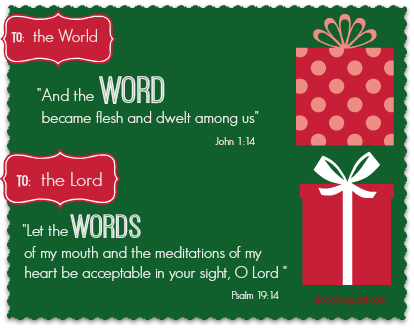
Word became flesh

As we praise, as we share, as we converse, as we witness … may our words be an offering to the Word who became like us, to live among us, and then give His life for us.
Word became flesh

Christ in our conversations

December 17, 2013 by Julie 3 Comments

Sharing Christ

We don’t need an official calendar holiday in order to use the gift of words well. You might not even celebrate Christmas, but if we believe the account of the Babe in the manger, we must be inspired to share the good tidings.Good tidings in modern times

Christ belongs in our conversations. We’ve talked about some of the challenges of having the story of the Word who became flesh heard in our modern times. We’ve talked about using God’s gift of words to praise Him, and we’ve considered how to tame our tongues and  how to take care and caution in sharing responsibly in the social media age. But how do we use our words to naturally weave Jesus into our conversations? The sight of manger scenes, talk of peace on earth, and sounds of Silent Night open doors of opportunity to talk about the Prince of Peace, regardless of our take on the Christmas season.

If Jesus can find a place in an unlikely manger, it shouldn’t be so hard to find a place in the chatter of those who know Him. A simple, but intentional, question or comment may be the pivotal point to bring up “the Jesus” in our conversations.

Christ in our conversations

  • Q:  So do you have a favorite image that says “Christmas” to you?
  • A:  I love to imagine the manger scene. It’s hard to grasp that God became a helpless baby for me, but He did. Have you ever wondered why Jesus had to become a man?
  • Q:  What’s your favorite Christmas carol?
  • A:   I’ve sung a lot of them without even thinking. Recently, I paid attention to O Holy Night. “Long lay the world in sin and error pining ’til He appeared and the soul felt His worth.” I thought about how I was pining away for something to bring me hope before I knew the worth Jesus brings to my life.
  • Q:  So after Christmas comes the New Year. Do you have hopes for the year ahead?women chatting over coffee
  • A:  I’d love to pray about that for you. God says that if we give God the right place in our lives, He will direct our paths. I’ll ask Him to show you what good things He has for you.

Some day, our friend or relative may come to know Jesus as their personal Savior. While we’re rejoicing, they might be wondering why we didn’t speak up and turn our common conversations to spiritual things, life-changing things. News that the Word became flesh and lived among us, full of grace and truth (John 1:14).

“but in your hearts honor Christ the Lord as holy, always being prepared to make a defense to anyone who asks you for a reason for the hope that is in you; yet do it with gentleness and respect,” (1 Peter 3:15 ESV).

When we use our gift of words to share the true events of the coming of Christ, we honor Him as holy. It’s not as complicated or frightening as we often make it. After all, the Word in us gives us hope, and that’s something amazing to talk about!

(Here is a printable sheet of more examples and reminders to help us include Christ in our conversations this Christmas and in the New Year.)

Do you have a way that works for you to turn conversations to Christ?

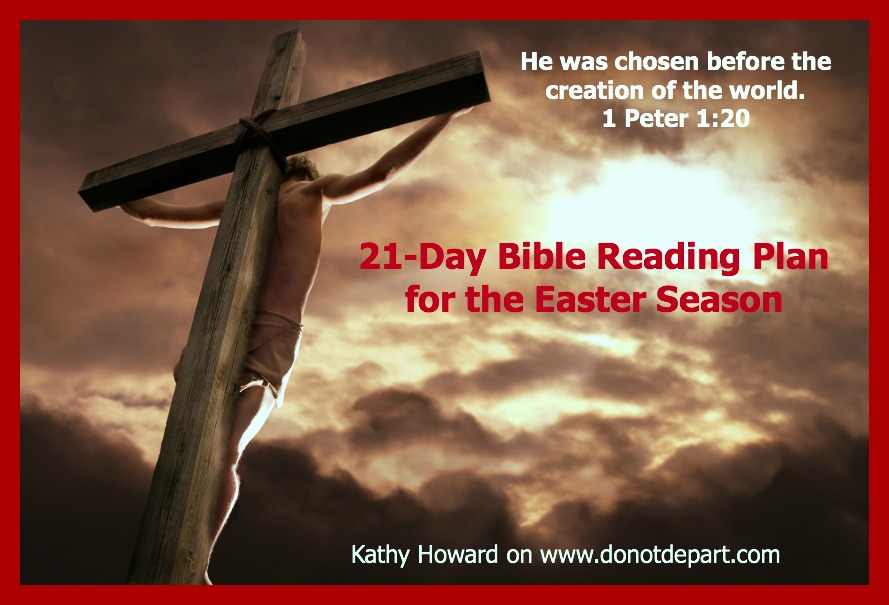
Count Down to Easter with this 21-Day Bible Reading Plan

March 12, 2013 by Kathy Howard 8 Comments

Crucifixion, Jesus on Cross

Easter was always God’s Plan A. Jesus coming to earth, dying, and climbing out of the tomb was not the back-up plan after God’s other efforts to save the world fell through.

For you know that is was not with perishable things such as silver or gold that you were redeemed from the empty way of life handed down to you by your forefathers, but with the precious blood of Christ, a lamb without blemish or defect. He was chosen before the creation of the world, but was revealed in these last times for your sake. 1 Peter 1:18-20, NIV

Crucifixion, Jesus on Cross

Just imagine the conversation the Trinity had before God created the world:

We know mankind will reject us and choose their way.

 Yes, and death will be the result.

But we will provide a way of forgiveness, salvation, and restoration.

We will Ourself provide a perfect sacrifice.

Everything in God’s Word points us to Christ and His provision for us. From Genesis to Revelation we read God’s story of redemption. Everywhere we look we see shadows and pictures of our Redeemer. From God’s covenant with Abraham and Passover to the Tabernacle and the Sacrificial system everything is a picture of Christ’s work.

I invite you to spend the next 21 days immersing yourself in the biblical story of redemption. Download and print the Bible reading plan. The selected readings start in Genesis and continue through Jesus’ ascension. The one-page plan also includes questions for reflection and application. (If you start today, you will read about the resurrection on Easter Sunday, then you will have a couple more days of reading.)

Let’s not wait to Good Friday to start thinking about God’s provision for us through Christ.

What is your favorite picture or shadow of Christ in the Old Testament?

Resurrection: Preparing our hearts to celebrate Easter

March 5, 2013 by Julie Leave a Comment

Resurrection Series on www.donotdepart.com

We’re born wanting something we can’t have. Have you ever lost a loved one? Have you ever battled for your own life? Since death was announced in Genesis 3:19, people have searched for ways to prolong life, live forever, and outwit death. After all, Adam’s judgment echoes through the ages to all of us: “Therefore, just as sin came into the world through one man, and death through sin, and so death spread to all men because all sinned.”   (Romans 5:12)

From tombs full of riches for the afterlife to quests for the fountain of youth to modern medical technology, the hope of life and fear of death spurs men on to find the key to eternal life. Losses, disappointments, and decay tasted in earthly life point to our shared ultimate end: “And just as it is appointed for man to die once, and after that comes judgment” (Hebrews 9:27).

Only One has power over death. There have always been skeptics; even the Sadducees of Jesus’ day scoffed at the thought of immortality. Scripture records the stories of a few who were powerless over death, but they saw God intervene and do the unimaginable: restore life.

Brought to Life In the Old Testament

  • The Widow of Zeraphath’s Son (1 Kings 17:17-24)
  • The Shunnamite Woman’s Son (11 Kings 4:20-37)
  • The Man thrown into Elisha’s Tomb (II Kings 13:21)

Brought to Life In the New Testament

  • The Widow of Nain’s Son (Luke 7:11-16)
  • Jairus’ 12 year old daughter (Mark 5:35-43)
  • Lazarus (John 11:1-44)
  • Tabitha (Acts 9:36-41)
  • Eutychus (Acts 20:7-12)
  • Saints buried near Jerusalem (Matt. 27:51-53)

These people did not raise themselves, but they were raised by God. His power worked independently, and occasionally through His servants, to defeat death itself. As foretold in Genesis 3:15, the Enemy’s plan suffered a fatal blow when the gospel triumphed in the risen Savior. The resurrected life of Jesus makes our abundant life possible. What man could never do, God did.

Resurrection is the conquering of death, the overcoming of the Enemy’s plan to thwart God’s gift of life. Jesus said, “The thief comes only to steal and kill and destroy. I came that they may have life and have it abundantly.“ (John 10:10)

This month we celebrate the Resurrection victory over loss and pain and death. With “Easter” at the end of this month, we want to prepare our hearts with fresh appreciation for the Resurrection. All month long, we will share Bible Study tools to help you focus on this greatest of all mysteries that makes abundant life possible.

Behold! I tell you a mystery. We shall not all sleep, but we shall all be changed … the dead will be raised imperishable, and we shall be changed. For this perishable body must put on the imperishable, and this mortal body must put on immortality…“Death is swallowed up in victory. O death, where is your victory? O death, where is your sting?”… thanks be to God, who gives us the victory through our Lord Jesus Christ.
(Excerpts from 1 Corinthians 15:51-57)

Join us this month on Do Not Depart as we share Bible Study Tools to prepare our hearts for a celebration of the Resurrection.

Adoption: It’s a joint effort

October 16, 2012 by Julie 5 Comments

The American Academy of Child and Adolescent Psychiatry reports that approximately 120,000 children are adopted in the United States each year. To be adopted is to be accepted, claimed, and raised as a child of promise. Last week Lisa helped us understand the difference between a Roman slave child and a family child and how adoption points back to the Father. Millions of children around the globe long for a father to accept them, claim them, and raise them as a beloved son.

I am AdoptedSonship happens for all those “in Christ Jesus,” who become “sons of God, through faith” (Galatians 3:26). The action of all three members of the Trinity has the power to move us from the position of the father-less to that of a secure son. As all three take part as One adoptive parent in a joint effort, something new and wonderful is born.

The Father Initiates

Slave children and adopted children of Roman culture lived side by side for their childhood years, but when the time was right, the adopted child realized the benefits of his adoption. The timing was not random or haphazard, but carefully planned. In the same way, “when the fullness of time had come,” (Galatians 4:4a) the Father initiated our adoption. Like many parents save and sacrifice today in order to bring home a child from places like Ethiopia, China, and Guatemala, the Heavenly Father paid a high price for the redemption of His cherished ones who long to be accepted into His forever family.

The Son Provides

The Son acted in our adoption by becoming the payment for our transfer from slave child to adopted child. “God sent forth His Son, born of a woman, born under law, to redeem those who were under the law, so that we might receive adoption as sons” (Galatians 4:5). Jesus did once and for all what we could never do on our own; He bought our permanent place in God’s family as sons of promise.

The Spirit Guarantees

The Father initiated our adoption, and the Son provided for it, but the Spirit was sent as our guarantee of a coming inheritance. “And because you are sons, God has sent the Spirit of his Son into our hearts, crying, ‘Abba! Father’” (Galatians 4:6) At just the right time, all members of the Trinity acted in union to make us children of God. We’re so loved.Paraguayan child

New Benefits with Adoption

With our adoption comes a new relationship, expressed when we cry out the familiar and intimate words of a child to their daddy: “Abba!” In today’s world, this change merits a new status update: “I’m a son now, not a slave!” (Galatians 4:7) If we become a son, then we become an heir through God (Galatians 4:7).

God the Father, Son, and Spirit act in a joint effort to make us their own, to give us a new relationship, to declare our new status, and to guarantee our new future. We leave scraps of bread to sit at a banquet table. We escape our dirty stone bed to nestle in the lap of our Abba. We erase the fear of tonight with the expectation of eternity. We “are no longer a slave, but a son, and if a son, then an heir through God.”

In many countries, children “age out” of the foster care and adoption system at the age of 16 or 18. Time runs out to find a family. But there’s no aging out of God’s divine plan for adoption and no limit on His love for those who want to come home.

How old were you when God brought you into a new relationship with Him?

How does it make you feel to know the Father, Son, and Spirit made a joint effort to make you their own?

DO. GO. STAND.

April 16, 2012 by Julie Leave a Comment

Open Prison Cells
Open Prison Cells
Photo by Arvind Balaraman

Three weeks ago, the news was heavy: six of our partners imprisoned in a hostile country. Their court case won’t be heard until this Wednesday, but their chances for justice are, by earthly standards, slim. If they are miraculously given their freedom, there’s no chance they’ll stay shackled. They’ll go to where the freedom is, and they’ll celebrate their release.  But until this Wednesday, we pray.

Sin imprisoned all of mankind and all of creation in corruption’s cell; even the world waits for freedom (Romans 8:19-23).

If you can … DO!

In speaking to bondservants in the position of slaves, Paul encouraged that, “if you can gain your freedom, avail yourself of the opportunity” (1 Cor. 7:21). When one who has been captive gains freedom, there’s no reason to return to the master of cruelty. We are encouraged that since, “You were bought with a price; do not become bondservants of men” 1 Cor. 7:23.  The earth and all of mankind waited for a liberator.  If you can be free … DO!

Sin bound each soul since birth, but we are not without hope. Though we once gave ourselves as slaves to evil, we can give ourselves to a new Master. Our “kyrios” is the One who owns, possesses, and controls us; He is our Lord, and “the Lord is the Spirit, and where the Spirit of the Lord is, there is freedom” (2 Cor. 3:17).

If it’s there … GO!

There is a place of freedom within our reach. “For just as you once presented your members as slaves to impurity and to lawlessness leading to more lawlessness, so now present your members as slaves to righteousness leading to sanctification” (Romans 6:19).  Freedom for one-time prisoners awaits in the presence of the kyrios, the Master. If its’ there … GO!

Why would a prisoner return to his cell? Paul asked the Galatians, “now that you have come to know God, or rather to be known by God, how can you turn back again to the weak and worthless elementary principles of the world, whose slaves you want to be once more?” (Galatians 4:9). Once the case is heard and the captives are freed, why would they return?  But some do.

If it’s done … STAND!

Christ sacrificed his perfect life for the sake of our freedom. “For freedom Christ has set us free; stand firm therefore, and do not submit again to a yoke of slavery” (Galatians 5:1).  If his work has paid the high price for our freedom, we should stand and stay in it, not turning back to our captor who would gladly re-chain us. Since we were called to be free (Gal. 5:13) we should,   “Live as people who are free, not using {our} freedom as a cover-up for evil, but living as servants of God” (1 Peter 2:16).  The payment for our release has been made, so we should stay that way and not make excuses to go back to our cell or corruption.  If it’s done … STAND!

Freedom in Christ!

We could offer to pay the price for the physical freedom of our friends. No one could offer a price high enough for Satan to free us. “For freedom Christ has set us free.”  He paid what no one else could, and the case is closed. No one has the power to recapture us; why would we ever want to give up our precious, dearly bought freedom? Why would we go back?

  • Our freedom from sin’s slavery is possible.
  • Our freedom is in the presence of the Lord’s Spirit.
  • Our freedom is completely paid for.
  • If you can … DO!
  • If it’s there … GO!
  • If it’s done … STAND!

Would you pray with me for the decision of those who will hear the case of our partners in chains? Their captors are but slaves, themselves. Oh that they would know the same freedom offered to each reader today through the Friend who paid our ransom prince. Our freedom physically and spiritually is a gift. Let’s DO, GO, STAND!

10 Churchy Words We All Need to Know

February 13, 2012 by Kathy Howard 16 Comments

Last fall, I spent two weeks in Moldova. Most of the people speak Russian. Since I don’t, I often wondered what people were talking about. Translators helped, but I longed to understand and speak the language.

Christians have a unique language too. Theological words and “Christianize” pop-up constantly in church services, Bible studies, and conversations. For long-time church-goers, words like “saved,” “lost,” and “repentance” come naturally. But others often wonder what we’re talking about. And sometimes even Christians can’t explain them.

So, should we just toss them out? No, these words – which come straight from Scripture – richly express the truths of our faith. Instead, we must define them and help others to understand them too.

Here’s my list of the top ten “churchy” words you should know, complete with Scripture references and definitions:

  1. Born Again (John 3:3-8) – Jesus coined this phrase Himself referring to being spiritually reborn or born from above; this term is synonymous with “Christian.” The phrase “born again Christian” is redundant.
  2. Lost (Luke 19:10; Matt 10:6) – Jesus used this term to refer to those who are alienated or separated from God. The same Greek word is translated as “perish” in John 3:16! The Greek means “to destroy, kill, or to declare that one must be put to death.” Christians use “lost” to refer to those who are spiritually dead in their sin and separated from God.
  3. Salvation/Saved (Acts 4:12; Ephesians 2:8-9) – Delivery from sin and its consequences; the present and eternal spiritual condition granted by God to those who believe in Jesus and His saving work.
  4. Repent/Repentance (Luke 24:47, Acts 2:38; 2 Cor 7:10) – The Greek noun and verb translated as “repentance” and “repent” means to “change one’s mind or purpose.” The Bible uses this word specifically to refer to changing one’s mind and behavior regarding sin and evil.
  5. Faith (Ephesians 2:8; James 2:14) – having a solid confidence, trust, hope and active reliance in God and His promises. This firm conviction produces full acknowledgment and personal surrender.
  6. Sin (Romans 3:23) – to “miss the mark” as an arrow missing a bull’s-eye; to deviate from the norm. The Bible uses “sin” to refer to anything that deviates from the perfect pattern God established for mankind. “Sin” refers to our wrong thinking actions, and corrupted nature.
  7. Justification (Romans 3:24; 4:25) – to make or declare one to be righteous. Our sin earned the guilty verdict, but Jesus paid our penalty and gave us His righteousness.
  8. Redemption (Romans 3:24) – a releasing or deliverance bought with a ransom. Christ bought our “redemption” from sin, spiritual death, and separation from God with His own life, given on the cross.
  9. Righteousness (Romans 3:25; 2 Cor 5:21) – the quality of being right or just; conformity to God’s perfect moral standard. Righteousness is impossible to accomplish on our own. But Jesus gives His righteousness to those who trust in His death for salvation.
  10. Sanctification/Holiness (Romans 6:19; 1 Thess 4:3; Hebrews 12:14) – separation of the believer from anything sinful. It requires conscious action and submissive obedience to God’s will and way. It is an ongoing process that begins at salvation and continues throughout this life.

Are you still with me or do you feel like you just got thrown into the deep end of the pool? Although these “churchy” words can be confusing, understanding them will deepen our understanding of our great salvation.

I’d love to know what “churchy” words you love and hate! What “churchy” word do you struggle to understand or use? What “churchy” word do you just love because it conveys so much meaning?

Jesus Came to Seek & to Save the Lost

December 8, 2011 by Stephanie Shott 4 Comments

[Zacc+3.jpg]

Just on the heels of Jesus’ encounter with a wee little man we find these eternity-altering words… “For the Son of Man came to seek and to save the lost.” Luke 19:10

In this beautiful story of redemption we see a sinner willing to look foolish in his attempts to sneak a peek at the Savior. Could this man who told the woman at the well everything she had ever done give this tax collecting thief any hope? Had He really healed the sick and raised the dead? Was He really the long awaited Messiah?

As we examine this interesting account we find  Zacchaeus seeking to see Jesus (vs 3) and Jesus seeking (vs 10) and saving the lost. The same verb is used here and it means to seek or strive after something or someone.

While reading through these verses with this verb comparison in mind, I couldn’t help but think that although Zacchaeus thought he was seeking Jesus, it was Jesus who was seeking Him. Zacchaeus was lost, without hope and without a future. But Jesus showed up, raised a few eyebrows when he went to Zacchaeus’ home for a bite to eat and then, after listening to Zacchaeus repent, Jesus declares His purpose statement.

Zacchaeus may have scurried up a tree seeking the Savior, but the Savior left heaven to seek out Zacchaeus…to seek out sinners…to seek out you and me! The purpose our precious Lord came to this earth was so that we could be saved…so those who have have no future and no hope could find salvation.

Being lost in the city or lost in the woods is a bad thing. But it’s only temporary. Eventually you find your way out. But being lost in your sin is very different. It’s eternal unless the Savior who came to seek and save us does just that. And when we get to that place where we are finally ready to scurry up a tree to seek out the Savior, we find that He’s been the One seeking after us all the while and then we understand this eternity-altering truth…Jesus came to seek and to save the lost. Aren’t you glad He did!?

How does the truth that Jesus seeks and saves change your life? We would love to hear your own story about how Jesus sought you out and saved you!

Calling All Sinners!

December 5, 2011 by Sandra Peoples Leave a Comment

Levi was at work, sitting in his tax booth, when Jesus walked by and said, “Follow me” (Mark 2:14). The Bible says Levi rose and followed Him. Then Jesus went to Levi’s house and many “tax collectors and sinner” were there, along with Jesus’ disciples. The scribes and Pharisees observed the scene and asked Jesus’ disciples, “Why does he eat with tax collectors and sinners?” Jesus heard them and answered, “Those who are well have no need of a physician, but those who are sick. I came not to call the righteous, but sinners” (Mark 2:17).

I think of Jesus’ words when I feel like I’ve done too much to ask for His forgiveness again.

I think of Jesus’ words when I think I’m not good enough.

I think of Jesus’ words when I want to give-up on praying for someone else to come to know Him.

Jesus loves sinners. He loves that moment you realize you are a sinner for the first time. That’s why He came—to call you into a relationship with Him that’s not based on your resume of good works, but your need for Him.

Jesus loves you even as you continue to sin. As you wrestle and struggle and try to do better, He continues to call you to Himself. He provides forgiveness and He also provides rest. In this passage in Luke, Jesus is hanging out, caring for the sinners and tax collectors. They are comfortable in His presence because they can feel His love for them. He loves them enough to call them to turn from their sin and follow Him, as He called Levi to do.

Jesus came to save sinners. Praise Him today for your salvation and for the continued process of sanctification in your life. Pray for those who still believe they are well and don’t have need for a physician.

He Came to Proclaim

December 2, 2011 by Julie 3 Comments

visualbiblealive.com

Sometimes it’s easy to feel like we just here to do things like laundry, drive carpools, and empty the dishwasher.  People pull us into the black hole of meeting needs. Other times it’s easy to wonder why we exist at all. Do you know why you’re here? So much about Jesus’ coming was unique, including the fact that He knew exactly why He was on earth.


After healing crowds of desperate and hurting people, Jesus slipped away for some solitude and rest, apart from the black hole of needs. But they found him, longing for their Healer to stay with them. So relieved by His help, Capernaum wanted exclusive rights to Jesus. Even He faced pressure to keep His purpose the priority.

 “I must preach the good news of the kingdom of God to other towns as well; for I was sent for this purpose” (Luke 4:43).

It was necessary and right for the Messiah to announce the glad tidings that the Kingdom of God was coming. For people long focused on physical agony or even oppression by demons, the real life-changing news was the rule of Almighty God over all things. Unlike the words of prophets until that point, Jesus brought word that grace would reign because of the one time sacrifice of His life. By taking on human form without sin, Jesus provided for God’s mercy and rule. Though the crowds didn’t know it, hearing about the Kingdom and the news of salvation was the main message they needed.


Found in the solitary place by the grateful but greedy and needy crowds, Jesus did not waver in knowing why He came to earth.  “I was sent for this purpose,” to preach “the good news of the kingdom of God” to all. He was intentionally sent by God His Father to an appointed destination, earth, as Savior and Proclaimer to the world.


We’re here for so much more than laundry or shopping for presents or making cookies or addressing cards. Just as Jesus knew why He was sent here, we’ve been commissioned to “Go into all the world and preach the gospel to every creature” (Mark 16:15, NKJV).  Maybe we’ll use laundry or a gift or a cookie or a card to do it, but whatever we do, let’s do as Jesus did.  Let’s proclaim the good news. That’s why we’re here.


~ Is there someone in the “crowd” around you who needs you to proclaim good news to them this Christmas?

The Lamb of God

November 11, 2011 by Kathy Howard 4 Comments

About fifteen years ago, friends invited our family to share their Passover Seder. Since they knew all about our faith in Jesus they graciously encouraged us to talk to our children during the ceremonial meal about the Christian significance of each element.

I will never forget the experience. We were so honored to be included in this special occasion, but more than that we were overwhelmed by how completely and thoroughly everything pointed to Christ and the salvation He offers.

God established Passover with the nation of Israel at the end of their Egyptian slavery. It was to be a lasting observance to remind them of His dramatic deliverance (Exodus 12:14). Pharaoh had hardened his heart through the first nine plagues God brought on Egypt. The tenth plague would be the last, but God had to provide a way to protect His own people.

Through Moses, God instructed each household to kill, roast, and eat an unblemished lamb. They were to smear some of the lamb’s blood on the doorposts of their home. The blood would be a sign to God as He brought the death plague to all the firstborn males in the land. God would see the blood and “not allow the destroyer to enter your houses to strike you” (Exodus 12:23).

Passover stands as a permanent reminder to Israel of God’s salvation. The blood of the lamb without spot or blemish covered them and protected them from death. There would have been no salvation without the blood. There would have been no blood without the death of the lamb.

Image from VisualBibleAlive.com

The Bible clearly teaches that Jesus Christ is our Passover lamb.

  • John the Baptist proclaimed it. “Behold, the Lamb of God who takes away the sin of the world” (John 1:29).
  • Jesus’ trial and crucifixion corresponded with the “Day of Preparation” and the slaughtering of the Passover lamb in the temple (John 19:14, 31,42).
  • Jesus Christ, our spotless Lamb (1 Peter 1:19) was sacrificed for our salvation (1 Corinthians 5:7).

Only the blood of the spotless Lamb of God can take away our sin and provide eternal life. No death, no blood. No blood, no salvation.

If you’d like to find out more about a traditional Jewish Passover check out these links:

Judaism 101: Passover

Guide to Passover Seder

If you’re interested in celebrating a Christian Seder, check out these resources:

Introduction to a Christian Seder

The Christian Seder Haggadah (the telling)

The Passover was established as a permanent reminder of God’s salvation. What ways do you purposefully work to remember the salvation provided by your Passover Lamb?

What is Your Name?

June 30, 2011 by ScriptureDig 1 Comment

All this week I will be sharing some thoughts on the life of Jacob, based on a series of messages I gave at a youth retreat last fall. I pray that this has been encouraging and challenging for you, as it was for me!

Image from visualBiblealive.com

Monday we asked the question, “Who are you?” Tuesday, we considered “What do you really want?” Wednesday the question was, “Where are you?” Today we finish our studies of the life of Jacob with one final, very important question: what is your name?

Today we find Jacob, the heel-grabber, the deceiver, fearing for his life as he nears his reunion with Esau. In verses 9-12, Jacob prays as we have never seen him pray before.

Then Jacob said, “O God of my father Abraham and God of my father Isaac, the Lord who said to me, ‘Return to your country and to your family, and I will deal well with you’: “I am not worthy of the least of all the mercies and of all the truth which You have shown Your servant; for I crossed over this Jordan with my staff, and now I have become two companies…

Genesis 32:9-10

This is the first time we have seen Jacob acknowledging God’s undeserved mercy and blessing toward him, and expressing faith in God’s promise to watch over him. And what is God’s answer to his prayer?

After dividing his family and possessions into two groups, hoping at least one of them would escape if Esau attacked him, he sends them across a stream ahead of him and prepares to spend the night alone. Then verse 24 says, “Then Jacob was left alone; and a Man wrestled with him until the breaking of day.” What? How random is that?? It seems strange, but really it is God’s answer to his earlier prayer. If you haven’t read this recently, take a few minutes to brush up on this account – Genesis 32:24-30.

Who is this random man who wrestles with him? Jacob apparently knows – in verse 30 he says, “…I have seen God face to face…”

He is wrestling with Jesus himself! (This is what is known as a “Christophany” – an Old Testament appearance of Christ.)

So Jesus is wrestling with him and Jacob just will not give up. He is fighting and fighting and fighting, so Jesus touches his hip socket, dislocates it, and forces him into submission. Then Jacob refuses to let go of Him unless He blesses Him. Jesus asks Jacob his name, he gives it, and then Jesus says he is no longer Jacob, but will be Israel.

Here is my rephrased version of this chapter.

Jacob, “the deceiver,” the “heel grabber,” finally cries out to God. He finally recognizes that he is absolutely unworthy of all of God’s blessings upon Him, and begs for God’s protection and deliverance. God’s answer to the prayer? Jesus Himself comes and fights Jacob into submission – it is a long struggle, but He physically forces Jacob to submit. Jacob then clings to Him until he receives His blessing.

And then, Jesus asks him what his name is.

Isn’t that a strange question, since God created Jacob, has watched over him, pursued him, and knows him intimately? Did Jacob’s “hello, my name is:” tag fall off during the wrestling match? Why does He ask Jacob’s name?

Imagine the tension here. He is clinging to “the Man” he somehow knows is God Himself and has asked for a blessing. Jesus looks into his eyes and says, “What is your name?” And now Jacob has to say it: I am Jacob. I am a deceiver. I am a heel-grabber. And he knows full well that he has done a bang-up job of living up to that name. Jesus hears his answer and then replies, “Your name shall no longer be called Jacob, but Israel…

This change of name was very significant. He is no longer the deceiver. His name has been changed because his character has been changed.

Imagine that your deepest, darkest sin in your life was your name… what name would you have to confess to Him if you were in Jacob’s position?

We all have something to confess to Him. No one is good except God alone.

It is interesting to me that in Genesis 32:28, Jesus changes Jacob’s name to Israel and says, “because you have struggled with God and with men and have overcome.”

In Revelation chapters 2 and 3 there are seven letters to different churches- and each ends with a promise to those who “overcome.”

In Revelation 2:17, Jesus says that He will give to those who overcome “a white stone with a new name written on it, known only to him to receives it.”

We overcome the same way Jacob did… we don’t overcome by following rules. We don’t overcome by looking the part. We don’t overcome because we have a Christian heritage. We overcome by submitting to Jesus Christ, admitting to Him who we really are, and clinging to Him with all of our strength.

When you do that – He changes your name.

And He changes your story.

Next Page »

This Month’s Theme

  • Jesus is the Way
  • And He Shall Be Called Series Intro

Enter your email address to have new posts emailed to you:

We’ll come to you

Enter your email address to have new posts emailed to you

Categories

Bible Memory – Lent 2021

Memorizing Isaiah 12

Let the Children Come

Let the Children Come

Want more #HideHisWord resources?

Memorizing Psalm 1

Find Us on Facebook


Search

Recent Posts

  • Series Wrap-Up: The Lord Is My Light
  • His Marvelous Light
  • When the Darkness Deepens
  • Though I Sit in Darkness…
  • Let Your Light Shine
  • Life-Giving Light

Archives

© 2026 · Pretty Creative WordPress Theme by, Pretty Darn Cute Design